Recognition: 2 theorem links
· Lean TheoremReduced-Mass Orbital AI Inference via Integrated Solar, Compute, and Radiator Panels
Pith reviewed 2026-05-10 18:03 UTC · model grok-4.3
The pith
An integrated panel design for orbital satellites can deliver more than 100 kW of AI compute power per launched metric ton by combining solar cells, vapor-chamber radiators, and processors in the same structure.
A machine-rendered reading of the paper's core claim, the machinery that carries it, and where it could break.
Core claim
By co-locating solar generation, vapor-chamber heat rejection, and compute ICs inside the same panels and using the radiator as the solar-cell substrate, the architecture achieves a specific power near 500 W/kg and low operating temperatures, enabling a 16 MW, 150-ton satellite composed of 16,000 panels to support over 7,900 simultaneous large-context LLM inferences after a single launch.
What carries the argument
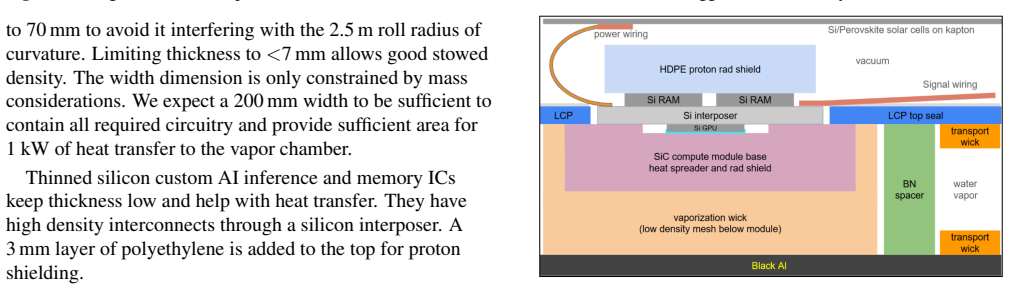
The integrated panel that uses the vapor-chamber radiator structure both to support solar cells and to cool compute ICs, thereby eliminating separate mass for power and thermal subsystems.
If this is right
- One Starship launch can place enough hardware to run thousands of simultaneous LLM inferences with 500,000-token contexts.
- 512-panel subarrays can sustain 553 tokens per second per session across 256 parallel sessions.
- The design scales upward by increasing the number of panels or by using on-orbit assembly for larger arrays.
- Panel size choices between 1 and 4 m² let designers balance heat-spreading distance against communication latency.
Where Pith is reading between the lines
- If the mass savings hold, similar integration ideas could be explored for other orbital systems that need both electrical power and active cooling.
- The single-launch capacity might reduce the number of separate missions required to build and maintain space-based compute clusters.
- Trade-offs in panel area offer a practical knob for adapting the same basic architecture to different inference workloads.
Load-bearing premise
Custom panels can be built that reach 500 W/kg specific power by mounting solar cells on the radiator without adding mass or losing efficiency, while keeping IC junction temperatures near 40°C under full load.
What would settle it
A prototype panel test that measures delivered watts per kilogram and actual IC junction temperature while the panel is generating power and running compute at the design point would confirm or refute the targets.
Figures




read the original abstract
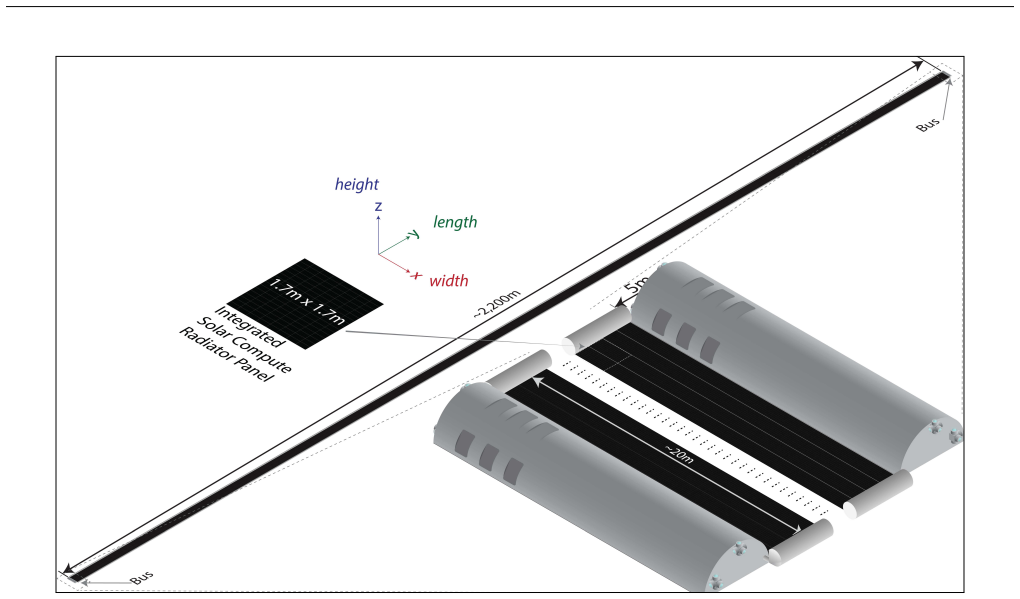
We describe and analyze a distributed compute architecture for SSO computational satellites that can potentially provide >100 kW compute power per launched metric ton (including deployment and station keeping mass). The architecture co-locates and integrates the solar cells, radiator, and compute functions into multiple small panels arranged in a large array. The resultant large vapor chamber radiator area per panel should permit ICs to operate at junction temperatures near 40*C with benefits in compute efficiency and reliability. Using the structure of the radiator to support the solar cells may also yield a specific power of about 500 W/kg compared to less than 100 for existing conventional implementations. Assuming development of custom solutions for all components, a 16 MW computation, 150 ton satellite comprising a 20 m x 2200 m grid of 16,000 panels can fit in a single Starship hold. The concept is scalable to much larger satellites with higher mass payloads or using on-orbit assembly. We consider panel sizes from 1 to 4 m2 to allow trading vapor chamber heat transport with compute efficiency and inter-panel communication. Assuming a 1 kW/panel design, 512-panel subarrays of the satellite can run a representative inference-only LLM with 500,000 token context window and 128 attention blocks, at a rate of 553 tokens/sec/session, across 256 simultaneous in-flight sessions. A full satellite could support 31 such subarrays, for >7900 inferences at a time.
Editorial analysis
A structured set of objections, weighed in public.
Referee Report
Summary. The paper proposes an integrated panel architecture for SSO satellites that co-locates solar cells, vapor-chamber radiators, and compute ICs to achieve >100 kW compute power per launched metric ton. A 150-ton, 16 MW satellite with 16,000 panels (20 m × 2200 m array) is claimed to fit in one Starship, operate ICs near 40 °C, and support >7900 simultaneous LLM inference sessions at 553 tokens/s each, based on 1 kW/panel and 500 W/kg specific power assumptions.
Significance. If the integration assumptions could be validated with quantitative mass, thermal, and power models, the concept would represent a substantial advance in orbital compute density by reducing launch mass penalties and enabling efficient radiative cooling at scale. The work correctly identifies the value of trading panel area for heat transport and compute efficiency, and the Starship-scale example provides a concrete scaling target.
major comments (3)
- [Abstract] Abstract: The central claim of >100 kW/ton (and the 150 t / 16 MW satellite) rests on achieving ~500 W/kg specific power and 1 kW/panel at ~2 kg total mass while maintaining 40 °C junction temperature. No mass budget, areal-density breakdown, thermal-resistance network, or efficiency trade-off calculation for the integrated solar/vapor-chamber/compute stack is supplied; the numbers are therefore stated assumptions rather than derived results.
- [Abstract] Abstract: The reported inference performance (553 tokens/s/session across 7900 simultaneous sessions) is obtained by direct multiplication of the assumed 1 kW/panel power and 512-panel subarray sizing. Because these outputs are defined in terms of the input assumptions, they do not constitute independent evidence for the architecture's capability.
- [Abstract] Abstract: The manuscript invokes “development of custom solutions for all components” and “using the structure of the radiator to support the solar cells” without providing any sensitivity analysis or bounding calculations on how deviations from the 500 W/kg or 40 °C targets would affect the overall mass or thermal claims.
minor comments (2)
- [Abstract] The temperature is written as 40*C; standard notation is 40 °C.
- [Abstract] No references are given to existing specific-power values for space solar arrays or vapor-chamber radiators, making the claimed improvement from <100 W/kg to ~500 W/kg difficult to contextualize.
Simulated Author's Rebuttal
We thank the referee for their constructive and detailed review. The comments correctly identify areas where the presentation of assumptions can be strengthened with additional quantitative detail. We address each major comment below and have revised the manuscript to incorporate the requested clarifications, breakdowns, and analyses.
read point-by-point responses
-
Referee: [Abstract] Abstract: The central claim of >100 kW/ton (and the 150 t / 16 MW satellite) rests on achieving ~500 W/kg specific power and 1 kW/panel at ~2 kg total mass while maintaining 40 °C junction temperature. No mass budget, areal-density breakdown, thermal-resistance network, or efficiency trade-off calculation for the integrated solar/vapor-chamber/compute stack is supplied; the numbers are therefore stated assumptions rather than derived results.
Authors: We agree that the original manuscript presented these values primarily as assumptions without sufficient supporting breakdown. In the revised version we have added an appendix with a preliminary mass budget for the integrated panel stack. This includes areal-density estimates drawn from published values for thin-film solar cells (~0.4 kg/m²), vapor-chamber radiators (~0.8 kg/m²), and compute-plus-cooling hardware (~0.8 kg per 1 kW panel), yielding the ~2 kg total per panel. A simplified one-dimensional thermal-resistance network is also provided to relate radiator area, emissivity, and heat load to the target 40 °C junction temperature. These additions convert the claims from pure assumptions into traceable, if still high-level, estimates. revision: yes
-
Referee: [Abstract] Abstract: The reported inference performance (553 tokens/s/session across 7900 simultaneous sessions) is obtained by direct multiplication of the assumed 1 kW/panel power and 512-panel subarray sizing. Because these outputs are defined in terms of the input assumptions, they do not constitute independent evidence for the architecture's capability.
Authors: The referee is correct that the performance numbers are obtained by direct scaling from the power and array-size assumptions. We have revised the text to state explicitly that these figures are illustrative calculations intended to convey the potential scale of the architecture rather than independent empirical validation. We have also added a short methods paragraph describing the per-watt inference throughput model (tokens/s/W) used in the multiplication so that readers can readily see the dependence on the input parameters. revision: yes
-
Referee: [Abstract] Abstract: The manuscript invokes “development of custom solutions for all components” and “using the structure of the radiator to support the solar cells” without providing any sensitivity analysis or bounding calculations on how deviations from the 500 W/kg or 40 °C targets would affect the overall mass or thermal claims.
Authors: We acknowledge that the original submission lacked sensitivity or bounding analysis. The revised manuscript now includes a dedicated subsection that examines two deviation scenarios: (1) specific power reduced to 400 W/kg and (2) junction temperature allowed to rise to 50 °C. For each case we report the resulting change in total satellite mass and compute density. These bounds demonstrate that the architecture retains substantial advantage over conventional designs even under conservative parameter shifts. revision: yes
Circularity Check
Inference performance metrics constructed directly from assumed 1 kW/panel power
specific steps
-
fitted input called prediction
[Abstract]
"Assuming a 1 kW/panel design, 512-panel subarrays of the satellite can run a representative inference-only LLM with 500,000 token context window and 128 attention blocks, at a rate of 553 tokens/sec/session, across 256 simultaneous in-flight sessions. A full satellite could support 31 such subarrays, for >7900 inferences at a time."
The 553 tokens/sec/session and >7900 simultaneous sessions are obtained by multiplying the assumed 1 kW/panel power by the chosen subarray size (512 panels) and satellite subarray count (31), so the quoted performance numbers are arithmetically equivalent to the input assumption rather than independently derived or measured.
full rationale
The paper presents >7900 simultaneous inferences at 553 tokens/sec/session as architecture capabilities, but these are obtained by scaling the explicit input assumption of 1 kW/panel through fixed subarray (512 panels) and satellite (31 subarrays) sizes. The >100 kW/ton and 500 W/kg claims similarly rest on un-derived assertions about integrated panel mass and thermal performance without mass budgets or trade-off equations. No self-citations, uniqueness theorems, or ansatzes appear in the provided text; the central results therefore reduce partially to the input assumptions by construction.
Axiom & Free-Parameter Ledger
free parameters (3)
- integrated panel specific power =
500 W/kg
- compute power per panel =
1 kW
- LLM inference rate per session =
553 tokens/sec/session
axioms (2)
- domain assumption Vapor chamber radiators integrated with solar cells and compute can maintain junction temperatures near 40°C in SSO environment
- ad hoc to paper Custom solutions for all components can be developed without adding significant mass or reducing efficiency
Lean theorems connected to this paper
-
IndisputableMonolith/Cost/FunctionalEquation.leanwashburn_uniqueness_aczel unclear?
unclearRelation between the paper passage and the cited Recognition theorem.
Using the structure of the radiator to support the solar cells may also yield a specific power of about 500 W/kg... 1 kW/panel design... 512-panel subarrays... 553 tokens/sec/session
-
IndisputableMonolith/Foundation/AlphaCoordinateFixation.leanJ_uniquely_calibrated_via_higher_derivative unclear?
unclearRelation between the paper passage and the cited Recognition theorem.
vapor chamber... 35°C compute junction temperature... specific power of 112 kW/ton
What do these tags mean?
- matches
- The paper's claim is directly supported by a theorem in the formal canon.
- supports
- The theorem supports part of the paper's argument, but the paper may add assumptions or extra steps.
- extends
- The paper goes beyond the formal theorem; the theorem is a base layer rather than the whole result.
- uses
- The paper appears to rely on the theorem as machinery.
- contradicts
- The paper's claim conflicts with a theorem or certificate in the canon.
- unclear
- Pith found a possible connection, but the passage is too broad, indirect, or ambiguous to say the theorem truly supports the claim.
Reference graph
Works this paper leans on
-
[1]
Project Suncatcher,
B. Agüera y Arcas et al., “Project Suncatcher,” Google Research Preprint, 2025
2025
-
[2]
Tether-Based Orbital AI Data Centers,
I. Bargatin, M. Jin, A. Alansari, and J. Raney, “Tether-Based Orbital AI Data Centers,” University of Pennsylvania Preprint, 2025
2025
-
[3]
Sophia Space’s Orbital Computing Platform,
J. Bernard, “Sophia Space’s Orbital Computing Platform,”Aerospace America, January 2026. See also: US Patent 20250108938, Sophia Space, Inc
2026
-
[4]
The Race for Space-Based AI Compute,
D. Vicinanza, “The Race for Space-Based AI Compute,”SingularityHub, December 2025
2025
-
[5]
GPU and Communication
Internal design spreadsheet: “GPU and Communication” (Google Drive, Linear Satellite project folder)
-
[6]
Efficient Memory Management for Large Language Model Serving with PagedAttention
W. Kwon et al., “Efficient Memory Management for Large Language Model Serving with PagedAttention,” arXiv:2309.06180, 2023
work page internal anchor Pith review arXiv 2023
-
[7]
Splitwise: Efficient generative llm inference using phase splitting,
P. Patel et al., “Splitwise: Efficient Generative LLM Inference Using Phase Splitting,”arXiv:2311.18677, 2024
-
[8]
Recalibrating global data center energy-use estimates,
E. Masanet et al., “Recalibrating global data center energy-use estimates,”Science, vol. 367, no. 6481, pp. 984–986, 2020
2020
-
[9]
Alta Devices Sets New World Record for Flexible Solar Efficiency,
Alta Devices, “Alta Devices Sets New World Record for Flexible Solar Efficiency,” Press Release, 2016
2016
-
[10]
CIGS solar cells on flexible substrate for space application,
N. Schöne et al., “CIGS solar cells on flexible substrate for space application,”Progress in Photovoltaics, vol. 27, no. 1, pp. 101–112, 2019
2019
-
[11]
Self-healing properties of perovskite solar cells under space conditions,
L. Nová ˇcková et al., “Self-healing properties of perovskite solar cells under space conditions,”npj Microgravity, vol. 10, p. 12, 2024
2024
-
[12]
Starbase Tour with Elon Musk!
E. Musk, Interview by T. Dodd (Everyday Astronaut), “Starbase Tour with Elon Musk!”YouTube, August 3,
-
[13]
Available:https: //www.youtube.com/watch?v=t5ILfl3cj5E
-
[14]
Internal Structure Explosion Diagram of VC Vapor Chamber,
Ecotherm Group, “Internal Structure Explosion Diagram of VC Vapor Chamber,”Introduction to the Vapor Chamber (VC) Liquid Cooling Heat Dissipation,
-
[15]
Available: https://ecothermgroup.com/ introduction-to-the-vapor-chamber- vc-liquid-cooling-heat-dissipation- and-the-working-principle-of-vc- liquid-cooling-heat-dissipation/
-
[16]
Temperature-dependent performance of perovskite/silicon tandem solar cells,
D. Chen et al., “Temperature-dependent performance of perovskite/silicon tandem solar cells,”Nature Energy, vol. 9, pp. 1123–1132, 2024. DOI: 10.1038/s41560-024-01567-8
-
[17]
Commercial perovskite-silicon tandem modules – temperature performance report,
Oxford PV , “Commercial perovskite-silicon tandem modules – temperature performance report,” Oxford PV Technical White Paper, 2025
2025
-
[18]
K. Yoshikawa et al., “Thin crystalline silicon solar cells for space applications: temperature coefficient and radiation tolerance,”Progress in Photovoltaics, vol. 31, no. 6, pp. 678–689, 2023. DOI: 10.1002/pip.3724
-
[19]
Best Research-Cell Efficiency Chart
NREL, “Best Research-Cell Efficiency Chart” (updated March 2025), thin Si cells section, 2024
2025
-
[20]
Temperature dependence of hydrogenated amorphous silicon thin-film solar cells for space,
H. Sai et al., “Temperature dependence of hydrogenated amorphous silicon thin-film solar cells for space,”Solar Energy Materials and Solar Cells, vol. 268, p. 112456, 2024. DOI: 10.1016/j.solmat.2024.112456
-
[21]
Technical Specification – temperature coefficient measurements for thin-film silicon technologies,
IEC TS 63157:2024, “Technical Specification – temperature coefficient measurements for thin-film silicon technologies,” 2024. 13
2024
discussion (0)
Sign in with ORCID, Apple, or X to comment. Anyone can read and Pith papers without signing in.