Recognition: 2 theorem links
· Lean TheoremRag Performance Prediction for Question Answering
Pith reviewed 2026-05-10 17:57 UTC · model grok-4.3
The pith
A supervised predictor that models semantic links between question, passages and answer best forecasts RAG gains in question answering.
A machine-rendered reading of the paper's core claim, the machinery that carries it, and where it could break.
Core claim
The paper claims that predicting the performance gain from using RAG versus not using it for question answering is accomplished most effectively by a novel supervised predictor that explicitly models the semantic relationships among the question, the retrieved passages, and the generated answer.
What carries the argument
novel supervised predictor that explicitly models the semantic relationships among the question, retrieved passages, and the generated answer
Load-bearing premise
Labeled data must exist that records the actual performance difference between using RAG and not using it for each individual question so the semantic model can be trained.
What would settle it
On a fresh set of questions with measured RAG versus non-RAG accuracy labels, check whether the semantic-relationship predictor still achieves higher prediction quality than the pre-retrieval, post-retrieval, and other post-generation baselines.
Figures
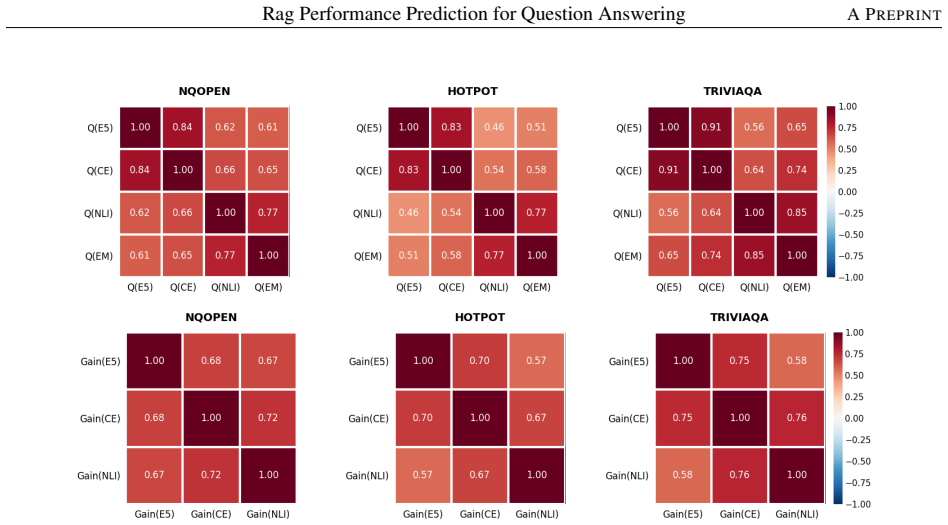

read the original abstract
We address the task of predicting the gain of using RAG (retrieval augmented generation) for question answering with respect to not using it. We study the performance of a few pre-retrieval and post-retrieval predictors originally devised for ad hoc retrieval. We also study a few post-generation predictors, one of which is novel to this study and posts the best prediction quality. Our results show that the most effective prediction approach is a novel supervised predictor that explicitly models the semantic relationships among the question, retrieved passages, and the generated answer.
Editorial analysis
A structured set of objections, weighed in public.
Referee Report
Summary. The manuscript addresses the task of predicting the performance gain from using Retrieval-Augmented Generation (RAG) versus standard generation for question answering. It evaluates several pre-retrieval and post-retrieval predictors adapted from ad hoc retrieval literature, along with post-generation predictors. A novel supervised predictor that explicitly models semantic relationships among the question, retrieved passages, and generated answer is introduced and reported to achieve the highest prediction quality.
Significance. If the empirical results hold under rigorous evaluation, the work could support selective application of RAG in QA pipelines, improving efficiency by avoiding retrieval when it is unlikely to help. The novel supervised model represents a potential methodological contribution by incorporating semantic modeling across the RAG components, provided the training labels (actual RAG vs. non-RAG metric deltas) are obtained without introducing circularity or excessive labeling cost.
major comments (1)
- Abstract: The central claim that the novel supervised predictor 'posts the best prediction quality' is presented without any reference to datasets, evaluation metrics (e.g., EM/F1 deltas), number of test instances, baseline implementations, or statistical significance tests. This absence prevents verification of whether the reported superiority is load-bearing or merely descriptive.
Simulated Author's Rebuttal
We thank the referee for the detailed review and constructive feedback on our manuscript. We agree that the abstract would benefit from greater specificity to substantiate the central claim. We address the major comment below and will incorporate the suggested changes in the revised version.
read point-by-point responses
-
Referee: Abstract: The central claim that the novel supervised predictor 'posts the best prediction quality' is presented without any reference to datasets, evaluation metrics (e.g., EM/F1 deltas), number of test instances, baseline implementations, or statistical significance tests. This absence prevents verification of whether the reported superiority is load-bearing or merely descriptive.
Authors: We agree with the referee that the abstract, as currently written, is too high-level and lacks the concrete details needed for readers to assess the strength of the claim. In the revised manuscript we will expand the abstract to explicitly reference the evaluation datasets (Natural Questions and TriviaQA), the performance metrics (EM and F1 deltas between RAG and non-RAG settings), the scale of the test sets, the full set of baselines (both pre-retrieval/post-retrieval predictors from the ad-hoc retrieval literature and the post-generation predictors), and the fact that the reported gains of the novel supervised model are statistically significant (p < 0.05 via paired t-test). These additions will make the superiority claim verifiable from the abstract while preserving its concise nature. revision: yes
Circularity Check
No circularity; supervised predictor trained on independently computed labels
full rationale
The paper presents an empirical comparison of retrieval and generation predictors for RAG performance gain. The novel supervised model is trained on ground-truth labels obtained by separately running RAG and non-RAG systems to compute metric deltas on the same questions. These labels are external to the model's semantic-relationship features and the evaluation is performed on held-out data. No derivation step reduces by construction to the inputs, no self-citation is load-bearing for the central claim, and the approach remains falsifiable on new labeled instances.
Axiom & Free-Parameter Ledger
Lean theorems connected to this paper
-
IndisputableMonolith/Foundation/RealityFromDistinction.leanreality_from_one_distinction unclear?
unclearRelation between the paper passage and the cited Recognition theorem.
novel supervised predictor that explicitly models the semantic relationships among the question, retrieved passages, and the generated answer
-
IndisputableMonolith/Cost/FunctionalEquation.leanwashburn_uniqueness_aczel unclear?
unclearRelation between the paper passage and the cited Recognition theorem.
supervised post-generation approach designed to capture semantic relationships
What do these tags mean?
- matches
- The paper's claim is directly supported by a theorem in the formal canon.
- supports
- The theorem supports part of the paper's argument, but the paper may add assumptions or extra steps.
- extends
- The paper goes beyond the formal theorem; the theorem is a base layer rather than the whole result.
- uses
- The paper appears to rely on the theorem as machinery.
- contradicts
- The paper's claim conflicts with a theorem or certificate in the canon.
- unclear
- Pith found a possible connection, but the passage is too broad, indirect, or ambiguous to say the theorem truly supports the claim.
Reference graph
Works this paper leans on
-
[1]
Retrieval-augmented generation for knowledge- intensive NLP tasks
Patrick Lewis, Ethan Perez, Aleksandra Piktus, Fabio Petroni, Vladimir Karpukhin, Naman Goyal, Heinrich Küttler, Mike Lewis, Wen-tau Yih, Tim Rocktäschel, et al. Retrieval-augmented generation for knowledge- intensive NLP tasks. InAdvances in Neural Information Processing Systems (NeurIPS), volume 33, pages 9459–9474, 2020. (Original RAG Paper)
2020
-
[2]
Retrieval augmentation reduces hallucination in conversation
Kurt Shuster, Spencer Poff, Moya Chen, Douwe Kiela, and Jason Weston. Retrieval augmentation reduces hallucination in conversation. In Marie-Francine Moens, Xuanjing Huang, Lucia Specia, and Scott Wen-tau Yih, editors,Findings of the Association for Computational Linguistics: EMNLP 2021, pages 3784–3803, Punta Cana, Dominican Republic, November 2021. Asso...
2021
-
[3]
Making retrieval-augmented language models robust to irrelevant context
Ori Yoran, Tomer Wolfson, Ori Ram, and Jonathan Berant. Making retrieval-augmented language models robust to irrelevant context. InThe Twelfth International Conference on Learning Representations, 2024
2024
-
[4]
Chain-of-note: Enhancing robustness in retrieval-augmented language models
Wenhao Yu, Hongming Zhang, Xiaoman Pan, Peixin Cao, Kaixin Ma, Jian Li, Hongwei Wang, and Dong Yu. Chain-of-note: Enhancing robustness in retrieval-augmented language models. InProceedings of the 2024 conference on empirical methods in natural language processing, pages 14672–14685, 2024
2024
-
[5]
The distracting effect: Understanding irrelevant passages in RAG
Chen Amiraz, Florin Cuconasu, Simone Filice, and Zohar Karnin. The distracting effect: Understanding irrelevant passages in RAG. In Wanxiang Che, Joyce Nabende, Ekaterina Shutova, and Mohammad Taher Pilehvar, editors, Proceedings of the 63rd Annual Meeting of the Association for Computational Linguistics (Volume 1: Long Papers), pages 18228–18258, Vienna,...
2025
-
[6]
Morgan & Claypool Publishers, 2010
David Carmel and Elad Yom-Tov.Estimating the Query Difficulty for Information Retrieval. Morgan & Claypool Publishers, 2010
2010
-
[7]
Predicting RAG performance for text completion
Oz Huly, David Carmel, and Oren Kurland. Predicting RAG performance for text completion. InProceedings of the 48th International ACM SIGIR Conference on Research and Development in Information Retrieval (SIGIR ’25), pages 1283–1293, Padua, Italy, 2025. ACM
2025
-
[8]
Evaluating retrieval quality in retrieval-augmented generation
Alireza Salemi and Hamed Zamani. Evaluating retrieval quality in retrieval-augmented generation. InProceedings of the 47th International ACM SIGIR Conference on Research and Development in Information Retrieval, pages 2395–2400, 2024
2024
-
[9]
The power of noise: Redefining retrieval for rag systems
Florin Cuconasu, Giovanni Trappolini, Federico Siciliano, Simone Filice, Cesare Campagnano, Yoelle Maarek, Nicola Tonellotto, and Fabrizio Silvestri. The power of noise: Redefining retrieval for rag systems. InProceedings of the 47th International ACM SIGIR Conference on Research and Development in Information Retrieval, pages 719–729, 2024
2024
-
[10]
Is relevance propagated from retriever to generator in rag? InEuropean Conference on Information Retrieval, pages 32–48
Fangzheng Tian, Debasis Ganguly, and Craig Macdonald. Is relevance propagated from retriever to generator in rag? InEuropean Conference on Information Retrieval, pages 32–48. Springer, 2025
2025
-
[11]
Fangzheng Tian, Debasis Ganguly, and Craig Macdonald. Predicting retrieval utility and answer quality in retrieval-augmented generation.arXiv preprint arXiv:2601.14546, 2026
-
[12]
DYNAMICQA: Tracing internal knowledge conflicts in language models
Sara Vera Marjanovic, Haeun Yu, Pepa Atanasova, Maria Maistro, Christina Lioma, and Isabelle Augenstein. DYNAMICQA: Tracing internal knowledge conflicts in language models. In Yaser Al-Onaizan, Mohit Bansal, and Yun-Nung Chen, editors,Findings of the Association for Computational Linguistics: EMNLP 2024, pages 14346–14360, Miami, Florida, USA, November 20...
2024
-
[13]
Seper: Measure retrieval utility through the lens of semantic perplexity reduction
Lu Dai, Yijie Xu, Jinhui Ye, Hao Liu, and Hui Xiong. Seper: Measure retrieval utility through the lens of semantic perplexity reduction. InThe Thirteenth International Conference on Learning Representations, 2025
2025
-
[14]
Self-rag: Learning to retrieve, generate, and critique through self-reflection
Akari Asai, Zeqiu Wu, Yizhong Wang, Avirup Sil, and Hannaneh Hajishirzi. Self-rag: Learning to retrieve, generate, and critique through self-reflection. InInternational Conference on Learning Representations (ICLR), 2024
2024
-
[15]
Active retrieval augmented generation
Zhengbao Jiang, Frank Xu, Luyu Gao, Zhiqing Sun, Qian Liu, Jane Dwivedi-Yu, Yiming Yang, Jamie Callan, and Graham Neubig. Active retrieval augmented generation. InProceedings of the 2023 Conference on Empirical Methods in Natural Language Processing (EMNLP), pages 7969–7992, 2023
2023
-
[16]
Adaptive-RAG: Learning to adapt retrieval-augmented large language models through question complexity
Soyeong Jeong, Jinheon Baek, Sukmin Cho, Sung Ju Hwang, and Jong Park. Adaptive-RAG: Learning to adapt retrieval-augmented large language models through question complexity. In Kevin Duh, Helena Gomez, and Steven Bethard, editors,Proceedings of the 2024 Conference of the North American Chapter of the Association for Computational Linguistics: Human Langua...
2024
-
[17]
Adaptive retrieval-augmented generation for conversational systems
Xi Wang, Procheta Sen, Ruizhe Li, and Emine Yilmaz. Adaptive retrieval-augmented generation for conversational systems. InFindings of the Association for Computational Linguistics: NAACL 2025, pages 491–503, 2025. 10 Rag Performance Prediction for Question AnsweringA PREPRINT
2025
-
[18]
Natural questions: A benchmark for question answering research.Transactions of the Association for Computational Linguistics, 7:452–466, 2019
Tom Kwiatkowski, Jennimaria Palomaki, Olivia Redfield, Michael Collins, Ankur Parikh, Chris Alberti, Danielle Epstein, Illia Polosukhin, Jacob Devlin, Kenton Lee, et al. Natural questions: A benchmark for question answering research.Transactions of the Association for Computational Linguistics, 7:452–466, 2019
2019
-
[19]
TriviaQA: A large scale distantly supervised challenge dataset for reading comprehension
Mandar Joshi, Eunsol Choi, Daniel S Weld, and Luke Zettlemoyer. TriviaQA: A large scale distantly supervised challenge dataset for reading comprehension. InProceedings of the 55th Annual Meeting of the Association for Computational Linguistics (ACL), pages 1601–1611, 2017
2017
-
[20]
HotpotQA: A dataset for diverse, explainable multi-hop question answering
Zhilin Yang, Peng Qi, Saizheng Zhang, Yoshua Bengio, William W Cohen, Ruslan Salakhutdinov, and Christo- pher D Manning. HotpotQA: A dataset for diverse, explainable multi-hop question answering. InProceedings of the 2018 Conference on Empirical Methods in Natural Language Processing (EMNLP), pages 2369–2380, 2018
2018
-
[21]
When not to trust language models: Investigating effectiveness of parametric and non-parametric memories
Alex Mallen, Akari Asai, Victor Zhong, Rajarshi Das, Daniel Khashabi, and Hannaneh Hajishirzi. When not to trust language models: Investigating effectiveness of parametric and non-parametric memories. InProceeding of ACL, pages 9802–9822, 2023
2023
-
[22]
Ragas: Automated evaluation of retrieval augmented generation
Shahul Es, Jithin James, Luis Espinosa Anke, and Steven Schockaert. Ragas: Automated evaluation of retrieval augmented generation. InProceedings of the 18th Conference of the European Chapter of the Association for Computational Linguistics: System Demonstrations, pages 150–158, 2024
2024
-
[23]
Jiawei Gu, Xuhui Jiang, Zhichao Shi, Hexiang Tan, Xuehao Zhai, Chengjin Xu, Wei Li, Yinghan Shen, Shengjie Ma, Honghao Liu, et al. A survey on llm-as-a-judge.arXiv preprint arXiv:2411.15594, 2024
work page internal anchor Pith review Pith/arXiv arXiv 2024
-
[24]
Judging llm-as-a-judge with mt-bench and chatbot arena.Advances in neural information processing systems, 36:46595–46623, 2023
Lianmin Zheng, Wei-Lin Chiang, Ying Sheng, Siyuan Zhuang, Zhanghao Wu, Yonghao Zhuang, Zi Lin, Zhuohan Li, Dacheng Li, Eric Xing, et al. Judging llm-as-a-judge with mt-bench and chatbot arena.Advances in neural information processing systems, 36:46595–46623, 2023
2023
-
[25]
Sai Shridhar Balamurali and Lu Cheng. Revisiting nli: Towards cost-effective and human-aligned metrics for evaluating llms in question answering.arXiv preprint arXiv:2511.07659, 2025
-
[26]
Text Embeddings by Weakly-Supervised Contrastive Pre-training
Liang Wang, Nan Yang, Xiaolong Huang, Binxing Jiao, Linjun Yang, Daxin Jiang, Rangan Majumder, and Furu Wei. Text embeddings by weakly-supervised contrastive pre-training.arXiv preprint arXiv:2212.03533, 2022. (E5)
work page internal anchor Pith review arXiv 2022
-
[27]
RoBERTa: A Robustly Optimized BERT Pretraining Approach
Yinhan Liu, Myle Ott, Naman Goyal, Jingfei Du, Mandar Joshi, Danqi Chen, Omer Levy, Mike Lewis, Luke Zettlemoyer, and Veselin Stoyanov. Roberta: A robustly optimized bert pretraining approach.arXiv preprint arXiv:1907.11692, 2019
work page internal anchor Pith review Pith/arXiv arXiv 1907
-
[28]
Building efficient universal classifiers with natural language inference, 2023
Moritz Laurer, Wouter van Atteveldt, Andreu Casas, and Kasper Welbers. Building efficient universal classifiers with natural language inference, 2023
2023
-
[29]
The falcon 3 family of open models.https://huggingface.co/blog/falcon3, 2024
Falcon-LLM Team. The falcon 3 family of open models.https://huggingface.co/blog/falcon3, 2024
2024
-
[30]
Wikipedia dump 20181220, 2018
Wikimedia Foundation. Wikipedia dump 20181220, 2018. Data snapshot from December 20, 2018
2018
-
[31]
A survey of pre-retrieval query performance predictors
Claudia Hauff, Djoerd Hiemstra, and Franciska de Jong. A survey of pre-retrieval query performance predictors. InProceedings of the 17th ACM conference on Information and knowledge management, pages 1419–1420, 2008
2008
-
[32]
Effective pre-retrieval query performance prediction using similarity and variability evidence
Ying Zhao, Falk Scholer, and Yohannes Tsegay. Effective pre-retrieval query performance prediction using similarity and variability evidence. InProceedings of the 30th European Conference on Information Retrieval (ECIR), pages 52–64, 2008
2008
-
[33]
K. L. Kwok. A new method of weighting query terms for ad-hoc retrieval. InProceedings of the 19th Annual International ACM SIGIR Conference on Research and Development in Information Retrieval, pages 187–195, 1996
1996
-
[34]
Bruce Croft
Yun Zhou and W. Bruce Croft. Query performance prediction in web search environments. InProceedings of the 30th Annual International ACM SIGIR Conference on Research and Development in Information Retrieval, pages 543–550, 2007
2007
-
[35]
Predicting query performance by query-drift estimation.ACM Transactions on Information Systems (TOIS), 30(2):11, 2012
Anna Shtok, Oren Kurland, David Carmel, Fiana Raiber, and Gad Markovits. Predicting query performance by query-drift estimation.ACM Transactions on Information Systems (TOIS), 30(2):11, 2012
2012
-
[36]
Query performance prediction by considering score magnitude and variance together
Yongquan Tao and Shengli Wu. Query performance prediction by considering score magnitude and variance together. InProceedings of the 23rd ACM International Conference on Information and Knowledge Management (CIKM), pages 1891–1894, 2014
2014
-
[37]
Query performance prediction using reference lists.ACM Transactions on Information Systems (TOIS), 34(4):1–34, 2016
Anna Shtok, Oren Kurland, and David Carmel. Query performance prediction using reference lists.ACM Transactions on Information Systems (TOIS), 34(4):1–34, 2016
2016
-
[38]
BGE M3-Embedding: Multi- Lingual, Multi-Functionality, Multi-Granularity Text Embeddings Through Self-Knowledge Distillation, 2024
Jianlv Chen, Shitao Xiao, Peitian Zhang, Kun Luo, Defu Lian, and Zheng Liu. BGE M3-Embedding: Multi- Lingual, Multi-Functionality, Multi-Granularity Text Embeddings Through Self-Knowledge Distillation, 2024. 11 Rag Performance Prediction for Question AnsweringA PREPRINT
2024
-
[39]
A similarity measure for indefinite rankings.ACM Transactions on Information Systems (TOIS), 28(4):20, 2010
William Webber, Alistair Moffat, and Justin Zobel. A similarity measure for indefinite rankings.ACM Transactions on Information Systems (TOIS), 28(4):20, 2010
2010
-
[40]
BERT-QPP: Contextualized pre-trained trans- formers for query performance prediction
Negar Arabzadeh, Maryam Khodabakhsh, and Ebrahim Bagheri. BERT-QPP: Contextualized pre-trained trans- formers for query performance prediction. InProceedings of the 30th ACM International Conference on Information & Knowledge Management (CIKM), pages 3707–3716, 2021
2021
-
[41]
Patrick Wilhelm, Thorsten Wittkopp, and Odej Kao
Benjamin Warner, Antoine Chaffin, Benjamin Clavié, Orion Hong, X Pham, O Simon, et al. Smarter, better, faster, longer: A modern bidirectional encoder for fast, memory efficient, and long context finetuning and inference. arXiv preprint arXiv:2412.13663, 2024. (ModernBERT)
-
[42]
Lorenz Kuhn, Yarin Gal, and Sebastian Farquhar. Semantic uncertainty: Linguistic invariances for uncertainty estimation in natural language generation.arXiv preprint arXiv:2302.09664, 2023. (Entropy for Uncertainty)
work page internal anchor Pith review arXiv 2023
-
[43]
Abhimanyu Dubey, Abhinav Jauhri, Abhinav Pandey, Abhishek Keshwam, et al. The llama 3 herd of models. arXiv preprint arXiv:2407.21783, 2024
work page internal anchor Pith review Pith/arXiv arXiv 2024
-
[44]
Okapi at trec
Stephen E Robertson, Steve Walker, Micheline Hancock-Beaulieu, Aarron Gull, and Marianna Lau. Okapi at trec. InProceedings of the 1st Text REtrieval Conference (TREC), pages 21–30, 1992
1992
-
[45]
Pyserini: A python toolkit for reproducible information retrieval research with sparse and dense representations
Jimmy Lin, Xueguang Ma, Sheng-Chieh Lin, Jheng-Hong Yang, Ronak Pradeep, and Rodrigo Nogueira. Pyserini: A python toolkit for reproducible information retrieval research with sparse and dense representations. In Proceedings of the 44th International ACM SIGIR Conference on Research and Development in Information Retrieval, pages 2356–2362, 2021
2021
-
[46]
Billion-scale similarity search with gpus.IEEE Transactions on Big Data, 7(3):535–547, 2019
Jeff Johnson, Matthijs Douze, and Hervé Jégou. Billion-scale similarity search with gpus.IEEE Transactions on Big Data, 7(3):535–547, 2019. (FAISS)
2019
-
[47]
Decoupled weight decay regularization
Ilya Loshchilov and Frank Hutter. Decoupled weight decay regularization. InInternational Conference on Learning Representations, 2019
2019
-
[48]
E. J. Williams. The comparison of regression variables.Journal of the Royal Statistical Society, Series B, 21(2):396–399, 1959. A Prompt Templates In this section, we provide the exact prompt templates used for both LLMs, with RAG and no-RAG conditions. A.1 No-RAG Condition NO-RAG Q&A You are an AI assistant that answers questions. Answer the question con...
1959
discussion (0)
Sign in with ORCID, Apple, or X to comment. Anyone can read and Pith papers without signing in.