Recognition: 2 theorem links
· Lean TheoremLarge-Scale Universal Defect Generation: Foundation Models and Datasets
Pith reviewed 2026-05-10 17:45 UTC · model grok-4.3
The pith
UniDG uses a 300K-pair dataset and MM-DiT fusion to generate realistic defects from references or text instructions without per-category fine-tuning.
A machine-rendered reading of the paper's core claim, the machinery that carries it, and where it could break.
Core claim
UniDG is a universal defect generation model that supports both reference-based generation and text instruction-based editing without per-category fine-tuning. It achieves this via Defect-Context Editing with adaptive defect cropping and structured diptych inputs, fuses reference and target conditions through MM-DiT multimodal attention, and applies a two-stage training strategy of Diversity-SFT followed by Consistency-RFT. Experiments show it outperforms prior few-shot anomaly generation and image insertion baselines in synthesis quality and in single- and multi-class anomaly detection and localization on MVTec-AD and VisA.
What carries the argument
Defect-Context Editing mechanism that uses adaptive cropping and diptych input format, combined with MM-DiT multimodal attention for fusing reference and target conditions, trained in two stages on the UDG dataset.
If this is right
- Enables single-class and multi-class anomaly detection and localization without retraining per defect category.
- Improves image synthesis quality over existing few-shot generation and editing methods.
- Supports both copying defects from reference images and following natural-language editing instructions.
- Handles wide variation in defect scale and morphology while preserving category consistency.
- Provides a large paired dataset that can serve as a foundation for further defect-related model development.
Where Pith is reading between the lines
- The method could lower the cost of collecting real defect samples for training industrial inspection systems.
- Similar two-stage diversity-then-consistency training might transfer to generating other rare visual events such as medical lesions.
- If the model truly generalizes across domains, it could reduce the need for domain-specific fine-tuning in broader image-editing applications.
- Cross-testing the generated defects on additional industrial datasets would test whether the reported gains hold outside MVTec-AD and VisA.
Load-bearing premise
That defects produced by the two-stage training and MM-DiT fusion stay realistic, diverse, and category-consistent enough to improve downstream anomaly detection without adding artifacts or biases.
What would settle it
Train anomaly detectors on UniDG synthetics and measure whether they achieve lower or equal detection and localization scores than detectors trained on real defects or prior synthetic methods when evaluated on the same held-out MVTec-AD and VisA test sets.
Figures



read the original abstract
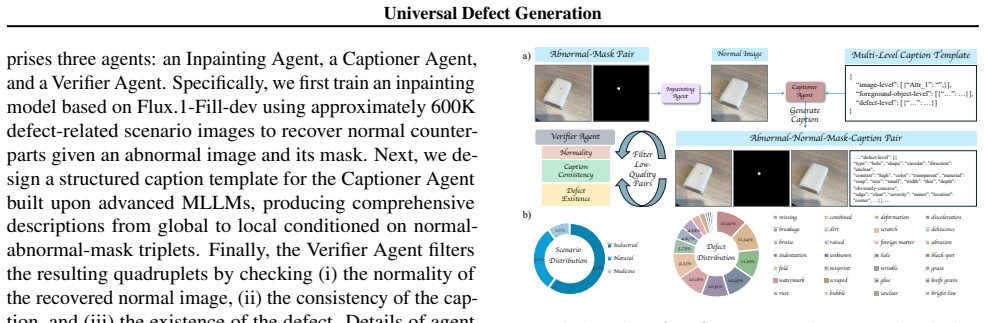
Existing defect/anomaly generation methods often rely on few-shot learning, which overfits to specific defect categories due to the lack of large-scale paired defect editing data. This issue is aggravated by substantial variations in defect scale and morphology, resulting in limited generalization, degraded realism, and category consistency. We address these challenges by introducing UDG, a large-scale dataset of 300K normal-abnormal-mask-caption quadruplets spanning diverse domains, and by presenting UniDG, a universal defect generation foundation model that supports both reference-based defect generation and text instruction-based defect editing without per-category fine-tuning. UniDG performs Defect-Context Editing via adaptive defect cropping and structured diptych input format, and fuses reference and target conditions through MM-DiT multimodal attention. A two-stage training strategy, Diversity-SFT followed by Consistency-RFT, further improves diversity while enhancing realism and reference consistency. Extensive experiments on MVTec-AD and VisA show that UniDG outperforms prior few-shot anomaly generation and image insertion/editing baselines in synthesis quality and downstream single- and multi-class anomaly detection/localization. Code will be available at https://github.com/RetoFan233/UniDG.
Editorial analysis
A structured set of objections, weighed in public.
Referee Report
Summary. The paper introduces UDG, a dataset of 300K normal-abnormal-mask-caption quadruplets across domains, and UniDG, a foundation model for universal defect generation supporting reference-based and text-instruction-based editing without per-category fine-tuning. The method uses Defect-Context Editing with adaptive cropping and diptych inputs, MM-DiT multimodal attention for condition fusion, and a two-stage training schedule (Diversity-SFT followed by Consistency-RFT). Experiments claim superior synthesis quality and improved single- and multi-class anomaly detection/localization performance over few-shot baselines on MVTec-AD and VisA.
Significance. If the empirical results hold under rigorous verification, this work could meaningfully advance industrial anomaly detection by providing scalable, generalizable synthetic defect data that reduces overfitting issues in few-shot approaches. The large-scale dataset and foundation-model framing with explicit two-stage training for diversity and consistency are notable strengths that could influence future data-generation pipelines.
major comments (2)
- [§5] §5 (Experiments): The reported outperformance on MVTec-AD and VisA for both synthesis quality and downstream detection/localization lacks accompanying details on run counts, standard deviations, or statistical significance tests. Without these, it is difficult to assess whether the gains are robust or could be explained by evaluation variance or implementation differences in baselines.
- [§4.2] §4.2 (MM-DiT fusion): The multimodal attention mechanism for fusing reference and target conditions is load-bearing for the claimed generalization, yet the manuscript provides insufficient architectural specifics (e.g., exact attention masking, conditioning injection points, or parameter counts) to allow reproduction or to verify that the fusion indeed preserves category consistency across scales and morphologies.
minor comments (2)
- [Abstract] The abstract states that code will be available at a GitHub link, but the manuscript should explicitly confirm dataset release details (e.g., access method, licensing) to support the large-scale claim.
- [§3] Figure captions and §3 (dataset construction) would benefit from additional quantitative statistics on defect scale/morphology distributions to substantiate the diversity assertions.
Simulated Author's Rebuttal
We thank the referee for the positive evaluation, the recommendation for minor revision, and the constructive comments on experimental rigor and architectural reproducibility. We address each major comment below and will incorporate the suggested improvements in the revised manuscript.
read point-by-point responses
-
Referee: [§5] §5 (Experiments): The reported outperformance on MVTec-AD and VisA for both synthesis quality and downstream detection/localization lacks accompanying details on run counts, standard deviations, or statistical significance tests. Without these, it is difficult to assess whether the gains are robust or could be explained by evaluation variance or implementation differences in baselines.
Authors: We agree that additional statistical details would strengthen the empirical claims. The reported results were obtained from single training and evaluation runs due to the substantial computational cost of training the foundation model. In the revised manuscript we will re-run the key experiments on MVTec-AD and VisA using three independent random seeds, report mean and standard deviation for all synthesis-quality and anomaly-detection metrics, and include paired t-tests (or Wilcoxon tests where appropriate) against the strongest baselines to establish statistical significance. revision: yes
-
Referee: [§4.2] §4.2 (MM-DiT fusion): The multimodal attention mechanism for fusing reference and target conditions is load-bearing for the claimed generalization, yet the manuscript provides insufficient architectural specifics (e.g., exact attention masking, conditioning injection points, or parameter counts) to allow reproduction or to verify that the fusion indeed preserves category consistency across scales and morphologies.
Authors: We acknowledge that the current description of MM-DiT is high-level. In the revision we will expand Section 4.2 with: (i) the precise attention-masking pattern used to prevent cross-contamination between reference and target tokens, (ii) the exact DiT block indices and layer types where reference and text embeddings are injected, (iii) the parameter counts of the multimodal attention modules, and (iv) a short ablation showing that the chosen fusion strategy maintains category consistency across defect scales. We will also release the full model configuration file together with the code. revision: yes
Circularity Check
No significant circularity detected
full rationale
The paper's core contribution is a new 300K quadruplet dataset (UDG) and a foundation model (UniDG) trained via Defect-Context Editing, MM-DiT fusion, and a two-stage Diversity-SFT + Consistency-RFT schedule. All performance claims are supported by direct empirical comparisons on external, standard benchmarks (MVTec-AD, VisA) against prior few-shot baselines, with no load-bearing equations, fitted parameters renamed as predictions, or self-citation chains that reduce the central result to its own inputs by construction. The derivation chain remains self-contained and externally falsifiable.
Axiom & Free-Parameter Ledger
free parameters (1)
- training hyperparameters for Diversity-SFT and Consistency-RFT stages
axioms (2)
- domain assumption Defect-Context Editing via adaptive cropping and diptych format preserves sufficient context for realistic and consistent defect insertion
- domain assumption MM-DiT multimodal attention effectively fuses reference defect and target image conditions
Lean theorems connected to this paper
-
IndisputableMonolith/Foundation/AbsoluteFloorClosure.leanreality_from_one_distinction unclearUniDG performs Defect-Context Editing via adaptive defect cropping and structured diptych input format, and fuses reference and target conditions through MM-DiT multimodal attention. A two-stage training strategy, Diversity-SFT followed by Consistency-RFT...
-
IndisputableMonolith/Cost/FunctionalEquation.leanwashburn_uniqueness_aczel unclearWe adopt a two-stage training strategy for universal defect generation: Diversity-SFT followed by Consistency-RFT... construct two reward models (Defect-Und-Reward and Defect-Recog-Reward) and build an online RFT pipeline... based on Flow-GRPO
Reference graph
Works this paper leans on
-
[1]
Bai, S., Cai, Y ., Chen, R., and etal. Qwen3-vl technical report.arXiv preprint arXiv:2511.21631,
work page internal anchor Pith review Pith/arXiv arXiv
-
[2]
Z-Image: An Efficient Image Generation Foundation Model with Single-Stream Diffusion Transformer
Cai, H., Cao, S., Du, R., Gao, P., Hoi, S., Huang, S., Hou, Z., Jiang, D., Jin, X., Li, L., et al. Z-image: An efficient image generation foundation model with single-stream diffusion transformer.arXiv preprint arXiv:2511.22699,
work page internal anchor Pith review arXiv
-
[3]
Comanici, G., Bieber, E., Schaekermann, M., Pasupat, I., Sachdeva, N., Dhillon, I., Blistein, M., Ram, O., Zhang, D., Rosen, E., et al. Gemini 2.5: Pushing the frontier with advanced reasoning, multimodality, long context, and next generation agentic capabilities.arXiv preprint arXiv:2507.06261,
work page internal anchor Pith review Pith/arXiv arXiv
-
[4]
An Image is Worth One Word: Personalizing Text-to-Image Generation using Textual Inversion
Gal, R., Alaluf, Y ., Atzmon, Y ., Patashnik, O., Bermano, A. H., Chechik, G., and Cohen-Or, D. An image is worth one word: Personalizing text-to-image generation using textual inversion.arXiv preprint arXiv:2208.01618,
work page internal anchor Pith review arXiv
-
[5]
He, R., Ma, K., Huang, L., Huang, S., Gao, J., Wei, X., Dai, J., Han, J., and Liu, S. Freeedit: Mask-free reference- based image editing with multi-modal instruction.arXiv preprint arXiv:2409.18071,
-
[6]
Flow Straight and Fast: Learning to Generate and Transfer Data with Rectified Flow
Liu, X., Gong, C., and Liu, Q. Flow straight and fast: Learning to generate and transfer data with rectified flow. arXiv preprint arXiv:2209.03003,
work page internal anchor Pith review Pith/arXiv arXiv
-
[7]
9 Universal Defect Generation Mishchenko, K. and Defazio, A. Prodigy: An expedi- tiously adaptive parameter-free learner.arXiv preprint arXiv:2306.06101,
-
[8]
SAM 2: Segment Anything in Images and Videos
Ravi, N., Gabeur, V ., Hu, Y .-T., Hu, R., Ryali, C., Ma, T., Khedr, H., R ¨adle, R., Rolland, C., Gustafson, L., et al. Sam 2: Segment anything in images and videos.arXiv preprint arXiv:2408.00714,
work page internal anchor Pith review Pith/arXiv arXiv
-
[9]
Defectfill: Realistic defect generation with inpainting diffusion model for visual inspection
Song, J., Park, D., Baek, K., Lee, S., Choi, J., Kim, E., and Yoon, S. Defectfill: Realistic defect generation with inpainting diffusion model for visual inspection. InCVPR, 2025a. Song, W., Jiang, H., Yang, Z., Quan, R., and Yang, Y . Insert anything: Image insertion via in-context editing in dit. In AAAI, 2025b. Tan, X., Liu, J., Fan, Y ., Gao, B.-B., J...
-
[10]
IP-Adapter: Text Compatible Image Prompt Adapter for Text-to-Image Diffusion Models
Ye, H., Zhang, J., Liu, S., Han, X., and Yang, W. Ip-adapter: Text compatible image prompt adapter for text-to-image diffusion models.arXiv preprint arXiv:2308.06721,
work page internal anchor Pith review arXiv
-
[11]
For abnormal images, we ensure that the randomly sampled masks do not overlap with the annotated abnormal regions, and otherwise apply the same data construction procedure
to extract foreground regions and apply a pre-constructed mask template library to sample diverse masks (1–3 masks) for training. For abnormal images, we ensure that the randomly sampled masks do not overlap with the annotated abnormal regions, and otherwise apply the same data construction procedure. We follow the same training setup as UniDG (optimizer,...
2026
-
[12]
The V AE encoder compresses the dimensionality of MM-DiT latent features to reduce computational cost, following the design of LDM (Rombach et al., 2022)
MM-DiT. The V AE encoder compresses the dimensionality of MM-DiT latent features to reduce computational cost, following the design of LDM (Rombach et al., 2022). The CLIP and T5-XXL text encoders are used to encode text instructions; they are not activated for reference-based defect synthesis, and are only required for the instruction-based defect synthe...
2022
-
[13]
Analysis
Overall Quality (Score: 0.0 -5.0)Evaluate the holistic visual quality of the final target image. Consider:-**Realism**: Does the final image look like a genuine photograph?-**Visual Fidelity**: Is the image sharp, clear, and free from artifacts?-**Professional Appearance**: Would this result be suitable for industrial quality assessment?-**Composite Score...
2025
-
[14]
Defect-Und-Reward achieves performance comparable to proprietary models on UDG-Reward-Bench, demonstrating its effectiveness and robustness
An advanced MLLM (i.e., Gemini-3-Pro (Comanici et al., 2025)) then summarizes the annotations for each pair by discarding the highest and lowest scores. Defect-Und-Reward achieves performance comparable to proprietary models on UDG-Reward-Bench, demonstrating its effectiveness and robustness. Defect-Recog-Reward.Defect-Recog-Reward trains a universal defe...
2025
-
[15]
Higher scores are assigned when the predicted masks better match the ground-truth masks
The instance segmentation model is built on ViT-B/16 and predicts defect instance masks for input images. Higher scores are assigned when the predicted masks better match the ground-truth masks. The scoring is based on three metrics: pixel AUROC, pixel AP, and pixel PRO. We normalize these metrics, average them with the category score, and use the resulti...
2025
-
[16]
We adopt Group Relative Policy Optimization (GRPO) to optimize the generation model using reward signals
Partially inspired by Consistent-RFT (Tan et al., 2026). We adopt Group Relative Policy Optimization (GRPO) to optimize the generation model using reward signals. For each defect generation task, we sample a group of G generated images {I(i) tar }G i=1 and compute their rewards {r(i)}G i=1. Note that ˜Iref means the reference defect subject features from ...
2026
-
[17]
Beyond MLLM-based approaches, these contextual signals may also benefit vision-language alignment-based anomaly detection methods (Gao et al., 2026)
These quadruplets explicitly provide defect-region cues and aligned textual descriptions, leading to improved performance for Qwen2.5-VL-7B-Instruct, which becomes comparable to Qwen2.5-VL-72B-Instruct without quadruplet context. Beyond MLLM-based approaches, these contextual signals may also benefit vision-language alignment-based anomaly detection metho...
2026
-
[18]
It can be noticed that UniDG (reference image-based) is not significantly slower than other FSAG or Image Insertion methods, as it adopts the Rectified Flow 21 Universal Defect Generation Table 9.The quadruplets ofUDGimproves MLLM-based anomaly classification and detection methods. Model Scale Anomaly Defect Object Average Discrimination Classification Lo...
2022
discussion (0)
Sign in with ORCID, Apple, or X to comment. Anyone can read and Pith papers without signing in.