Recognition: unknown
The evolution of the mid-infrared spectrum of SN 1987A observed with the JWST/MIRI-MRS
Pith reviewed 2026-05-10 17:18 UTC · model grok-4.3
The pith
SN 1987A's dense Fe-rich ejecta has reached the reverse shock.
A machine-rendered reading of the paper's core claim, the machinery that carries it, and where it could break.
Core claim
The paper establishes that the dense inner Fe-rich ejecta of SN 1987A has now reached the reverse shock. This is based on the first identification of mid-IR H2 emission associated with the ejecta and the application of near- and mid-IR [Fe II] lines as density and temperature diagnostics of the ejecta in the interaction region.
What carries the argument
The near- and mid-infrared [Fe II] emission lines serving as density and temperature diagnostics for the ejecta in the ejecta-equatorial ring interaction region.
Load-bearing premise
The spatial and spectral decomposition cleanly separates the contributions from the equatorial ring dust, the ejecta, and the shocks without contamination.
What would settle it
Independent measurements of ejecta density or temperature from other lines or wavelengths that contradict the [Fe II] diagnostics, or the absence of H2 emission in deeper observations.
Figures
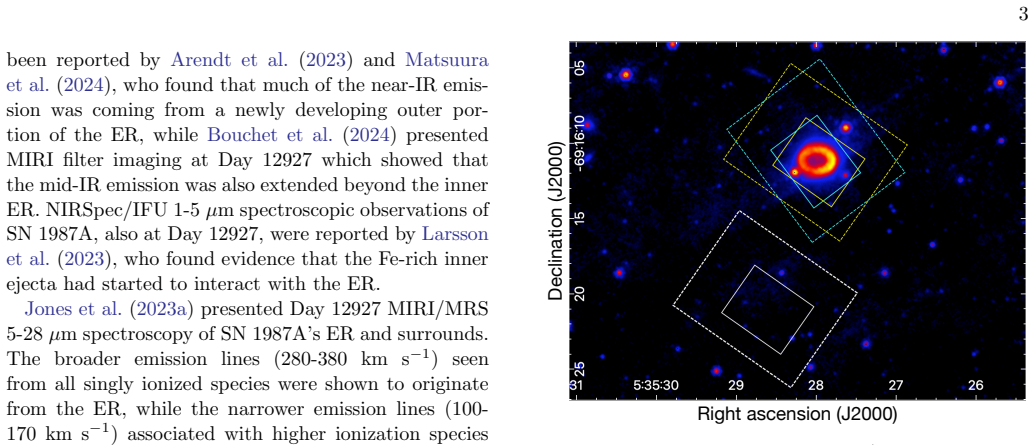
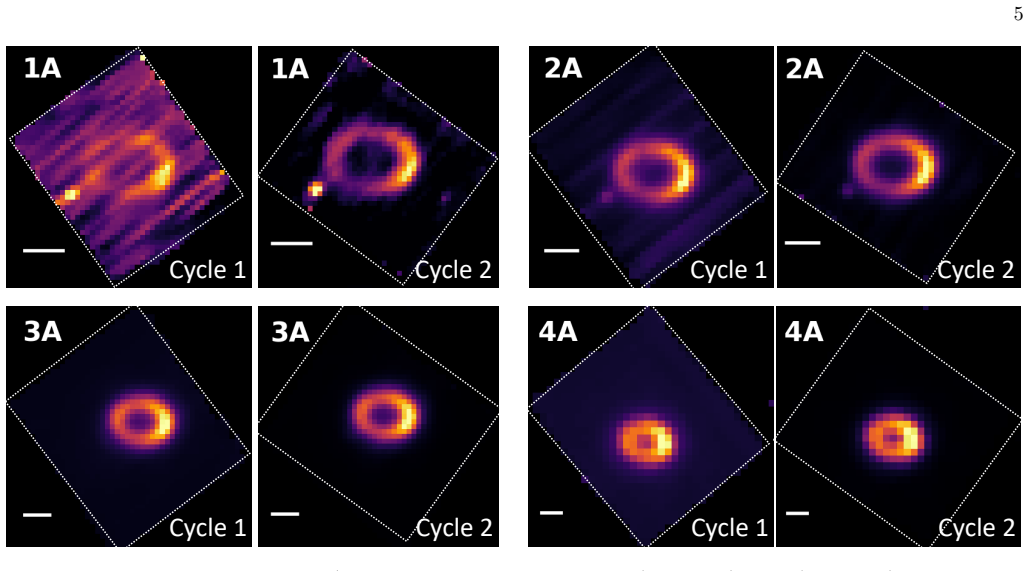


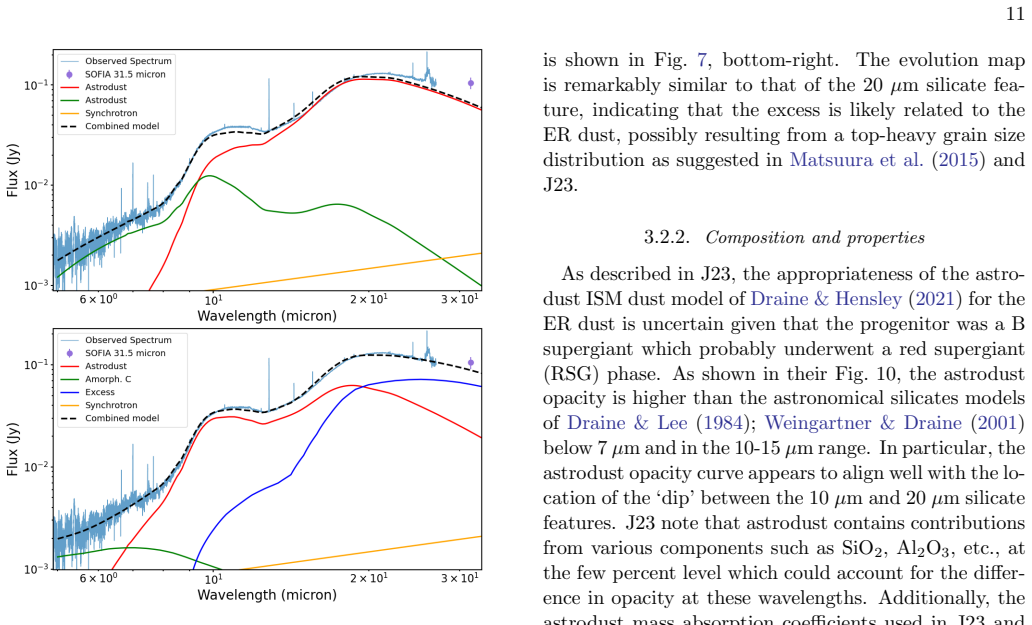
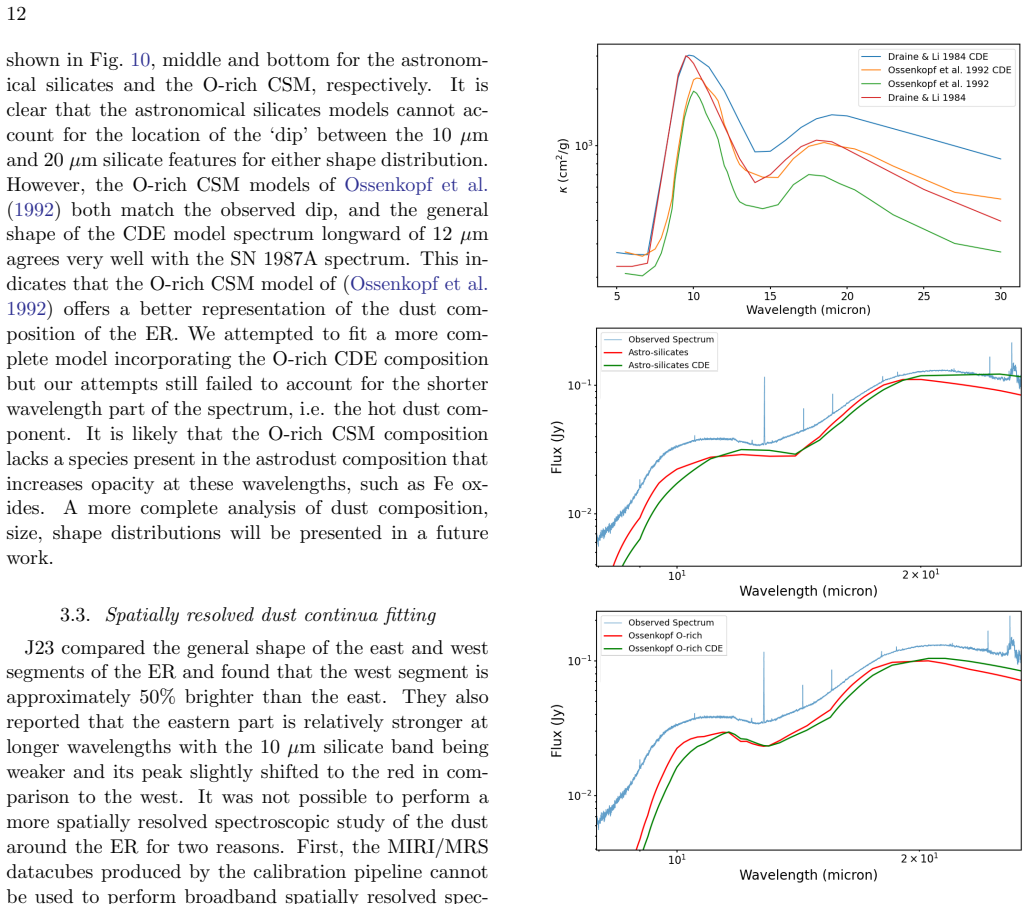




read the original abstract
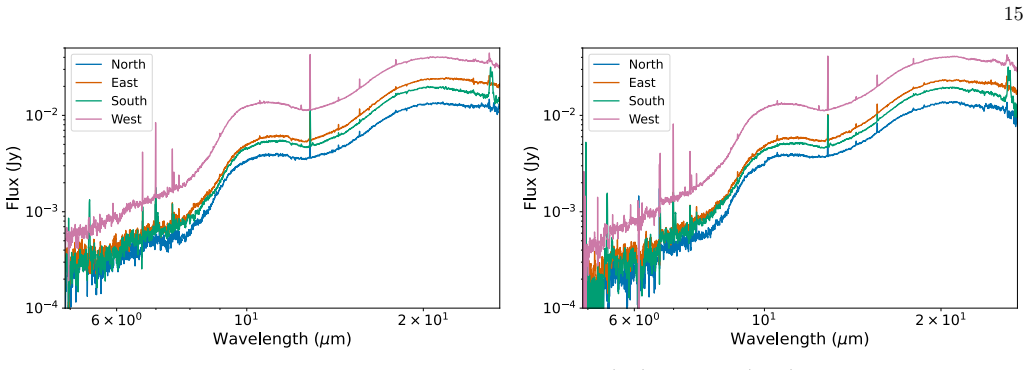
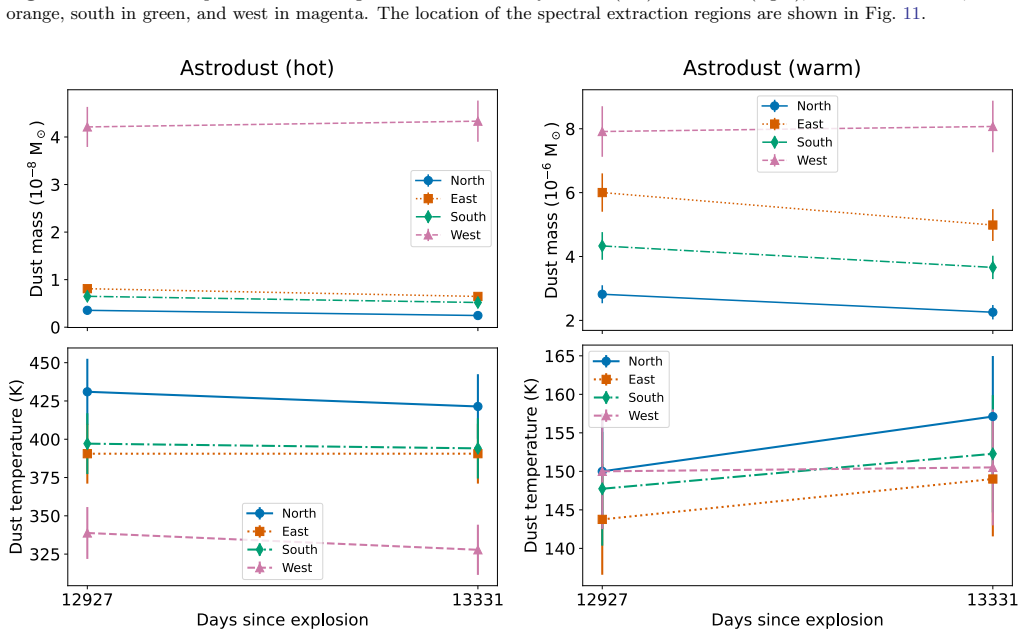
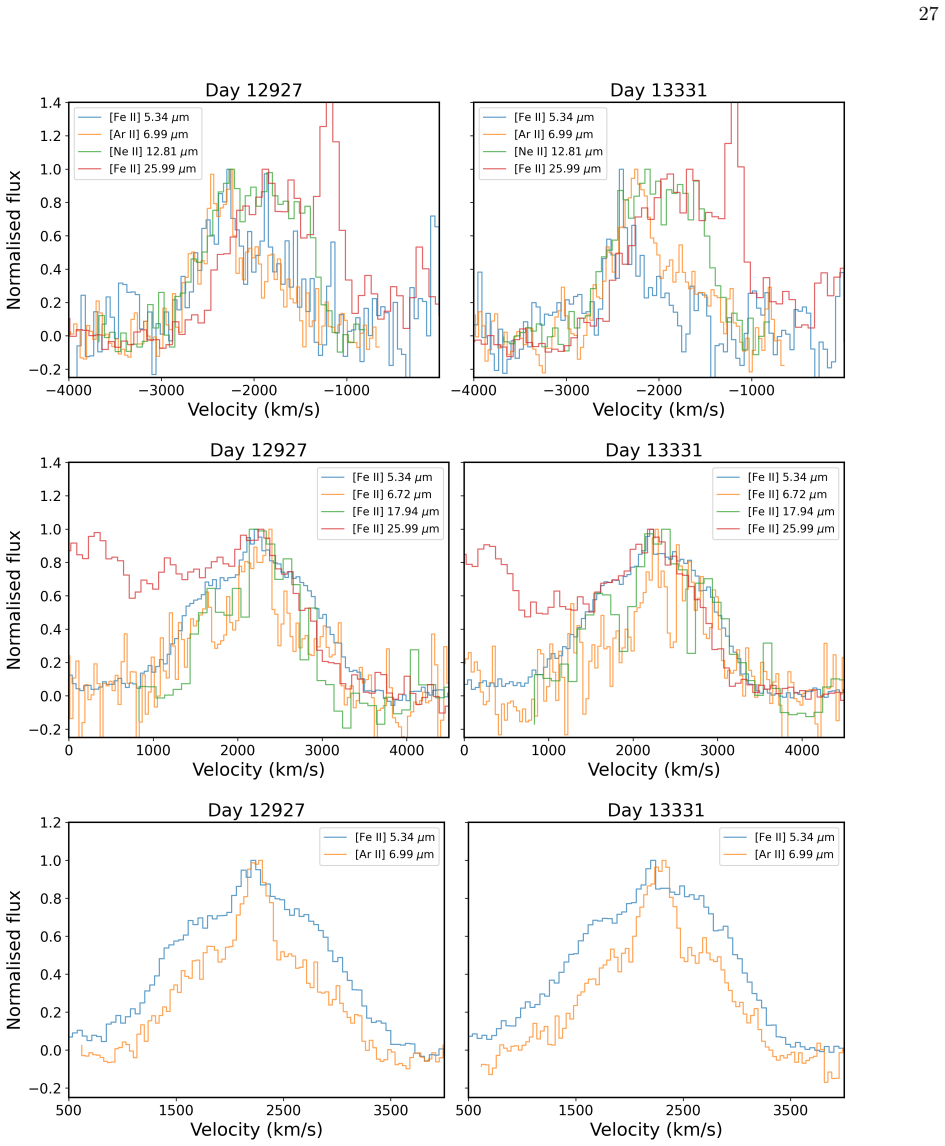
Supernova (SN) 1987A provides a unique laboratory for investigating many aspects of SN physics and evolution. An observation at Day 12927 (35.4 yr) since the explosion with the Mid-Infrared Instrument (MIRI) Medium Resolution Spectrometer (MRS) on the James Webb Space Telescope (JWST) provided the first spatially resolved spectroscopic study of SN 1987A in the mid-IR, yielding insights into the evolution of dust, the ejecta, the equatorial ring (ER), and shocks in the system. Here we present a second epoch with MIRI/MRS at Day 13311 (36.4 yr) allowing the mid-IR spatially resolved spectroscopic temporal evolution of SN 1987A to be probed for the first time. Analysis of the ER-dominated dust continuum showed little evolution between Days 12927 and 13311. However, a spatial analysis reveals the inner ER to be fading while the outermost regions are brightening. Broad ejecta emission lines detected at Day 12927 are evolving rapidly, driven by the recent onset of the ejecta/equatorial ring interaction in the northeast and southwest of the ER. Most lines from the ER show no change during the 384 days between the epochs, though some such as [Ne II] and [Ar II] have faded. We identify mid-IR H2 emission associated with the ejecta for the first time. Using the near- and mid-IR [Fe II] lines as density and temperature diagnostics of the ejecta in the interaction region we find it likely that the dense inner Fe-rich ejecta has now reached the reverse shock. Continued monitoring of SN 1987A is essential to observe the evolving ejecta/ER interaction and dust components.
Editorial analysis
A structured set of objections, weighed in public.
Referee Report
Summary. This manuscript reports the second epoch of JWST/MIRI-MRS mid-infrared spectroscopy of SN 1987A at day 13311 (36.4 yr post-explosion), compared to the prior epoch at day 12927. It finds little change in the ER-dominated dust continuum but spatial evolution within the ER (inner fading, outer brightening), rapid changes in broad ejecta lines driven by ejecta/ER interaction in the northeast and southwest, the first identification of mid-IR H2 emission associated with the ejecta, and—via near- and mid-IR [Fe II] line ratios as density/temperature diagnostics—concludes that the dense inner Fe-rich ejecta has likely reached the reverse shock.
Significance. If the component separations hold, the work supplies the first mid-IR temporal baseline on SN 1987A's ejecta/ER interaction, dust evolution, and shock conditions, strengthening its role as a laboratory for supernova remnant physics. The new H2 detection and [Fe II] diagnostics add multi-wavelength constraints that can be tested against hydrodynamic models.
major comments (2)
- [Abstract and [Fe II] diagnostics section] Abstract and the section on [Fe II] diagnostics: the inference that dense inner Fe-rich ejecta has reached the reverse shock rests on [Fe II] line ratios yielding n_e ~ 10^4–10^5 cm^{-3} and T ~ 10^3–10^4 K in the interaction region. No quantitative residuals from ER template subtraction are shown at the [Fe II] wavelengths, nor are tests presented for blending with ER [Fe II], [Ne II], or dust features given the MIRI-MRS PSF and velocity overlap; if residuals exceed the line contrast, the derived parameters no longer trace the inner ejecta.
- [Ejecta line evolution section] Section on broad ejecta line evolution: the claim of rapid evolution in broad ejecta lines over the 384-day baseline is central to the interaction onset narrative, yet the manuscript provides neither tabulated line fluxes with uncertainties nor a quantitative assessment of how much the changes exceed measurement noise or possible subtraction artifacts.
minor comments (2)
- [Abstract] The abstract states that 'some such as [Ne II] and [Ar II] have faded' without reporting the fractional change or statistical significance; adding these values would strengthen the no-evolution claim for most ER lines.
- [Data reduction and analysis section] Spatial extraction regions for the interaction zone and ER template should be defined with explicit aperture sizes and position angles to enable independent verification of the decompositions.
Simulated Author's Rebuttal
We thank the referee for their careful and constructive review of our manuscript. We address each major comment below and have revised the manuscript to provide the requested quantitative details and validations.
read point-by-point responses
-
Referee: [Abstract and [Fe II] diagnostics section] Abstract and the section on [Fe II] diagnostics: the inference that dense inner Fe-rich ejecta has reached the reverse shock rests on [Fe II] line ratios yielding n_e ~ 10^4–10^5 cm^{-3} and T ~ 10^3–10^4 K in the interaction region. No quantitative residuals from ER template subtraction are shown at the [Fe II] wavelengths, nor are tests presented for blending with ER [Fe II], [Ne II], or dust features given the MIRI-MRS PSF and velocity overlap; if residuals exceed the line contrast, the derived parameters no longer trace the inner ejecta.
Authors: We thank the referee for this important observation on the robustness of our diagnostics. In the revised manuscript we have added a figure showing the quantitative residuals from ER template subtraction at the [Fe II] wavelengths. We have also included explicit tests for blending with ER [Fe II], [Ne II], and dust features that account for the MIRI-MRS PSF and velocity overlap. These additions confirm that residuals remain well below the observed line contrasts, so the derived n_e and T values continue to trace the dense inner Fe-rich ejecta. The abstract and [Fe II] diagnostics section have been updated to incorporate these results. revision: yes
-
Referee: [Ejecta line evolution section] Section on broad ejecta line evolution: the claim of rapid evolution in broad ejecta lines over the 384-day baseline is central to the interaction onset narrative, yet the manuscript provides neither tabulated line fluxes with uncertainties nor a quantitative assessment of how much the changes exceed measurement noise or possible subtraction artifacts.
Authors: We agree that tabulated fluxes and a quantitative noise assessment are required to substantiate the rapid-evolution claim. The revised manuscript now contains a table of measured broad-ejecta line fluxes with uncertainties for both epochs. We have also added a statistical comparison demonstrating that the observed changes exceed the combined measurement noise and subtraction-artifact uncertainties by several sigma. These revisions strengthen the evidence for the onset of ejecta/ER interaction and have been incorporated into the ejecta line evolution section. revision: yes
Circularity Check
No significant circularity; observational analysis uses independent atomic diagnostics
full rationale
The paper reports new JWST/MIRI-MRS spectra of SN 1987A at two epochs and performs line identification plus spatial/spectral decomposition. The central inference that dense Fe-rich ejecta has reached the reverse shock rests on applying standard [Fe II] line-ratio diagnostics (density and temperature) drawn from atomic physics, combined with prior multi-wavelength knowledge of the remnant. No equations, parameters, or predictions are fitted to the present dataset and then re-used as outputs; component separation relies on established templates rather than self-referential fitting. No self-citation chains, ansatzes smuggled via prior work, or renamings of known results appear as load-bearing steps. The derivation chain is therefore self-contained against external benchmarks.
Axiom & Free-Parameter Ledger
axioms (2)
- domain assumption The observed mid-IR features can be attributed to specific physical components (ER dust continuum, ejecta lines, ER lines) based on wavelength, spatial distribution, and prior knowledge of SN 1987A.
- domain assumption [Fe II] lines serve as reliable density and temperature diagnostics for the ejecta in the interaction region.
Reference graph
Works this paper leans on
-
[1]
, " * write output.state after.block = add.period write newline
ENTRY address archivePrefix author booktitle chapter doi edition editor eprint howpublished institution journal key month number organization pages publisher school series title misctitle type volume year version url label extra.label sort.label short.list INTEGERS output.state before.all mid.sentence after.sentence after.block FUNCTION init.state.consts ...
-
[2]
write newline
" write newline "" before.all 'output.state := FUNCTION format.url url empty "" new.block "" url * "" * if FUNCTION format.eprint eprint empty "" archivePrefix empty "" archivePrefix "arXiv" = new.block " " eprint * " " * new.block " " eprint * " " * if if if FUNCTION format.doi doi empty "" " " doi * " " * if FUNCTION format.pid doi empty eprint empty ur...
-
[3]
thebibliography [1] 20pt to REFERENCES 6pt =0pt -12pt 10pt plus 3pt =0pt =0pt =1pt plus 1pt =0pt =0pt -12pt =13pt plus 1pt =20pt =13pt plus 1pt \@M =10000 =-1.0em =0pt =0pt 0pt =0pt =1.0em @enumiv\@empty 10000 10000 `\.\@m \@noitemerr \@latex@warning Empty `thebibliography' environment \@ifnextchar \@reference \@latexerr Missing key on reference command E...
-
[4]
G., Dwek , E., Bouchet , P., et al
Arendt , R. G., Dwek , E., Bouchet , P., et al. 2016, , 151, 62, 10.3847/0004-6256/151/3/62
-
[5]
2020, , 890, 2, 10.3847/1538-4357/ab660f
---. 2020, , 890, 2, 10.3847/1538-4357/ab660f
-
[6]
Arendt , R. G., Boyer , M. L., Dwek , E., et al. 2023, , 959, 95, 10.3847/1538-4357/acfd95
-
[7]
Argyriou , I., Glasse , A., Law , D. R., et al. 2023, , 675, A111, 10.1051/0004-6361/202346489
-
[8]
The Astronomical Journal , author =
Astropy Collaboration , Price-Whelan , A. M., Sip o cz , B. M., et al. 2018, , 156, 123, 10.3847/1538-3881/aabc4f
-
[9]
Astropy Collaboration , Price-Whelan , A. M., Lim , P. L., et al. 2022, , 935, 167, 10.3847/1538-4357/ac7c74
work page internal anchor Pith review doi:10.3847/1538-4357/ac7c74 2022
-
[10]
Badnell , N. R., & Ballance , C. P. 2014, , 785, 99, 10.1088/0004-637X/785/2/99
-
[11]
R., & Robinson , D
Bevington , P. R., & Robinson , D. K. 2003, Data reduction and error analysis for the physical sciences
2003
-
[12]
Bouchet , P., De Buizer , J. M., Suntzeff , N. B., et al. 2004, , 611, 394, 10.1086/421936
-
[13]
M., Suntzeff , N
Bouchet , P., Phillips , M. M., Suntzeff , N. B., et al. 1991, , 245, 490
1991
-
[14]
2006, , 650, 212, 10.1086/505929
Bouchet , P., Dwek , E., Danziger , J., et al. 2006, , 650, 212, 10.1086/505929
-
[15]
2024, , 965, 51, 10.3847/1538-4357/ad2770
Bouchet , P., Gastaud , R., Coulais , A., et al. 2024, , 965, 51, 10.3847/1538-4357/ad2770
-
[16]
Bradley, L., Sipőcz, B., Robitaille, T., et al. 2022 a , astropy/photutils: 1.5.0, 1.5.0, Zenodo, 10.5281/zenodo.6825092
-
[17]
2022 b , astropy/regions: v0.7, v0.7, Zenodo, 10.5281/zenodo.7259631
Bradley, L., Deil, C., Ginsburg, A., et al. 2022 b , astropy/regions: v0.7, v0.7, Zenodo, 10.5281/zenodo.7259631
-
[18]
2023, JWST Calibration Pipeline, 1.9.5 Zenodo, doi: 10.5281/zenodo.7692609
Bushouse , H., Eisenhamer , J., Dencheva , N., et al. 2023, JWST Calibration Pipeline , 1.9.5, Zenodo, Zenodo, 10.5281/zenodo.7692609
-
[19]
Cendes , Y., Gaensler , B. M., Ng , C. Y., et al. 2018, , 867, 65, 10.3847/1538-4357/aae261
-
[20]
Cigan , P., Matsuura , M., Gomez , H. L., et al. 2019, , 886, 51, 10.3847/1538-4357/ab4b46
-
[21]
Deb , N. C., & Hibbert , A. 2011, , 536, A74, 10.1051/0004-6361/201118059
-
[22]
Draine , B. T., & Bertoldi , F. 1996, , 468, 269, 10.1086/177689
-
[23]
Draine , B. T., & Hensley , B. S. 2021, , 909, 94, 10.3847/1538-4357/abd6c6
-
[24]
Draine , B. T., & Lee , H. M. 1984, , 285, 89, 10.1086/162480
-
[25]
Dwek , E., Moseley , S. H., Glaccum , W., et al. 1992, , 389, L21, 10.1086/186339
-
[26]
Dwek , E., Arendt , R. G., Bouchet , P., et al. 2010, , 722, 425, 10.1088/0004-637X/722/1/425
-
[27]
2022, astropy/specutils: v1.9.1, v1.9.1, Zenodo, 10.5281/zenodo.7348235
Earl, N., Tollerud, E., O'Steen, R., et al. 2022, astropy/specutils: v1.9.1, v1.9.1, Zenodo, 10.5281/zenodo.7348235
-
[28]
France , K., McCray , R., Penton , S. V., et al. 2011, , 743, 186, 10.1088/0004-637X/743/2/186
-
[29]
2016, , 821, L5, 10.3847/2041-8205/821/1/L5
Fransson , C., Larsson , J., Spyromilio , J., et al. 2016, , 821, L5, 10.3847/2041-8205/821/1/L5
-
[30]
2013, , 768, 88, 10.1088/0004-637X/768/1/88
---. 2013, , 768, 88, 10.1088/0004-637X/768/1/88
-
[31]
2015, , 806, L19, 10.1088/2041-8205/806/1/L19
Fransson , C., Larsson , J., Migotto , K., et al. 2015, , 806, L19, 10.1088/2041-8205/806/1/L19
-
[32]
Fransson , C., Barlow , M. J., Kavanagh , P. J., et al. 2024, Science, 383, 898, 10.1126/science.adj5796
-
[33]
Gehrz , R. D., & Ney , E. P. 1990, Proceedings of the National Academy of Science, 87, 4354, 10.1073/pnas.87.11.4354
-
[34]
2008, , 492, 481, 10.1051/0004-6361:200810551
Gr \"o ningsson , P., Fransson , C., Leibundgut , B., et al. 2008, , 492, 481, 10.1051/0004-6361:200810551
-
[35]
Hensley , B. S., & Draine , B. T. 2023, , 948, 55, 10.3847/1538-4357/acc4c2
-
[36]
D., Murray , J., Mills , D., & Berry , D
Howarth , I. D., Murray , J., Mills , D., & Berry , D. S. 2014, DIPSO: Spectrum analysis code , Astrophysics Source Code Library, record ascl:1405.016. 1405.016
2014
-
[37]
2014, , 782, L2, 10.1088/2041-8205/782/1/L2
Indebetouw , R., Matsuura , M., Dwek , E., et al. 2014, , 782, L2, 10.1088/2041-8205/782/1/L2
-
[38]
2011, , 530, A45, 10.1051/0004-6361/201015937
Jerkstrand , A., Fransson , C., & Kozma , C. 2011, , 530, A45, 10.1051/0004-6361/201015937
-
[39]
Jones , O. C., Kavanagh , P. J., Barlow , M. J., et al. 2023 a , , 958, 95, 10.3847/1538-4357/ad0036
-
[40]
Jones , O. C., \'A lvarez-M \'a rquez , J., Sloan , G. C., et al. 2023 b , , 523, 2519, 10.1093/mnras/stad1609
-
[41]
A., & Mandel , E
Joye , W. A., & Mandel , E. 2003, in Astronomical Society of the Pacific Conference Series, Vol. 295, Astronomical Data Analysis Software and Systems XII, ed. H. E. Payne , R. I. Jedrzejewski , & R. N. Hook , 489
2003
-
[42]
2023, , 675, A166, 10.1051/0004-6361/202245829
Kangas , T., Ahola , A., Fransson , C., et al. 2023, , 675, A166, 10.1051/0004-6361/202245829
-
[43]
2022, , 511, 2977, 10.1093/mnras/stab3683
Kangas , T., Fransson , C., Larsson , J., et al. 2022, , 511, 2977, 10.1093/mnras/stab3683
-
[44]
2013, , 768, 89, 10.1088/0004-637X/768/1/89
Larsson , J., Fransson , C., Kjaer , K., et al. 2013, , 768, 89, 10.1088/0004-637X/768/1/89
-
[45]
2016, , 833, 147, 10.3847/1538-4357/833/2/147
Larsson , J., Fransson , C., Spyromilio , J., et al. 2016, , 833, 147, 10.3847/1538-4357/833/2/147
-
[46]
2019 a , , 886, 147, 10.3847/1538-4357/ab4ff2
Larsson , J., Fransson , C., Alp , D., et al. 2019 a , , 886, 147, 10.3847/1538-4357/ab4ff2
-
[47]
2019 b , , 873, 15, 10.3847/1538-4357/ab03d1
Larsson , J., Spyromilio , J., Fransson , C., et al. 2019 b , , 873, 15, 10.3847/1538-4357/ab03d1
-
[48]
2023, , 949, L27, 10.3847/2041-8213/acd555
Larsson , J., Fransson , C., Sargent , B., et al. 2023, , 949, L27, 10.3847/2041-8213/acd555
-
[49]
Larsson , J., Fransson , C., Kavanagh , P. J., et al. 2025, , 991, 130, 10.3847/1538-4357/adf741
-
[50]
Law , D. R., E. Morrison , J., Argyriou , I., et al. 2023, , 166, 45, 10.3847/1538-3881/acdddc
-
[51]
Law , D. R., Argyriou , I., Gordon , K. D., et al. 2024, arXiv e-prints, arXiv:2409.15435, 10.48550/arXiv.2409.15435
-
[52]
Lawrence , S. S., Sugerman , B. E., Bouchet , P., et al. 2000, , 537, L123, 10.1086/312771
-
[53]
Lucy , L. B., Danziger , I. J., Gouiffes , C., & Bouchet , P. 1989, in IAU Colloq. 120: Structure and Dynamics of the Interstellar Medium, ed. G. Tenorio-Tagle , M. Moles , & J. Melnick , Vol. 350, 164, 10.1007/BFb0114861
-
[54]
2011, Science, 333, 1258, 10.1126/science.1205983
Matsuura , M., Dwek , E., Meixner , M., et al. 2011, Science, 333, 1258, 10.1126/science.1205983
-
[55]
Matsuura , M., Dwek , E., Barlow , M. J., et al. 2015, , 800, 50, 10.1088/0004-637X/800/1/50
-
[56]
Matsuura , M., De Buizer , J. M., Arendt , R. G., et al. 2019, , 482, 1715, 10.1093/mnras/sty2734
-
[57]
Matsuura , M., Wesson , R., Arendt , R. G., et al. 2022, , 517, 4327, 10.1093/mnras/stac3036
-
[58]
Matsuura , M., Boyer , M., Arendt , R. G., et al. 2024, , 532, 3625, 10.1093/mnras/stae1032
-
[59]
2016, , 54, 19, 10.1146/annurev-astro-082615-105405
McCray , R., & Fransson , C. 2016, , 54, 19, 10.1146/annurev-astro-082615-105405
-
[60]
R., Matsuura , M., & Sarangi , A
Micelotta , E. R., Matsuura , M., & Sarangi , A. 2018, , 214, 53, 10.1007/s11214-018-0484-7
-
[61]
1908, Annalen der Physik, 330, 377
Mie, G. 1908, Annalen der Physik, 330, 377
1908
-
[62]
Min , M., Hovenier , J. W., & de Koter , A. 2003, , 404, 35, 10.1051/0004-6361:20030456
-
[63]
2007, Science, 315, 1103, 10.1126/science.1136351
Morris , T., & Podsiadlowski , P. 2007, Science, 315, 1103, 10.1126/science.1136351
-
[64]
2010, MNRAS, 401, 1670, doi: 10.1111/j.1365-2966.2009.15794.x
---. 2009, , 399, 515, 10.1111/j.1365-2966.2009.15114.x
-
[65]
Nahar , S. N. 1997, , 55, 1980, 10.1103/PhysRevA.55.1980
-
[66]
Ossenkopf , V., Henning , T., & Mathis , J. S. 1992, , 261, 567
1992
-
[67]
2011, Journal of machine learning research, 12, 2825
Pedregosa, F., Varoquaux, G., Gramfort, A., et al. 2011, Journal of machine learning research, 12, 2825
2011
-
[68]
2019, , 567, 200, 10.1038/s41586-019-0999-4
Pietrzy \'n ski , G., Graczyk , D., Gallenne , A., et al. 2019, , 567, 200, 10.1038/s41586-019-0999-4
-
[69]
Ramsbottom , C. A., Hudson , C. E., Norrington , P. H., & Scott , M. P. 2007, , 475, 765, 10.1051/0004-6361:20078640
-
[70]
2024, , 966, 238, 10.3847/1538-4357/ad36cc
Rosu , S., Larsson , J., Fransson , C., et al. 2024, , 966, 238, 10.3847/1538-4357/ad36cc
-
[71]
Smith , J. D. T., Rudnick , L., Delaney , T., et al. 2009, , 693, 713, 10.1088/0004-637X/693/1/713
-
[72]
Smyth , R. T., Ramsbottom , C. A., Keenan , F. P., Ferland , G. J., & Ballance , C. P. 2019, , 483, 654, 10.1093/mnras/sty3198
-
[73]
Sonneborn , G., Pun , C. S. J., Kimble , R. A., et al. 1998, , 492, L139, 10.1086/311106
-
[74]
2024, , 976, 164, 10.3847/1538-4357/ad812e
Tegkelidis , C., Larsson , J., & Fransson , C. 2024, , 976, 164, 10.3847/1538-4357/ad812e
-
[75]
van Hoof , P. A. M. 2018, Galaxies, 6, 63, 10.3390/galaxies6020063
-
[76]
Weingartner , J. C., & Draine , B. T. 2001, , 548, 296, 10.1086/318651
-
[77]
2015, PASP, 127, 646, doi: 10.1086/682281
Wells , M., Pel , J. W., Glasse , A., et al. 2015, , 127, 646, 10.1086/682281
-
[78]
J., Matsuura , M., & Ercolano , B
Wesson , R., Barlow , M. J., Matsuura , M., & Ercolano , B. 2015, , 446, 2089, 10.1093/mnras/stu2250
-
[79]
Wooden , D. H., Rank , D. M., Bregman , J. D., et al. 1993, , 88, 477, 10.1086/191830
discussion (0)
Sign in with ORCID, Apple, or X to comment. Anyone can read and Pith papers without signing in.