Recognition: no theorem link
Rays as Pixels: Learning A Joint Distribution of Videos and Camera Trajectories
Pith reviewed 2026-05-10 18:16 UTC · model grok-4.3
The pith
A video diffusion model learns a joint distribution over videos and camera trajectories by encoding rays as pixels in the shared latent space.
A machine-rendered reading of the paper's core claim, the machinery that carries it, and where it could break.
Core claim
The central claim is that rays as pixels, a pixel-aligned encoding of cameras that occupies the identical latent space as video frames, combined with Decoupled Self-Cross Attention for joint denoising, allows a single Video Diffusion Model to learn the joint distribution over videos and camera trajectories, supporting accurate camera-pose prediction from video, video generation along a prescribed trajectory, and joint synthesis of both from input images.
What carries the argument
Dense ray pixels (raxels) – pixel-aligned camera encodings placed in the same latent space as video frames – denoised jointly via Decoupled Self-Cross Attention.
If this is right
- The same trained model can predict camera trajectories from video input.
- The model can generate video from input images along any pre-defined camera trajectory.
- The model can jointly synthesize both video and trajectory from input images.
- Predicted poses and the renderings conditioned on those poses remain consistent in self-consistency tests.
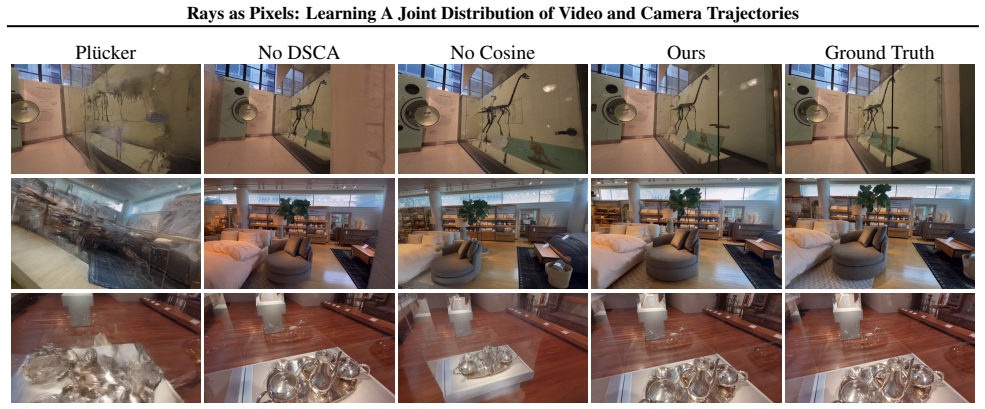
- Representing cameras in the shared video latent space outperforms Plücker embeddings on the evaluated tasks.
Where Pith is reading between the lines
- The approach could reduce error accumulation in applications like robotics or augmented reality where pose estimation and view synthesis must stay aligned.
- Joint modeling in a shared latent space might extend naturally to other scene attributes such as depth or lighting if they can be encoded similarly.
- Longer sequences or more complex dynamic scenes would test whether the raxel representation scales without additional regularization.
- The method suggests that many separate 3D-vision modules could be replaced by a single diffusion process if their signals can be cast into a common pixel-like latent format.
Load-bearing premise
Encoding cameras as dense ray pixels in the identical latent space as video frames together with Decoupled Self-Cross Attention is enough to learn a coherent joint distribution that supports accurate pose prediction, controlled generation, and self-consistent closed-loop behavior without extra 3D supervision.
What would settle it
A closed-loop self-consistency test in which the model first predicts a camera trajectory from a video clip and then generates a new video conditioned on that trajectory, where the generated video fails to match the original clip in appearance or motion.
Figures


read the original abstract
Recovering camera parameters from images and rendering scenes from novel viewpoints have been treated as separate tasks in computer vision and graphics. This separation breaks down when image coverage is sparse or poses are ambiguous, since each task depends on what the other produces. We propose Rays as Pixels, a Video Diffusion Model (VDM) that learns a joint distribution over videos and camera trajectories. To our knowledge, this is the first model to predict camera poses and do camera-controlled video generation within a single framework. We represent each camera as dense ray pixels (raxels), a pixel-aligned encoding that lives in the same latent space as video frames, and denoise the two jointly through a Decoupled Self-Cross Attention mechanism. A single trained model handles three tasks: predicting camera trajectories from video, generating video from input images along a pre-defined trajectory, and jointly synthesizing video and trajectory from input images. We evaluate on pose estimation and camera-controlled video generation, and introduce a closed-loop self-consistency test showing that the model's predicted poses and its renderings conditioned on those poses agree. Ablations against Pl\"ucker embeddings confirm that representing cameras in a shared latent space with video is subtantially more effective.
Editorial analysis
A structured set of objections, weighed in public.
Referee Report
Summary. The paper introduces Rays as Pixels, a video diffusion model that learns a joint distribution over videos and camera trajectories. Cameras are encoded as dense ray pixels (raxels) sharing the same latent space as video frames and denoised jointly via Decoupled Self-Cross Attention. A single model performs three tasks: camera trajectory prediction from video, camera-controlled video generation from input images, and joint video-trajectory synthesis. Evaluation covers pose estimation, controlled generation, and a closed-loop self-consistency test, with ablations favoring the shared-space raxel design over Plücker embeddings.
Significance. If the quantitative results and closed-loop test hold, the work is significant for unifying pose estimation and novel-view video synthesis in one generative framework without explicit 3D supervision. The pixel-aligned raxel representation and joint denoising mechanism are technically coherent innovations that directly enable the claimed multi-task capability. Credit is due for the self-consistency evaluation protocol and the Plücker ablation, both of which provide falsifiable checks on the joint-distribution claim.
minor comments (3)
- Abstract: 'subtantially' is a typographical error and should read 'substantially'.
- Abstract and method description: the precise definition of raxels (how rays are sampled and encoded into the latent space) and the exact architecture of Decoupled Self-Cross Attention would benefit from an early figure or equation block to improve readability for readers unfamiliar with the construction.
- Evaluation section: while the closed-loop consistency test is a strength, the manuscript should explicitly state the quantitative metrics used to measure agreement between predicted poses and rendered frames (e.g., pose error thresholds or perceptual consistency scores) so that the test's robustness can be assessed.
Simulated Author's Rebuttal
We thank the referee for their positive and accurate summary of our work, for highlighting the significance of the joint-distribution approach and the self-consistency evaluation, and for recommending minor revision. No specific major comments were raised that require technical changes.
Circularity Check
No significant circularity in derivation chain
full rationale
The paper introduces a video diffusion model architecture that encodes camera trajectories as dense raxels sharing the video latent space, then performs joint denoising via Decoupled Self-Cross Attention. This directly enables the three tasks (pose prediction, camera-controlled generation, joint synthesis) and the closed-loop consistency evaluation. No equations, derivations, or self-citations are shown that reduce any claimed prediction or joint distribution to a fitted parameter or input defined by the result itself. Training occurs on external video data with independent ablations (e.g., vs. Plücker embeddings) and external evaluation metrics. The construction is self-contained against benchmarks and does not rely on self-referential definitions or load-bearing prior work by the authors.
Axiom & Free-Parameter Ledger
axioms (1)
- domain assumption Video diffusion models can be extended to model joint distributions over appearance and camera geometry when both are represented in a shared latent space.
invented entities (1)
-
Raxels (dense ray pixels)
no independent evidence
Forward citations
Cited by 1 Pith paper
-
TrackCraft3R: Repurposing Video Diffusion Transformers for Dense 3D Tracking
TrackCraft3R is the first method to repurpose a video diffusion transformer as a feed-forward dense 3D tracker via dual-latent representations and temporal RoPE alignment, achieving SOTA performance with lower compute.
Reference graph
Works this paper leans on
-
[1]
LTX-Video: Realtime Video Latent Diffusion
URL https://storage. googleapis.com/deepmind-media/veo/ Veo-3-Tech-Report.pdf. HaCohen, Y ., Chiprut, N., Brazowski, B., Shalem, D., Moshe, D., Richardson, E., Levin, E., Shiran, G., Zabari, N., Gordon, O., Panet, P., Weissbuch, S., Kulikov, V ., Bitterman, Y ., Melumian, Z., and Bibi, O. Ltx- video: Realtime video latent diffusion.arXiv preprint arXiv:25...
work page internal anchor Pith review arXiv
-
[2]
CameraCtrl: Enabling Camera Control for Text-to-Video Generation
He, H., Xu, Y ., Guo, Y ., Wetzstein, G., Dai, B., Li, H., and Yang, C. Cameractrl: Enabling camera control for text- to-video generation.arXiv preprint arXiv:2404.02101,
work page internal anchor Pith review arXiv
-
[3]
He, H., Yang, C., Lin, S., Xu, Y ., Wei, M., Gui, L., Zhao, Q., Wetzstein, G., Jiang, L., and Li, H. Cameractrl ii: Dy- namic scene exploration via camera-controlled video dif- fusion models.arXiv preprint arXiv:2503.10592,
-
[4]
doi: 10.1109/TPAMI.2024.3444912. Hu, W., Gao, X., Li, X., Zhao, S., Cun, X., Zhang, Y ., Quan, L., and Shan, Y . Depthcrafter: Generating consistent long depth sequences for open-world videos. InProceedings of the IEEE/CVF Conference on Computer Vision and Pattern Recognition, pp. 2005–2015,
-
[6]
MapAnything: Universal Feed-Forward Metric 3D Reconstruction
URL https://arxiv.org/abs/2509.13414. Kerbl, B., Kopanas, G., Leimk¨uhler, T., and Drettakis, G. 3d gaussian splatting for real-time radiance field rendering. ACM Transactions on Graphics (TOG), 2023a. Kerbl, B., Kopanas, G., Leimk¨uhler, T., and Drettakis, G. 3d gaussian splatting for real-time radiance field rendering. ACM Transactions on Graphics, 2023...
work page internal anchor Pith review arXiv
-
[7]
Collaborative video diffusion: Consistent multi-video generation with camera control
Kuang, Z., Cai, S., He, H., Xu, Y ., Li, H., Guibas, L., and Wetzstein, G. Collaborative video diffusion: Consis- tent multi-video generation with camera control.arXiv preprint arXiv:2405.17414,
-
[8]
Cameras as relative positional encoding.arXiv preprint arXiv:2507.10496,
Li, R., Yi, B., Liu, J., Gao, H., Ma, Y ., and Kanazawa, A. Cameras as relative positional encoding.arXiv preprint arXiv:2507.10496,
-
[9]
arXiv preprint arXiv:2412.12091 (2024)
Liang, H., Cao, J., Goel, V ., Qian, G., Korolev, S., Ter- zopoulos, D., Plataniotis, K., Tulyakov, S., and Ren, J. Wonderland: Navigating 3d scenes from a single image. arXiv preprint arXiv:2412.12091,
-
[11]
Depth Anything 3: Recovering the Visual Space from Any Views
URL https:// arxiv.org/abs/2511.10647. Ling, L., Sheng, Y ., Tu, Z., Zhao, W., Xin, C., Wan, K., Yu, L., Guo, Q., Yu, Z., Lu, Y ., et al. Dl3dv-10k: A large- scale scene dataset for deep learning-based 3d vision. In Proceedings of the IEEE Conference on Computer Vision and Pattern Recognition (CVPR),
work page internal anchor Pith review arXiv
-
[12]
Liu, Y ., Lin, C., Zeng, Z., Long, X., Liu, L., Komura, T., and Wang, W. Syncdreamer: Generating multiview- consistent images from a single-view image.arXiv preprint arXiv:2309.03453, 2023b. Long, X., Guo, Y .-C., Lin, C., Liu, Y ., Dou, Z., Liu, L., Ma, Y ., Zhang, S.-H., Habermann, M., Theobalt, C., et al. Wonder3d: Single image to 3d using cross-domain...
-
[13]
DreamFusion: Text-to-3D using 2D Diffusion
Technical report. Poole, B., Jain, A., Barron, J. T., and Mildenhall, B. Dream- fusion: Text-to-3d using 2d diffusion.arXiv preprint arXiv:2209.14988,
work page internal anchor Pith review arXiv
-
[14]
Make-A-Video: Text-to-Video Generation without Text-Video Data
URL https: //arxiv.org/abs/2209.14792. Skorokhodov, I., Tulyakov, S., and Elhoseiny, M. Stylegan- v: A continuous video generator with the price, image quality and perks of stylegan2. InProceedings of the IEEE/CVF Conference on Computer Vision and Pattern Recognition, pp. 3626–3636,
work page internal anchor Pith review arXiv
-
[15]
Towards Accurate Generative Models of Video: A New Metric & Challenges
Unterthiner, T., Van Steenkiste, S., Kurach, K., Marinier, R., Michalski, M., and Gelly, S. Towards accurate generative models of video: A new metric & challenges.arXiv preprint arXiv:1812.01717,
work page internal anchor Pith review arXiv
-
[16]
Wan: Open and Advanced Large-Scale Video Generative Models
Wan, T., Wang, A., Ai, B., Wen, B., Mao, C., Xie, C.-W., Chen, D., Yu, F., Zhao, H., Yang, J., Zeng, J., Wang, J., Zhang, J., Zhou, J., Wang, J., Chen, J., Zhu, K., Zhao, K., Yan, K., Huang, L., Feng, M., Zhang, N., Li, P., Wu, P., Chu, R., Feng, R., Zhang, S., Sun, S., Fang, T., Wang, T., Gui, T., Weng, T., Shen, T., Lin, W., Wang, W., Wang, W., Zhou, W....
work page internal anchor Pith review Pith/arXiv arXiv
-
[17]
Motionctrl: A unified and flexible motion controller for video generation, 2024
Wang, S., Leroy, V ., Cabon, Y ., Chidlovskii, B., and Revaud, J. Dust3r: Geometric 3d vision made easy. InProceedings of the IEEE Conference on Computer Vision and Pattern Recognition (CVPR), 2024a. Wang, S., Leroy, V ., Cabon, Y ., Chidlovskii, B., and Revaud, J. Dust3r: Geometric 3d vision made easy. InProceedings of the IEEE Conference on Computer Vis...
-
[18]
Video models are zero-shot learners and reasoners
Wang, Z., Yuan, Z., Wang, X., Li, Y ., Chen, T., Xia, M., Luo, P., and Shan, Y . Motionctrl: A unified and flexible motion controller for video generation. InProceedings of SIGGRAPH, 2024c. Wiedemer, T., Li, Y ., Vicol, P., Gu, S. S., Matarese, N., Swer- sky, K., Kim, B., Jaini, P., and Geirhos, R. Video mod- els are zero-shot learners and reasoners.arXiv...
work page internal anchor Pith review arXiv
-
[19]
Xu, D., Nie, W., Liu, C., Liu, S., Kautz, J., Wang, Z., and Vahdat, A. Camco: Camera-controllable 3d- consistent image-to-video generation.arXiv preprint arXiv:2406.02509,
-
[20]
Seeing without pixels: Perception from camera trajecories.arXiv preprint arXiv:2511.21681,
Xue, Z., Grauman, K., Damen, D., Zisserman, A., and Han, T. Seeing without pixels: Perception from camera trajecories.arXiv preprint arXiv:2511.21681,
-
[21]
arXiv preprint arXiv:2503.05638 (2025) 18 Liu et al
Yu, M., Hu, W., Xing, J., and Shan, Y . Trajectorycrafter: Redirecting camera trajectory for monocular videos via diffusion models.arXiv preprint arXiv:2503.05638, 2025a. Yu, W., Xing, J., Yuan, L., Hu, W., Li, X., Huang, Z., Gao, X., Wong, T.-T., Shan, Y ., and Tian, Y . Viewcrafter: Taming video diffusion models for high-fidelity novel view synthesis.IE...
discussion (0)
Sign in with ORCID, Apple, or X to comment. Anyone can read and Pith papers without signing in.