Recognition: no theorem link
HearthNet: Edge Multi-Agent Orchestration for Smart Homes
Pith reviewed 2026-05-15 10:10 UTC · model grok-4.3
The pith
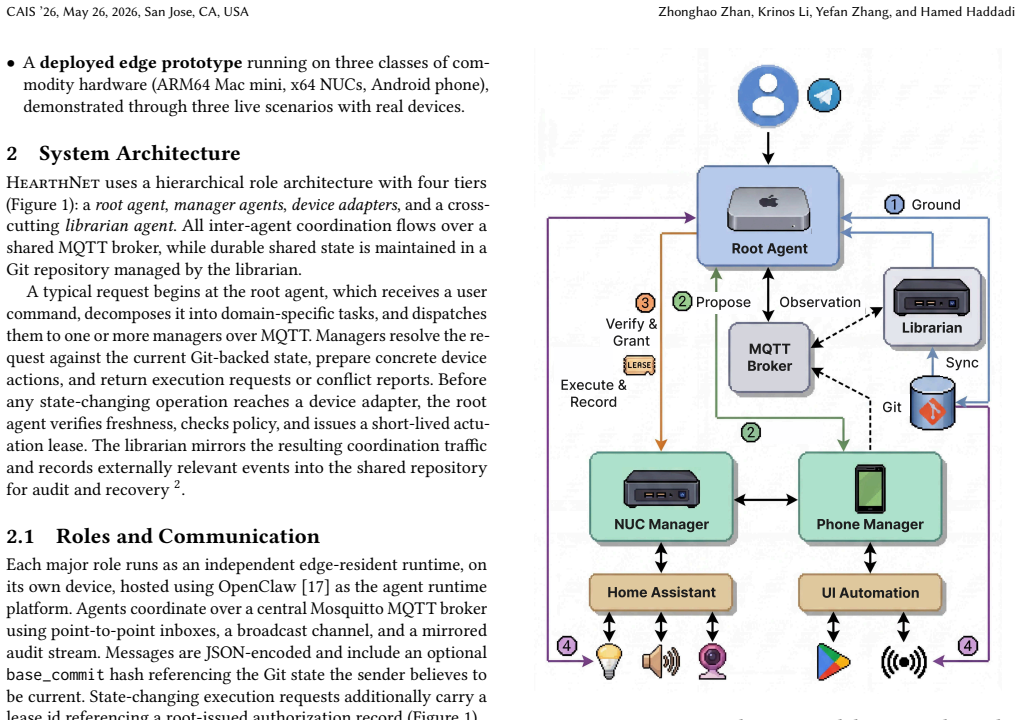
HearthNet deploys persistent role-specialized LLM agents on home hubs to coordinate devices via MQTT, Git state, and actuation leases.
A machine-rendered reading of the paper's core claim, the machinery that carries it, and where it could break.
Core claim
HearthNet deploys a small set of persistent, role-specialized LLM agents at the home hub, where they coordinate through MQTT, Git-backed shared state, and root-issued actuation leases to govern heterogeneous devices through thin adapters. This design externalizes context, preserves execution history, and separates planning, verification, authorization, and actuation across explicit boundaries. The prototype runs on commodity edge hardware and Android devices, keeping orchestration and control on-premise while using hosted LLM APIs for inference, and it demonstrates intent-driven coordination from ambiguous language, conflict resolution with timeline tracing, and rejection of stale or invalid
What carries the argument
Persistent role-specialized LLM agents that coordinate via MQTT messaging, Git-backed shared state, and root-issued actuation leases through thin device adapters.
If this is right
- Ambiguous natural-language intents can trigger coordinated responses across multiple specialized agents without hand-crafted rules.
- Conflicts between commands can be resolved and audited using timeline-based tracing of state changes.
- Stale or unauthorized commands are rejected before any physical actuation occurs.
- State and execution history remain available on local edge hardware for recovery and inspection.
Where Pith is reading between the lines
- The same coordination pattern could extend to other persistent physical control domains such as small industrial or agricultural IoT setups.
- Git-backed state opens the possibility of versioned rollbacks or human review of agent decisions in safety-critical cases.
- The thin-adapter layer would need explicit testing against a wider range of proprietary device protocols to confirm generality.
Load-bearing premise
Thin adapters, MQTT coordination, Git state, and root-issued leases will reliably maintain consistent behavior and recover from device failures without manual intervention in real heterogeneous deployments.
What would settle it
Run a live deployment in which a device fails or an integration breaks and check whether the system restores consistent control automatically or requires human intervention to resume operation.
Figures
read the original abstract
Smart-home users increasingly want to control their homes in natural language rather than assemble rules, dashboards, and API integrations by hand. At the same time, real deployments are brittle: devices fail, integrations break, and recoveries often require manual intervention. Existing agent toolkits are effective for session-scoped delegation, but smart-home control operates under a different scenario: it is persistent, event-driven, failure-prone, and tied to physical devices with no shared context window. We present HearthNet, an edge multi-agent orchestration system for smart homes. HearthNet deploys a small set of persistent, role-specialized LLM agents at the home hub, where they coordinate through MQTT, Git-backed shared state, and root-issued actuation leases to govern heterogeneous devices through thin adapters. This design externalizes context, preserves execution history, and separates planning, verification, authorization, and actuation across explicit boundaries. Our current prototype runs on commodity edge hardware and Android devices; it keeps orchestration, state management, and device control on-premise while using hosted LLM APIs for inference. We demonstrate the system through three live scenarios: intent-driven multi-agent coordination from ambiguous natural language, conflict resolution with timeline-based tracing, and rejection of stale or unauthorized commands before device actuation.
Editorial analysis
A structured set of objections, weighed in public.
Referee Report
Summary. The paper presents HearthNet, an edge multi-agent orchestration system for smart homes. It deploys a small set of persistent, role-specialized LLM agents at the home hub that coordinate through MQTT, Git-backed shared state, and root-issued actuation leases to control heterogeneous devices via thin adapters. The design separates planning, verification, authorization, and actuation; the prototype runs on commodity edge hardware while using hosted LLMs, and is demonstrated via three live scenarios showing intent-driven coordination, conflict resolution with tracing, and rejection of stale commands.
Significance. If the reliability and recovery properties hold in heterogeneous deployments, the architecture could meaningfully reduce manual intervention in smart-home systems by externalizing context and enforcing explicit boundaries between agents. The on-premise focus and use of standard primitives (MQTT, Git, leases) are practical strengths for privacy-sensitive IoT settings. However, the absence of any quantitative metrics, baselines, or failure data limits the ability to assess whether the central claims about consistent behavior and automatic recovery are realized.
major comments (2)
- [Abstract / demonstration scenarios] Abstract and demonstration section: the central claim that thin adapters + MQTT + Git state + root leases maintain consistent behavior and recover from device failures without manual intervention rests on three live nominal scenarios only. No fault-injection experiments, recovery-latency measurements, state-reconciliation logs after network partitions, or lease-expiration handling results are reported, leaving the weakest assumption untested.
- [Abstract / prototype description] Evaluation approach: the manuscript provides no quantitative metrics, baselines, error analysis, or comparison against existing agent toolkits or rule-based smart-home systems. This makes it impossible to evaluate whether the multi-agent orchestration improves upon brittle existing deployments in practice.
minor comments (2)
- [Abstract] The abstract states that the system 'keeps orchestration, state management, and device control on-premise' but does not specify the exact division of responsibilities between the edge hub and Android devices or how thin adapters are implemented for different device classes.
- [Prototype description] No discussion of LLM inference latency, token costs, or fallback mechanisms when hosted APIs are unavailable, which are relevant for an edge system.
Simulated Author's Rebuttal
We thank the referee for the constructive comments and for recognizing the practical strengths of the on-premise architecture. We agree that the current evaluation is limited and will strengthen the manuscript with additional experiments and metrics in the revision.
read point-by-point responses
-
Referee: [Abstract / demonstration scenarios] Abstract and demonstration section: the central claim that thin adapters + MQTT + Git state + root leases maintain consistent behavior and recover from device failures without manual intervention rests on three live nominal scenarios only. No fault-injection experiments, recovery-latency measurements, state-reconciliation logs after network partitions, or lease-expiration handling results are reported, leaving the weakest assumption untested.
Authors: We acknowledge that the three live scenarios are nominal and do not include systematic fault injection, recovery-latency measurements, or logs for network partitions and lease expiration. This leaves the recovery claims insufficiently tested. In the revised version we will add a new evaluation subsection that reports fault-injection results (device disconnections, network partitions), recovery latencies, state-reconciliation traces, and lease-expiration handling, together with a clearer statement in the abstract that the scenarios illustrate the design rather than constitute exhaustive validation. revision: yes
-
Referee: [Abstract / prototype description] Evaluation approach: the manuscript provides no quantitative metrics, baselines, error analysis, or comparison against existing agent toolkits or rule-based smart-home systems. This makes it impossible to evaluate whether the multi-agent orchestration improves upon brittle existing deployments in practice.
Authors: We agree that the lack of quantitative metrics, baselines, and comparisons is a genuine limitation that prevents direct assessment of practical gains. The present manuscript is primarily a system description. For the revision we will add an evaluation section containing (1) repeated-trial success rates and latency figures, (2) a baseline comparison against a rule-based system (Home Assistant) and a single-agent LLM controller, and (3) error analysis drawn from the new fault-injection runs. revision: yes
Circularity Check
No circularity: purely descriptive systems architecture
full rationale
The paper presents HearthNet as an edge multi-agent orchestration design using persistent LLM agents, MQTT coordination, Git-backed state, and root-issued leases. No equations, predictions, derivations, or first-principles results are claimed anywhere in the manuscript. The contribution consists of a system description, prototype implementation details, and three nominal live scenarios; none of these reduce by construction to fitted inputs or self-citations. External primitives (MQTT, Git, leases) are adopted as standard building blocks without any load-bearing uniqueness theorem or ansatz imported from the authors' prior work. The architecture is therefore self-contained against external benchmarks and exhibits no circularity.
Axiom & Free-Parameter Ledger
Reference graph
Works this paper leans on
-
[1]
Ala Al-Fuqaha, Mohsen Guizani, Mehdi Mohammadi, Mohammed Aledhari, and Moussa Ayyash. 2015. Internet of things: A survey on enabling technologies, protocols, and applications.IEEE communications surveys & tutorials17, 4 (2015), 2347–2376
work page 2015
-
[2]
Amazon Web Services. 2024. AWS IoT Device Shadow service. https://docs. aws.amazon.com/iot/latest/developerguide/iot-device-shadows.html. Accessed 2026-03-11
work page 2024
-
[3]
Anthropic. 2025. Effective Harness for Long Running Agents. https://www. anthropic.com/engineering/effective-harnesses-for-long-running-agents. Ac- cessed 2026-03-11
work page 2025
-
[4]
Anthropic. 2026. Claude Code: Best Practices. https://code.claude.com/docs/en/ best-practices. Accessed 2026-03-11
work page 2026
-
[5]
SLSA Authors. 2024. Supply-chain Levels for Software Artifacts. https://slsa.dev/. Accessed 2026-03-11
work page 2024
-
[6]
Michael Fagan, Katerina N Megas, Karen Scarfone, and Matthew Smith. 2020. Foundational cybersecurity activities for IoT device manufacturers. US Department of Commerce, National Institute of Standards and Technology
work page 2020
- [7]
-
[8]
Kai Greshake, Sahar Abdelnabi, Shailesh Mishra, Christoph Endres, Thorsten Holz, and Mario Fritz. 2023. Not what you’ve signed up for: Compromising real- world llm-integrated applications with indirect prompt injection. InProceedings of the 16th ACM workshop on artificial intelligence and security. 79–90
work page 2023
- [9]
-
[10]
Home Assistant Contributors. 2024. Home Assistant: Open-Source Home Au- tomation. https://www.home-assistant.io/. Accessed 2026-03-11
work page 2024
-
[11]
Bing Huang, Dipankar Chaki, Athman Bouguettaya, and Kwok-Yan Lam. 2023. A survey on conflict detection in IoT-based smart homes.Comput. Surveys56, 5 (2023), 1–40
work page 2023
-
[12]
LangChain. 2025. LangChain: Multi-agent. https://docs.langchain.com/oss/ python/langchain/multi-agent. Accessed 2026-03-11
work page 2025
-
[13]
Dongrui Liu, Qihan Ren, Chen Qian, Shuai Shao, Yuejin Xie, Yu Li, Zhonghao Yang, Haoyu Luo, Peng Wang, Qingyu Liu, et al . 2026. AgentDoG: A Diag- nostic Guardrail Framework for AI Agent Safety and Security.arXiv preprint arXiv:2601.18491(2026)
work page internal anchor Pith review Pith/arXiv arXiv 2026
-
[14]
Microsoft. 2025. AutoGen: A framework for building AI agents and applications. https://microsoft.github.io/autogen/dev/index.html. Accessed 2026-03-11
work page 2025
-
[15]
Microsoft. 2026. AutoGen to Microsoft Agent Framework Migration Guide. https://learn.microsoft.com/en-us/agent-framework/migration-guide/ from-autogen/. Accessed 2026-03-11
work page 2026
-
[16]
OpenAI. 2025. Agents SDK. https://developers.openai.com/api/docs/guides/ agents-sdk/. Accessed 2026-03-11
work page 2025
-
[17]
Peter Steinberger and OpenClaw Community. 2025. OpenClaw: Personal AI Assistant. https://openclaw.ai/. Accessed 2026-03-11
work page 2025
-
[18]
Santiago Torres-Arias, Hammad Afzali, Trishank Karthik Kuppusamy, Reza Curt- mola, and Justin Cappos. 2019. in-toto: Providing farm-to-table guarantees for bits and bytes. In28th USENIX Security Symposium (USENIX Security 19). 1393–1410
work page 2019
- [19]
discussion (0)
Sign in with ORCID, Apple, or X to comment. Anyone can read and Pith papers without signing in.