Recognition: no theorem link
From Understanding to Creation: A Prerequisite-Free AI Literacy Course with Technical Depth Across Majors
Pith reviewed 2026-05-15 07:46 UTC · model grok-4.3
The pith
A prerequisite-free course teaches non-technical undergraduates to design and build AI systems with integrated safeguards.
A machine-rendered reading of the paper's core claim, the machinery that carries it, and where it could break.
Core claim
By structuring the course around five mechanisms—a unifying pipeline traversed repeatedly at increasing sophistication, concurrent ethical integration, AI Studios with critique, a cumulative portfolio culminating in field experiments and projects, and a custom AI agent—the course enables students to move from intuition-based descriptions to technically grounded designs with safeguards, achieving the Create level of Bloom's revised taxonomy as documented through instructor-coded analysis of artifacts at multiple stages.
What carries the argument
The unifying conceptual pipeline (problem definition, data, model selection, evaluation, reflection) traversed repeatedly at increasing sophistication, which carries the technical and ethical progression.
If this is right
- The design demonstrates that technical depth and broad accessibility can coexist in AI literacy education.
- Mechanisms such as the portfolio and AI Studios can be adapted or separated for different institutional settings.
- Students produce co-authored field experiments on chatbot reasoning and defend AI artifacts to external evaluators.
- The course reaches the Create level of Bloom's taxonomy across majors without prior technical requirements.
Where Pith is reading between the lines
- If the progression holds beyond this single institution, it could inform scalable models for AI education in diverse university contexts.
- Extending the pipeline approach to discipline-specific AI applications might help embed literacy in fields like biology or business.
- Testing the course in online or hybrid formats could reveal how much in-person studio time is essential for the observed gains.
Load-bearing premise
The documented progression in student artifacts is caused by the five course mechanisms rather than student self-selection or other unmeasured factors.
What would settle it
A comparison study at another institution using a control group without the cumulative portfolio or AI Studios showing no significant difference in final artifact technical grounding would falsify the claim that these mechanisms drive the progression.
Figures





read the original abstract
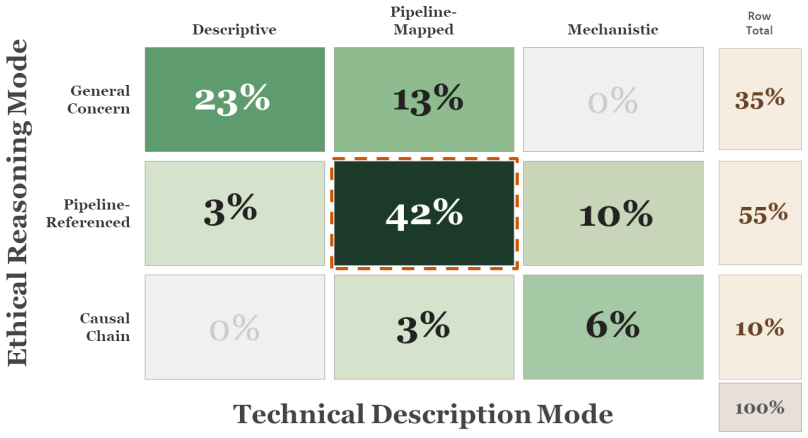
Most AI literacy courses for non-technical undergraduates emphasize conceptual breadth over technical depth. This paper describes UNIV 182, a prerequisite-free course at George Mason University that teaches undergraduates across majors to understand, use, evaluate, and build AI systems. The course is organized around five mechanisms: (1) a unifying conceptual pipeline (problem definition, data, model selection, evaluation, reflection) traversed repeatedly at increasing sophistication; (2) concurrent integration of ethical reasoning with the technical progression; (3) AI Studios, structured in-class work sessions with documentation protocols and real-time critique; (4) a cumulative assessment portfolio in which each assignment builds competencies required by the next, culminating in a co-authored field experiment on chatbot reasoning and a final project in which teams build AI-enabled artifacts and defend them before external evaluators; and (5) a custom AI agent providing structured reinforcement outside class. The paper situates this design within a comparative taxonomy of cross-major AI literacy courses and pedagogical traditions. Instructor-coded analysis of student artifacts at four assessment stages documents a progression from descriptive, intuition-based reasoning to technically grounded design with integrated safeguards, reaching the Create level of Bloom's revised taxonomy. To support adoption, the paper identifies which mechanisms are separable, which require institutional infrastructure, and how the design adapts to settings ranging from general AI literacy to discipline-embedded offerings. The course is offered as a documented resource, demonstrating that technical depth and broad accessibility can coexist when scaffolding supports both.
Editorial analysis
A structured set of objections, weighed in public.
Referee Report
Summary. The paper describes UNIV 182, a prerequisite-free undergraduate AI literacy course at George Mason University open to all majors. It organizes instruction around five mechanisms: a repeatedly traversed conceptual pipeline (problem definition through reflection), concurrent ethics integration, structured AI Studios with critique protocols, a cumulative portfolio culminating in a co-authored chatbot field experiment and defended AI artifact project, and a custom reinforcement agent. Instructor-coded qualitative analysis of artifacts from four assessment stages is presented as evidence of progression from intuition-based description to technically grounded design with safeguards, reaching Bloom's revised Create level. The work situates the design in a comparative taxonomy of cross-major AI courses and discusses separable mechanisms and adaptation to other settings.
Significance. If the reported progression is robustly attributable to the course mechanisms, the manuscript supplies a concrete, documented template for delivering technical depth in AI education without prerequisites. The explicit mapping of mechanisms to Bloom's taxonomy, the provision of the course as an adoptable resource, and the taxonomy of existing offerings add practical value for curriculum designers seeking to balance accessibility and rigor.
major comments (2)
- [Instructor-coded analysis of student artifacts] The section presenting the instructor-coded analysis of student artifacts supplies no coding rubric, inter-rater reliability statistic, blinding procedure, or quantitative supplement. Because the central claim—that the five mechanisms produce measurable movement to Bloom's Create level—rests entirely on this qualitative evidence, the absence of these methodological details leaves open the possibility that observed changes reflect coding expectations or self-selection rather than instructional effects.
- [Course design and evaluation] No control cohort, pre-course baseline measures, or multi-institution replication is reported. The single-offering design at one university therefore cannot isolate the causal contribution of the unifying pipeline, AI Studios, portfolio structure, agent, or ethics integration from confounding factors such as motivated student enrollment or institutional context.
minor comments (1)
- [Comparative taxonomy] The comparative taxonomy of AI literacy courses would be clearer if the categorization criteria (e.g., depth vs. breadth axes) were stated explicitly rather than left implicit in the narrative.
Simulated Author's Rebuttal
We thank the referee for the detailed and constructive report. The comments correctly identify limitations in the current presentation of evidence. We address each point below, indicating revisions that will be incorporated in the next version of the manuscript.
read point-by-point responses
-
Referee: [Instructor-coded analysis of student artifacts] The section presenting the instructor-coded analysis of student artifacts supplies no coding rubric, inter-rater reliability statistic, blinding procedure, or quantitative supplement. Because the central claim—that the five mechanisms produce measurable movement to Bloom's Create level—rests entirely on this qualitative evidence, the absence of these methodological details leaves open the possibility that observed changes reflect coding expectations or self-selection rather than instructional effects.
Authors: We agree that the current description of the qualitative analysis is insufficiently detailed. In the revised manuscript we will add: (1) the full coding rubric with explicit criteria for each Bloom level, (2) a step-by-step description of the coding procedure including how artifacts were selected and how progression was tracked across the four stages, (3) acknowledgment that a single instructor performed the coding and that no blinding or inter-rater reliability statistic is available, and (4) a new appendix containing representative coded excerpts from each stage so readers can evaluate the coding themselves. We will also revise the language of the central claim to describe the analysis as illustrative documentation of student progression rather than as quantitative proof of causal effect. These changes will be made. revision: yes
-
Referee: [Course design and evaluation] No control cohort, pre-course baseline measures, or multi-institution replication is reported. The single-offering design at one university therefore cannot isolate the causal contribution of the unifying pipeline, AI Studios, portfolio structure, agent, or ethics integration from confounding factors such as motivated student enrollment or institutional context.
Authors: We accept that the single-offering, single-institution design precludes strong causal claims. The revised manuscript will: (1) explicitly state in the methods and discussion sections that the study is observational and that alternative explanations (self-selection, instructor effects, institutional context) cannot be ruled out, (2) add a dedicated limitations subsection that outlines the exact threats to internal validity, and (3) describe concrete plans for future controlled and multi-site replications that would isolate the contribution of each mechanism. Because the data were collected from a completed offering, we cannot retroactively introduce a control cohort or pre-course measures. We will therefore frame the current evidence as a documented existence proof and template rather than as a definitive demonstration of mechanism efficacy. revision: partial
- Absence of a control cohort or pre-course baseline measures: these data were not collected during the single past offering and cannot be added retrospectively.
Circularity Check
No circularity: descriptive course report with no derivations or self-referential reductions
full rationale
The paper is a descriptive account of an AI literacy course design organized around five mechanisms, supported by instructor-coded qualitative analysis of student artifacts across four stages. No equations, fitted parameters, mathematical derivations, or load-bearing self-citations appear in the provided text. The central claim—that artifacts progress from descriptive to technically grounded design reaching Bloom's Create level—rests on narrative documentation rather than any reduction to inputs by construction. The analysis does not invoke uniqueness theorems, ansatzes smuggled via citation, or rename known results; it is self-contained as an observational report without self-definitional loops or predictions that are statistically forced by prior fits.
Axiom & Free-Parameter Ledger
axioms (1)
- domain assumption Bloom's revised taxonomy accurately measures progression in AI reasoning and design skills
Forward citations
Cited by 1 Pith paper
-
A Discipline-Agnostic AI Literacy Course for Academic Research: Architecture, Pedagogy, and Implementation
A four-module, discipline-agnostic course on AI-assisted literature review produces large self-reported confidence gains in hallucination detection, responsible use, and AI attribution.
Reference graph
Works this paper leans on
-
[1]
What is ai literacy? competencies and design considerations
Duri Long and Brian Magerko. What is ai literacy? competencies and design considerations. InProceedings of the 2020 CHI Conference on Human Factors in Computing Systems, CHI ’20, page 1–16, New York, NY, USA, 2020. Association for Computing Machinery. ISBN 9781450367080. doi: 10.1145/3313831.3376727. URLhttps://doi.org/10.1145/3313831. 3376727
-
[2]
David Touretzky, Christina Gardner-McCune, Fred Martin, and Deborah Seehorn. Envision- ing AI for K-12: what should every child know about AI? InProceedings of the Thirty-Third AAAI Conference on Artificial Intelligence and Thirty-First Innovative Applications of Artifi- cial Intelligence Conference and Ninth AAAI Symposium on Educational Advances in Arti...
-
[3]
Ai literacy as a core component of ai education
Sri Yash Tadimalla and Mary Lou Maher. Ai literacy as a core component of ai education. AI Magazine, 46(2):e70007, 2025. doi: https://doi.org/10.1002/aaai.70007. URLhttps:// onlinelibrary.wiley.com/doi/abs/10.1002/aaai.70007
-
[4]
Davy Tsz Kit Ng, Jac Ka Lok Leung, Samuel Kai Wah Chu, and Maggie Shen Qiao. Concep- tualizing ai literacy: An exploratory review.Computers and Education: Artificial Intelligence, 2:100041, 2021. ISSN 2666-920X. doi: https://doi.org/10.1016/j.caeai.2021.100041. URL https://www.sciencedirect.com/science/article/pii/S2666920X21000357
-
[5]
The essentials of ai for life and society: A full-scale ai literacy course accessible to all, 2025
Zifan Xu, Kristen Procko, Michael Munje, Kristin Patterson, Lea Sabatini, Joydeep Biswas, and Peter Stone. The essentials of ai for life and society: A full-scale ai literacy course accessible to all, 2025. URLhttps://arxiv.org/abs/2512.04110
-
[6]
The essentials of ai for life and society: An ai literacy course for the university community
Joydeep Biswas, Don Fussell, Peter Stone, Kristin Patterson, Kristen Procko, Lea Sabatini, and Zifan Xu. The essentials of ai for life and society: An ai literacy course for the university community. InProceedings of the AAAI Conference on Artificial Intelligence, volume 39, pages 28973–28978, Apr. 2025. doi: 10.1609/aaai.v39i28.35166
-
[7]
Georgiou, Rebecca Ramnauth, Jessie Cheung, E
Kate Candon, Nicholas C. Georgiou, Rebecca Ramnauth, Jessie Cheung, E. Chandra Fincke, and Brian Scassellati. Artificial intelligence for future presidents: Teaching ai literacy to ev- eryone. InProceedings of the AAAI Conference on Artificial Intelligence, volume 39, pages 28988–28995, Apr. 2025. doi: 10.1609/aaai.v39i28.35168
-
[8]
Bynum, Lucas Rosenblatt, and Falaah Arif Khan
Julia Stoyanovich, Armanda Lewis, Eric Corbett, Lucius E.J. Bynum, Lucas Rosenblatt, and Falaah Arif Khan. We are ai: Taking control of technology. InProceedings of the AAAI Conference on Artificial Intelligence, volume 39, pages 29070–29077, Apr. 2025. doi: 10.1609/ aaai.v39i28.35178
work page 2025
-
[9]
Artificial intelligence and the future of teaching and learning: 34 Insights and recommendations
Office of Educational Technology. Artificial intelligence and the future of teaching and learning: 34 Insights and recommendations. Technical report, U.S. Department of Education, Washington, DC, May 2023. URLhttps://eric.ed.gov/?id=ED631097. ERIC Number: ED631097
work page 2023
-
[10]
Guidance for generative ai in education and research, 2023
UNESCO. Guidance for generative ai in education and research, 2023. URLhttps://www. unesco.org/en/articles/guidance-generative-ai-education-and-research
work page 2023
-
[11]
Siu-Cheung Kong, William Man-Yin Cheung, and Guo Zhang. Evaluation of an artificial intelligence literacy course for university students with diverse study backgrounds.Computers and Education: Artificial Intelligence, 2:100026, 2021. ISSN 2666-920X. doi: https://doi.org/ 10.1016/j.caeai.2021.100026. URLhttps://www.sciencedirect.com/science/article/pii/ S2...
-
[12]
Artur Klingbeil, Cassandra Grützner, and Philipp Schreck. Trust and reliance on ai — an ex- perimental study on the extent and costs of overreliance on ai.Computers in Human Behavior, 160:108352, 2024. ISSN 0747-5632. doi: https://doi.org/10.1016/j.chb.2024.108352
-
[13]
Parshin Shojaee, Iman Mirzadeh, Keivan Alizadeh, Maxwell Horton, Samy Bengio, and Mehrdad Farajtabar. The illusion of thinking: Understanding the strengths and limitations of reasoning models via the lens of problem complexity, 2025. URLhttps://arxiv.org/abs/ 2506.06941
-
[14]
Thomas K. F. Chiu. Ai literacy and competency: definitions, frameworks, development and future research directions.Interactive Learning Environments, 33(5):3225–3229, 2025. doi: 10.1080/10494820.2025.2514372
- [15]
-
[16]
Stephen Downie, and Samuel Kai Wah Chu
Davy Tsz Kit Ng, Min Lee, Roy Jun Yi Tan, Xiao Hu, J. Stephen Downie, and Samuel Kai Wah Chu. A review of ai teaching and learning from 2000 to 2020.Education and Information Technologies, 28(7):8445–8501, 2023. ISSN 1573-7608. doi: 10.1007/s10639-022-11491-w. URL https://doi.org/10.1007/s10639-022-11491-w
-
[17]
Siu-Cheung Kong, Man-Yin William Cheung, and Olson Tsang. Developing an artificial in- telligence literacy framework: Evaluation of a literacy course for senior secondary students using a project-based learning approach.Computers and Education: Artificial Intelligence, 6:100214, 2024. ISSN 2666-920X. doi: https://doi.org/10.1016/j.caeai.2024.100214. URL h...
-
[18]
Humans and automation: Use, misuse, disuse, abuse
Raja Parasuraman and Victor Riley. Humans and automation: Use, misuse, disuse, abuse. Human Factors, 39(2):230–253, 1997. doi: 10.1518/001872097778543886. URLhttps://doi. org/10.1518/001872097778543886
-
[19]
Teachable machine: Approachable web- based tool for exploring machine learning classification
Michelle Carney, Barron Webster, Irene Alvarado, Kyle Phillips, Noura Howell, Jordan Griffith, Jonas Jongejan, Amit Pitaru, and Alexander Chen. Teachable machine: Approachable web- based tool for exploring machine learning classification. InExtended Abstracts of the 2020 CHI Conference on Human Factors in Computing Systems, CHI EA ’20, page 1–8, New York,...
-
[20]
OpenAI. Openai academy, 2025. URLhttps://academy.openai.com/. Accessed: 2026-03-14
work page 2025
-
[21]
Google. Google ai essentials, 2025. URLhttps://grow.google/ai-essentials/. Accessed: 2026-03-14
work page 2025
- [22]
-
[23]
URLhttps://www.digitaleducationcouncil.com/ digital-education-council-ai-literacy-for-all-course. Accessed: 2026-03-14. 35
work page 2026
-
[24]
Andrew Ng. Ai for everyone. Online course, 2019. URLhttps://www.coursera.org/learn/ ai-for-everyone. Accessed: 2026-03-19
work page 2019
-
[25]
The National Academies Press, Washington, DC, 2005
National Research Council.How Students Learn: Science in the Classroom. The National Academies Press, Washington, DC, 2005. ISBN 978-0-309-08950-
work page 2005
-
[26]
URLhttps://nap.nationalacademies.org/catalog/11102/ how-students-learn-science-in-the-classroom
doi: 10.17226/11102. URLhttps://nap.nationalacademies.org/catalog/11102/ how-students-learn-science-in-the-classroom
-
[27]
Charles Henderson, Andrea Beach, and Noah Finkelstein. Facilitating change in undergraduate stem instructional practices: An analytic review of the literature.Journal of Research in Science Teaching, 48(8):952–984, 2011. doi: https://doi.org/10.1002/tea.20439. URLhttps: //onlinelibrary.wiley.com/doi/abs/10.1002/tea.20439
-
[28]
Tsai, Sivasankaran Rajamanickam, and Melanie Mitchell
Claas Beger, Ryan Yi, Shuhao Fu, Kaleda Denton, Arseny Moskvichev, Sarah W. Tsai, Sivasankaran Rajamanickam, and Melanie Mitchell. Do ai models perform human-like abstract reasoning across modalities?, 2026. URLhttps://arxiv.org/abs/2510.02125
-
[29]
Integrating ethics within machine learning courses.ACM Trans
Jeffrey Saltz, Michael Skirpan, Casey Fiesler, Micha Gorelick, Tom Yeh, Robert Heckman, Neil Dewar, and Nathan Beard. Integrating ethics within machine learning courses.ACM Trans. Comput. Educ., 19(4), August 2019. doi: 10.1145/3341164. URLhttps://doi.org/10.1145/ 3341164
-
[30]
Using role-play to scale the integration of ethics across the computer science curriculum
Ben Rydal Shapiro, Emma Lovegall, Amanda Meng, Jason Borenstein, and Ellen Zegura. Using role-play to scale the integration of ethics across the computer science curriculum. In Proceedings of the 52nd ACM Technical Symposium on Computer Science Education, SIGCSE ’21, page 1034–1040, New York, NY, USA, 2021. Association for Computing Machinery. ISBN 978145...
-
[31]
Teaching AI ethics using science fiction
Emanuelle Burton, Judy Goldsmith, and Nicholas Mattei. Teaching AI ethics using science fiction. InArtificial Intelligence and Ethics: Papers from the 2015 AAAI Workshop, pages 1–6, 2015
work page 2015
-
[32]
Ekaba Bisong.Google Colaboratory, pages 59–64. Apress, Berkeley, CA, 2019. ISBN 978-1-4842-4470-8. doi: 10.1007/978-1-4842-4470-8_7. URLhttps://doi.org/10.1007/ 978-1-4842-4470-8_7
-
[33]
Amarda Shehu, Adonyas Ababu, Asma Akbary, Griffin Allen, Aroush Baig, Tereana Battle, Elias Beall, Christopher Byrom, Matt Dean, Kate Demarco, Ethan Douglass, Luis Granados, Layla Hantush, Andy Hay, Eleanor Hay, Caleb Jackson, Jaewon Jang, Carter Jones, Quanyang Li, Adrian Lopez, Logan Massimo, Garrett McMullin, Ariana Mendoza Maldonado, Eman Mirza, Hadiy...
work page 2025
-
[34]
Gomez, Łukasz Kaiser, and Illia Polosukhin
Ashish Vaswani, Noam Shazeer, Niki Parmar, Jakob Uszkoreit, Llion Jones, Aidan N. Gomez, Łukasz Kaiser, and Illia Polosukhin. Attention is all you need. InProceedings of the 31st International Conference on Neural Information Processing Systems, NIPS’17, page 6000–6010, Red Hook, NY, USA, 2017. Curran Associates Inc. ISBN 9781510860964
work page 2017
-
[35]
Alex Sherstinsky. Fundamentals of recurrent neural network (rnn) and long short-term mem- ory (lstm) network.Physica D: Nonlinear Phenomena, 404:132306, 2020. ISSN 0167-2789. doi: https://doi.org/10.1016/j.physd.2019.132306. URLhttps://www.sciencedirect.com/ science/article/pii/S0167278919305974. 36
-
[36]
Distributedrepresen- tations of words and phrases and their compositionality
TomasMikolov, IlyaSutskever, KaiChen, GregSCorrado, andJeffDean. Distributedrepresen- tations of words and phrases and their compositionality. In C.J. Burges, L. Bottou, M. Welling, Z. Ghahramani, and K.Q. Weinberger, editors,Advances in Neural Information Processing Systems, volume 26. Curran Associates, Inc., 2013. URLhttps://proceedings.neurips.cc/ pap...
work page 2013
-
[37]
GloVe: Global vectors for word representation
Jeffrey Pennington, Richard Socher, and Christopher Manning. GloVe: Global vectors for word representation. In Alessandro Moschitti, Bo Pang, and Walter Daelemans, editors,Proceedings of the 2014 Conference on Empirical Methods in Natural Language Processing (EMNLP), pages 1532–1543, Doha, Qatar, October 2014. Association for Computational Linguistics. do...
work page 2014
-
[38]
StevenJ.KarauandKiplingD.Williams. Socialloafing: Ameta-analyticreviewandtheoretical integration.Journal of Personality and Social Psychology, 65(4):681–706, 1993. doi: 10.1037/ 0022-3514.65.4.681
work page 1993
-
[39]
Pradeep Aggarwal and Connie L. O’Brien. Social loafing on group projects: Structural an- tecedents and effect on student satisfaction.Journal of Marketing Education, 30(3):255–264,
-
[40]
doi: 10.1177/0273475308322283
-
[41]
JackConklin. Ataxonomyforlearning, teaching, andassessing: Arevisionofbloom’staxonomy of educational objectives complete edition by lorin w. anderson et al.Educational Horizons, 83 (3):154–159, 2005. URLhttp://www.jstor.org/stable/42926529. Accessed 19 Mar. 2026
-
[42]
Alison Crowe, Clarissa Dirks, and Mary Pat Wenderoth. Biology in bloom: Implementing bloom’s taxonomy to enhance student learning in biology.CBE–Life Sciences Education, 7(4): 368–381, 2008. doi: 10.1187/cbe.08-05-0024
-
[43]
Jennifer L. Momsen, Tammy M. Long, Sarah A. Wyse, and Diane Ebert-May. Just the facts? introductory undergraduate biology courses focus on low-level cognitive skills.CBE–Life Sci- ences Education, 9(4):435–440, 2010. doi: 10.1187/cbe.10-01-0001
-
[44]
Zaidi, Christina Hwang, Shannon Scott, Shelly Stallard, Joel Purkiss, and Michael Hortsch
Nadia B. Zaidi, Christina Hwang, Shannon Scott, Shelly Stallard, Joel Purkiss, and Michael Hortsch. Climbing bloom’s taxonomy pyramid: Lessons from a graduate histology course. Anatomical Sciences Education, 10(5):456–464, 2017. doi: 10.1002/ase.1685. 37
discussion (0)
Sign in with ORCID, Apple, or X to comment. Anyone can read and Pith papers without signing in.