Recognition: unknown
Repopulating the pair-instability mass gap without sustained growth to massive IMBHs: the case of 47\,Tuc
Pith reviewed 2026-05-10 16:32 UTC · model grok-4.3
The pith
Simulations of 47 Tucanae show that repeated black hole mergers rarely produce anything heavier than 70 solar masses and favor a subsystem of dark remnants over a single massive intermediate-mass black hole.
A machine-rendered reading of the paper's core claim, the machinery that carries it, and where it could break.
Core claim
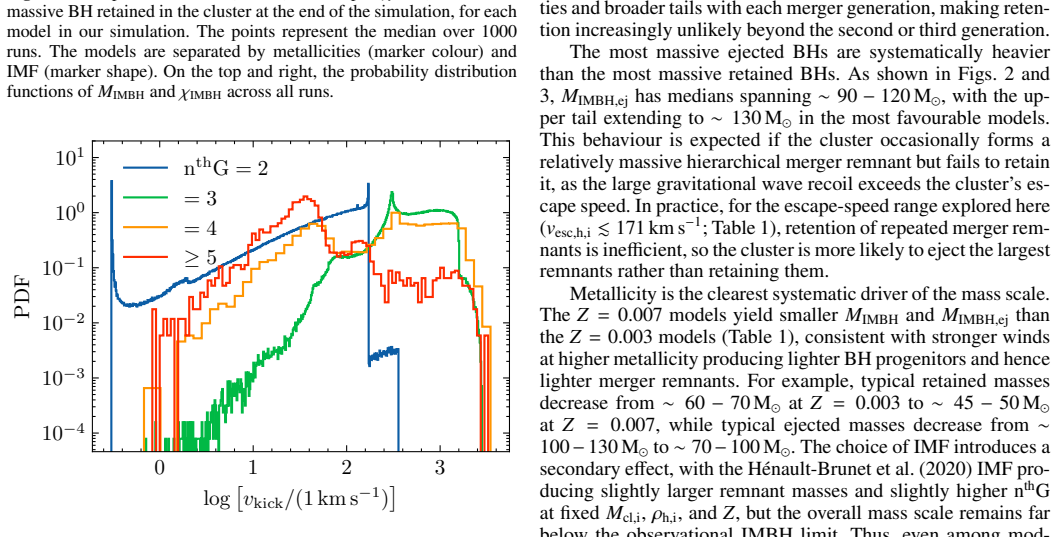
Hierarchical mergers alone produce a most massive retained black hole of 45-70 solar masses with spin around 0.65 after only one to three mergers, since remnants from the second generation acquire spins near 0.7 that amplify recoil kicks; including primordial seeds of 130-700 solar masses yields a bimodal retained-mass distribution in which roughly 90 percent of seeds are ejected while 10 percent survive above 450 solar masses, together with a trimodal joint mass-spin distribution in which seed-stellar mergers keep low spin and seed-seed mergers produce high-mass high-spin objects, all still below the 578 solar mass observational limit and favoring a dark-remnant subsystem over a single very
What carries the argument
The cBHBd semi-analytical code that couples cluster evolution with binary black hole dynamics, together with numerical-relativity surrogate prescriptions that compute merger-remnant masses, spins, and gravitational-wave recoil kicks.
If this is right
- The most massive black hole in 47 Tucanae should show a mass-spin combination that distinguishes merger-built remnants from surviving primordial seeds.
- Gravitational-wave detectors including LIGO-Virgo-KAGRA, the Einstein Telescope, Cosmic Explorer, and LISA can test the predicted spin-mass diagnostic through future detections.
- The pair-instability mass gap can be repopulated in globular clusters by retained primordial seeds without sustained growth into very massive single objects.
- Only a small minority of evolutionary histories allow heavy seeds to remain bound to the cluster.
Where Pith is reading between the lines
- If the models are correct, many globular clusters may host populations of intermediate-mass black holes as collections of remnants rather than single central objects.
- The mass-spin diagnostic could be applied to other dense stellar systems to identify formation channels without needing to resolve individual objects.
- Extending the same simulation framework to clusters with different masses and densities would predict which ones are most likely to retain heavy black holes.
Load-bearing premise
The semi-analytical code and numerical-relativity prescriptions accurately represent the full N-body dynamics and black-hole retention physics across the explored range of initial conditions.
What would settle it
A direct measurement of the mass and spin of the most massive black hole in 47 Tucanae that lies outside the predicted 45-70 solar mass range with spin near 0.65 or the bimodal-trimodal distribution from primordial seeds would falsify the models.
Figures


read the original abstract
We model the formation and retention of the most massive black hole (BH) in 47~Tuc using the semi-analytical code \texttt{cBHBd}, coupling cluster evolution with binary BH dynamics and computing merger-remnant masses, spins, and gravitational-wave recoil kicks via numerical-relativity surrogate prescriptions. We evolve 80\,000 cluster realisations spanning initial masses, densities, IMFs, and metallicities, in both a baseline scenario ($m_{\rm max} = 130\,\mathrm{M}_{\odot}$) and an extended-IMF scenario with ${\sim}\,50-110$ primordial BH seeds above the pair-instability gap ($M_{\rm BH} \sim 130-700\,\mathrm{M}_{\odot}$). Selecting models reproducing 47~Tuc's present-day mass and half-mass radius, we find hierarchical mergers alone yield a most massive retained BH of $M_{\rm BH} \sim 45-70\,\mathrm{M}_{\odot}$ with spin $\chi_{\rm BH} \sim 0.65$, limited to ${\sim}\,1-3$ mergers, as second-generation remnants acquire spin $\chi \sim 0.7$ that amplifies recoil kicks in subsequent generations. When primordial seeds are included, the retained-mass distribution becomes bimodal -- in ${\sim}\,90\%$ of realisations all seeds are ejected, but in ${\sim}\,10\%$ a massive seed ($M_{\rm BH} \gtrsim 450\,\mathrm{M}_{\odot}$) survives -- while the joint mass-spin distribution is trimodal; seeds surviving via stellar-mass BH mergers retain low spin ($\chi \lesssim 0.3$), whereas seed-seed mergers produce high-mass, high-spin remnants ($\chi \sim 0.65-0.7$), yielding 90th-percentile retained masses of ${\sim}\,500-1100\,\mathrm{M}_{\odot}$. Both scenarios are consistent with the $3\sigma$ dynamical upper limit of $578\,\mathrm{M}_{\odot}$. Our results favour a dark-remnant subsystem over a single massive IMBH and provide a spin-mass diagnostic testable with LIGO-Virgo-KAGRA, the Einstein Telescope, Cosmic Explorer, and LISA.
Editorial analysis
A structured set of objections, weighed in public.
Referee Report
Summary. The manuscript models the most massive black hole in the globular cluster 47 Tuc using the semi-analytical code cBHBd, which couples cluster evolution with binary black hole dynamics and incorporates numerical-relativity surrogate models for merger remnants, spins, and recoil kicks. Through 80,000 realizations spanning a range of initial cluster masses, densities, initial mass functions, and metallicities, the authors compare a baseline scenario limited to stellar-mass black holes (m_max = 130 M_⊙) with an extended-IMF scenario including 50-110 primordial black hole seeds in the 130-700 M_⊙ range. After selecting realizations that match the observed present-day mass and half-mass radius of 47 Tuc, they find that hierarchical mergers in the baseline case produce a most massive retained black hole of 45-70 M_⊙ with spin ~0.65, limited by spin-induced recoil kicks. In the extended-IMF case, the retained mass distribution is bimodal, with ~90% of realizations ejecting all seeds and ~10% retaining a massive seed (M_BH ≳ 450 M_⊙), resulting in a trimodal mass-spin distribution. Both scenarios are consistent with the 3σ upper limit of 578 M_⊙, leading the authors to favor a dark-remnant subsystem over a single massive intermediate-mass black hole and to propose a spin-mass diagnostic testable with current and future gravitational-wave observatories.
Significance. If robust, these findings offer a mechanism to repopulate the pair-instability mass gap through primordial seeds without sustained growth to a single massive IMBH, while remaining consistent with dynamical constraints on 47 Tuc. The strength of the work lies in the large-scale parameter study involving 80,000 cluster realizations and the derivation of observable predictions for the joint mass-spin distribution of retained black holes, which can be tested with LIGO-Virgo-KAGRA, the Einstein Telescope, Cosmic Explorer, and LISA. The integration of NR-surrogate prescriptions for merger outcomes enhances the physical realism of the binary evolution component.
major comments (2)
- [Methods] The bimodal retained-mass distribution reported for the extended-IMF scenario, with approximately 90% of realizations ejecting all seeds and 10% retaining M_BH ≳ 450 M_⊙, is derived from cBHBd's treatment of recoil kicks and retention probabilities. Given that this distribution underpins the conclusion favoring a dark-remnant subsystem, the manuscript should include validation of cBHBd against full N-body simulations for the ejection/retention of massive seeds in the 130-700 M_⊙ range, as semi-analytical approximations for encounter-driven dynamics may introduce systematic biases in the survival fraction and the 90th-percentile retained masses of 500-1100 M_⊙.
- [Results] The post-selection procedure on models that reproduce 47 Tuc's present-day mass and half-mass radius could influence the reported retained-mass and spin distributions. To ensure the bimodality and trimodality are not artifacts of this selection, the authors should present the distributions prior to selection or perform a sensitivity analysis showing that the key statistics (e.g., the 10% survival fraction) remain stable under variations in the selection criteria.
minor comments (3)
- Clarify in the methods how the ~50-110 primordial BH seeds are sampled from the extended IMF, including the specific mass range and number density assumptions.
- The abstract states that second-generation remnants acquire spin χ ~ 0.7; provide the exact distribution or average value used from the NR surrogates in the relevant section.
- Ensure that all figures showing mass-spin distributions include error bars or confidence intervals reflecting the finite number of realizations contributing to each bin.
Simulated Author's Rebuttal
We thank the referee for their positive evaluation of our manuscript and for the constructive major comments. We address each point below and will revise the manuscript to incorporate improvements where feasible.
read point-by-point responses
-
Referee: [Methods] The bimodal retained-mass distribution reported for the extended-IMF scenario, with approximately 90% of realizations ejecting all seeds and 10% retaining M_BH ≳ 450 M_⊙, is derived from cBHBd's treatment of recoil kicks and retention probabilities. Given that this distribution underpins the conclusion favoring a dark-remnant subsystem, the manuscript should include validation of cBHBd against full N-body simulations for the ejection/retention of massive seeds in the 130-700 M_⊙ range, as semi-analytical approximations for encounter-driven dynamics may introduce systematic biases in the survival fraction and the 90th-percentile retained masses of 500-1100 M_⊙.
Authors: We agree that explicit validation would strengthen confidence in the retention statistics. cBHBd has been benchmarked against N-body results for stellar-mass black hole retention and binary dynamics in earlier works, with the recoil kicks here taken directly from NR surrogate models that are independent of the semi-analytic framework. For the 130-700 M_⊙ seeds the dominant ejection mechanism is the post-merger recoil velocity, whose accuracy is set by numerical relativity rather than the encounter-rate approximation. A complete end-to-end N-body validation across 80 000 realizations is computationally prohibitive. In the revised manuscript we will add a dedicated paragraph in the Methods section that (i) cites the existing N-body benchmarks for cBHBd, (ii) quantifies the expected systematic uncertainty in the semi-analytic encounter rates for massive objects, and (iii) notes that the reported 10 % survival fraction is driven primarily by the NR recoil prescription. revision: partial
-
Referee: [Results] The post-selection procedure on models that reproduce 47 Tuc's present-day mass and half-mass radius could influence the reported retained-mass and spin distributions. To ensure the bimodality and trimodality are not artifacts of this selection, the authors should present the distributions prior to selection or perform a sensitivity analysis showing that the key statistics (e.g., the 10% survival fraction) remain stable under variations in the selection criteria.
Authors: We thank the referee for highlighting this potential selection effect. In the revised manuscript we will include two new figures (or panels) showing the retained-mass and joint mass-spin distributions for the entire ensemble of 80 000 realizations before any selection on present-day mass or half-mass radius. We will also perform a sensitivity test by repeating the analysis with selection windows widened to 1σ and 2σ around the observed values of 47 Tuc and demonstrate that the bimodal character of the retained-mass distribution and the ~10 % fraction of realizations retaining M_BH ≳ 450 M_⊙ remain stable to within a few percent. revision: yes
- A full, dedicated N-body validation campaign for the retention of 130-700 M_⊙ seeds across the full 80 000-realization grid is computationally infeasible within the scope of this study.
Circularity Check
No significant circularity in the derivation chain
full rationale
The paper evolves 80,000 realizations with the semi-analytical cBHBd code, applying NR-surrogate prescriptions for merger masses, spins, and recoil kicks as external inputs. A post-hoc selection retains only those models whose final total mass and half-mass radius match 47 Tuc observations; the reported bimodal retained-mass distribution, trimodal mass-spin distribution, and 90/10 ejection/survival fractions are direct outputs of the dynamical evolution under those selected initial conditions. No equation reduces a claimed prediction to a fitted parameter by construction, no load-bearing premise rests solely on self-citation, and the central claim (favoring a dark-remnant subsystem) follows from the simulated statistics rather than being tautological with the selection criteria or code internals.
Axiom & Free-Parameter Ledger
free parameters (1)
- initial cluster mass, density, IMF, and metallicity
axioms (1)
- domain assumption Numerical-relativity surrogate prescriptions accurately predict merger-remnant masses, spins, and gravitational-wave recoil kicks
invented entities (1)
-
primordial black hole seeds with masses 130-700 solar masses
no independent evidence
Reference graph
Works this paper leans on
-
[1]
Abac, A. G. et al. 2025 [arXiv:2508.18082]
work page internal anchor Pith review arXiv 2025
-
[2]
Abbott, B. P. et al. 2017, Classical and Quantum Gravity, 34, 044001
2017
-
[3]
Abbott, R. et al. 2020, Phys. Rev. Lett., 125, 101102
2020
-
[4]
Abbott, R. et al. 2023, Phys. Rev. X, 13, 011048
2023
-
[5]
Amaro-Seoane, P. et al. 2017, arXiv e-prints [arXiv:1702.00786]
work page internal anchor Pith review Pith/arXiv arXiv 2017
-
[6]
Amaro-Seoane, P. et al. 2023, Living Reviews in Relativity, 26, 2
2023
-
[7]
L., et al
Antonini, F., Chatterjee, S., Rodriguez, C. L., et al. 2016, ApJ, 816, 65
2016
-
[8]
& Gieles, M
Antonini, F. & Gieles, M. 2020, Mon. Not. Roy. Astron. Soc., 492, 2936
2020
-
[9]
2023, MNRAS, 522, 466
Antonini, F., Gieles, M., Dosopoulou, F., & Chattopadhyay, D. 2023, MNRAS, 522, 466
2023
-
[10]
2019, Mon
Antonini, F., Gieles, M., & Gualandris, A. 2019, Mon. Not. Roy. Astron. Soc., 486, 5008
2019
-
[11]
Gravitational-wave constraints on the pair-instability mass gap and nuclear burning in massive stars
Antonini, F., Romero-Shaw, I., Callister, T., et al. 2025, arXiv e-prints, arXiv:2509.04637
work page internal anchor Pith review Pith/arXiv arXiv 2025
-
[12]
Bahcall, J. N. & Wolf, R. A. 1976, ApJ, 209, 214
1976
-
[13]
G., Boggs, W
Baker, J. G., Boggs, W. D., Centrella, J., et al. 2007, ApJ, 668, 1140
2007
-
[14]
& Lardo, C
Bastian, N. & Lardo, C. 2018, ARA&A, 56, 83
2018
-
[15]
& Hilker, M
Baumgardt, H. & Hilker, M. 2018, MNRAS, 478, 1520
2018
-
[16]
& Makino, J
Baumgardt, H. & Makino, J. 2003, MNRAS, 340, 227
2003
-
[17]
L., et al
Belczynski, K., Bulik, T., Fryer, C. L., et al. 2010, ApJ, 714, 1217
2010
-
[18]
L., et al
Bellini, A., Bianchini, P., Varri, A. L., et al. 2017, ApJ, 844, 167
2017
-
[19]
A., Bedin, L
Brogaard, K., VandenBerg, D. A., Bedin, L. R., et al. 2017, MNRAS, 468, 645
2017
-
[20]
2007, ApJ, 659, L5
Campanelli, M., Lousto, C., Zlochower, Y ., & Merritt, D. 2007, ApJ, 659, L5
2007
-
[21]
Chattopadhyay, D., Stegmann, J., Antonini, F., Barber, J., & Romero-Shaw, I. M. 2023, MNRAS, 526, 4908
2023
-
[22]
& Kulsrud, R
Cohn, H. & Kulsrud, R. M. 1978, ApJ, 226, 1087 Della Croce, A., Pascale, R., Giunchi, E., et al. 2024, A&A, 682, A22 Di Carlo, U. N., Mapelli, M., Pasquato, M., et al. 2021, MNRAS, 507, 5132 di Criscienzo, M., Ventura, P., D’Antona, F., Milone, A., & Piotto, G. 2010, MNRAS, 408, 999
1978
-
[23]
Dickson, N., Hénault-Brunet, V ., Baumgardt, H., Gieles, M., & Smith, P. J. 2023, MNRAS, 522, 5320
2023
-
[24]
& Silk, J
Fragione, G. & Silk, J. 2020, Mon. Not. Roy. Astron. Soc., 498, 4591
2020
-
[25]
L., Belczynski, K., Wiktorowicz, G., et al
Fryer, C. L., Belczynski, K., Wiktorowicz, G., et al. 2012, ApJ, 749, 91
2012
-
[26]
Fuller, J. & Ma, L. 2019, ApJL, 881, L1
2019
-
[27]
& Berti, E
Gerosa, D. & Berti, E. 2019, Phys. Rev. D, 100, 041301
2019
-
[28]
& Fishbach, M
Gerosa, D. & Fishbach, M. 2021, Nature Astronomy, 5, 749
2021
-
[29]
K., Madgwick, D
Gibson, B. K., Madgwick, D. S., Jones, L. A., Da Costa, G. S., & Norris, J. E. 1999, AJ, 118, 1268
1999
-
[30]
S., & Ramírez-Galeano, L
Gieles, M., Padoan, P., Charbonnel, C., Vink, J. S., & Ramírez-Galeano, L. 2025, MNRAS, 544, 483
2025
-
[31]
& Heggie, D
Giersz, M. & Heggie, D. C. 2011, MNRAS, 410, 2698
2011
-
[32]
Gnedin, O. Y . & Ostriker, J. P. 1997, ApJ, 474, 223 González, J. A., Sperhake, U., Brügmann, B., Hannam, M., & Husa, S. 2007, Phys. Rev. Lett., 98, 091101 Häberle, M., Neumayer, N., Seth, A., et al. 2024, Nature, 631, 285 Article number, page 8 of 10 Debatri Chattopadhyay et al.: Repopulating the pair-instability mass gap: the case of 47 Tuc Table 1.Mode...
1997
- [33]
-
[34]
& Woosley, S
Heger, A. & Woosley, S. E. 2002, ApJ, 567, 532 Hénault-Brunet, V ., Gieles, M., Strader, J., et al. 2020, MNRAS, 491, 113 Hénon, M. 1972, in Gravitational N-Body Problem, ed. M. Lecar (Dordrecht: Springer Netherlands), 44–59
2002
-
[35]
R., Lyne, A
Hobbs, G., Lorimer, D. R., Lyne, A. G., & Kramer, M. 2005, MNRAS, 360, 974
2005
-
[36]
2008, ApJ, 686, 829
Holley-Bockelmann, K., Gültekin, K., Shoemaker, D., & Yunes, N. 2008, ApJ, 686, 829
2008
-
[37]
R., Pols, O
Hurley, J. R., Pols, O. R., & Tout, C. A. 2000, MNRAS, 315, 543
2000
-
[38]
& Giersz, M
Hypki, A. & Giersz, M. 2013, MNRAS, 429, 1221
2013
-
[39]
E., & Khanna, G
Islam, T., Field, S. E., & Khanna, G. 2023, Phys. Rev. D, 108, 064048 Jordán, A. 2004, ApJ, 613, L117
2023
-
[40]
& McWilliam, A
Koch, A. & McWilliam, A. 2008, AJ, 135, 1551
2008
-
[41]
2001, MNRAS, 322, 231
Kroupa, P. 2001, MNRAS, 322, 231
2001
-
[42]
2022, ApJS, 263, 20
Lee, J.-W. 2022, ApJS, 263, 20
2022
-
[43]
Lightman, A. P. & Shapiro, S. L. 1977, ApJ, 211, 244
1977
-
[44]
O., Campanelli, M., Zlochower, Y ., & Nakano, H
Lousto, C. O., Campanelli, M., Zlochower, Y ., & Nakano, H. 2010, Classical and Quantum Gravity, 27, 114006
2010
-
[45]
Lousto, C. O. & Zlochower, Y . 2009, Phys. Rev. D, 79, 064018
2009
-
[46]
Lousto, C. O. & Zlochower, Y . 2011, Phys. Rev. Lett., 107, 231102
2011
-
[47]
Mackey, A. D. & van den Bergh, S. 2005, MNRAS, 360, 631
2005
-
[48]
2016, MNRAS, 459, 3432
Mapelli, M. 2016, MNRAS, 459, 3432
2016
-
[49]
2021, MNRAS, 505, 339
Mapelli, M., Dall’Amico, M., Bouffanais, Y ., et al. 2021, MNRAS, 505, 339
2021
-
[50]
Martinez, M. A. S., González Prieto, E., & Rasio, F. A. 2026, arXiv e-prints, arXiv:2602.23431 Article number, page 9 of 10 A&A proofs:manuscript no. aanda Table 2.Models with IMBH seeds (S) ModelM cl,i ρh,i ZIMFv esc,h,i Mcl,f rh,f MIMBH MIMBH,ej nthGχ IMBH name (M ⊙) (M ⊙ pc−3) (km/s) (M ⊙) (pc) (M ⊙) (M ⊙) M01KZ1S 2×10 6 1×10 3 0.003 K 63 1.15×10 6 17....
-
[51]
J., & Sills, A
Miholics, M., Webb, J. J., & Sills, A. 2014, MNRAS, 445, 2872 O’Leary, R. M., Rasio, F. A., Fregeau, J. M., Ivanova, N., & O’Shaughnessy, R. 2006, ApJ, 637, 937
2014
-
[52]
2020, ApJ, 900, 82
Padoan, P., Pan, L., Juvela, M., Haugbølle, T., & Nordlund, Å. 2020, ApJ, 900, 82
2020
-
[53]
Paduano, A. et al. 2024, ApJ, 961, 54
2024
-
[54]
& Molaro, P
Pasquini, L. & Molaro, P. 1997, A&A, 322, 109 Portegies Zwart, S. F., Baumgardt, H., Hut, P., Makino, J., & McMillan, S. L. W. 2004, Nature, 428, 724 Portegies Zwart, S. F. & McMillan, S. L. W. 2002, ApJ, 576, 899
1997
-
[55]
Punturo, M. et al. 2010, Classical and Quantum Gravity, 27, 194002
2010
-
[56]
Quinlan, G. D. & Shapiro, S. L. 1987, ApJ, 321, 199
1987
-
[57]
2026, A&A, 707, A217
Rastello, S., Iorio, G., Gieles, M., & Wang, L. 2026, A&A, 707, A217
2026
-
[58]
D., Glebbeek, E., & Sills, A
Schulman, R. D., Glebbeek, E., & Sills, A. 2012, MNRAS, 420, 651
2012
-
[59]
Shapiro, S. L. & Teukolsky, S. A. 1985, ApJ, 292, L41
1985
-
[60]
C., Hurley, J
Sippel, A. C., Hurley, J. R., Madrid, J. P., & Harris, W. E. 2012, MNRAS, 427, 167
2012
-
[61]
& Mapelli, M
Spera, M. & Mapelli, M. 2017, MNRAS, 470, 4739
2017
-
[62]
E., Scheel, M
Varma, V ., Field, S. E., Scheel, M. A., et al. 2019, Physical Review Research, 1, 033015
2019
-
[63]
2014, MNRAS, 437, 3274
Ventura, P., di Criscienzo, M., D’Antona, F., et al. 2014, MNRAS, 437, 3274
2014
-
[64]
C., Askar, A., Kamlah, A
Vergara, M. C., Askar, A., Kamlah, A. W. H., et al. 2025, A&A, 704, A321
2025
-
[65]
C., Escala, A., Schleicher, D
Vergara, M. C., Escala, A., Schleicher, D. R. G., & Reinoso, B. 2023, MNRAS, 522, 4224
2023
-
[66]
S., de Koter, A., & Lamers, H
Vink, J. S., de Koter, A., & Lamers, H. J. G. L. M. 2001, A&A, 369, 574 V olonteri, M. 2010, A&A Rev., 18, 279
2001
-
[67]
Woosley, S. E. 2017, ApJ, 836, 244
2017
-
[68]
S., Kremer, K., Rodriguez, C
Ye, C. S., Kremer, K., Rodriguez, C. L., et al. 2022, ApJ, 931, 84 Article number, page 10 of 10
2022
discussion (0)
Sign in with ORCID, Apple, or X to comment. Anyone can read and Pith papers without signing in.