Recognition: unknown
High Resolution X-ray Spectroscopy of the Nova-Like Cataclysmic Variable BZ Cam using Chandra HETG: Diagnosis of the ADAF-like (Advective) Hot Flow
Pith reviewed 2026-05-10 16:13 UTC · model grok-4.3
The pith
X-ray line ratios in BZ Cam indicate nonequilibrium ionization consistent with an ADAF-like advective hot flow in the inner disk.
A machine-rendered reading of the paper's core claim, the machinery that carries it, and where it could break.
Core claim
The H to He line ratios and the R and G ratios show that the plasma is in a nonequilibrium ionization condition, which is consistent with our previous X-ray results and the accretion flow in the X-ray region being an ADAF-like (advective) hot flow.
What carries the argument
The R and G ratios extracted from He-like triplets (forbidden, intercombination, and resonance lines) of Mg, Si, S, and Fe, together with H/He line ratios, used to constrain density, temperature, and ionization equilibrium in the VNEI spectral fits.
If this is right
- Nova-like CVs in the high state can be modeled with advective hot flows in their inner accretion regions rather than standard thin disks.
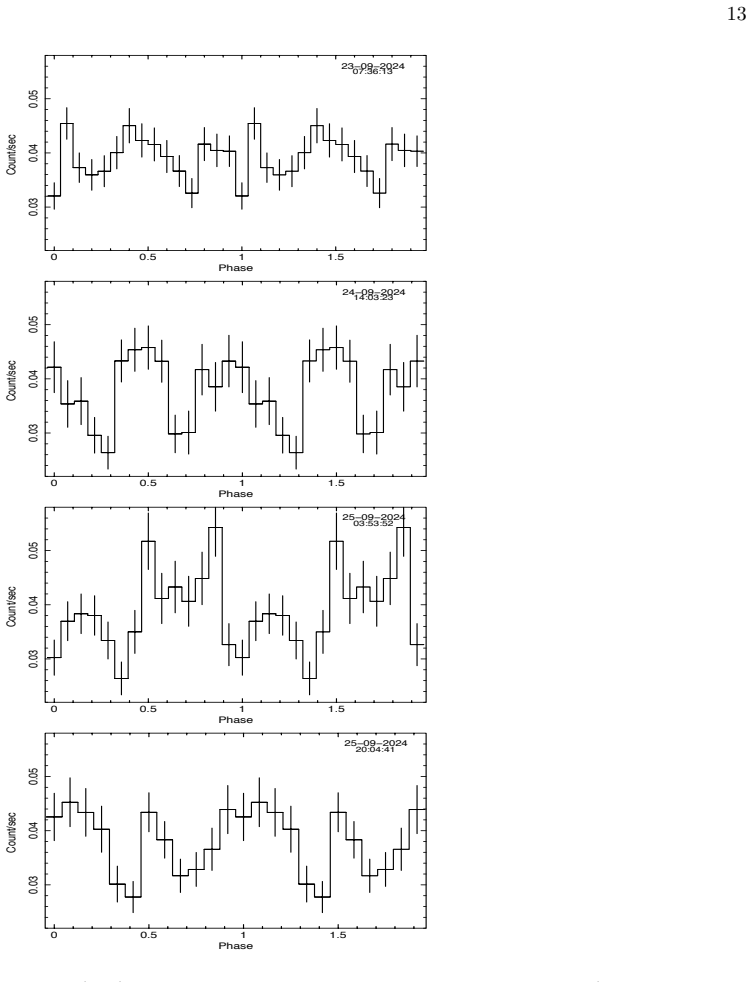
- Orbital-phase dipping and veiling of the X-rays require an additional warm absorber with log xi around 2.7-3.6.
- A power-law component above 10 keV is needed in joint ROSAT-Chandra-NuSTAR fits at >98 percent .
Where Pith is reading between the lines
- Similar line-ratio diagnostics could be applied to other hard-X-ray nova-likes to test how common advective flows are among them.
- If the nonequilibrium condition persists across multiple epochs, it would constrain the radial extent and stability of the hot flow.
- The combination of high-resolution grating data with broadband coverage may help separate contributions from the hot flow versus any boundary-layer or wind components.
Load-bearing premise
That the observed line ratios and spectral features arise exclusively from a single ADAF-like hot flow component without significant contributions from other regions, shocks, or model degeneracies in the VNEI and absorber fits.
What would settle it
A future high-resolution spectrum in which the H/He and R/G ratios match the values expected for collisional ionization equilibrium at the fitted temperatures (3-30 million K) would falsify the nonequilibrium ADAF claim.
Figures




read the original abstract
Nova-likes such as BZ Cam are high state Cataclysmic Variables showing hard X-ray emission that can be characterized with advective hot flows in the inner accretion disk. We explore Chandra High Energy Transmission Grating (HETG) observations of BZ~Cam for detailed line diagnosis and ionization conditions in the X-ray regime. We mostly find H- and He-like emission lines of Mg, Si, S, and Fe. All He-like line components of forbidden, intercombination and resonance lines are present. The R ratios of selected lines indicate plasma densities of a few $\times$10$^{12-14}$ cm$^{-3}$ and G ratios reveal temperatures (3-6)$\times$ 10$^6$ K where the Fe lines yield (1-3)$\times$ 10$^7$ K. The H to He line ratios and the R and G ratios show that the plasma is in a nonequilibrium ionization condition, which is consistent with our previous X-ray results and the accretion flow in the X-ray region being an ADAF-like (advective) hot flow. Simultaneous fits of the HEG and MEG spectra or the broadband joint spectra of ROSAT, Chandra zero order and NuSTAR yield temperatures 3.4-6.3 keV using a VNEI model of plasma emission (in XSPEC) or Bremsstrahlung emission. An additional power law is detected above 98\% Confidence Level in the broadband analysis. The orbital variations and the broadband spectra show dipping/veiling of the X-rays and an additional warm absorber model with an ionization parameter log($\xi$) = 2.7 is required at the 3$\sigma$ level, along with the VNEI model where the HEG and MEG simultaneous fits yield the log($\xi$) = 3.6 .
Editorial analysis
A structured set of objections, weighed in public.
Referee Report
Summary. The manuscript presents an analysis of Chandra HETG spectra of the nova-like cataclysmic variable BZ Cam. It reports detection of H- and He-like emission lines from Mg, Si, S, and Fe, derives plasma densities of a few ×10^{12-14} cm^{-3} from R ratios and temperatures of (3-6)×10^6 K (or higher for Fe) from G ratios, and concludes that H/He line ratios plus R and G ratios indicate nonequilibrium ionization consistent with an ADAF-like advective hot flow. Broadband joint fits with ROSAT, Chandra zero-order, and NuSTAR data using VNEI (or bremsstrahlung) plus power-law and warm-absorber components are also presented.
Significance. If the nonequilibrium ionization diagnosis is shown to be required by the data rather than model-dependent, the work would supply useful high-resolution line diagnostics for plasma conditions in the X-ray emitting region of a high-state CV, adding to prior X-ray studies of advective flows and providing concrete density and temperature constraints.
major comments (2)
- [Spectral fitting and line-ratio analysis] The central claim that the observed H/He, R, and G line ratios demonstrate nonequilibrium ionization (and thereby support an ADAF-like flow) rests on VNEI modeling of the HEG/MEG spectra. No control fits with a collisional ionization equilibrium model such as APEC are shown to establish that CIE models cannot reproduce the line strengths, ratios, or overall spectrum at comparable χ². Without this null test, the NEI conclusion is not uniquely supported and could reflect model choice or unaccounted multi-component contributions (including the required warm absorber with log ξ ~2.7–3.6).
- [Discussion and interpretation of ADAF-like flow] The interpretation that the line ratios arise exclusively from a single ADAF-like hot flow is not fully justified. The broadband fits require an additional power-law component (detected above 98% CL) and a warm absorber, yet the paper does not quantify possible contributions from other regions, shocks, or model degeneracies to the extracted line ratios.
minor comments (1)
- [Abstract and results] Notation for the ionization parameter should be standardized (e.g., consistent use of log ξ or log(xi) with proper LaTeX rendering); temperatures are reported in both K and keV without explicit conversion in all instances.
Simulated Author's Rebuttal
We thank the referee for the constructive and detailed comments, which have helped us improve the clarity and robustness of our analysis. We address each major comment point by point below. Where appropriate, we have revised the manuscript to incorporate additional model comparisons and expanded discussion.
read point-by-point responses
-
Referee: [Spectral fitting and line-ratio analysis] The central claim that the observed H/He, R, and G line ratios demonstrate nonequilibrium ionization (and thereby support an ADAF-like flow) rests on VNEI modeling of the HEG/MEG spectra. No control fits with a collisional ionization equilibrium model such as APEC are shown to establish that CIE models cannot reproduce the line strengths, ratios, or overall spectrum at comparable χ². Without this null test, the NEI conclusion is not uniquely supported and could reflect model choice or unaccounted multi-component contributions (including the required warm absorber with log ξ ~2.7–3.6).
Authors: We agree that a direct comparison with a CIE model such as APEC was not included in the original submission and that this would strengthen the case for nonequilibrium ionization. In the revised manuscript we have added simultaneous fits to the HEG and MEG spectra using the APEC model (with the same warm-absorber component) and compare the resulting χ² values, residuals, and predicted H/He, R, and G ratios against the VNEI results. The VNEI model yields a statistically significant improvement (Δχ² ≈ 25 for the same number of degrees of freedom) and reproduces the observed line ratios more closely, particularly the elevated H/He ratios that are difficult to match under CIE assumptions at the derived temperatures. We also explicitly discuss the possible influence of the warm absorber on the extracted line fluxes and show that the NEI diagnosis remains robust after accounting for it. revision: yes
-
Referee: [Discussion and interpretation of ADAF-like flow] The interpretation that the line ratios arise exclusively from a single ADAF-like hot flow is not fully justified. The broadband fits require an additional power-law component (detected above 98% CL) and a warm absorber, yet the paper does not quantify possible contributions from other regions, shocks, or model degeneracies to the extracted line ratios.
Authors: The manuscript states that the derived plasma conditions are consistent with an ADAF-like advective hot flow rather than claiming that the emission arises exclusively from a single such flow. Nevertheless, we acknowledge that the broadband modeling includes a statistically significant power-law component and a warm absorber, and that possible contributions from these or other regions (e.g., shocks in the accretion stream) were not quantified in the original text. In the revised version we have expanded the discussion section to (i) estimate the maximum fractional contribution of the power-law component to the He-like line fluxes using the broadband spectral decomposition, (ii) note that the high-resolution HETG data isolate the thermal lines used for the R and G diagnostics, and (iii) discuss potential model degeneracies with the warm absorber. These additions clarify the limitations while preserving the conclusion that the observed line ratios are consistent with the advective-flow scenario. revision: partial
Circularity Check
No significant circularity; observational fitting and line-ratio diagnostics are independent of inputs
full rationale
The paper extracts H/He, R, and G line ratios directly from Chandra HETG spectra, fits them with standard XSPEC models (VNEI, bremsstrahlung, warm absorber), and interprets the resulting parameters as evidence for nonequilibrium ionization. No step defines a quantity in terms of itself, renames a fitted parameter as a prediction, or relies on a self-citation chain to establish the core result. The single phrase noting consistency with prior work is supplementary and does not carry the load of the NEI or ADAF conclusion, which rests on the current dataset and model fits.
Axiom & Free-Parameter Ledger
free parameters (3)
- plasma temperature from VNEI
- ionization parameter log(xi)
- density from R ratios
axioms (2)
- domain assumption He-like triplet line ratios (R and G) reliably indicate density and temperature in the observed plasma
- domain assumption VNEI model in XSPEC accurately describes the nonequilibrium ionization state of the hot flow
Reference graph
Works this paper leans on
-
[1]
Arnaud, K. A. 1996, in Astronomical Society of the Pacific Conference Series, Vol. 101, Astronomical Data Analysis Software and Systems V, ed. G. H. Jacoby & J. Barnes, 17
1996
-
[2]
2020, Advances in Space Research, 66, 1097, doi: 10.1016/j.asr.2020.05.031
Balman, S ¸. 2020, Advances in Space Research, 66, 1097, doi: 10.1016/j.asr.2020.05.031
-
[3]
Balman, S ¸., Godon, P., & Sion, E. M. 2014, ApJ, 794, 84, doi: 10.1088/0004-637X/794/1/84 20
-
[4]
Balman, S ¸., Godon, P., Sion, E. M., et al. 2011, ApJ, 741, 84, doi: 10.1088/0004-637X/741/2/84
-
[5]
Balman, S ¸., Orio, M., & Luna, G. J. M. 2025, Universe, 11, 105, doi: 10.3390/universe11040105
-
[6]
Balman, S ¸., Schlegel, E. M., & Godon, P. 2022, ApJ, 932, 33, doi: 10.3847/1538-4357/ac6616
-
[7]
Balman, S ¸., Schlegel, E. M., Godon, P., & Drake, J. J. 2024, ApJ, 977, 136, doi: 10.3847/1538-4357/ad85e5
-
[8]
Bautista, M. A., & Kallman, T. R. 2000, ApJ, 544, 581, doi: 10.1086/317206
-
[9]
Canizares, C. R., Davis, J. E., Dewey, D., et al. 2005, PASP, 117, 1144, doi: 10.1086/432898
-
[10]
Datta, S. R., Dhang, P., & Mishra, B. 2021, ApJ, 918, 87, doi: 10.3847/1538-4357/ac0e9e
-
[11]
U., Mineshige, S., & Nucita, A
Dobrotka, A., Ness, J. U., Mineshige, S., & Nucita, A. A. 2017, MNRAS, 468, 1183, doi: 10.1093/mnras/stx513
-
[12]
2007, A&A Rv, 15, 1, doi: 10.1007/s00159-007-0006-1
Done, C., Gierli´ nski, M., & Kubota, A. 2007, A&A Rv, 15, 1, doi: 10.1007/s00159-007-0006-1
-
[13]
Observatory Operations: Strategies, Processes, and Systems , year = 2006, editor =
Fruscione, A., McDowell, J. C., Allen, G. E., et al. 2006, in Society of Photo-Optical Instrumentation Engineers (SPIE) Conference Series, Vol. 6270, Observatory Operations: Strategies, Processes, and Systems, ed. D. R. Silva & R. E. Doxsey, 62701V, doi: 10.1117/12.671760
-
[14]
Gabriel, A. H., & Jordan, C. 1969, MNRAS, 145, 241, doi: 10.1093/mnras/145.2.241
-
[15]
Garmire, G. P., Bautz, M. W., Ford, P. G., Nousek, J. A., & Ricker, Jr., G. R. 2003, in Society of Photo-Optical Instrumentation Engineers (SPIE) Conference Series, Vol. 4851, X-Ray and Gamma-Ray Telescopes and Instruments for Astronomy., ed. J. E. Truemper & H. D. Tananbaum, 28–44, doi: 10.1117/12.461599
-
[16]
2024, A&A, 681, A83, doi: 10.1051/0004-6361/202244014
Gilmozzi, R., & Selvelli, P. 2024, A&A, 681, A83, doi: 10.1051/0004-6361/202244014
-
[17]
1995, MNRAS, 275, 1093, doi: 10.1093/mnras/275.4.1093
Godon, P., Regev, O., & Shaviv, G. 1995, MNRAS, 275, 1093, doi: 10.1093/mnras/275.4.1093
-
[18]
Godon, P., Sion, E. M., Balman, S ¸., & Blair, W. P. 2017, ApJ, 846, 52, doi: 10.3847/1538-4357/aa7f71
-
[19]
Griffith, D., Fabian, D., & Sion, E. M. 1995, PASP, 107, 856, doi: 10.1086/133633
-
[20]
2015, A&A, 579, A54, doi: 10.1051/0004-6361/201526005
Hertfelder, M., & Kley, W. 2015, A&A, 579, A54, doi: 10.1051/0004-6361/201526005
-
[21]
2017, A&A, 605, A24, doi: 10.1051/0004-6361/201730847
Hertfelder, M., & Kley, W. 2017, A&A, 605, A24, doi: 10.1051/0004-6361/201730847
-
[22]
Honeycutt, R. K., Kafka, S., & Robertson, J. W. 2013, AJ, 145, 45, doi: 10.1088/0004-6256/145/2/45
-
[23]
Hubeny, I., & Long, K. S. 2021, MNRAS, 503, 5534, doi: 10.1093/mnras/stab830
-
[24]
P., Mitschang, A., Dewey, D., et al
Huenemoerder, D. P., Mitschang, A., Dewey, D., et al. 2011, AJ, 141, 129, doi: 10.1088/0004-6256/141/4/129
-
[25]
Kafka, S., & Honeycutt, R. K. 2004, AJ, 128, 2420, doi: 10.1086/424618
-
[26]
1987, A&A, 181, 373
Krautter, J., Klaas, U., & Radons, G. 1987, A&A, 181, 373
1987
-
[27]
2006, X-rays from cataclysmic variables, Vol
Kuulkers, E., Norton, A., Schwope, A., & Warner, B. 2006, X-rays from cataclysmic variables, Vol. 39 (Cambridge University Press, UK), 421–460
2006
-
[28]
2010, ApJ, 719, 271, doi: 10.1088/0004-637X/719/1/271
Szkody, P. 2010, ApJ, 719, 271, doi: 10.1088/0004-637X/719/1/271
-
[29]
Xie, G. Z. 1999, ApJL, 527, L17, doi: 10.1086/312383
-
[30]
Long, K. S., & Knigge, C. 2002, ApJ, 579, 725, doi: 10.1086/342879
-
[31]
Lynden-Bell, D., & Pringle, J. E. 1974, MNRAS, 168, 603, doi: 10.1093/mnras/168.3.603
-
[32]
Mauche, C. W., & Mukai, K. 2002, ApJL, 566, L33, doi: 10.1086/339454
-
[33]
Mayer, M., & Pringle, J. E. 2007, MNRAS, 376, 435, doi: 10.1111/j.1365-2966.2007.11448.x
-
[34]
Narayan, R., & McClintock, J. E. 2008, NewAR, 51, 733, doi: 10.1016/j.newar.2008.03.002
-
[35]
1993, Nature, 362, 820, doi: 10.1038/362820a0
Narayan, R., & Popham, R. 1993, Nature, 362, 820, doi: 10.1038/362820a0
-
[36]
Pradhan, A. K. 2009, MNRAS, 394, 742, doi: 10.1111/j.1365-2966.2008.14248.x
-
[37]
Oelgoetz, J., & Pradhan, A. K. 2001, MNRAS, 327, L42, doi: 10.1046/j.1365-8711.2001.04980.x
-
[38]
Oelgoetz, J., & Pradhan, A. K. 2004, MNRAS, 354, 1093, doi: 10.1111/j.1365-2966.2004.08269.x
-
[39]
Page, K. L., Osborne, J. P., Beardmore, A. P., et al. 2014, A&A, 570, A37, doi: 10.1051/0004-6361/201424777
-
[40]
Pandel, D., C´ ordova, F. A., Mason, K. O., & Priedhorsky, W. C. 2005, ApJ, 626, 396, doi: 10.1086/429983
-
[41]
Patterson, J., Patino, R., Thorstensen, J. R., et al. 1996, AJ, 111, 2422, doi: 10.1086/117976
-
[42]
Popham, R. 1999, MNRAS, 308, 979, doi: 10.1046/j.1365-8711.1999.02782.x
-
[43]
1995, ApJ, 442, 337, doi: 10.1086/175444
Popham, R., & Narayan, R. 1995, ApJ, 442, 337, doi: 10.1086/175444
-
[44]
2000, A&AS, 143, 495, doi: 10.1051/aas:2000192
Porquet, D., & Dubau, J. 2000, A&AS, 143, 495, doi: 10.1051/aas:2000192
-
[45]
Wood, J. H. 2004, MNRAS, 348, L49, doi: 10.1111/j.1365-2966.2004.07574.x
-
[46]
Puebla, R. E., Diaz, M. P., & Hubeny, I. 2007, AJ, 134, 1923, doi: 10.1086/522112 R´ o˙ za´ nska, A., & Czerny, B. 2000, A&A, 360, 1170, doi: 10.48550/arXiv.astro-ph/0004158 21
-
[47]
Schlegel, E. M., Shipley, H. V., Rana, V. R., Barrett, P. E., & Singh, K. P. 2014, ApJ, 797, 38, doi: 10.1088/0004-637X/797/1/38
-
[48]
I., & Sunyaev, R
Shakura, N. I., & Sunyaev, R. A. 1973, A&A, 500, 33
1973
-
[49]
Sion, E. M. 1985, ApJ, 292, 601, doi: 10.1086/163192
-
[50]
Smith, R. K., & Hughes, J. P. 2010, ApJ, 718, 583, doi: 10.1088/0004-637X/718/1/583
-
[51]
2014, A&A, 571, A55, doi: 10.1051/0004-6361/201423724
Suleimanov, V., Hertfelder, M., Werner, K., & Kley, W. 2014, A&A, 571, A55, doi: 10.1051/0004-6361/201423724
-
[52]
Tappert, C., Vogt, N., Ederoclite, A., et al. 2020, A&A, 641, A122, doi: 10.1051/0004-6361/202037913 van Teeseling, A., Beuermann, K., & Verbunt, F. 1996, A&A, 315, 467
-
[53]
1995, Cambridge Astrophysics Series, 28
Warner, B. 1995, Cambridge Astrophysics Series, 28
1995
-
[54]
C., Brinkman, B., Canizares, C., et al
Weisskopf, M. C., Brinkman, B., Canizares, C., et al. 2002, PASP, 114, 1, doi: 10.1086/338108
-
[55]
Willingale, R., Starling, R. L. C., Beardmore, A. P., Tanvir, N. R., & O’Brien, P. T. 2013, MNRAS, 431, 394, doi: 10.1093/mnras/stt175
-
[56]
2000, The Astrophysical Journal, 542, 914, doi: 10.1086/317016
Wilms, J., Allen, A., & McCray, R. 2000, ApJ, 542, 914, doi: 10.1086/317016
work page internal anchor Pith review doi:10.1086/317016 2000
-
[57]
Hot Accretion Flows Around Black Holes
Yuan, F., & Narayan, R. 2014, ARA&A, 52, 529, doi: 10.1146/annurev-astro-082812-141003
work page Pith review doi:10.1146/annurev-astro-082812-141003 2014
-
[58]
2014, MNRAS, 445, 869, doi: 10.1093/mnras/stu1783
Zemko, P., Orio, M., Mukai, K., & Shugarov, S. 2014, MNRAS, 445, 869, doi: 10.1093/mnras/stu1783
discussion (0)
Sign in with ORCID, Apple, or X to comment. Anyone can read and Pith papers without signing in.