Recognition: unknown
Analysis of Log-Weighted Quadrature Domains
Pith reviewed 2026-05-10 16:36 UTC · model grok-4.3
The pith
A domain is a log-weighted quadrature domain if and only if the outer factor of its Riemann map is the exponential of a rational function, in the simply connected case.
A machine-rendered reading of the paper's core claim, the machinery that carries it, and where it could break.
Core claim
In the simply connected case, a domain is an LQD if and only if the outer factor of its Riemann map extends to the exponential of a rational function. This characterization yields explicit formulae relating the quadrature function and the Riemann map via the Faber transform, thereby extending earlier formulae from the non-singular theory.
What carries the argument
the outer factor of the Riemann map together with its extension to the exponential of a rational function, which supplies the if-and-only-if test and the explicit quadrature-map relations through the Faber transform
If this is right
- A generalized Schwarz function characterization holds for these domains with the singular weight.
- The inverse problem for recovering the domain from quadrature data admits a natural formulation in the singular setting.
- Basic families of LQDs can be constructed and computed explicitly from rational functions.
- Classical formulae relating quadrature data to Riemann maps extend directly to the log-weighted case.
Where Pith is reading between the lines
- Choosing different rational functions could systematically generate families of domains with prescribed quadrature behavior.
- The non-uniqueness resolved by a point charge may suggest similar adjustments when adapting the theory to domains with interior holes.
- The explicit formulae might be used to test numerical methods that approximate domains from quadrature measurements.
Load-bearing premise
The domain is simply connected and the logarithmic singularity at the origin is absorbed into an undetermined point charge.
What would settle it
A simply connected domain whose Riemann map outer factor is not the exponential of any rational function yet still obeys the log-weighted quadrature identity.
Figures



read the original abstract
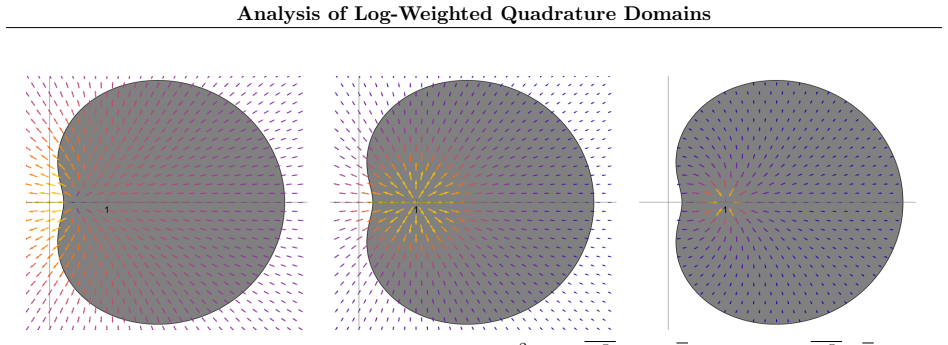
This paper studies plane domains satisfying a quadrature identity with respect to the singular weight $\rho_0(w)=|w|^{-2}$. These are referred to as log-weighted quadrature domains (LQDs). The logarithmic singularity at $w=0$ leads to phenomena not present in the classical theory: in particular, when the domain contains the origin, the associated quadrature data are no longer unique, but are determined only up to a point charge at $0$. A generalized Schwarz function characterization of LQDs is established together with a natural formulation of the inverse problem in the singular setting. In the simply connected case, it is shown that a domain is an LQD if and only if the outer factor of its Riemann map extends to the exponential of a rational function. This characterization yields explicit formulae relating the quadrature function and the Riemann map via the Faber transform, thereby extending earlier formulae from the non-singular theory. Several basic classes of LQDs are also covered, and explicit examples are computed.
Editorial analysis
A structured set of objections, weighed in public.
Referee Report
Summary. The paper studies log-weighted quadrature domains (LQDs) satisfying a quadrature identity with the singular weight ρ₀(w) = |w|^{-2}. It establishes a generalized Schwarz-function characterization of LQDs, formulates the associated inverse problem, and proves that in the simply connected case a domain is an LQD if and only if the outer factor of its Riemann map extends to the exponential of a rational function. This yields explicit formulae relating the quadrature function to the Riemann map via the Faber transform (extending the non-singular theory), together with explicit computations for several basic classes of LQDs. The non-uniqueness of quadrature data up to a point charge at the origin (when 0 lies inside the domain) is explicitly noted.
Significance. If the central characterization holds, the work provides a clean extension of classical quadrature-domain theory to a singular logarithmic weight, supplying both an if-and-only-if criterion in the simply connected setting and concrete Faber-transform formulae that permit explicit construction. The explicit examples and the careful treatment of the point-charge ambiguity constitute concrete strengths that make the results immediately usable for further analytic or computational work in potential theory.
minor comments (2)
- The transition from the generalized Schwarz-function characterization to the Riemann-map criterion (in the simply connected case) would benefit from an explicit display of the outer-factor expression immediately before the statement of the if-and-only-if theorem, to make the rational-function condition easier to verify by the reader.
- In the section presenting the explicit formulae via the Faber transform, the dependence on the undetermined point charge at the origin should be written out in one displayed equation so that the non-uniqueness is visible at a glance rather than only described in prose.
Simulated Author's Rebuttal
We thank the referee for the positive and detailed summary of our manuscript on log-weighted quadrature domains, as well as for the recommendation of minor revision. The report does not contain any enumerated major comments or specific criticisms, so there are no individual points requiring a point-by-point response. We remain ready to incorporate any minor editorial or technical adjustments that may be suggested outside the major-comments section.
Circularity Check
No significant circularity; derivation relies on standard complex-analytic machinery
full rationale
The central result is an if-and-only-if characterization of simply-connected LQDs via the outer factor of the Riemann map being the exponential of a rational function, together with explicit Faber-transform formulae. This is derived from a generalized Schwarz-function identity that is stated as established for the singular weight. The argument extends prior non-singular theory but does not reduce the new claim to a self-referential definition, a fitted parameter renamed as a prediction, or a load-bearing self-citation chain. All steps remain independent of the target statement and rest on classical Riemann-mapping and Faber-polynomial constructions.
Axiom & Free-Parameter Ledger
axioms (1)
- standard math Existence and basic properties of Riemann maps and Faber transforms for simply connected domains.
Reference graph
Works this paper leans on
-
[1]
Makarov.Quadrature Domains and the Faber Transform
Andrew Graven and Nikolai G. Makarov.Quadrature Domains and the Faber Transform. 2025. arXiv: 2509.03777 [math.CV].url:https://arxiv.org/abs/2509.03777
- [2]
-
[3]
Bj¨ orn Gustafsson and Yu-Lin Lin.Non-univalent solutions of the Polubarinova-Galin equation. 2014. doi:10.48550/ARXIV.1411.1909.url:https://arxiv.org/abs/1411.1909
work page doi:10.48550/arxiv.1411.1909.url:https://arxiv.org/abs/1411.1909 2014
-
[4]
Domains on which analytic functions satisfy quadrature identities
D. Aharonov and H.S. Shapiro. “Domains on which analytic functions satisfy quadrature identities”. In:Journal d’Analyse Math´ ematique30 (1976), pp. 39–73
1976
-
[5]
Topology of quadrature domains
Seung-Yeop Lee and Nikolai Makarov. “Topology of quadrature domains”. In:Journal of the American Mathematical Society29.2 (May 2015), pp. 333–369.doi:10.1090/jams828.url:https://doi.org/ 10.1090%2Fjams828
-
[6]
Davis.The Schwarz Function and its Applications
Philip J. Davis.The Schwarz Function and its Applications. Mathematical Association of America, 1974.doi:10.5948/9781614440178
-
[7]
Regularity of a boundary having a Schwarz function
Makoto Sakai. “Regularity of a boundary having a Schwarz function”. In:Acta Mathematica166 (1991). issn: 1871-2509.doi:https://doi.org/10.1007/BF02398888
-
[8]
Why the boundary of a round drop becomes a curve of order four
Varchenko A.N and Etingof P.I. “Why the boundary of a round drop becomes a curve of order four”. In: vol. 3. American Mathematical Society, 1992
1992
-
[9]
Steven Bell.The Cauchy Transform, Potential Theory and Conformal Mapping, 2nd Edition. CRC Press, Nov. 2015, pp. 1–207.isbn: 9780429162893.doi:10.1201/b19222
-
[10]
Makoto Sakai. “Null quadrature domains”. In:Journal d’Analyse Mathematique40 (1981).issn: 1565- 8538.doi:https://doi.org/10.1007/BF02790159
-
[11]
Javad Mashreghi.Derivatives of Inner Functions. Vol. 31. Feb. 2013.isbn: 978-1-4614-5611-7.doi: 10.1007/978-1-4614-5611-7
-
[12]
Constructing Multiply Connected Quadrature Domains
Darren Crowdy and Jonathan Marshall. “Constructing Multiply Connected Quadrature Domains”. In: SIAM Journal on Applied Mathematics64.4 (2004), pp. 1334–1359.doi:10.1137/S0036139903438545. eprint:https : / / doi . org / 10 . 1137 / S0036139903438545.url:https : / / doi . org / 10 . 1137 / S0036139903438545
-
[13]
John Wiley & Sons, 1986
Peter Henrici.Applied And Computational Complex Analysis. John Wiley & Sons, 1986
1986
- [14]
-
[15]
On the Faber Transform and Efficient Numerical Rational Approximation
S. W. Ellacott. “On the Faber Transform and Efficient Numerical Rational Approximation”. In:SIAM Journal on Numerical Analysis20.5 (1983), pp. 989–1000.issn: 00361429.url:http://www.jstor. org/stable/2157112(visited on 04/11/2026)
-
[16]
The Faber Transform and Analytic Continuation
Elgin Johnston. “The Faber Transform and Analytic Continuation”. In:Proceedings of the American Mathematical Society103.1 (1988), pp. 237–243.issn: 00029939, 10886826.url:http://www.jstor. org/stable/2047558(visited on 04/11/2026)
-
[17]
The faber operator
J. M. Anderson. “The faber operator”. In:Rational Approximation and Interpolation. Ed. by Peter Russell Graves-Morris, Edward B. Saff, and Richard S. Varga. Berlin, Heidelberg: Springer Berlin Heidelberg, 1984, pp. 1–10.isbn: 978-3-540-39113-5. 31 Analysis of Log-Weighted Quadrature Domains 8 Appendix 1: The Cauchy Projection and the Faber Transform 8.1 T...
1984
-
[18]
Iffis analytic on∂Ω, 3 then •C Ωf∈ A(Ω), •C Ω∗ f∈ A 0(Ω∗), •f˙ =CΩf+C Ω∗ f
-
[19]
Iff∈ A(Ω), thenC Ωf=fandC Ω∗ f= 0
-
[20]
Iff∈ A 0(Ω∗), thenC Ω∗ f=fandC Ωf= 0
-
[21]
Iff∈ M(Ω) and extends continuously to∂Ω, thenC Ω∗ f∈Rat 0(Ω)
-
[22]
analytic part
Iff∈ M(Ω ∗) and extends continuously to∂Ω, thenC Ωf∈Rat(Ω ∗). The analogous results hold for unbounded Ω. Proof of Lemma 8.1. (1) Follows immediately from the Sokhotski-Plemelj theorem (see e.g. [13], Theorem 14.1c). (2-3) Follow from the Cauchy integral formula and the identity theorem. (4) Follows from the principal part decomposition off:f=r+G, wherer∈...
discussion (0)
Sign in with ORCID, Apple, or X to comment. Anyone can read and Pith papers without signing in.