Recognition: unknown
NexusAI: Enabling Design Space Exploration of Ideas through Cognitive Abstraction and Functional Decomposition
Pith reviewed 2026-05-10 16:01 UTC · model grok-4.3
The pith
NexusAI decomposes LLM-generated ideas into functional fragments to expand design space exploration and reduce fixation.
A machine-rendered reading of the paper's core claim, the machinery that carries it, and where it could break.
Core claim
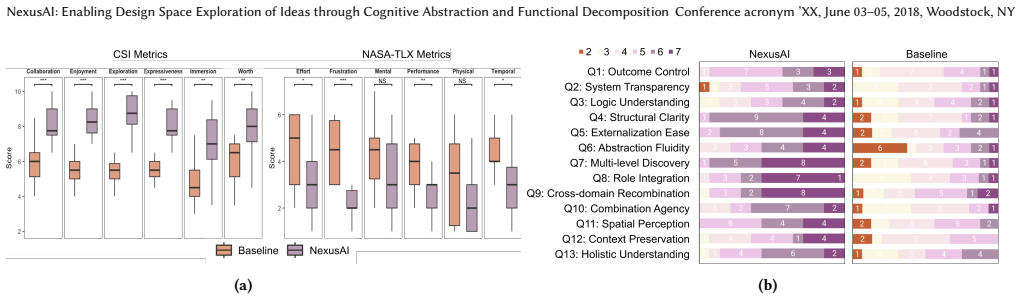
The central claim is that Cognitive Abstraction transforms unstructured LLM inspiration into a navigable design space by decomposing ideas into typed functional fragments, enabling multi-level abstraction to externalize mental scaling and cross-dimensional recombination to generate novel directions; this is supported by a within-subject user study (N=14) showing statistically significant improvements in design space exploration, reduced cognitive overhead, and perspective reframing relative to a baseline interface.
What carries the argument
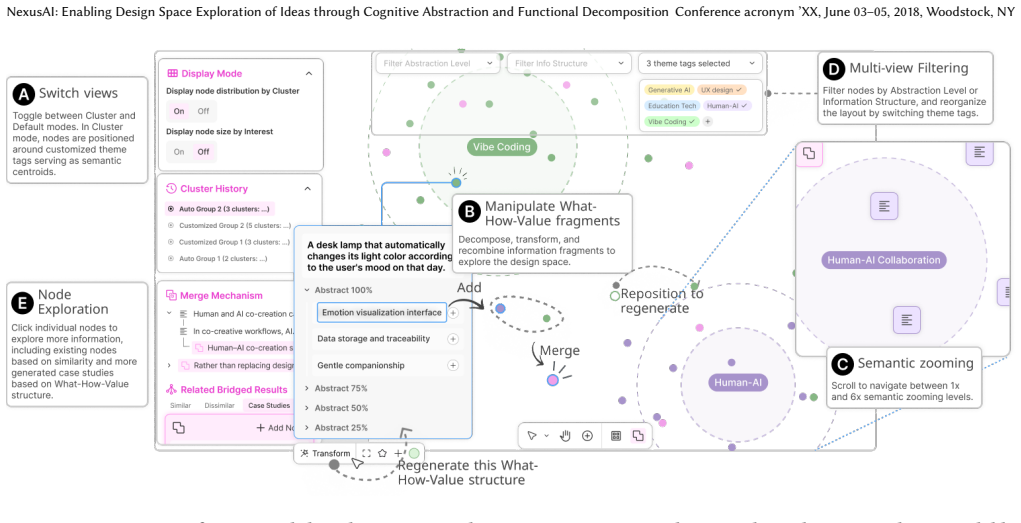
Cognitive Abstraction (CA) pipeline, which decomposes raw LLM inspiration into typed functional fragments that support abstraction and recombination.
If this is right
- Compositional opacity in LLM outputs limits effective human-AI co-creation.
- Structured multi-level representations mitigate fixation during creative tasks.
- The CA pipeline operationalizes cognitive primitives such as decomposition and recombination at scale.
- Diagramming tools built on functional fragments enable measurable gains in divergent exploration.
Where Pith is reading between the lines
- The same decomposition approach could be tested in non-design creative domains such as narrative writing or engineering concept generation.
- Integration with future LLM interfaces might reduce the need for separate diagramming steps.
- Repeated use could train users to apply similar mental decomposition even without the tool.
Load-bearing premise
The pipeline accurately externalizes human mental scaling and recombination without introducing new fixation or distorting original idea content.
What would settle it
A controlled replication in which participants using NexusAI generate no more design variants and report equivalent or higher fixation than users of unstructured LLM text would falsify the central effectiveness claim.
Figures





read the original abstract
Large Language Models (LLMs) offer vast potential for creative ideation; however, their standard interaction paradigm often produces unstructured textual outputs that lead users to prematurely converge on sub-optimal ideas-a phenomenon known as fixation. While recent creativity tools have begun to structure these outputs, they remain compositionally opaque: ideas are organized as monolithic units that cannot be decomposed, abstracted, or recombinable at a sub-idea level. To address this, we propose Cognitive Abstraction (CA), a computational pipeline that transforms raw LLM-generated inspiration into a navigable and transformable design space. We implement this pipeline in NexusAI, a prototype diagramming system that supports (I) decomposition of inspiration into typed functional fragments, (II) multi-level abstraction to externalize mental scaling, and (III) cross-dimensional recombination to spark novel design directions. A within-subject user study (N=14) demonstrates that NexusAI significantly improves design space exploration, reduces cognitive overhead, and facilitates perspective reframing compared to a baseline. Our work contributes: (1) a characterization of "compositional opacity" as a barrier in human-AI co-creation; (2) the CA pipeline for operationalizing creative cognitive primitives at scale; and (3) empirical evidence that structured, multi-level representations can effectively mitigate fixation and support divergent exploration.
Editorial analysis
A structured set of objections, weighed in public.
Referee Report
Summary. The manuscript introduces NexusAI, a diagramming system implementing a Cognitive Abstraction (CA) pipeline that converts unstructured LLM-generated ideas into a navigable design space via (I) decomposition into typed functional fragments, (II) multi-level abstraction to externalize mental scaling, and (III) cross-dimensional recombination. It characterizes 'compositional opacity' as a barrier in human-AI co-creation and reports a within-subject user study (N=14) claiming that NexusAI significantly improves design space exploration, reduces cognitive overhead, and facilitates perspective reframing relative to a baseline.
Significance. If the empirical claims hold after proper reporting, the work would contribute a useful operationalization of creative cognitive primitives for LLM-assisted ideation and empirical evidence that structured multi-level representations can mitigate fixation. This could inform future creativity support tools in HCI. The small N and absent methodological details, however, limit current significance and generalizability.
major comments (3)
- User Study section: the central claim of 'significant improvements' rests on a within-subject study (N=14) but supplies no operational definitions, measurement instruments (e.g., NASA-TLX, idea-counting protocols, reframing scales), statistical tests, effect sizes, error bars, exclusion criteria, or raw data. This prevents evaluation of whether directional trends exceed noise or order effects.
- User Study section: no description is provided of the baseline interface, counterbalancing procedure, or how the within-subject design controlled for learning effects, making it impossible to isolate the contribution of the CA pipeline.
- Cognitive Abstraction Pipeline and User Study: the paper asserts that the pipeline mitigates fixation without introducing new forms or loss of fidelity, yet the study reports no fidelity measures or introduced-fixation checks, leaving the weakest assumption untested.
Simulated Author's Rebuttal
We thank the referee for their constructive comments, which help strengthen the reporting of our user study. We address each major comment below and commit to revisions that provide the necessary methodological details.
read point-by-point responses
-
Referee: User Study section: the central claim of 'significant improvements' rests on a within-subject study (N=14) but supplies no operational definitions, measurement instruments (e.g., NASA-TLX, idea-counting protocols, reframing scales), statistical tests, effect sizes, error bars, exclusion criteria, or raw data. This prevents evaluation of whether directional trends exceed noise or order effects.
Authors: We agree that the manuscript currently omits detailed descriptions of the measurement instruments and statistical reporting. In the revised manuscript, we will provide operational definitions: design space exploration will be measured by the number of unique ideas generated and their diversity (via semantic similarity clustering); cognitive overhead via a modified NASA-TLX scale; and perspective reframing through thematic analysis of think-aloud protocols and post-task interviews. We will report the specific statistical tests (paired t-tests for normally distributed data, with Shapiro-Wilk tests for normality), effect sizes, confidence intervals, and include error bars on all relevant figures. Exclusion criteria (e.g., incomplete sessions) and raw anonymized data will be provided in an open repository. This addresses the concern about distinguishing signal from noise. revision: yes
-
Referee: User Study section: no description is provided of the baseline interface, counterbalancing procedure, or how the within-subject design controlled for learning effects, making it impossible to isolate the contribution of the CA pipeline.
Authors: The current version does not fully describe these aspects. We will revise the User Study section to detail the baseline as a standard chat-based LLM interface without the decomposition, abstraction, or recombination features of NexusAI. The within-subject design incorporated counterbalancing of condition order and a break between tasks to control for learning effects. We will also add analysis of potential order effects and discuss them in the limitations. This will better isolate the effects of the CA pipeline. revision: yes
-
Referee: Cognitive Abstraction Pipeline and User Study: the paper asserts that the pipeline mitigates fixation without introducing new forms or loss of fidelity, yet the study reports no fidelity measures or introduced-fixation checks, leaving the weakest assumption untested.
Authors: We acknowledge this as a valid point; the study did not include explicit quantitative measures for fidelity or checks for introduced fixation. While participant feedback indicated that the functional fragments retained the essence of original ideas and no new fixation was reported, we did not collect similarity ratings or fixation metrics. In the revision, we will incorporate a fidelity assessment (e.g., participant ratings of idea preservation on a Likert scale) and a check for introduced fixation via comparison of idea novelty pre- and post-use. We will also clarify in the discussion that while the pipeline is designed to avoid these issues through typed decomposition, empirical validation was limited and will be expanded. revision: partial
Circularity Check
No circularity: empirical system evaluation stands independently
full rationale
The paper proposes a Cognitive Abstraction pipeline implemented in NexusAI and supports its claims via a within-subject user study (N=14). No equations, derivations, fitted parameters, or predictions appear in the abstract or described structure. Claims of improved exploration and reduced overhead rest on the study results rather than reducing to self-definitions, self-citations, or ansatzes. The derivation chain is therefore self-contained with no load-bearing steps that collapse to inputs by construction.
Axiom & Free-Parameter Ledger
Reference graph
Works this paper leans on
-
[1]
1977.A Pattern Language: Towns, Buildings, Construction
Christopher Alexander, Sara Ishikawa, and Murray Silverstein. 1977.A Pattern Language: Towns, Buildings, Construction. Oxford University Press, New York. http://www.amazon.fr/exec/obidos/ASIN/0195019199/citeulike04-21
-
[2]
Alan Baddeley. 2003. Working memory: Looking back and looking forward. Nature Reviews Neuroscience4, 10 (2003), 829–839. doi:10.1038/nrn1201
-
[3]
Michel Beaudouin-Lafon and Wendy E. Mackay. 2007. Prototyping Tools and Techniques. InThe Human-Computer Interaction Handbook. CRC Press, 1043–1066. https://www.kth.se/social/upload/52ef5ee4f2765445a466a28a/ mackaylafon-prototypes-52-HCI.pdf
2007
-
[4]
Michael Mose Biskjaer, Peter Dalsgaard, and Kim Halskov. 2014. A Constraint- Based Understanding of Design Spaces. InProceedings of the 2014 Conference on Designing Interactive Systems. 453–462. doi:10.1145/2598510.2598533
-
[5]
Margaret A. Boden. 1991.The creative mind: myths and mechanisms. Basic Books, Inc., USA
1991
-
[6]
Angie Boggust, Hyemin Bang, Hendrik Strobelt, and Arvind Satyanarayan. 2025. Abstraction Alignment: Comparing Model-Learned and Human-Encoded Concep- tual Relationships. InProceedings of the 2025 CHI Conference on Human Factors in Computing Systems. ACM, Yokohama Japan, 1–20. doi:10.1145/3706598.3713406
-
[7]
Virginia Braun and Victoria Clarke. 2006. Using thematic analy- sis in psychology.Qualitative Research in Psychology3, 2 (2006), 77–101. arXiv:https://doi.org/10.1191/1478088706qp063oa doi:10.1191/ 1478088706qp063oa
-
[8]
William Buxton. 1995. CHUNKING AND PHRASING AND THE DESIGN OF HUMAN-COMPUTER DIALOGUES. InReadings in Human–Computer Interaction. Elsevier, 494–499. doi:10.1016/B978-0-08-051574-8.50051-0
-
[9]
Card, Jock D
Stuart K. Card, Jock D. Mackinlay, and Ben Shneiderman (Eds.). 1999.Readings in information visualization: using vision to think. Morgan Kaufmann Publishers Inc., San Francisco, CA, USA
1999
-
[10]
Joel Chan, Katherine K. Fu, Christian D. Schunn, Jonathan Cagan, Kristin L. Wood, and Kenneth Kotovsky. 2011. On the Benefits and Pitfalls of Analogies for Innovative Design: Ideation Performance Based on Analogical Distance, Com- monness, and Modality of Examples.Journal of Mechanical Design133, 8 (2011), 081004. doi:10.1115/1.4004396
-
[11]
Pei Chen, Jiayi Yao, Zhuoyi Cheng, Yichen Cai, Jiayang Li, Weitao You, and Lingyun Sun. 2025. CoExploreDS: Framing and Advancing Collaborative Design Space Exploration Between Human and AI. InProceedings of the 2025 CHI Con- ference on Human Factors in Computing Systems. ACM, Yokohama Japan, 1–20. doi:10.1145/3706598.3713869 TLDR: CoExploreDS is a system ...
-
[12]
Erin Cherry and Celine Latulipe. 2014. Quantifying the Creativity Support of Digital Tools through the Creativity Support Index.ACM Transactions on Computer-Human Interaction21, 4 (Aug. 2014), 1–25. doi:10.1145/2617588
-
[13]
InProceedings of the 2019 CHI Conference on Human Factors in Computing Systems (CHI ’19)
Lydia B. Chilton, Savvas Petridis, and Maneesh Agrawala. 2019. VisiBlends: A Flexible Workflow for Visual Blends. InProceedings of the 2019 CHI Conference on Human Factors in Computing Systems(Glasgow, Scotland Uk)(CHI ’19). Associa- tion for Computing Machinery, New York, NY, USA, 1–14. doi:10.1145/3290605. 3300402
-
[14]
John Joon Young Chung and Eytan Adar. 2023. Artinter: AI-powered Boundary Objects for Commissioning Visual Arts. InProceedings of the 2023 ACM Designing Interactive Systems Conference(Pittsburgh, PA, USA)(DIS ’23). Association for Computing Machinery, New York, NY, USA, 1997–2018. doi:10.1145/3563657. 3595961
-
[15]
John Joon Young Chung and Max Kreminski. 2024. Patchview: LLM-powered Worldbuilding with Generative Dust and Magnet Visualization. InProceedings of the 37th Annual ACM Symposium on User Interface Software and Technology. ACM, Pittsburgh PA USA, 1–19. doi:10.1145/3654777.3676352
-
[16]
2014.Basics of qualitative research: Techniques and procedures for developing grounded theory
Juliet Corbin and Anselm Strauss. 2014.Basics of qualitative research: Techniques and procedures for developing grounded theory. Sage publications
2014
-
[17]
Nigel Cross. 2004. Expertise in Design: An Overview.Design Studies25, 5 (2004), 427–441. doi:10.1016/j.destud.2004.06.002
-
[18]
Kees Dorst. 2011. The core of ‘design thinking’ and its application.Design Studies 32, 6 (Nov. 2011), 521–532. doi:10.1016/j.destud.2011.07.006
-
[19]
Graham Dove, Kim Halskov, Jodi Forlizzi, and John Zimmerman. 2017. UX Design Innovation: Challenges for Working with Machine Learning as a Design Material. InProceedings of the 2017 CHI Conference on Human Factors in Computing Systems (Denver, Colorado, USA)(CHI ’17). Association for Computing Machinery, New York, NY, USA, 278–288. doi:10.1145/3025453.3025739
-
[20]
Graham Dove, Nicolai Brodersen Hansen, and Kim Halskov. 2016. An Argument for Design Space Reflection. InProceedings of the 9th Nordic Conference on Human- Computer Interaction (NordiCHI ’16). ACM, 1–10. doi:10.1145/2971485.2971528
-
[21]
Dow, Alana Glassco, Jonathan Kass, Melissa Schwarz, Daniel L
Steven P. Dow, Alana Glassco, Jonathan Kass, Melissa Schwarz, Daniel L. Schwartz, and Scott R. Klemmer. 2011. Parallel prototyping leads to better design results, more divergence, and increased self-efficacy.ACM Trans. Comput.-Hum. Interact.17, 4, Article 18 (Dec. 2011), 24 pages. doi:10.1145/1879831.1879836
-
[22]
Karin Ericsson and Herbert A. Simon. 1980. Verbal reports as data.Psychological Review87 (1980), 215–251. https://api.semanticscholar.org/CorpusID:144763091
1980
-
[23]
Katherine Fu, Joel Chan, Jonathan Cagan, Kenneth Kotovsky, Christian Schunn, and Kristin Wood. 2012. The Meaning of “Near” and “Far”: The Impact of Struc- turing Design Databases and the Effect of Distance of Analogy on Design Output. InVolume 7: 9th International Conference on Design Education; 24th International Conference on Design Theory and Methodolo...
-
[24]
Dedre Gentner and Arthur B. Markman. 1997. Structure Mapping in Analogy and Similarity.American Psychologist52, 1 (1997), 45–56. doi:10.1037/0003- 066X.52.1.45
-
[25]
Dedre Gentner and Arthur B. Markman. 1998. Structure Mapping in Analogy and Similarity. InMind Readings: Introductory Selections on Cog- nitive Science. The MIT Press. arXiv:https://direct.mit.edu/book/chapter- pdf/2429452/9780262315906_caf.pdf doi:10.7551/mitpress/4631.003.0008
-
[26]
John S Gero. 1990. Design prototypes: a knowledge representation schema for design.AI magazine11, 4 (1990), 26–26
1990
-
[27]
John S Gero and Udo Kannengiesser. 2004. The situated function–behaviour– structure framework.Design studies25, 4 (2004), 373–391
2004
-
[28]
Vinod Goel. 1995.Sketches of Thought. MIT Press. doi:10.7551/mitpress/6270. 001.0001
-
[29]
Kim Halskov and Caroline Lundqvist. 2021. Filtering and Informing the Design Space: Towards Design-Space Thinking.ACM Transactions on Computer-Human Interaction (TOCHI)28, 1 (2021), 1–28. doi:10.1145/3434462
-
[30]
2007.The Design Space: The Design Process as the Construction, Exploration and Expansion of a Conceptual Space
Chris Heape. 2007.The Design Space: The Design Process as the Construction, Exploration and Expansion of a Conceptual Space. Ph. D. Dissertation. Open University
2007
-
[31]
Matt-Heun Hong, Lauren A. Marsh, Jessica L. Feuston, Janet Ruppert, Jed R. Brubaker, and Danielle Albers Szafir. 2022. Scholastic: Graphical Human-AI Collaboration for Inductive and Interpretive Text Analysis. InProceedings of the 35th Annual ACM Symposium on User Interface Software and Technology. ACM, Bend OR USA, 1–12. doi:10.1145/3526113.3545681
-
[32]
Tom Hope, Ronen Tamari, Daniel Hershcovich, Hyeonsu B Kang, Joel Chan, Aniket Kittur, and Dafna Shahaf. 2022. Scaling Creative Inspiration with Fine- Grained Functional Aspects of Ideas. InCHI Conference on Human Factors in Computing Systems. ACM, New Orleans LA USA, 1–15. doi:10.1145/3491102. 3517434 TLDR: A novel representation that automatically breaks...
-
[33]
Hsiu-Fang Hsieh and Sarah E. Shannon. 2005. Three approaches to qualitative content analysis.Qualitative Health Research15, 9 (2005), 1277–1288
2005
-
[34]
David G. Jansson and Steven M. Smith. 1991. Design Fixation.Design Studies12, 1 (1991), 3–11. doi:10.1016/0142-694X(91)90003-F
-
[35]
Youngseung Jeon, Seungwan Jin, Patrick C. Shih, and Kyungsik Han. 2021. Fash- ionQ: An AI-Driven Creativity Support Tool for Facilitating Ideation in Fashion Design. InProceedings of the 2021 CHI Conference on Human Factors in Computing Systems(Yokohama, Japan)(CHI ’21). Association for Computing Machinery, New York, NY, USA, Article 576, 18 pages. doi:10...
-
[36]
Peiling Jiang, Jude Rayan, Steven P. Dow, and Haijun Xia. 2023. Graphologue: Exploring Large Language Model Responses with Interactive Diagrams. InPro- ceedings of the 36th Annual ACM Symposium on User Interface Software and Technology. ACM, San Francisco CA USA, 1–20. doi:10.1145/3586183.3606737
-
[37]
Brigitte Jordan and Austin Henderson. 1995. Interaction Analysis: Foundations and Practice.Journal of the Learning Sciences4, 1 (1995), 39–103. doi:10.1207/ s15327809jls040_2
1995
-
[38]
Daye Kang, Zhuolun Han, Jiahe Tian, Muhan Zhang, and Jeffrey M Rzeszotarski
-
[39]
ThemeViz: Understanding the Effect of Human-AI Collaboration in Theme Development with an LLM-enhanced Interactive Visual System.Proceedings of the ACM on Human-Computer Interaction9, 7 (Oct. 2025), 1–29. doi:10.1145/3757675
-
[40]
Michelle S. Lam, Janice Teoh, James A. Landay, Jeffrey Heer, and Michael S. Bernstein. 2024. Concept Induction: Analyzing Unstructured Text with High- Level Concepts Using LLooM. InProceedings of the CHI Conference on Human Factors in Computing Systems. ACM, Honolulu HI USA, 1–28. doi:10.1145/3613904. 3642830
-
[41]
Barbara Liskov and John V. Guttag. 1986.Abstraction and Specification in Program Development(2 ed.). Vol. 20. MIT Press, Cambridge, MA
1986
-
[42]
Barbara Liskov and John V. Guttag. 1986.Abstraction and Specification in Program Development. The MIT Press
1986
-
[43]
Michael Xieyang Liu, Tongshuang Wu, Tianying Chen, Franklin Mingzhe Li, Aniket Kittur, and Brad A Myers. 2024. Selenite: Scaffolding Online Sensemak- ing with Comprehensive Overviews Elicited from Large Language Models. In Proceedings of the CHI Conference on Human Factors in Computing Systems. ACM, Honolulu HI USA, 1–26. doi:10.1145/3613904.3642149
-
[44]
James Derek Lomas, Mihovil Karac, and Mathieu Gielen. 2021. Design Space Cards: Using a Card Deck to Navigate the Design Space of Interactive Play. Proceedings of the ACM on Human-Computer Interaction5, CHI PLAY (2021), 1–21. doi:10.1145/3474654
-
[45]
Allan MacLean, Richard Young, Victoria Bellotti, and Thomas Moran. 1991. De- sign Space Analysis: Bridging from Theory to Practice via Design Rationale. In Proceedings of Esprit. doi:10.1016/0142-694X(94)90026-4
-
[46]
Stephen MacNeil, Zijian Ding, Kexin Quan, Ziheng Huang, Kenneth Chen, and Steven P. Dow. 2021. ProbMap: Automatically Constructing Design Galleries through Feature Extraction and Semantic Clustering. InAdjunct Proceedings of the 34th Annual ACM Symposium on User Interface Software and Technology. ACM, Virtual Event USA, 134–136. doi:10.1145/3474349.3480203
-
[47]
Stephen MacNeil, Johanna Okerlund, and Celine Latulipe. 2017. Dimensional Reasoning and Research Design Spaces. InProceedings of the 2017 ACM SIGCHI Conference on Creativity and Cognition. ACM, Singapore Singapore, 367–379. doi:10.1145/3059454.3059472
-
[48]
George A Miller. 1956. The Magical Number Seven, Plus or Minus Two: Some Limits on Our Capacity for Processing Information. (1956). Issue 63. http: //psychclassics.yorku.ca/Miller/
1956
-
[49]
Diana P. Moreno, Luciënne T. Blessing, Maria C. Yang, Alberto A. Hernández, and Kristin L. Wood. 2016. Overcoming Design Fixation: Design by Analogy Studies and Nonintuitive Findings.Artificial Intelligence for Engineering Design, Analysis and Manufacturing30, 2 (May 2016), 185–199. doi:10.1017/S0890060416000068
-
[50]
Confidence in Assurance 2.0 Cases
Diana P. Moreno, Maria C. Yang, Alberto A. Hernández, Julie S. Linsey, and Kristin L. Wood. 2015. A Step Beyond to Overcome Design Fixation: A Design-by- Analogy Approach. InDesign Computing and Cognition ’14, John S. Gero and Sean Hanna (Eds.). Springer International Publishing, Cham, 607–624. doi:10.1007/978- 3-319-14956-1_34
-
[51]
Srishti Palani, Zijian Ding, Austin Nguyen, Andrew Chuang, Stephen MacNeil, and Steven P. Dow. 2021. CoNotate: Suggesting Queries Based on Notes Promotes Knowledge Discovery. InProceedings of the 2021 CHI Conference on Human Factors in Computing Systems (Chi ’21). Association for Computing Machinery, Yokohama, Japan and New York, NY, USA, Article 726. doi...
-
[52]
Florian Perteneder, Martin Bresler, Eva-Maria Grossauer, Joanne Leong, and Michael Haller. 2015. cLuster: Smart Clustering of Free-Hand Sketches on Large Interactive Surfaces. InProceedings of the 28th Annual ACM Symposium on User Interface Software & Technology. ACM, Charlotte NC USA, 37–46. doi:10.1145/ 2807442.2807455
-
[53]
Savvas Petridis, Nicholas Diakopoulos, Kevin Crowston, Mark Hansen, Keren Henderson, Stan Jastrzebski, Jeffrey V Nickerson, and Lydia B Chilton. 2023. AngleKindling: Supporting Journalistic Angle Ideation with Large Language Models. InProceedings of the 2023 CHI Conference on Human Factors in Computing Systems(Hamburg, Germany)(CHI ’23). Association for C...
-
[54]
Savvas Petridis, Benjamin D Wedin, James Wexler, Mahima Pushkarna, Aaron Donsbach, Nitesh Goyal, Carrie J Cai, and Michael Terry. 2024. Constitution- Maker: Interactively Critiquing Large Language Models by Converting Feedback into Principles. InProceedings of the 29th International Conference on Intelligent User Interfaces(Greenville, SC, USA)(IUI ’24). ...
-
[55]
Mary Shaw. 2011. The Role of Design Spaces.IEEE Software29, 1 (2011), 46–50. doi:10.1109/MS.2011.121
-
[56]
Hanshu Shen, Lyukesheng Shen, Wenqi Wu, and Kejun Zhang. 2025. Ideation- Web: Tracking the Evolution of Design Ideas in Human-AI Co-Creation. In Proceedings of the 2025 CHI Conference on Human Factors in Computing Systems. ACM, Yokohama Japan, 1–19. doi:10.1145/3706598.3713375 TLDR: A human-AI co-ideation framework aimed at tracking the evolution of desig...
-
[57]
Herbert A. Simon. 1991.The Architecture of Complexity. Springer US, Boston, MA, 457–476. doi:10.1007/978-1-4899-0718-9_31
-
[58]
Hariharan Subramonyam, Jane Im, Colleen Seifert, and Eytan Adar. 2022. Solving Separation-of-Concerns Problems in Collaborative Design of Human-AI Systems through Leaky Abstractions. InCHI Conference on Human Factors in Computing Systems. ACM, New Orleans LA USA, 1–21. doi:10.1145/3491102.3517537
-
[59]
Sangho Suh, Meng Chen, Bryan Min, Toby Jia-Jun Li, and Haijun Xia. 2024. Luminate: Structured Generation and Exploration of Design Space with Large Language Models for Human-AI Co-Creation. InProceedings of the CHI Conference on Human Factors in Computing Systems. ACM, Honolulu HI USA, 1–26. doi:10. 1145/3613904.3642400 TLDR: This work proposes a framewor...
-
[60]
Pollock, Ian Arawjo, Rubaiat Habib Kazi, Hariharan Subramonyam, Jingyi Li, Nazmus Saquib, and Arvind Satyanarayan
Sangho Suh, Hai Dang, Ryan Yen, Josh M. Pollock, Ian Arawjo, Rubaiat Habib Kazi, Hariharan Subramonyam, Jingyi Li, Nazmus Saquib, and Arvind Satyanarayan
-
[61]
InAdjunct Proceedings of the 37th Annual ACM Symposium on User Interface Software and Technology
Dynamic Abstractions: Building the Next Generation of Cognitive Tools and Interfaces. InThe 37th Annual ACM Symposium on User Interface Software and Technology. ACM, Pittsburgh PA USA, 1–3. doi:10.1145/3672539.3686706
-
[62]
Sangho Suh, Bryan Min, Srishti Palani, and Haijun Xia. 2023. Sensecape: En- abling Multilevel Exploration and Sensemaking with Large Language Models. In Proceedings of the 36th Annual ACM Symposium on User Interface Software and Technology. ACM, San Francisco CA USA, 1–18. doi:10.1145/3586183.3606756
-
[63]
Leong-Hwee Teo, Bonnie John, and Marilyn Blackmon. 2012. CogTool-Explorer: a model of goal-directed user exploration that considers information layout. In Proceedings of the SIGCHI Conference on Human Factors in Computing Systems (Austin, Texas, USA)(CHI ’12). Association for Computing Machinery, New York, NY, USA, 2479–2488. doi:10.1145/2207676.2208414
- [64]
-
[65]
Penglei Wang, Ziming Quan, Danyang Wu, and Jin Xu. 2025. Cluster-Aware Contrastive Multi-View Clustering Based on Masked Views. InProceedings of the 33rd ACM International Conference on Multimedia. ACM, Dublin Ireland, 5942–5950. doi:10.1145/3746027.3754834
-
[66]
Sitong Wang, Savvas Petridis, Taeahn Kwon, Xiaojuan Ma, and Lydia B Chilton
-
[67]
PopBlends: Strategies for Conceptual Blending with Large Language Models. InProceedings of the 2023 CHI Conference on Human Factors in Computing Systems (Hamburg, Germany)(CHI ’23). Association for Computing Machinery, New York, NY, USA, Article 435, 19 pages. doi:10.1145/3544548.3580948
-
[68]
Nayuko Watanabe, Motoi Washida, and Takeo Igarashi. 2007. Bubble Clusters: An Interface for Manipulating Spatial Aggregation of Graphical Objects. InProceed- ings of the 20th Annual ACM Symposium on User Interface Software and Technology. ACM, Newport Rhode Island USA, 173–182. doi:10.1145/1294211.1294241
-
[69]
Bo Westerlund. 2005. Design Space Conceptual Tool–Grasping the Design Process. Nordes1 (2005). doi:10.21606/nordes.2005.048
- [70]
-
[71]
Nickerson, Barbara Tversky, James E
Doris Zahner, Jeffrey V. Nickerson, Barbara Tversky, James E. Corter, and Jing Ma. 2010. A Fix for Fixation? Rerepresenting and Abstracting as Cre- ative Processes in the Design of Information Systems. 24, 2 (2010), 231–244. doi:10.1017/S0890060410000077
-
[72]
Chao Zhang, Kexin Ju, Zhuolun Han, Yu-Chun Grace Yen, and Jeffrey M. Rzeszotarski. 2025. Synthia: Visually Interpreting and Synthesizing Feedback for Writing Revision. InProceedings of the 38th Annual ACM Symposium on User Interface Software and Technology. ACM, Busan Republic of Korea, 1–16. doi:10.1145/3746059.3747703 TLDR: Synthia, a system that visual...
-
[73]
Lau, Jose Echevarria, and Zoya Bylinskii
Nanxuan Zhao, Nam Wook Kim, Laura Mariah Herman, Hanspeter Pfister, Rynson W.H. Lau, Jose Echevarria, and Zoya Bylinskii. 2020. ICONATE: Au- tomatic Compound Icon Generation and Ideation. InProceedings of the 2020 CHI Conference on Human Factors in Computing Systems(Honolulu, HI, USA) (CHI ’20). Association for Computing Machinery, New York, NY, USA, 1–13...
-
[74]
Chengbo Zheng, Yuanhao Zhang, Zeyu Huang, Chuhan Shi, Minrui Xu, and Xiaojuan Ma. 2024. DiscipLink: Unfolding Interdisciplinary Information Seeking Process via Human-AI Co-Exploration. InProceedings of the 37th Annual ACM Symposium on User Interface Software and Technology. ACM, Pittsburgh PA USA, 1–20. doi:10.1145/3654777.3676366 A Formative Study A.1 Pa...
-
[80]
Abstraction Levels: - level = 25 (Fact): Verifiable concrete situations, behaviors, or observable data
implicit value judgments or evaluation criteria Structural Guidance: Use the shared What-How-Value definitions and the shared few-shot pool only as structural guidance for role interpretation and cross-level abstraction. Abstraction Levels: - level = 25 (Fact): Verifiable concrete situations, behaviors, or observable data. - level = 50 (Insight): Recurrin...
-
[81]
Each content must be a short phrase of 12--20 characters
-
[82]
empower,
Avoid generic expressions such as "empower," "innovation platform," "improve efficiency," or "intelligent system."
-
[83]
The what / how / value entries within the same level must remain tightly coupled
-
[84]
level": 25,
Do not introduce goals or domains that are absent from the raw input. Output Format: Return only a JSON array. The array length must be exactly 12. Each object must follow the format: { "level": 25, "pillar": "what", "title": "...", "content": "..." } Level must be one of 25, 50, 75, or 100. Pillar must be one of what, how, or value. Title must be a short...
2018
-
[85]
core objects or concepts
discussion (0)
Sign in with ORCID, Apple, or X to comment. Anyone can read and Pith papers without signing in.