Recognition: unknown
Kinetic models of opinion-driven epidemic dynamics modulated by graphons
Pith reviewed 2026-05-10 16:05 UTC · model grok-4.3
The pith
Kinetic models with graphon opinion dynamics prove convergence to equilibrium and show a reproduction analog whose oscillations generate epidemic waves without external forcing.
A machine-rendered reading of the paper's core claim, the machinery that carries it, and where it could break.
Core claim
We introduce kinetic models to simulate epidemic spread while accounting for individuals' opinions on protective behaviors. Opinion exchanges occur on a social network represented by a graphon, leading to scenarios with or without opinion leaders. We prove convergence to equilibrium in the strong L1 norm via relative entropy methods and in homogeneous Sobolev spaces dot H^{-s}, s in (1/2,1), using Fourier-based techniques. We then design a structure-preserving scheme for the coupled opinion-epidemiological system, highlighting graphon effects: opinion leaders supporting protective behaviors limit disease spread, whereas influenceable individuals may shift toward opposing views, worsening the
What carries the argument
The graphon-modulated kinetic system that couples opinion exchange with epidemiological compartments, together with the time-dependent reproduction-number analog whose oscillations drive waves.
If this is right
- Opinion leaders favoring protective behaviors reduce overall disease spread through the graphon-mediated network.
- Individuals who are easily influenced can shift toward opposing protective views and thereby increase epidemic severity.
- The numerical scheme preserves key structural properties and accurately reproduces graphon-driven effects in simulations.
- Solutions converge strongly in L1 and in dot H^{-s} for s in (1/2,1), independent of the specific graphon shape under the model's assumptions.
Where Pith is reading between the lines
- Targeted messaging aimed at a small set of opinion leaders on real networks approximated by graphons could measurably slow epidemic growth.
- Recurrent waves arising purely from internal opinion feedback imply that seasonal external drivers are not always required to explain multi-wave outbreaks.
- Replacing the abstract graphon with empirical adjacency data from contact-tracing studies would test whether specific network motifs amplify or suppress the observed oscillations.
Load-bearing premise
The coupled kinetic system admits the stated equilibria and is well-posed under the chosen graphon modulation and opinion-exchange rules.
What would settle it
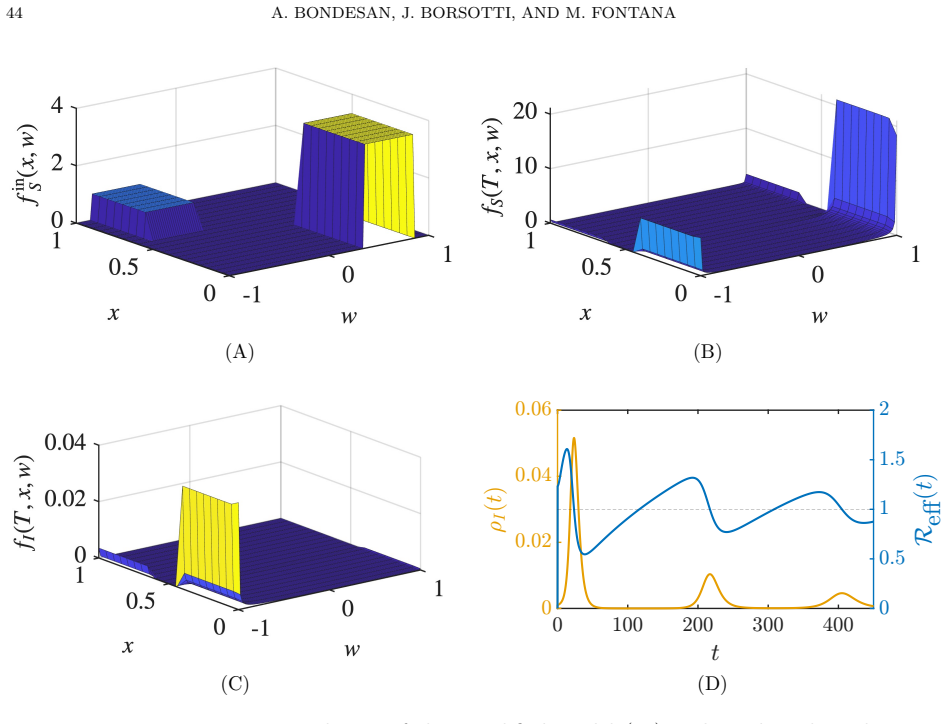
Running the structure-preserving scheme on a fixed graphon with constant parameters and no external forcing, then checking whether epidemic waves appear precisely when the time-dependent reproduction analog oscillates.
Figures






read the original abstract
We introduce kinetic models to simulate epidemic spread while accounting for individuals' opinions on protective behaviors. Opinion exchanges occur on a social network represented by a graphon, leading to scenarios with or without opinion leaders. We prove convergence to equilibrium in the strong $L^1$ norm via relative entropy methods and in homogeneous Sobolev spaces $\dot{H}^{-s}$, $s \in \big(\frac{1}{2},1\big)$, using Fourier-based techniques. We then design a structure-preserving scheme for the coupled opinion-epidemiological system, highlighting graphon effects: opinion leaders supporting protective behaviors limit disease spread, whereas influenceable individuals may shift toward opposing views, worsening epidemics. Finally, we introduce a time-dependent quantity, analogous to the reproduction number, whose oscillations can generate epidemic waves without explicit external forcing. The MATLAB code implementing our algorithms is made publicly available.
Editorial analysis
A structured set of objections, weighed in public.
Referee Report
Summary. The manuscript introduces kinetic models coupling opinion dynamics on graphons with epidemic spread, accounting for protective behaviors and opinion leaders. It proves strong L1 convergence to equilibrium via relative entropy methods and convergence in homogeneous Sobolev spaces dot H^{-s} (s in (1/2,1)) via Fourier techniques. A structure-preserving numerical scheme is developed for the coupled system, with numerical illustrations of graphon effects on disease spread. Finally, a time-dependent quantity analogous to the reproduction number is introduced, whose oscillations are claimed to generate epidemic waves without external forcing. Public MATLAB code is provided.
Significance. If the convergence results hold with appropriate regularity, the framework connects kinetic theory, graphon networks, and epidemiology in a novel way, offering mechanistic insight into how opinion leaders and network structure modulate epidemics. The structure-preserving scheme and open code support reproducibility and potential extensions. The oscillating reproduction-number analog, if rigorously tied to the dynamics, could explain endogenous waves, though its impact depends on precise justification.
major comments (2)
- [Well-posedness and convergence sections (around the statements of Theorems on L1 and dot H^{-s} convergence)] The relative entropy dissipation for L1 convergence and the Fourier multiplier estimates for dot H^{-s} convergence both require the system to be globally well-posed with equilibria whose stability can be quantified. The manuscript does not explicitly list the functional assumptions on the graphon (e.g., measurability and L^infty boundedness on [0,1]^2) or the opinion-exchange kernel (e.g., Lipschitz continuity or boundedness) needed to close these estimates; without them the central convergence claims cannot be verified.
- [Section introducing the time-dependent reproduction-number analog and the associated numerical experiments] The time-dependent quantity introduced as analogous to the reproduction number is used to argue that oscillations can produce epidemic waves without external forcing. It is not shown to be derived from the linearization around the disease-free equilibrium or to control the growth rate via a precise threshold relation; if it remains phenomenological, the claim that it generates waves rests on numerical observation rather than analysis.
minor comments (3)
- [Model formulation] Notation for the graphon-modulated interaction terms and the opinion variable should be introduced with explicit functional forms early in the model section to aid readability.
- [Numerical scheme] The structure-preserving properties of the numerical scheme (positivity, conservation) are asserted but would benefit from a short theorem or explicit verification in the scheme section.
- [Numerical results] Figure captions should specify the graphon choices (e.g., constant vs. leader-dominated) and parameter values used in each panel for reproducibility.
Simulated Author's Rebuttal
We thank the referee for their careful reading of the manuscript and for the constructive comments. We address each major comment point by point below.
read point-by-point responses
-
Referee: [Well-posedness and convergence sections (around the statements of Theorems on L1 and dot H^{-s} convergence)] The relative entropy dissipation for L1 convergence and the Fourier multiplier estimates for dot H^{-s} convergence both require the system to be globally well-posed with equilibria whose stability can be quantified. The manuscript does not explicitly list the functional assumptions on the graphon (e.g., measurability and L^infty boundedness on [0,1]^2) or the opinion-exchange kernel (e.g., Lipschitz continuity or boundedness) needed to close these estimates; without them the central convergence claims cannot be verified.
Authors: We agree that the functional assumptions must be stated explicitly to allow verification of the convergence results. In the revised manuscript we have added a new subsection 2.1 'Assumptions' that lists: the graphon W is measurable and essentially bounded in L^infty([0,1]^2), and the opinion-exchange kernel is Lipschitz continuous and bounded. These are the minimal conditions used throughout the proofs of global well-posedness and of the relative-entropy and Fourier-multiplier estimates in Theorems 3.1 and 3.2. A short well-posedness argument has also been included in the appendix. revision: yes
-
Referee: [Section introducing the time-dependent reproduction-number analog and the associated numerical experiments] The time-dependent quantity introduced as analogous to the reproduction number is used to argue that oscillations can produce epidemic waves without external forcing. It is not shown to be derived from the linearization around the disease-free equilibrium or to control the growth rate via a precise threshold relation; if it remains phenomenological, the claim that it generates waves rests on numerical observation rather than analysis.
Authors: We acknowledge that the time-dependent quantity is introduced as a direct analog to the classical reproduction number rather than being obtained from linearization around the disease-free equilibrium. Its oscillatory behavior and correlation with wave-like incidence are demonstrated numerically. In the revision we have added a clarifying remark in Section 5 stating that a rigorous threshold analysis via linearization is outside the present scope and left for future work. The numerical evidence, obtained with the structure-preserving scheme, still provides mechanistic insight into endogenous wave generation. revision: partial
Circularity Check
No circularity: standard analytical proofs and model introduction are independent of conclusions.
full rationale
The paper introduces a coupled kinetic system for opinion-epidemic dynamics on graphons, proves strong L1 convergence via relative entropy dissipation and dot H^{-s} convergence via Fourier multipliers, designs a structure-preserving numerical scheme, and defines a time-dependent reproduction-number analog whose oscillations produce waves. These steps rely on external mathematical techniques (entropy methods, Fourier analysis) applied to the stated system; no equation reduces to a prior fitted parameter or self-referential definition, no load-bearing self-citation chain appears, and the new quantity is explicitly introduced rather than derived from data fits. The derivation chain is self-contained against the paper's own assumptions and standard PDE tools.
Axiom & Free-Parameter Ledger
axioms (2)
- domain assumption Opinion exchanges occur on a social network represented by a graphon
- domain assumption The coupled opinion-epidemiological system admits equilibria reachable via relative entropy and Fourier methods
Reference graph
Works this paper leans on
-
[1]
Ahmad, M
M.D. Ahmad, M. Usman, A. Khan, and M. Imran. Optimal control analysis of Ebola disease with con- trol strategies of quarantine and vaccination.Infect. Dis. Poverty, 5(1):72, 2016.https://doi.org/10.1186/ s40249-016-0161-6
2016
-
[2]
G. Albi, E. Calzola, G. Dimarco, and M. Zanella. Impact of opinion formation phenomena in epidemic dy- namics: kinetic modeling on networks.SIAM J. Appl. Math., 85(2):779–805, 2025.https://doi.org/10.1137/ 24M1696901
2025
-
[3]
V. Andreasen. The effect of age-dependent host mortality on the dynamics of an endemic disease.Math. Biosci., 114(1):29–58, 1993.https://doi.org/10.1016/0025-5564(93)90041-8
-
[4]
F. Auricchio, G. Toscani, and M. Zanella. Trends to equilibrium for a nonlocal Fokker–Planck equation.Appl. Math. Lett., 145:108746, 2023.https://doi.org/10.1016/j.aml.2023.108746
-
[5]
L. Bolzoni, E. Bonacini, R. Della Marca, and M. Groppi. Optimal control of epidemic size and duration with limited resources.Math. Biosci., 315:108232, 2019.https://doi.org/10.1016/j.mbs.2019.108232
-
[6]
L. Bolzoni, E. Bonacini, C. Soresina, and M. Groppi. Time-optimal control strategies in SIR epidemic models. Math. Biosci., 292:86–96, 2017.https://doi.org/10.1016/j.mbs.2017.07.011
-
[7]
A. Bondesan and J. Borsotti. Control strategies and trends to equilibrium for kinetic models of opinion dynamics driven by social activity.arXiv:2506.07840, 2025.https://doi.org/10.48550/arXiv.2506.07840
-
[8]
A. Bondesan, J. Borsotti, and M. Fontana. MATLAB code for kinetic SIR models on graphons.https://doi. org/10.5281/zenodo.19500724, 2026. Last access: 11 April 2026
-
[9]
Bondesan, G
A. Bondesan, G. Toscani, and M. Zanella. Kinetic compartmental models driven by opinion dynamics: Vaccine hesitancy and social influence.Math. Mod. Meth. Appl. S., 34(6):1043–1076, 2024.https://doi.org/10.1142/ S0218202524400062
2024
-
[10]
C. Borgs, J.T. Chayes, H. Cohn, and Y. Zhao. AnL p theory of sparse graph convergence II: LD convergence, quotients and right convergence.Ann. Probab., 46(1):337–396, 2018.https://doi.org/10.1214/17-AOP1187. 52 A. BONDESAN, J. BORSOTTI, AND M. FONTANA
-
[11]
C. Borgs, J.T. Chayes, H. Cohn, and Y. Zhao. AnL p theory of sparse graph convergence I: Limits, sparse random graph models, and power law distributions.Trans. Amer. Math. Soc., 372(5):3019–3062, 2019.https: //doi.org/10.1090/tran/7543
-
[12]
J. Borsotti. An SIRS model with hospitalizations: Economic impact by disease severity.Chaos Solit. Fractals, 200:116951, 2025.https://doi.org/10.1016/j.chaos.2025.116951
-
[13]
E.E. Brandell, A.P. Dobson, P.J. Hudson, P.C. Cross, and D.W. Smith. A metapopulation model of social group dynamics and disease applied to Yellowstone wolves.Proc. Natl. Acad. Sci. USA, 118(10):2047–205656, 2021. https://doi.org/10.1073/pnas.2020023118
-
[14]
I. M. Bulai, M. Sensi, and S. Sottile. A geometric analysis of the SIRS compartmental model with fast information and misinformation spreading.Chaos Solit. Fractals, 185:115104, 2024.https://doi.org/10.1016/j.chaos. 2024.115104
-
[15]
Castillo-Chavez, D
C. Castillo-Chavez, D. Bichara, and B.R. Morin. Perspectives on the role of mobility, behavior, and time scales in the spread of diseases.Proc. Natl. Acad. Sci. USA, 113(51):14582–14588, 2016.https://doi.org/10.1073/ pnas.1604994113
2016
-
[16]
Cercignani.The Boltzmann equation and its applications, volume 67 ofApplied Mathematical Sciences
C. Cercignani.The Boltzmann equation and its applications, volume 67 ofApplied Mathematical Sciences. Springer-Verlag, New York, 1988.https://doi.org/10.1007/978-1-4612-1039-9
-
[17]
J. S. Chang and G. Cooper. A practical difference scheme for fokker–planck equations.J. Comput. Phys., 6(1):1– 16, 1970.https://doi.org/10.1016/0021-9991(70)90001-X
-
[18]
J. Chen, C. Xia, and M. Perc. The SIQRS propagation model with quarantine on simplicial complexes.IEEE T. Comput. Soc. Syst., 11(3):4267–4278, 2024.https://doi.org/10.1109/TCSS.2024.3351173
-
[19]
S. Cordier, L. Pareschi, and G. Toscani. On a kinetic model for a simple market economy.J. Stat. Phys., 120:253–277, 2005.https://doi.org/10.1007/s10955-005-5456-0
-
[20]
A model for mosquito-borne epidemic outbreaks with information-dependent protective behaviour
S. De Reggi, A. Pugliese, M. Sensi, and C. Soresina. A model for mosquito-borne epidemic outbreaks with information-dependent protective behaviour.arXiv:2511.16802, 2025.https://doi.org/10.48550/arXiv. 2511.16802
work page internal anchor Pith review Pith/arXiv arXiv doi:10.48550/arxiv 2025
-
[21]
R. Della Marca, A. d’Onofrio, M. Sensi, and S. Sottile. A geometric analysis of the impact of large but finite switching rates on vaccination evolutionary games.Nonlinear Anal. Real World Appl., 75:103986, 2024.https: //doi.org/10.1016/j.nonrwa.2023.103986
-
[22]
R. Della Marca, N. Loy, and A. Tosin. An SIR-like kinetic model tracking individuals’ viral load.Netw. Heterog. Media, 17(3):467–494, 2022.https://doi.org/10.3934/nhm.2022017
-
[23]
Diekmann and J
O. Diekmann and J. A. P. Heesterbeek.Mathematical epidemiology of infectious diseases. Wiley Series in Math- ematical and Computational Biology. John Wiley & Sons, Ltd., Chichester, 2000
2000
-
[24]
G. Dimarco, L. Pareschi, G. Toscani, and M. Zanella. Wealth distribution under the spread of infectious diseases. Phys. Rev. E, 102(2):022303, 2020.https://doi.org/10.1103/physreve.102.022303
-
[25]
G. Dimarco, B. Perthame, G. Toscani, and M. Zanella. Kinetic models for epidemic dynamics with social heterogeneity.J. Math. Biol., 83(4), 2021.https://doi.org/10.1007/s00285-021-01630-1
-
[26]
B. D¨ uring, J. Franceschi, M.-T. Wolfram, and M. Zanella. Breaking consensus in kinetic opinion formation models on graphons.J. Nonlinear Sci., 34(79), 2024.https://doi.org/10.1007/s00332-024-10060-4
-
[27]
J. Franceschi and N. Loy. Optimal control of a kinetic model describing social interactions on a graph.Phys. A: Stat. Mech. Appl., 682:131141, 2026.https://doi.org/10.1016/j.physa.2025.131141
-
[28]
Furioli, A
G. Furioli, A. Pulvirenti, E. Terraneo, and G. Toscani. Fokker-Planck equations in the modelling of socio- economic phenomena.Math. Models Methods Appl. Sci., 27(1):115–158, 2017.https://doi.org/10.1142/ S0218202517400048
2017
-
[29]
G. Furioli, A. Pulvirenti, E. Terraneo, and G. Toscani. Wright-Fisher-type equations for opinion formation, large time behavior and weighted logarithmic-Sobolev inequalities.Ann. Inst. H. Poincar´ e C Anal. Non Lin´ eaire, 36(7):2065–2082, 2019.https://doi.org/10.1016/j.anihpc.2019.07.005
-
[30]
G. Gaeta. A simple SIR model with a large set of asymptomatic infectives.Math. Eng., 3(2):1–39, 2021.https: //doi.org/10.3934/mine.2021013
-
[31]
Glasscock
D. Glasscock. What is . . . a graphon?Notices Amer. Math. Soc., 62(1):46–48, 2015.http://dx.doi.org/10. 1090/noti1204
2015
-
[32]
I. S. Gradshteyn and I. M. Ryzhik.Table of integrals, series, and products. Academic Press, Amsterdam, 2007
2007
-
[33]
S. Gualandi and G. Toscani. Pareto tails in socio-economic phenomena: a kinetic description.Economics, 12(1):20180031, 2018.https://doi.org/10.5018/economics-ejournal.ja.2018-31
-
[34]
Hegselmann and U
R. Hegselmann and U. Krause. Opinion dynamics and bounded confidence: models, analysis, and simulation.J. Artif. Soc. Soc. Simulat., 5(3):1–33, 2002.https://www.jasss.org/5/3/2.html
2002
-
[35]
A. Holmes, M. Tildesley, and L. Dyson. Approximating steady state distributions for household structured epidemic models.J. Theoret. Biol., 534:110974, 2022.https://doi.org/10.1016/j.jtbi.2021.110974. KINETIC EPIDEMIOLOGICAL MODELS ON GRAPHONS 53
-
[36]
H. Jard´ on-Kojakhmetov, C. Kuehn, A. Pugliese, and M. Sensi. A geometric analysis of the SIR, SIRS and SIRWS epidemiological models.Nonlinear Anal. Real World Appl., 58:103220, 2021.https://doi.org/10.1016/ j.nonrwa.2020.103220
-
[37]
Jard´ on-Kojakhmetov, C
H. Jard´ on-Kojakhmetov, C. Kuehn, A. Pugliese, and M. Sensi. A geometric analysis of the SIRS epi- demiological model on a homogeneous network.J. Math. Biol., 83(4):37, 2021.https://doi.org/10.1007/ s00285-021-01664-5
2021
-
[38]
P. Kaklamanos, A. Pugliese, M. Sensi, and S. Sottile. A geometric analysis of the SIRS model with secondary infections.SIAM J. Appl. Math., 84(2):661–686, 2024.https://doi.org/10.1137/23M1565632
-
[39]
A. Karaivanov, S.H. Lu, H. Shigeoka, C. Chen, and S. Pamplona. Face masks, public policies and slowing the spread of COVID-19: Evidence from Canada.J. Health Econ., 78:102475, 2021.https://doi.org/10.1016/j. jhealeco.2021.102475
work page doi:10.1016/j 2021
-
[40]
W.O. Kermack and A.G. McKendrick. A contribution to the mathematical theory of epidemics.Proc. Roy. Soc. London Ser. A, 115:700–721, 1927.https://doi.org/10.1098/rspa.1927.0118
-
[41]
T. Langmuir, N. Wilson, M. andMcCleary, A.M. Patey, K. Mekki, H. Ghazal, E. Estey Noad, J. Buchan, V. Dubey, J. Galley, E. Gibson, G. Fontaine, M. Smith, A. Alghamyan, K. Thompson, J. Crawshaw, J.M. Grimshaw, T. Arnason, J. Brehaut, S. Michie, M. Brouwers, and J. Presseau. Strategies and resources used by public health units to encourage COVID-19 vaccinat...
-
[42]
Lorenzi, A
T. Lorenzi, A. Pugliese, M. Sensi, and A. Zardini. Evolutionary dynamics in an SI epidemic model with phenotype-structured susceptible compartment.J. Math. Biol., 83(6-7), 2021.https://doi.org/10.1007/ s00285-021-01703-1
2021
-
[43]
N. Loy and M. Zanella. Structure preserving schemes for Fokker-Planck equations with nonconstant diffusion matrices.Math. Comput. Simulation, 188:342–362, 2021.https://doi.org/10.1016/j.matcom.2021.04.018
-
[44]
K. MacKenzie and S.C. Bishop. Developing stochastic epidemiological models to quantify the dynamics of in- fectious diseases in domestic livestock.J. Anim. Sci., 79(8):2047–2056, 2001.https://doi.org/10.2527/2001. 7982047x
-
[45]
G. Martal` o, G. Toscani, and M. Zanella. Individual-based foundation of SIR-type epidemic models: mean-field limit and large time behaviour.Proc. R. Soc. A, 482(2331):20250633, 2026.https://doi.org/10.1098/rspa. 2025.0633
-
[46]
B. Nussbaumer-Streit, V. Mayr, A.I. Dobrescu, A. Chapman, E. Persad, I. Klerings, G. Wagner, U. Siebert, C. Christof, C. Zachariah, and G. Gartlehner. Quarantine alone or in combination with other public health measures to control COVID-19: a rapid review.Cochrane Database Syst. Rev., 4(4):CD013574, 2020.https: //doi.org/10.1002/14651858.CD013574
-
[47]
Pareschi and G
L. Pareschi and G. Toscani.Interacting Multiagent Systems: Kinetic Equations and Monte Carlo Methods. Oxford University Press, 2013.https://global.oup.com/academic/product/ interacting-multiagent-systems-9780199655465?cc=it&lang=en&
2013
-
[48]
L. Pareschi and G. Toscani. Wealth distribution and collective knowledge: a Boltzmann approach.Philos. Trans. R. Soc. Lond. Ser. A Math. Phys. Eng. Sci., 372:20130396, 2014.https://doi.org/10.1098/rsta.2013.0396
-
[49]
L. Pareschi, G. Toscani, A. Tosin, and M. Zanella. Hydrodynamic models of preference formation in multi-agent societies.J. Nonlinear Sci., 29(6):2761–2796, 2019.https://doi.org/10.1007/s00332-019-09558-z
-
[50]
L. Pareschi and M. Zanella. Structure preserving schemes for nonlinear Fokker-Planck equations and applications. J. Sci. Comput., 74(3):1575–1600, 2018.https://doi.org/10.1007/s10915-017-0510-z
-
[51]
P. Rashkov and B.W. Kooi. Complexity of host-vector dynamics in a two-strain dengue model.J. Biol. Dyn., 15(1):35–72, 2021.https://doi.org/10.1080/17513758.2020.1864038
-
[52]
A.N. Raskhodchikov and M. Pilgun. COVID-19 and public health: Analysis of opinions in social media.Int. J. Environ. Res. Public. Health, 20(2):971, 2023.https://doi.org/10.3390/ijerph20020971
-
[53]
S. Redner. How popular is your paper? An empirical study of the citation distribution.Eur. Phys. J. B, 4:131– –134, 1998.https://doi.org/10.1007/s100510050359
-
[54]
S. Schecter. Geometric singular perturbation theory analysis of an epidemic model with spontaneous human behavioral change.J. Math. Biol., 82:54, 2021.https://doi.org/10.1007/s00285-021-01605-2
-
[55]
S. Sinha and S. Raghavendra. Hollywood blockbusters and long-tailed distributions.Eur. Phys. J. B, 42:293–296, 2004.https://doi.org/10.1140/epjb/e2004-00382-7
-
[56]
M. Torregrossa and G. Toscani. On a Fokker-Planck equation for wealth distribution.Kinet. Relat. Models, 11(2):337–355, 2018.https://doi.org/10.3934/krm.2018016
-
[57]
M. Torregrossa and G. Toscani. Wealth distribution in presence of debts. A Fokker-Planck description.Commun. Math. Sci., 16(2):537–560, 2018.https://doi.org/10.4310/CMS.2018.v16.n2.a11
-
[58]
G. Toscani. Kinetic models of opinion formation.Commun. Math. Sci., 4(3):481–496, 2006.https://doi.org/ 10.4310/cms.2006.v4.n3.a1. 54 A. BONDESAN, J. BORSOTTI, AND M. FONTANA
-
[59]
G. Toscani, A. Tosin, and M. Zanella. Opinion modeling on social media and marketing aspects.Phys. Rev. E, 98:022315, 2018.https://link.aps.org/doi/10.1103/PhysRevE.98.022315
-
[60]
K. Tsamakis, D. Tsiptsios, B. Stubbs, R. Ma, E. Romano, C. Mueller, A. Ahmad, A.S. Triantafyllis, G. Tsitsas, and E. Dragioti. Summarising data and factors associated with COVID-19 related conspiracy theories in the first year of the pandemic: a systematic review and narrative synthesis.BMC Psychol., 10(244), 2022.https: //doi.org/10.1186/s40359-022-00959-6
-
[61]
van den Driessche and J
P. van den Driessche and J. Watmough. Reproduction numbers and sub-threshold endemic equilibria for compartmental models of disease transmission.Math. Biosci., 180:29–48, 2002.https://doi.org/10.1016/ S0025-5564(02)00108-6
2002
-
[62]
M. Zanella. Kinetic models for epidemic dynamics in the presence of opinion polarization.Bull. Math. Biol., 85(5):1–29, 2023.https://doi.org/10.1007/s11538-023-01147-2. Andrea Bondesan Department of Mathematical, Physical and Computer Sciences University of Parma Parco Area delle Scienze 53/A, 43124 Parma, Italy Email address:andrea.bondesan@unipr.it Jaco...
discussion (0)
Sign in with ORCID, Apple, or X to comment. Anyone can read and Pith papers without signing in.