Towards Adaptive Open-Set Object Detection via Category-Level Collaboration Knowledge Mining
Pith reviewed 2026-05-10 15:55 UTC · model grok-4.3
The pith
A clustering-based memory bank mines category knowledge from source features to adapt detectors to novel categories without target labels.
A machine-rendered reading of the paper's core claim, the machinery that carries it, and where it could break.
Core claim
By constructing a clustering-based memory bank to encode class prototypes, auxiliary features, and intra-class disparity information from the source domain, iteratively updating it via unsupervised clustering, applying a base-to-novel selection metric to initialize novel classifiers, and using adaptive feature assignment with asynchronous updates, the method transfers category-level knowledge to improve detection of both known and novel categories in the target domain.
What carries the argument
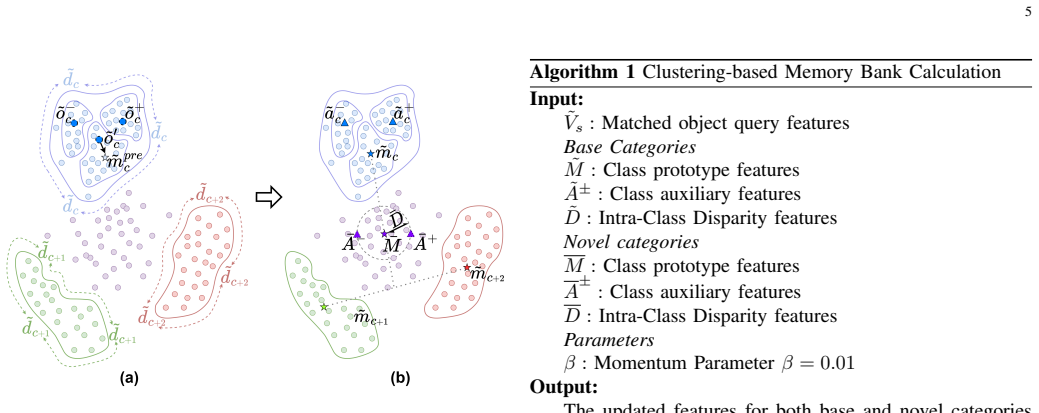
The clustering-based memory bank, which encodes class prototypes, auxiliary features, and intra-class disparity information and is updated iteratively by unsupervised clustering on source features and asynchronously for target-domain transfer.
If this is right
- The method surpasses prior adaptive open-set object detection approaches by 1.1-5.5 mAP across multiple benchmarks.
- Asynchronous memory bank updates reduce source-domain feature bias during target adaptation.
- A base-to-novel selection metric identifies source features useful for initializing novel-category classifiers.
- Inter-class and intra-class relationships mined from the source domain strengthen cross-domain representations for both base and novel categories.
Where Pith is reading between the lines
- The same memory-bank construction could be tested on unsupervised domain adaptation for tasks such as semantic segmentation or image classification.
- If the clustering step proves robust, the approach might support zero-shot or few-shot extensions where even fewer source examples are available.
- Applying the technique to video object detection could add temporal consistency constraints to the memory bank updates.
Load-bearing premise
Unsupervised clustering on source features can reliably encode class prototypes and intra-class disparity information that transfers effectively to novel categories in the target domain without any target annotations.
What would settle it
If the method shows no mAP gain or a performance drop for novel categories on a benchmark where source and target domains have large visual distribution shifts, the transferability of the mined knowledge would be refuted.
Figures




read the original abstract
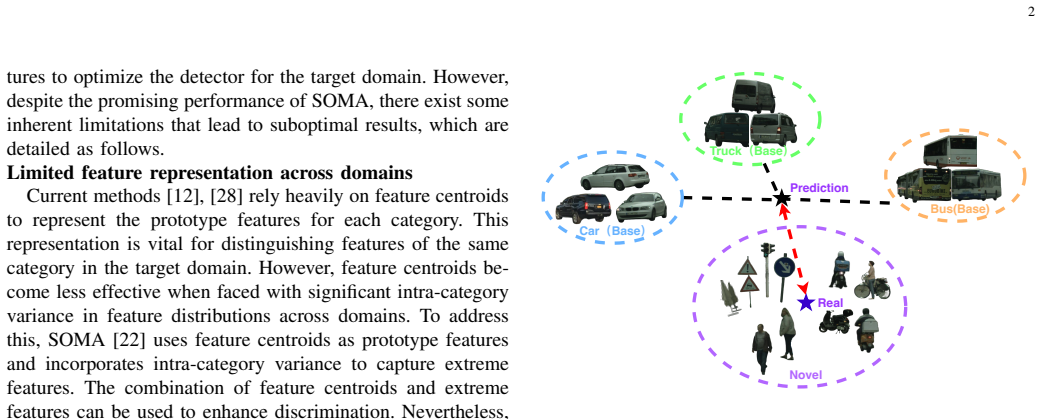
Existing object detectors often struggle to generalize across domains while adapting to emerging novel categories. Adaptive open-set object detection (AOOD) addresses this challenge by training on base categories in the source domain and adapting to both base and novel categories in the target domain without target annotations. However, current AOOD methods remain limited by weak cross-domain representations, ambiguity among novel categories, and source-domain feature bias. To address these issues, we propose a category-level collaboration knowledge mining strategy that exploits both inter-class and intra-class relationships across domains. Specifically, we construct a clustering-based memory bank to encode class prototypes, auxiliary features, and intra-class disparity information, and iteratively update it via unsupervised clustering to enhance category-level knowledge representation. We further design a base-to-novel selection metric to discover source-domain features related to novel categories and use them to initialize novel-category classifiers. In addition, an adaptive feature assignment strategy transfers the learned category-level knowledge to the target domain and asynchronously updates the memory bank to alleviate source-domain bias. Extensive experiments on multiple benchmarks show that our method consistently surpasses state-of-the-art AOOD methods by 1.1-5.5 mAP.
Editorial analysis
A structured set of objections, weighed in public.
Referee Report
Summary. The paper proposes a category-level collaboration knowledge mining strategy for adaptive open-set object detection (AOOD). It constructs a clustering-based memory bank from source-domain features to encode class prototypes, auxiliary features, and intra-class disparity information, iteratively updated via unsupervised clustering. A base-to-novel selection metric identifies source features related to novel categories to initialize novel classifiers. An adaptive feature assignment transfers the knowledge to the target domain (without annotations) while asynchronously updating the memory bank to reduce source bias. Extensive experiments on multiple benchmarks are reported to show consistent 1.1-5.5 mAP gains over prior AOOD methods.
Significance. If the reported gains prove robust, the work would advance AOOD by demonstrating how unsupervised source-only clustering and adaptive cross-domain assignment can mitigate weak representations, novel-category ambiguity, and source bias without target labels. The iterative memory-bank update and base-to-novel selection are concrete mechanisms that could be useful if they reliably encode transferable prototypes. The absence of target supervision makes the approach ambitious, but the empirical claims require strong validation of the clustering transfer step.
major comments (2)
- [§3] §3 (Method, clustering-based memory bank and base-to-novel selection): the central performance claim (1.1-5.5 mAP gains) rests on the assumption that unsupervised clustering of source features alone can produce reliable prototypes and intra-class disparity information that transfers to unseen novel categories under domain shift. No ablation or analysis is shown demonstrating that the selection metric identifies features genuinely related to novel classes rather than spurious correlations; this is load-bearing because novel classes are definitionally absent from source labels.
- [Experimental results] Experimental results section (tables reporting mAP): the abstract and results claim consistent outperformance, yet no details are provided on statistical significance testing, number of random seeds/runs, or controls for confounding factors such as hyper-parameter sensitivity in the clustering step. This weakens confidence that the gains are attributable to the proposed knowledge-mining components rather than implementation details.
minor comments (2)
- The abstract and method overview would benefit from explicit naming of the benchmarks and datasets used, as well as a brief statement of the open-set protocol (e.g., which categories are base vs. novel).
- Notation for the memory bank contents (prototypes, auxiliary features, disparity) could be formalized with a small equation or diagram to improve clarity for readers.
Simulated Author's Rebuttal
We thank the referee for the constructive comments and the positive evaluation of our work's potential impact on adaptive open-set object detection. We address each major comment below and describe the planned revisions to strengthen the manuscript.
read point-by-point responses
-
Referee: [§3] §3 (Method, clustering-based memory bank and base-to-novel selection): the central performance claim (1.1-5.5 mAP gains) rests on the assumption that unsupervised clustering of source features alone can produce reliable prototypes and intra-class disparity information that transfers to unseen novel categories under domain shift. No ablation or analysis is shown demonstrating that the selection metric identifies features genuinely related to novel classes rather than spurious correlations; this is load-bearing because novel classes are definitionally absent from source labels.
Authors: We agree that additional evidence is needed to substantiate the transfer of unsupervised prototypes and intra-class disparity encodings to novel categories under domain shift. The original manuscript relies on end-to-end benchmark gains to support the approach, but we acknowledge that direct validation of the base-to-novel selection metric is warranted. In the revised version, we will add targeted ablations and analyses, including quantitative similarity measures between selected source features and target-domain novel instances, as well as t-SNE visualizations of the memory bank prototypes before and after selection. These will help demonstrate that the metric captures transferable category-level relationships rather than spurious correlations. revision: partial
-
Referee: [Experimental results] Experimental results section (tables reporting mAP): the abstract and results claim consistent outperformance, yet no details are provided on statistical significance testing, number of random seeds/runs, or controls for confounding factors such as hyper-parameter sensitivity in the clustering step. This weakens confidence that the gains are attributable to the proposed knowledge-mining components rather than implementation details.
Authors: We appreciate this observation on experimental rigor. The current results report single-run mAP values across benchmarks. In the revised manuscript, we will update the experimental section to include performance averaged over multiple random seeds (mean ± standard deviation over three independent runs) and will add paired statistical significance tests against the strongest baselines. We will also include a sensitivity analysis for the clustering hyper-parameters (e.g., number of clusters and memory update frequency) to show that the reported gains remain stable across reasonable settings, thereby increasing confidence that improvements stem from the proposed category-level collaboration mechanisms. revision: yes
Circularity Check
No significant circularity detected
full rationale
The paper describes a methodological pipeline of unsupervised clustering to build a memory bank, a base-to-novel selection metric, and adaptive asynchronous updates, but the provided text contains no equations, derivations, fitted-parameter predictions, or self-citation chains that reduce any claimed result to its own inputs by construction. Performance claims rest on experimental mAP gains rather than algebraic equivalence. This is the expected non-finding for an empirical method paper without load-bearing mathematical self-reference.
Axiom & Free-Parameter Ledger
free parameters (1)
- clustering parameters
axioms (1)
- domain assumption Unsupervised clustering can capture meaningful class prototypes and intra-class variations across domains
Reference graph
Works this paper leans on
-
[1]
Retrieval-augmented open- vocabulary object detection,
J. Kim, E. Cho, S. Kim, and H. J. Kim, “Retrieval-augmented open- vocabulary object detection,” inProc. IEEE Comput. Vis. Pattern Recog- nit. (CVPR), 2024, pp. 17 427–17 436
work page 2024
-
[2]
Two- step strategy for domain adaptation retrieval,
Y . Chen, X. Fang, Y . Liu, W. Zheng, P. Kang, N. Han, and S. Xie, “Two- step strategy for domain adaptation retrieval,”IEEE Trans. Knowl. Data Eng., vol. 36, no. 2, pp. 897–912, 2023
work page 2023
-
[3]
Pixelwise instance segmentation with a dynamically instantiated network,
A. Arnab and P. H. Torr, “Pixelwise instance segmentation with a dynamically instantiated network,” inProc. IEEE Comput. Vis. Pattern Recognit. (CVPR), 2017, pp. 441–450
work page 2017
-
[4]
Yolact: Real-time instance segmentation,
D. Bolya, C. Zhou, F. Xiao, and Y . J. Lee, “Yolact: Real-time instance segmentation,” inProc. IEEE/CVF Int. Conf. Comput. Vis. (ICCV), 2019, pp. 9157–9166
work page 2019
-
[5]
Centermask: Real-time anchor-free instance seg- mentation,
Y . Lee and J. Park, “Centermask: Real-time anchor-free instance seg- mentation,” inProc. IEEE Comput. Vis. Pattern Recognit. (CVPR), 2020, pp. 13 906–13 915
work page 2020
-
[6]
Out-of-distribution semantic segmentation with disentangled and calibrated representation,
M. Wan, K. Li, Q. Geng, B. Su, and Z. Zhou, “Out-of-distribution semantic segmentation with disentangled and calibrated representation,” IEEE Trans. Circuits Syst. Video Technol., 2025
work page 2025
-
[7]
Multi-view 3d object detection network for autonomous driving,
X. Chen, H. Ma, J. Wan, B. Li, and T. Xia, “Multi-view 3d object detection network for autonomous driving,” inProc. IEEE Comput. Vis. Pattern Recognit. (CVPR), 2017, pp. 1907–1915
work page 2017
-
[8]
C. Lin, D. Tian, X. Duan, J. Zhou, D. Zhao, and D. Cao, “3D- DFM: Anchor-free multimodal 3-d object detection with dynamic fusion module for autonomous driving,”IEEE Trans. Neural Netw. Learn. Syst., vol. 34, no. 12, pp. 10 812–10 822, 2023
work page 2023
-
[9]
Fsrdd: An efficient few-shot detector for rare city road damage detection,
B. Su, H. Zhang, Z. Wu, and Z. Zhou, “Fsrdd: An efficient few-shot detector for rare city road damage detection,”IEEE Trans. Intell. Transp. Syst., vol. 23, no. 12, pp. 24 379–24 388, 2022
work page 2022
-
[10]
Pvel-ad: A large-scale open-world dataset for photovoltaic cell anomaly detection,
B. Su, Z. Zhou, and H. Chen, “Pvel-ad: A large-scale open-world dataset for photovoltaic cell anomaly detection,”IEEE Trans. Ind. Informat., vol. 19, no. 1, pp. 404–413, 2022
work page 2022
-
[11]
Improving predictive inference under covariate shift by weighting the log-likelihood function,
H. Shimodaira, “Improving predictive inference under covariate shift by weighting the log-likelihood function,”J. Stat. Plan. Inference, vol. 90, no. 2, pp. 227–244, 2000
work page 2000
-
[12]
Prototype- guided continual adaptation for class-incremental unsupervised domain adaptation,
H. Lin, Y . Zhang, Z. Qiu, S. Niu, C. Gan, Y . Liu, and M. Tan, “Prototype- guided continual adaptation for class-incremental unsupervised domain adaptation,” inProc.Eur .Conf.Comput.Vis.(ECCV), 2022, pp. 351–368
work page 2022
-
[13]
Robust object detection via adversarial novel style exploration,
W. Wang, J. Zhang, W. Zhai, Y . Cao, and D. Tao, “Robust object detection via adversarial novel style exploration,”IEEE Trans. Image Process., vol. 31, pp. 1949–1962, 2022
work page 1949
-
[14]
SCAN++: Enhanced semantic conditioned adaptation for domain adaptive object detection,
W. Li, X. Liu, and Y . Yuan, “SCAN++: Enhanced semantic conditioned adaptation for domain adaptive object detection,”IEEE Trans. Multime- dia, vol. 25, pp. 7051–7061, 2023
work page 2023
-
[15]
SIGMA: Semantic-complete graph matching for domain adaptive object detection,
——, “SIGMA: Semantic-complete graph matching for domain adaptive object detection,” inProc. IEEE/CVF Comput. Vis. Pattern Recognit. (CVPR), 2022, pp. 5291–5300
work page 2022
-
[16]
The overlooked elephant of object detection: Open set,
A. Dhamija, M. Gunther, J. Ventura, and T. Boult, “The overlooked elephant of object detection: Open set,” inProc. IEEE/CVF Winter Conf. Appl. Comput. Vis. (WACV), 2020, pp. 1021–1030
work page 2020
-
[17]
Expanding low- density latent regions for open-set object detection,
J. Han, Y . Ren, J. Ding, X. Pan, K. Yan, and G.-S. Xia, “Expanding low- density latent regions for open-set object detection,” inProc. IEEE/CVF Comput. Vis. Pattern Recognit. (CVPR), 2022, pp. 9591–9600
work page 2022
-
[18]
Toward generalized few-shot open-set object detection,
B. Su, H. Zhang, J. Li, and Z. Zhou, “Toward generalized few-shot open-set object detection,”IEEE Trans. Image Process., vol. 33, pp. 1389–1402, 2024
work page 2024
-
[19]
Hsic-based moving weight averaging for few-shot open-set object detection,
B. Su, H. Zhang, and Z. Zhou, “Hsic-based moving weight averaging for few-shot open-set object detection,” inProc. ACM Int. Conf. Multimedia (MM’23), 2023, pp. 5358–5369
work page 2023
-
[20]
Boosting few- shot open-set object detection via prompt learning and robust decision boundary,
Z. Wu, B. Su, Q. Geng, H. Zhang, and Z. Zhou, “Boosting few- shot open-set object detection via prompt learning and robust decision boundary,”arXiv preprint arXiv:2406.18443, 2024
-
[21]
Unknown sniffer for object detection: Don’t turn a blind eye to unknown objects,
W. Liang, F. Xue, Y . Liu, G. Zhong, and A. Ming, “Unknown sniffer for object detection: Don’t turn a blind eye to unknown objects,” in Proc. IEEE/CVF Conf. Comput. Vis. Pattern Recognit. (CVPR), 2023, pp. 3230–3239
work page 2023
-
[22]
Novel scenes & classes: Towards adaptive open-set object detection,
W. Li, X. Guo, and Y . Yuan, “Novel scenes & classes: Towards adaptive open-set object detection,” inProc. IEEE/CVF Int. Conf. Comput. Vis. (ICCV), 2023, pp. 15 780–15 790
work page 2023
-
[23]
Deformable DETR: Deformable transformers for end-to-end object detection,
X. Zhu, W. Su, L. Lu, B. Li, X. Wang, and J. Dai, “Deformable DETR: Deformable transformers for end-to-end object detection,” inProc. Int. Conf. Learn. Represent. (ICLR), 2020
work page 2020
-
[24]
RPN prototype alignment for domain adaptive object detector,
Y . Zhang, Z. Wang, and Y . Mao, “RPN prototype alignment for domain adaptive object detector,” inProc. IEEE/CVF Comput. Vis. Pattern Recognit. (CVPR), 2021, pp. 12 425–12 434. 14
work page 2021
-
[25]
Knowledge mining and transferring for domain adaptive object detection,
K. Tian, C. Zhang, Y . Wang, S. Xiang, and C. Pan, “Knowledge mining and transferring for domain adaptive object detection,” inProc. IEEE/CVF Int. Conf. Comput. Vis. (ICCV), 2021, pp. 9133–9142
work page 2021
-
[26]
Towards open- set object detection and discovery,
J. Zheng, W. Li, J. Hong, L. Petersson, and N. Barnes, “Towards open- set object detection and discovery,” inProc. IEEE/CVF Comput. Vis. Pattern Recognit. (CVPR), 2022, pp. 3961–3970
work page 2022
-
[27]
Towards open world object detection,
K. Joseph, S. Khan, F. S. Khan, and V . N. Balasubramanian, “Towards open world object detection,” inProc. IEEE/CVF Comput. Vis. Pattern Recognit. (CVPR), 2021, pp. 5830–5840
work page 2021
-
[28]
A prototype-oriented framework for unsupervised domain adaptation,
K. Tanwisuth, X. Fan, H. Zheng, S. Zhang, H. Zhang, B. Chen, and M. Zhou, “A prototype-oriented framework for unsupervised domain adaptation,” inProc. Adv. Neural Inf. Process. Syst. (NeurIPS), 2021, pp. 17 194–17 208
work page 2021
-
[29]
Silhouettes: a graphical aid to the interpretation and validation of cluster analysis,
P. J. Rousseeuw, “Silhouettes: a graphical aid to the interpretation and validation of cluster analysis,”J. Comput. Appl. Math., vol. 20, pp. 53– 65, 1987
work page 1987
-
[30]
Comparing clusterings by the variation of information,
M. Meil ˘a, “Comparing clusterings by the variation of information,” inProc. Annu. Conf. Learn. Theory Kernel Workshop (COLT/Kernel), 2003, pp. 173–187
work page 2003
-
[31]
Exploiting the intrinsic neighborhood structure for source-free domain adaptation,
S. Yang, J. Van de Weijer, L. Herranz, S. Juiet al., “Exploiting the intrinsic neighborhood structure for source-free domain adaptation,” in Proc. Adv. Neural Inf. Process. Syst. (NeurIPS), 2021, pp. 29 393– 29 405
work page 2021
-
[32]
Separate to adapt: Open set domain adaptation via progressive separation,
H. Liu, Z. Cao, M. Long, J. Wang, and Q. Yang, “Separate to adapt: Open set domain adaptation via progressive separation,” inProc. IEEE/CVF Comput. Vis. Pattern Recognit. (CVPR), 2019, pp. 2927– 2936
work page 2019
-
[33]
MeGA- CDA: Memory guided attention for category-aware unsupervised domain adaptive object detection,
V . Vs, V . Gupta, P. Oza, V . A. Sindagi, and V . M. Patel, “MeGA- CDA: Memory guided attention for category-aware unsupervised domain adaptive object detection,” inProc. IEEE/CVF Comput. Vis. Pattern Recognit. (CVPR), 2021, pp. 4516–4526
work page 2021
-
[34]
Cross-domain object detection through coarse-to-fine feature adaptation,
Y . Zheng, D. Huang, S. Liu, and Y . Wang, “Cross-domain object detection through coarse-to-fine feature adaptation,” inProc. IEEE/CVF Comput. Vis. Pattern Recognit. (CVPR), 2020, pp. 13 766–13 775
work page 2020
-
[35]
BDD100k: A diverse driving dataset for heterogeneous multitask learning,
F. Yu, H. Chen, X. Wang, W. Xian, Y . Chen, F. Liu, V . Madhavan, and T. Darrell, “BDD100k: A diverse driving dataset for heterogeneous multitask learning,” inProc. IEEE/CVF Comput. Vis. Pattern Recognit. (CVPR), 2020, pp. 2636–2645
work page 2020
-
[36]
The cityscapes dataset for semantic urban scene understanding,
M. Cordts, M. Omran, S. Ramos, T. Rehfeld, M. Enzweiler, R. Be- nenson, U. Franke, S. Roth, and B. Schiele, “The cityscapes dataset for semantic urban scene understanding,” inProc. IEEE Comput. Vis. Pattern Recognit. (CVPR), 2016, pp. 3213–3223
work page 2016
-
[37]
Semantic foggy scene under- standing with synthetic data,
C. Sakaridis, D. Dai, and L. Van Gool, “Semantic foggy scene under- standing with synthetic data,”Int. J. Comput. Vis., vol. 126, pp. 973–992, 2018
work page 2018
-
[38]
The pascal visual object classes challenge: A retrospective,
M. Everingham, S. A. Eslami, L. Van Gool, C. K. Williams, J. Winn, and A. Zisserman, “The pascal visual object classes challenge: A retrospective,”Int. J. Comput. Vis., vol. 111, pp. 98–136, 2015
work page 2015
-
[39]
Cross-domain weakly-supervised object detection through progressive domain adapta- tion,
N. Inoue, R. Furuta, T. Yamasaki, and K. Aizawa, “Cross-domain weakly-supervised object detection through progressive domain adapta- tion,” inProc. IEEE/CVF Comput. Vis. Pattern Recognit. (CVPR), 2018, pp. 5001–5009
work page 2018
-
[40]
Domain adaptive faster R-CNN for object detection in the wild,
Y . Chen, W. Li, C. Sakaridis, D. Dai, and L. Van Gool, “Domain adaptive faster R-CNN for object detection in the wild,” inProc. IEEE/CVF Comput. Vis. Pattern Recognit. (CVPR), 2018, pp. 3339–3348
work page 2018
-
[41]
Multi-adversarial faster-rcnn for unrestricted object detection,
Z. He and L. Zhang, “Multi-adversarial faster-rcnn for unrestricted object detection,” inProc. IEEE/CVF Comput. Vis. Pattern Recognit. (CVPR), 2019, pp. 6668–6677
work page 2019
-
[42]
Adapting object detectors via selective cross-domain alignment,
X. Zhu, J. Pang, C. Yang, J. Shi, and D. Lin, “Adapting object detectors via selective cross-domain alignment,” inProc. IEEE/CVF Comput. Vis. Pattern Recognit. (CVPR), 2019, pp. 687–696
work page 2019
-
[43]
SIGMA++: Improved semantic-complete graph matching for domain adaptive object detection,
W. Li, X. Liu, and Y . Yuan, “SIGMA++: Improved semantic-complete graph matching for domain adaptive object detection,”IEEE Trans. Pattern Anal. Mach. Intell., vol. 45, no. 7, pp. 9022–9040, 2023
work page 2023
-
[44]
Learning open set network with discriminative reciprocal points,
G. Chen, L. Qiao, Y . Shi, P. Peng, J. Li, T. Huang, S. Pu, and Y . Tian, “Learning open set network with discriminative reciprocal points,” in Proc. Eur . Conf. Comput. Vis. (ECCV), 2020, pp. 507–522
work page 2020
-
[45]
Adversarial reciprocal points learning for open set recognition,
G. Chen, P. Peng, X. Wang, and Y . Tian, “Adversarial reciprocal points learning for open set recognition,”IEEE Trans. Pattern Anal. Mach. Intell., vol. 44, no. 11, pp. 8065–8081, 2021
work page 2021
-
[46]
OW-DETR: Open-world detection transformer,
A. Gupta, S. Narayan, K. Joseph, S. Khan, F. S. Khan, and M. Shah, “OW-DETR: Open-world detection transformer,” inProc. IEEE/CVF Comput. Vis. Pattern Recognit. (CVPR), 2022, pp. 9235–9244
work page 2022
-
[47]
P. Panareda Busto and J. Gall, “Open set domain adaptation,” inProc. IEEE Int. Conf. Comput. Vis. (ICCV), 2017, pp. 754–763
work page 2017
-
[48]
Open set domain adaptation by backpropagation,
K. Saito, S. Yamamoto, Y . Ushiku, and T. Harada, “Open set domain adaptation by backpropagation,” inProc. Eur . Conf. Comput. Vis. (ECCV), 2018, pp. 156–171
work page 2018
-
[49]
On the effec- tiveness of image rotation for open set domain adaptation,
S. Bucci, M. R. Loghmani, and T. Tommasi, “On the effec- tiveness of image rotation for open set domain adaptation,” in Proc.Eur .Conf.Comput.Vis.(ECCV), 2020, pp. 422–438
work page 2020
-
[50]
Balanced open set domain adaptation via centroid alignment,
M. Jing, J. Li, L. Zhu, Z. Ding, K. Lu, and Y . Yang, “Balanced open set domain adaptation via centroid alignment,” inProc. AAAI Conf. Artif. Intell.(AAAI), 2021, pp. 8013–8020
work page 2021
-
[51]
Scene parsing with global context embedding,
W. C. Hung, Y . H. Tsai, X. Shen, Z. Lin, K. Sunkavalli, X. Lu, and M. H. Yang, “Scene parsing with global context embedding,” inProc. IEEE Int. Conf. Comput. Vis. (ICCV), 2017, pp. 2631–2639
work page 2017
-
[52]
Higher-order organization of complex networks,
A. R. Benson, D. F. Gleich, and J. Leskovec, “Higher-order organization of complex networks,”Science, vol. 353, no. 6295, pp. 163–166, 2016
work page 2016
-
[53]
Feature pyramid networks for object detection,
T.-Y . Lin, P. Doll´ar, R. Girshick, K. He, B. Hariharan, and S. Belongie, “Feature pyramid networks for object detection,” inProc. IEEE Comput. Vis. Pattern Recognit. (CVPR), 2017, pp. 2117–2125
work page 2017
-
[54]
The hungarian method for the assignment problem,
H. W. Kuhn, “The hungarian method for the assignment problem,”Naval Res. Logist., vol. 2, no. 1-2, pp. 83–97, 1955
work page 1955
-
[55]
Generalized intersection over union: A metric and a loss for bounding box regression,
H. Rezatofighi, N. Tsoi, J. Gwak, A. Sadeghian, I. Reid, and S. Savarese, “Generalized intersection over union: A metric and a loss for bounding box regression,” inProc. IEEE/CVF Comput. Vis. Pattern Recognit. (CVPR), 2019, pp. 658–666
work page 2019
-
[56]
Focal loss for dense object detection,
T.-Y . Lin, P. Goyal, R. Girshick, K. He, and P. Doll ´ar, “Focal loss for dense object detection,” inProc. IEEE/CVF Int. Conf. Comput. Vis. (ICCV), 2017, pp. 2980–2988
work page 2017
-
[57]
Momentum contrast for unsupervised visual representation learning,
K. He, H. Fan, Y . Wu, S. Xie, and R. Girshick, “Momentum contrast for unsupervised visual representation learning,” inProc. IEEE/CVF Conf. Comput. Vis. Pattern Recognit. (CVPR), 2020, pp. 9729–9738
work page 2020
-
[58]
Clustering with spectral norm and the k- means algorithm,
A. Kumar and R. Kannan, “Clustering with spectral norm and the k- means algorithm,” inProc. Annu. IEEE Symp. F ound. Comput. Sci. (FOCS), 2010, pp. 299–308
work page 2010
-
[59]
MLFA: Towards realistic test time adaptive object detection by multi-level feature alignment,
Y . Liu, J. Wang, C. Huang, Y . Wu, Y . Xu, and X. Cao, “MLFA: Towards realistic test time adaptive object detection by multi-level feature alignment,”IEEE Trans. Image Process., vol. 33, pp. 5837–5848, 2024
work page 2024
-
[60]
Towards open world recognition,
A. Bendale and T. E. Boult, “Towards open world recognition,” inProc. IEEE Comput. Vis. Pattern Recognit. (CVPR), 2015, pp. 1893–1902
work page 2015
-
[61]
W. J. Scheirer, A. de Rezende Rocha, A. Sapkota, and T. E. Boult, “Toward open set recognition,”IEEE Trans. Pattern Anal. Mach. Intell., vol. 35, no. 7, pp. 1757–1772, 2012
work page 2012
-
[62]
Learning placeholders for open- set recognition,
D.-W. Zhou, H.-J. Ye, and D.-C. Zhan, “Learning placeholders for open- set recognition,” inProc. IEEE/CVF Comput. Vis. Pattern Recognit. (CVPR), 2021, pp. 4401–4410
work page 2021
-
[63]
Exploring sequence feature alignment for domain adaptive detection transformers,
W. Wang, Y . Cao, J. Zhang, F. He, Z.-J. Zha, Y . Wen, and D. Tao, “Exploring sequence feature alignment for domain adaptive detection transformers,” inProc. ACM Int. Conf. Multimedia (MM’21), 2021, pp. 1730–1738
work page 2021
-
[64]
Vector-decomposed dis- entanglement for domain-invariant object detection,
A. Wu, R. Liu, Y . Han, L. Zhu, and Y . Yang, “Vector-decomposed dis- entanglement for domain-invariant object detection,” inProc. IEEE/CVF Int. Conf. Comput. Vis. (ICCV), 2021, pp. 9342–9351
work page 2021
-
[65]
I3NET: Implicit instance-invariant network for adapting one-stage object detectors,
C. Chen, Z. Zheng, Y . Huang, X. Ding, and Y . Yu, “I3NET: Implicit instance-invariant network for adapting one-stage object detectors,” in Proc. IEEE/CVF Comput. Vis. Pattern Recognit. (CVPR), 2021, pp. 12 576–12 585
work page 2021
-
[66]
Strong-weak distri- bution alignment for adaptive object detection,
K. Saito, Y . Ushiku, T. Harada, and K. Saenko, “Strong-weak distri- bution alignment for adaptive object detection,” inProc. IEEE/CVF Comput. Vis. Pattern Recognit. (CVPR), 2019, pp. 6956–6965
work page 2019
-
[67]
Deep residual learning for image recognition,
K. He, X. Zhang, S. Ren, and J. Sun, “Deep residual learning for image recognition,” inProc. IEEE/CVF Comput. Vis. Pattern Recognit. (CVPR), 2016, pp. 770–778
work page 2016
-
[68]
Imagenet: A large-scale hierarchical image database,
J. Deng, W. Dong, R. Socher, L.-J. Li, K. Li, and L. Fei-Fei, “Imagenet: A large-scale hierarchical image database,” inProc. IEEE/CVF Comput. Vis. Pattern Recognit. (CVPR), 2009, pp. 248–255
work page 2009
-
[69]
DINO: Detr with improved denoising anchor boxes for end-to- end object detection,
H. Zhang, F. Li, S. Liu, L. Zhang, H. Su, J. Zhu, L. Ni, and H.-Y . Shum, “DINO: Detr with improved denoising anchor boxes for end-to- end object detection,” inProc. Int. Conf. Learn. Representations. (ICLR), 2022, pp. 1–8
work page 2022
-
[70]
Objects365: A large-scale, high-quality dataset for object detection,
S. Shao, Z. Li, T. Zhang, C. Peng, G. Yu, X. Zhang, J. Li, and J. Sun, “Objects365: A large-scale, high-quality dataset for object detection,” in Proc. IEEE/CVF Int. Conf. Comput. Vis. (ICCV), 2019, pp. 8430–8439
work page 2019
-
[71]
Decoupled weight decay regularization,
I. Loshchilov and F. Hutter, “Decoupled weight decay regularization,” inProc. Int. Conf. Learn. Representations. (ICLR), 2019. 15 Yuqi Jireceived the B.Sc. degree in Detection, Guidance and Control Technology in 2022 from Xi- dian University, Xi’an, China, where he is currently working toward the Ph.D. degree. His research in- terests include object detec...
work page 2019
-
[72]
Lihuo He(Member, IEEE) received the B.Sc
His research interests focus on object detection and computer vision. Lihuo He(Member, IEEE) received the B.Sc. degree in electronic and information engineering and the Ph.D. degree in pattern recognition and intelligent systems from Xidian University, China, in 2008 and 2013, respectively. He is currently a Professor in the School of Electronic Engineeri...
work page 2008
discussion (0)
Sign in with ORCID, Apple, or X to comment. Anyone can read and Pith papers without signing in.