Recognition: unknown
Hardening x402: PII-Safe Agentic Payments via Pre-Execution Metadata Filtering
Pith reviewed 2026-05-10 15:32 UTC · model grok-4.3
The pith
Middleware detects and redacts PII in x402 payment requests before they reach servers.
A machine-rendered reading of the paper's core claim, the machinery that carries it, and where it could break.
Core claim
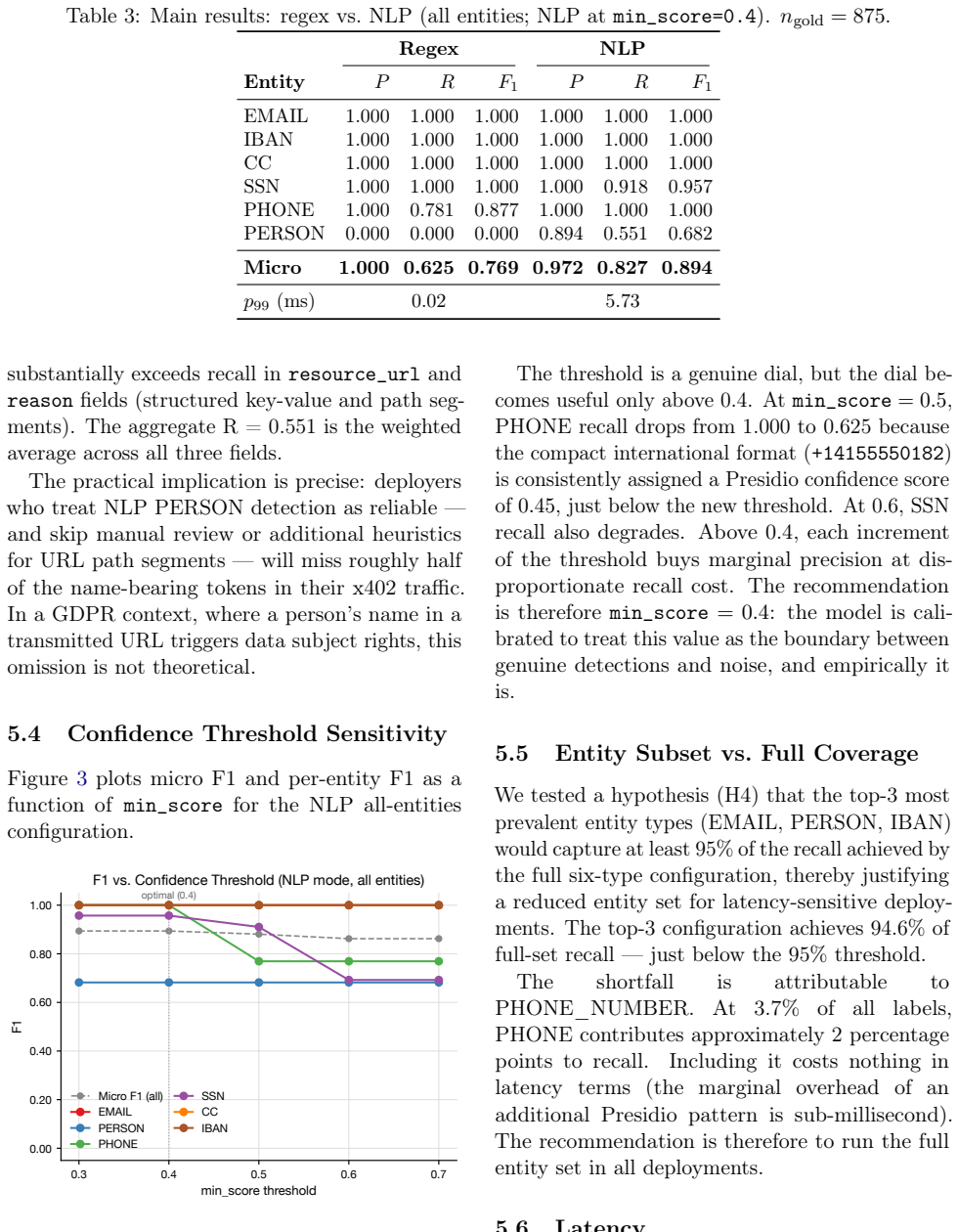
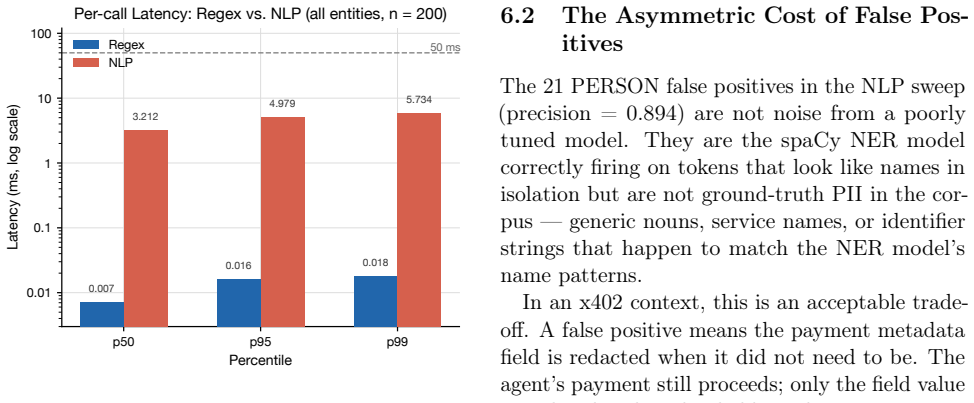
We present presidio-hardened-x402, the first open-source middleware that intercepts x402 payment requests before transmission to detect and redact personally identifiable information, enforce declarative spending policies, and block duplicate replay attempts. On a labeled synthetic corpus of 2,000 x402 metadata triples, the recommended configuration of NLP mode at min_score 0.4 for all entity types achieves micro-F1 of 0.894 with precision 0.972 at a p99 latency of 5.73 milliseconds.
What carries the argument
presidio-hardened-x402 middleware that applies Presidio-based PII detection in either regex or NLP mode with adjustable confidence thresholds before any transmission occurs.
If this is right
- Payment metadata containing user details can be stripped before reaching centralized facilitators.
- Spending rules can be checked against request content at the point of interception.
- Identical payment attempts can be recognized and rejected using metadata alone.
- The added processing stays under typical 50-millisecond overhead allowances for agent workflows.
Where Pith is reading between the lines
- Similar pre-execution filters could be applied to other agent communication or payment protocols.
- Agent frameworks might adopt this style of metadata sanitization to support regulatory compliance.
- Real deployment data would be needed to confirm whether synthetic performance holds in production traffic.
Load-bearing premise
The labeled synthetic corpus of 2,000 x402 metadata triples accurately represents the distribution and difficulty of PII in real-world agent payment requests.
What would settle it
Evaluating the same 42 configurations on a collection of live x402 requests captured from deployed AI agents and checking whether precision and recall remain near the reported levels.
Figures



read the original abstract
AI agents that pay for resources via the x402 protocol embed payment metadata - resource URLs, descriptions, and reason strings - in every HTTP payment request. This metadata is transmitted to the payment server and to the centralised facilitator API before any on-chain settlement occurs; neither party is typically bound by a data processing agreement. We present presidio-hardened-x402, the first open-source middleware that intercepts x402 payment requests before transmission to detect and redact personally identifiable information (PII), enforce declarative spending policies, and block duplicate replay attempts. To evaluate the PII filter, we construct a labeled synthetic corpus of 2,000 x402 metadata triples spanning seven use-case categories, and run a 42-configuration precision/recall sweep across two detection modes (regex, NLP) and five confidence thresholds. The recommended configuration (mode=nlp, min_score=0.4, all entity types) achieves micro-F1 = 0.894 with precision 0.972, at a p99 latency of 5.73ms - well within the 50ms overhead budget. The middleware, corpus, and all experiment code are publicly available at https://github.com/presidio-v/presidio-hardened-x402.
Editorial analysis
A structured set of objections, weighed in public.
Referee Report
Summary. The paper introduces presidio-hardened-x402, the first open-source middleware that intercepts x402 payment requests to detect and redact PII in metadata (resource URLs, descriptions, reason strings) using regex or NLP modes from Presidio, enforce declarative spending policies, and block replay attempts. It constructs a labeled synthetic corpus of 2,000 x402 metadata triples across seven use-case categories, performs a 42-configuration sweep over detection modes and confidence thresholds, and recommends the NLP mode with min_score=0.4 (all entity types) that achieves micro-F1=0.894, precision=0.972, and p99 latency of 5.73 ms, well under the 50 ms overhead budget. The middleware, corpus, and code are released publicly.
Significance. If the synthetic corpus is shown to be representative of real x402 metadata distributions, the work supplies a practical, low-latency, open-source tool for mitigating PII exposure in agentic payments where neither the payment server nor the facilitator is typically covered by a data-processing agreement. The public release of the implementation and evaluation artifacts supports reproducibility and incremental improvement by the community.
major comments (2)
- [Evaluation / Results] The central performance claim (recommended configuration: micro-F1 = 0.894, precision = 0.972) is obtained solely from a 42-setting sweep on a held-out synthetic corpus of 2,000 labeled triples. No quantitative comparison of token distributions, entity co-occurrence statistics, or obfuscation patterns against real-world x402 traffic is provided, nor are any results reported on actual production traces or adversarial examples. Because the claim of reliable pre-execution PII filtering in production rests on the unverified fidelity of this corpus, the evaluation section does not yet substantiate the production-readiness assertion.
- [Corpus construction] The manuscript supplies no description of the corpus-generation process, the labeling protocol for the seven PII entity types, or any inter-annotator agreement statistics. Without these details it is impossible to assess the quality of the ground-truth labels that underpin the reported precision/recall numbers.
minor comments (2)
- [Abstract] The abstract states that the p99 latency is 5.73 ms; clarify whether this figure measures only the PII filter or the full middleware stack including policy enforcement and replay detection.
- [Middleware design] The description of declarative spending policies is brief; an explicit example of policy syntax and its enforcement logic would improve clarity.
Simulated Author's Rebuttal
We thank the referee for the thoughtful and detailed comments. We address each major point below, indicating where revisions will be made to improve clarity and transparency while honestly noting limitations that cannot be fully resolved at this stage.
read point-by-point responses
-
Referee: [Evaluation / Results] The central performance claim (recommended configuration: micro-F1 = 0.894, precision = 0.972) is obtained solely from a 42-setting sweep on a held-out synthetic corpus of 2,000 labeled triples. No quantitative comparison of token distributions, entity co-occurrence statistics, or obfuscation patterns against real-world x402 traffic is provided, nor are any results reported on actual production traces or adversarial examples. Because the claim of reliable pre-execution PII filtering in production rests on the unverified fidelity of this corpus, the evaluation section does not yet substantiate the production-readiness assertion.
Authors: We agree that the absence of direct quantitative comparisons to real-world x402 metadata distributions limits the strength of the production-readiness claim. No public labeled datasets of real x402 traffic exist, and accessing production traces would involve privacy and legal barriers. The synthetic corpus was constructed to span seven representative use-case categories with deliberate variation in PII placement and obfuscation to approximate real scenarios. In revision we will add an explicit Limitations subsection that discusses the synthetic evaluation design, provides qualitative examples of how synthetic samples relate to plausible real metadata, and outlines the need for future community efforts on real-world validation. We will not be able to add results on actual production traces. revision: partial
-
Referee: [Corpus construction] The manuscript supplies no description of the corpus-generation process, the labeling protocol for the seven PII entity types, or any inter-annotator agreement statistics. Without these details it is impossible to assess the quality of the ground-truth labels that underpin the reported precision/recall numbers.
Authors: We accept that the current manuscript lacks sufficient detail on corpus construction. The 2,000 triples were generated via programmatic templates covering the seven categories, with PII entities inserted according to Presidio type definitions and varied positions/obfuscations. Labeling was performed manually by the authors using consistent guidelines derived from Presidio documentation. Because the effort was conducted by a small team, inter-annotator agreement was not measured. We will add a dedicated subsection in the Evaluation section describing the generation process, category definitions, labeling protocol, and pointing to the already-public generation scripts in the repository. This will enable readers to evaluate and replicate the ground-truth labels. revision: yes
- We cannot supply quantitative results on real production x402 traces or direct statistical comparisons to live traffic distributions, as no such publicly available labeled data exists and obtaining it would violate privacy constraints.
Circularity Check
No significant circularity; performance is direct measurement on synthetic corpus
full rationale
The paper constructs a labeled synthetic corpus of 2,000 x402 metadata triples and performs a 42-configuration sweep of standard Presidio-based regex and NLP detectors, reporting the micro-F1, precision, and latency of the best configuration as direct empirical results on held-out examples. No equations, fitted parameters, or predictions are defined in terms of the target metrics; the evaluation does not reduce to self-definition, renaming, or self-citation chains. The derivation chain is self-contained against the synthetic benchmark it explicitly describes.
Axiom & Free-Parameter Ledger
free parameters (1)
- min_score =
0.4
axioms (1)
- domain assumption Presidio's NLP-based PII detector produces reliable labels on short metadata strings of the form used in x402 requests.
Reference graph
Works this paper leans on
-
[1]
R. Behnke. x402 explained: Security risks & controls for HTTP 402 micropayments. Halborn Blog, https://www.halborn.com/blog/post/x402-explained-security-risks-and-controls-for-http-402-micropayments, Mar. 2026
2026
-
[2]
Boschung
J. Boschung. The AI -blockchain convergence: A new era for decentralized security. Halborn Blog, https://www.halborn.com/blog/post/the-ai-blockchain-convergence-a-new-era-for-decentralized-security, Mar. 2025. Author is CEO of Halborn
2025
-
[3]
H. Chase. LangChain . https://github.com/langchain-ai/langchain, 2022
2022
-
[4]
x402: A payment protocol for the internet
Coinbase . x402: A payment protocol for the internet. https://github.com/coinbase/x402, 2024
2024
-
[5]
Dzombeta, V
S. Dzombeta, V. Stantchev, R. Colomo-Palacios, K. Brandis, and K. Haufe. Governance of cloud computing services for the life sciences. IT Professional, 16 0 (4): 0 30--37, 2014
2014
-
[6]
General data protection regulation (gdpr)
European Union . General data protection regulation (gdpr). https://gdpr.eu/, 2016
2016
-
[7]
K. Greshake, S. Abdelnabi, S. Mishra, C. Endres, T. Holz, and M. Fritz. Not what you've signed up for: Compromising real-world LLM -integrated applications with indirect prompt injection. arXiv preprint arXiv:2302.12173, 2023
work page internal anchor Pith review arXiv 2023
-
[8]
Honnibal, I
M. Honnibal, I. Montani, S. Van Landeghem , and A. Boyd. spaCy : Industrial-strength natural language processing in Python . https://spacy.io, 2020
2020
-
[9]
M. Meli, M. R. McNiece, and B. Reaves. How bad can it git? characterizing secret leakage in public GitHub repositories. In Proceedings of the 26th Annual Network and Distributed System Security Symposium ( NDSS ) , 2019. doi:10.14722/ndss.2019.23418
-
[10]
Microsoft Presidio : Data protection and de-identification SDK
Microsoft . Microsoft Presidio : Data protection and de-identification SDK . https://github.com/microsoft/presidio, 2023
2023
-
[11]
J. Moura. CrewAI : Framework for orchestrating role-playing autonomous AI agents. https://github.com/crewAIInc/crewAI, 2023
2023
-
[12]
R. Nair, L. Logvinov, and J. Evans. EIP -712: Typed structured data hashing and signing. https://eips.ethereum.org/EIPS/eip-712, 2017
2017
-
[13]
Stantchev
V. Stantchev. KI und IT -Governance . Springer, 2026 a . German edition, in press
2026
-
[14]
Stantchev
V. Stantchev. AI and IT -Governance . Springer, 2026 b . English edition, in press
2026
-
[15]
V. Stantchev and L. Stantcheva. Applying it-governance frameworks for soa and cloud governance. In M. D. Lytras, P. Ordon\' e z de Pablos, A. Ziderman, A. Roulstone, H. Maurer, and J. B. Imber, editors, Knowledge Management, Information Systems, E-Learning, and Sustainability Research -- WSKS 2011, pages 398--407, Berlin, Heidelberg, 2011. Springer. doi:1...
-
[16]
Stantchev and L
V. Stantchev and L. Stantcheva. Extending traditional it-governance knowledge towards soa and cloud governance. International Journal of Knowledge Society Research (IJKSR), 3 0 (2): 0 30--43, 2012
2012
-
[17]
L. Stantcheva and V. Stantchev. Addressing sustainability in it-governance frameworks. International Journal of Human Capital and Information Technology Professionals, 5 0 (4): 0 79--87, 2014. doi:10.4018/ijhcitp.2014100105
discussion (0)
Sign in with ORCID, Apple, or X to comment. Anyone can read and Pith papers without signing in.