Recognition: unknown
Distinct First-to-Second Peak Yield Ratios and Timescales Reveal a Sub-dominant Prompt Channel
Pith reviewed 2026-05-10 15:55 UTC · model grok-4.3
The pith
Stellar [Y/Eu] trends require a prompt first-peak channel, dominant delayed r-process, and late AGB s-process
A machine-rendered reading of the paper's core claim, the machinery that carries it, and where it could break.
Core claim
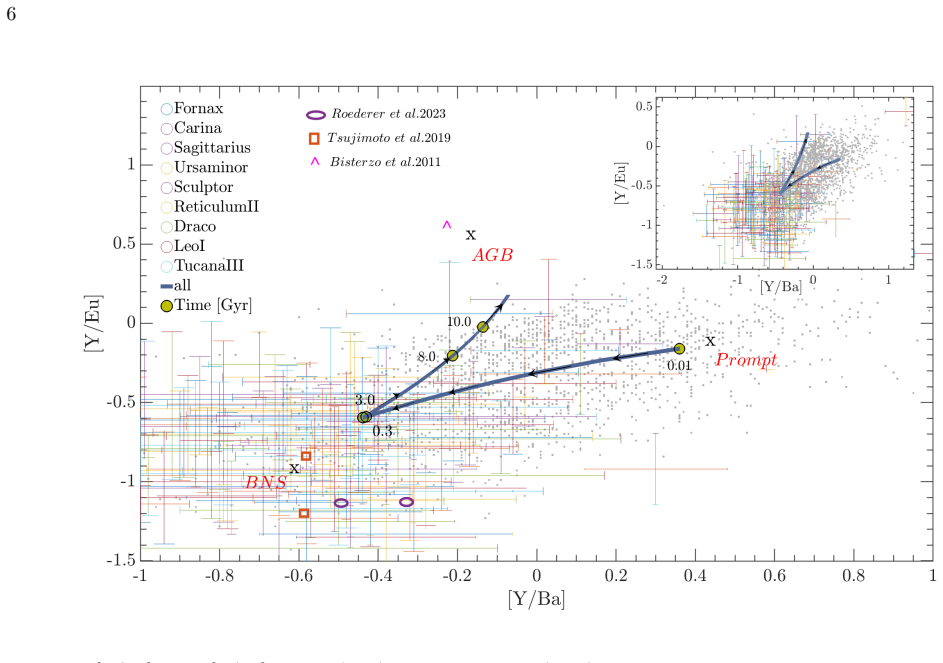
Reproducing the observed [Y/Eu] and [Sr/Eu] sequences requires a delayed r-process channel dominating Eu production (≳95% of total Eu), a prompt channel preferentially producing first-peak elements with minimal Eu, and delayed AGB s-process enrichment with delays greater than t_min = 0.3-0.6 Gyr. The first-to-second peak yield ratios correspond to [Y/Eu] ≈ -0.3 (prompt) and ≈ -0.8 (BNS mergers). The observed Δ[Y/Eu] amplitude establishes a model-independent lower limit on the first to second peak yield ratio ≳3.4 between the prompt and delayed channels.
What carries the argument
A one-zone chemical-evolution model that superposes three sources with fixed yield ratios and characteristic delay times to track the buildup of first- and second-peak elements.
If this is right
- The prompt channel must have a first-to-second peak yield ratio at least 3.4 times higher than the delayed r-process channel.
- Binary neutron-star mergers dominate europium production across the Galaxy.
- AGB s-process enrichment begins only after a minimum delay of 0.3-0.6 Gyr.
- All quantitative constraints including the 0.6 dex amplitude and the location of the minimum at [Eu/H] ~ -0.3 are simultaneously satisfied.
Where Pith is reading between the lines
- The same three-channel structure should produce analogous non-monotonic trends in other first-peak to second-peak ratios such as [Sr/Eu] or [Zr/Eu].
- The prompt channel is likely a rare, short-timescale event such as certain core-collapse supernovae or magnetorotational supernovae whose yield patterns can be tested against metal-poor star data.
- Extending the model to include inhomogeneous mixing would test whether the observed scatter at low metallicity is consistent with the well-mixed assumption.
- The derived rates and delay-time distributions can be compared directly to binary population synthesis predictions for neutron-star mergers.
Load-bearing premise
The observed non-monotonic abundance trends are produced solely by the superposition of three sources with fixed yield ratios and characteristic delay times inside a one-zone, well-mixed interstellar medium.
What would settle it
Spectroscopic measurements showing that [Y/Eu] does not increase below [Eu/H] ≲ -2.5 or that the amplitude of the variation between the minimum and late-time rise is substantially smaller than 0.6 dex would falsify the required separation in yield ratios and delay times.
Figures


read the original abstract
Stellar abundances reveal non-monotonic [Y/Eu] and [Sr/Eu] evolution, a systematic decline with increasing [Eu/H] at low metallicity, a minimum at $[\rm{Eu/H}] \sim -0.3$ and then a rise at high metallicity. This behavior requires at least three distinct neutron-capture sources operating on different timescales. We develop a one-zone chemical-evolution model constraining their typical delay-times, rates, and yield ratios. Reproducing the observed $\rm{[Y/Eu]}$ and $\rm{[Sr/Eu]}$ sequences requires, a delayed $r$-process channel (most likely binary neutron-star mergers) dominating Eu production ($\gtrsim 95\%$ of total Eu). A prompt channel preferentially producing first-peak elements with minimal Eu, explaining the increasing [Y/Eu] at decreasing [Eu/H] below $[\rm{Eu/H}] \lesssim -2.5$; and delayed AGB $s$-process enrichment with delays greater than $t_{min} = 0.3-0.6$\,Gyr reproducing the late-time upturn in Y (Sr). Our model quantitatively reproduces all constraints, including the large $\Delta[\rm{Y/Eu}] \approx 0.6$ dex variation between the late-time rise [Eu/H] and the minimum value, the location of the minimum at [Eu/H] $\sim -0.3$ and late-time rise. The first-to-second peak yield ratios correspond to $[\rm{Y/Eu}] \approx -0.3$ (prompt) and $\approx -0.8$ (BNS mergers). The observed $\Delta[\rm{Y/Eu}]$ amplitude establishes a model-independent lower limit on the first to second peak yield ratio $\gtrsim 3.4$ between the prompt and delayed channels, ruling out models with similar prompt and delayed yield ratios. These results demonstrate that explaining the observed heavy-element abundance patterns requires multiple channels with distinct nucleosynthetic signatures and operational timescales, providing constraints on the relative rates, delay times, and yield patterns of candidate production sites.
Editorial analysis
A structured set of objections, weighed in public.
Referee Report
Summary. The paper develops a one-zone chemical-evolution model to explain the observed non-monotonic trends in [Y/Eu] and [Sr/Eu] versus [Eu/H], which show a decline at low metallicity, a minimum near [Eu/H] ≈ −0.3, and a late-time rise. It argues that reproducing these sequences requires three distinct neutron-capture channels: a prompt first-peak channel with minimal Eu, a delayed r-process channel (likely BNS mergers) supplying ≳95 % of Eu, and a delayed AGB s-process channel with minimum delay 0.3–0.6 Gyr. The model is stated to quantitatively match the 0.6 dex amplitude, the location of the minimum, and the late upturn, while also providing a model-independent lower limit ≳3.4 on the first-to-second peak yield ratio between prompt and delayed channels.
Significance. If the central claim holds, the work supplies useful constraints on the relative rates, delay times, and yield patterns of candidate r-process and s-process sites. The model-independent lower limit on the yield-ratio amplitude is a clear strength that does not rely on the details of the one-zone fit and directly rules out scenarios with similar prompt and delayed yields. The explicit separation of prompt and delayed contributions also offers a concrete target for future nucleosynthesis calculations and rate estimates.
major comments (3)
- [Abstract and §4] Abstract and §4 (model results): the assertion that the model “quantitatively reproduces” the observed sequences and the 0.6 dex amplitude is made without any description of the fitting procedure, goodness-of-fit metric, or exploration of alternative parameter choices. The four free parameters (prompt [Y/Eu], BNS [Y/Eu], t_min, and Eu fraction from BNS) are adjusted until the model matches the data, so the reproduction reduces to a consistency check rather than an independent test.
- [§2] §2 (one-zone model): the necessity of a distinct prompt channel with fixed high [Y/Eu] rests on the assumption of a well-mixed, homogeneous ISM with linear superposition of sources. At [Eu/H] ≲ −2 the enrichment is dominated by individual events; the manuscript does not demonstrate that stochastic enrichment or modest metallicity dependence in the delayed-channel yields cannot produce comparable non-monotonic trends, which would weaken the claim that three fixed-yield channels are required.
- [§4 and abstract] §4 and abstract: while the model-independent lower limit ≳3.4 on the first-to-second peak yield ratio is robust, the specific quoted values ([Y/Eu] ≈ −0.3 prompt, ≈ −0.8 BNS, 95 % Eu from BNS) are obtained by construction from the same fit that is used to claim reproduction; this circularity should be stated explicitly when presenting the “quantitative” match.
minor comments (2)
- [Figures] Figure captions and text should explicitly state whether the plotted model curves include any uncertainty bands arising from parameter variations or data errors.
- [Throughout] Notation for abundance ratios should be uniform (e.g., always [Y/Eu] rather than Y/Eu) to avoid ambiguity.
Simulated Author's Rebuttal
We thank the referee for their constructive and detailed comments, which have improved the clarity of our presentation. We respond point-by-point to the major comments below and have made revisions where appropriate to address concerns about parameter exploration and explicit statements on model independence.
read point-by-point responses
-
Referee: [Abstract and §4] Abstract and §4 (model results): the assertion that the model “quantitatively reproduces” the observed sequences and the 0.6 dex amplitude is made without any description of the fitting procedure, goodness-of-fit metric, or exploration of alternative parameter choices. The four free parameters (prompt [Y/Eu], BNS [Y/Eu], t_min, and Eu fraction from BNS) are adjusted until the model matches the data, so the reproduction reduces to a consistency check rather than an independent test.
Authors: We agree that the original text did not describe the parameter selection process in sufficient detail. In the revised manuscript we have added a new subsection in §4 that outlines a systematic grid search over the four free parameters, with the combination chosen to simultaneously match the location of the minimum, the 0.6 dex amplitude, and the late-time upturn in both [Y/Eu] and [Sr/Eu]. We have also replaced the phrase “quantitatively reproduces” with “reproduces the principal observed features” to reflect that the exercise is a consistency check within the one-zone framework. The central claim—that no two-channel model reproduces the non-monotonic trend—remains unchanged, as it holds across the explored parameter space. revision: yes
-
Referee: [§2] §2 (one-zone model): the necessity of a distinct prompt channel with fixed high [Y/Eu] rests on the assumption of a well-mixed, homogeneous ISM with linear superposition of sources. At [Eu/H] ≲ −2 the enrichment is dominated by individual events; the manuscript does not demonstrate that stochastic enrichment or modest metallicity dependence in the delayed-channel yields cannot produce comparable non-monotonic trends, which would weaken the claim that three fixed-yield channels are required.
Authors: This limitation of the one-zone approximation is valid. We have added a paragraph in §2 that explicitly acknowledges the potential role of stochastic enrichment at the lowest metallicities and notes that the observed trends extend to [Eu/H] ≈ −0.3, where the ISM is expected to be well mixed. While we argue that the specific amplitude and minimum location are most naturally explained by distinct channels, we cannot rule out all stochastic or metallicity-dependent alternatives without new simulations. revision: partial
-
Referee: [§4 and abstract] §4 and abstract: while the model-independent lower limit ≳3.4 on the first-to-second peak yield ratio is robust, the specific quoted values ([Y/Eu] ≈ −0.3 prompt, ≈ −0.8 BNS, 95 % Eu from BNS) are obtained by construction from the same fit that is used to claim reproduction; this circularity should be stated explicitly when presenting the “quantitative” match.
Authors: We agree and have revised both the abstract and §4 to state explicitly that the numerical values for the prompt and BNS yield ratios and the 95 % BNS contribution to Eu are taken from the best-fit model, whereas the lower limit ≳3.4 follows directly from the observed 0.6 dex amplitude and does not depend on the particular parameter values adopted. revision: yes
- A full demonstration that stochastic enrichment or modest metallicity dependence in delayed-channel yields cannot produce the observed non-monotonic trends would require dedicated stochastic chemical-evolution simulations that lie outside the scope of the present one-zone study.
Circularity Check
No significant circularity; standard parameter fitting to data
full rationale
The paper builds a one-zone chemical-evolution model with free parameters for delay times, rates, and yield ratios of three channels, then tunes those parameters until the model matches the observed [Y/Eu] and [Sr/Eu] trends. This is ordinary forward modeling and parameter estimation, not a derivation in which any claimed result is definitionally identical to the input data or to a prior self-citation. The model-independent lower-limit statement on the yield-ratio amplitude is presented as arising directly from the observed Δ[Y/Eu] amplitude without further fitting. No equations are shown that equate a fitted quantity to a 'prediction' by construction, and no load-bearing premise rests solely on an unverified self-citation chain. The derivation therefore remains self-contained against external abundance data.
Axiom & Free-Parameter Ledger
free parameters (4)
- prompt [Y/Eu] yield ratio =
-0.3
- BNS [Y/Eu] yield ratio =
-0.8
- AGB minimum delay t_min =
0.3-0.6 Gyr
- Eu fraction from BNS mergers =
≥95%
axioms (3)
- domain assumption One-zone, well-mixed interstellar medium
- domain assumption Each nucleosynthetic channel has fixed yield ratios independent of metallicity or progenitor mass
- domain assumption The observed [Y/Eu] and [Sr/Eu] sequences are shaped only by the three channels under consideration
invented entities (1)
-
Prompt first-peak channel
no independent evidence
Reference graph
Works this paper leans on
-
[1]
Abbott, B. P., Abbott, R., Abbott, T. D., et al. 2017, ApJL, 848, L12, doi: 10.3847/2041-8213/aa91c9
-
[2]
Abbott, R., Abbott, T. D., Acernese, F., et al. 2023, Physical Review X, 13, 011048, doi: 10.1103/PhysRevX.13.011048 14 Figure B4.Time evolution of the modeled [X/H] abundance as a function of time, where X = Sr,Y,Ba,Eu. The individual curves show the contributions from channel A, channel B, and channel C, as well as the total
-
[3]
2023, A&A Rv, 31, 1, doi: 10.1007/s00159-022-00146-x
Arcones, A., & Thielemann, F.-K. 2023, A&A Rv, 31, 1, doi: 10.1007/s00159-022-00146-x
-
[4]
Asplund, M., Amarsi, A. M., & Grevesse, N. 2021, A&A, 653, A141, doi: 10.1051/0004-6361/202140445
-
[5]
Asplund, M., Grevesse, N., Sauval, A. J., & Scott, P. 2009, ARA&A, 47, 481, doi: 10.1146/annurev.astro.46.060407.145222 Astropy Collaboration, Robitaille, T. P., Tollerud, E. J., et al. 2013, Astronomy and Astrophysics, 558, A33, doi: 10.1051/0004-6361/201322068 Astropy Collaboration, Price-Whelan, A. M., Sip˝ ocz, B. M., et al. 2018, AJ, 156, 123, doi: 1...
-
[6]
2020, ApJL, 902, L34, doi: 10.3847/2041-8213/abbc0d
Banerjee, P., Wu, M.-R., & Yuan, Z. 2020, ApJL, 902, L34, doi: 10.3847/2041-8213/abbc0d
-
[7]
2019, Nature, 569, 85, doi: 10.1038/s41586-019-1113-7
Bartos, I., & Marka, S. 2019, Nature, 569, 85, doi: 10.1038/s41586-019-1113-7
-
[8]
2014, ApJL, 795, L9, doi: 10.1088/2041-8205/795/1/L9
Goriely, S. 2014, ApJL, 795, L9, doi: 10.1088/2041-8205/795/1/L9
-
[9]
2020, MNRAS, 496, 1891, doi: 10.1093/mnras/staa1690
Beniamini, P., & Hotokezaka, K. 2020, MNRAS, 496, 1891, doi: 10.1093/mnras/staa1690
-
[10]
2016, ApJ, 832, 149, doi: 10.3847/0004-637X/832/2/149
Beniamini, P., Hotokezaka, K., & Piran, T. 2016, ApJ, 832, 149, doi: 10.3847/0004-637X/832/2/149
-
[11]
2016, MNRAS, 456, 4089, doi: 10.1093/mnras/stv2903
Beniamini, P., & Piran, T. 2016, MNRAS, 456, 4089, doi: 10.1093/mnras/stv2903
-
[12]
2019, MNRAS, 487, 4847, doi: 10.1093/mnras/stz1589
Beniamini, P., & Piran, T. 2019, MNRAS, 487, 4847, doi: 10.1093/mnras/stz1589
-
[13]
2024, ApJ, 966, 17, doi: 10.3847/1538-4357/ad32cd
Beniamini, P., & Piran, T. 2024, ApJ, 966, 17, doi: 10.3847/1538-4357/ad32cd
-
[14]
2014, ApJ, 787, 10, doi: 10.1088/0004-637X/787/1/10
Bisterzo, S., Travaglio, C., Gallino, R., Wiescher, M., & K¨ appeler, F. 2014, ApJ, 787, 10, doi: 10.1088/0004-637X/787/1/10
-
[15]
2015, MNRAS, 449, 506, doi: 10.1093/mnras/stv271
Bisterzo, S., Gallino, R., K¨ appeler, F., et al. 2015, MNRAS, 449, 506, doi: 10.1093/mnras/stv271
-
[16]
Burbidge, E. M., Burbidge, G. R., Fowler, W. A., & Hoyle, F. 1957, Reviews of Modern Physics, 29, 547, doi: 10.1103/RevModPhys.29.547
-
[17]
Smith, V. V. 2001, ApJ, 557, 802, doi: 10.1086/322258
-
[18]
Busso, M., Gallino, R., & Wasserburg, G. J. 1999, ARA&A, 37, 239, doi: 10.1146/annurev.astro.37.1.239 Cˆ ot´ e, B., Lugaro, M., Reifarth, R., et al. 2019a, ApJ, 878, 156, doi: 10.3847/1538-4357/ab21d1 Cˆ ot´ e, B., Fryer, C. L., Belczynski, K., et al. 2018, ApJ, 855, 99, doi: 10.3847/1538-4357/aaad67 15 -6.0 -5.0 -4.0 -3.0 -2.0 -1.0 0.0 1.0 2.0 -5.0 -4.0 ...
-
[19]
Science358, 1556 (2017) https://doi.org/10.1126/science.aap9811 arXiv:1710.05452 [astro- ph.HE]
Coulter, D. A., Foley, R. J., Kilpatrick, C. D., et al. 2017, Science, 358, 1556, doi: 10.1126/science.aap9811
-
[20]
Cowan, J. J., Sneden, C., Lawler, J. E., et al. 2021, Reviews of Modern Physics, 93, 015002, doi: 10.1103/RevModPhys.93.015002
-
[21]
2024, PhRvD, 110, 083024, doi: 10.1103/PhysRevD.110.083024
Dean, C., & Fern´ andez, R. 2024, PhRvD, 110, 083024, doi: 10.1103/PhysRevD.110.083024
-
[22]
2021, ApJ, 913, 26, doi: 10.3847/1538-4357/abf358
Domoto, N., Tanaka, M., Wanajo, S., & Kawaguchi, K. 2021, ApJ, 913, 26, doi: 10.3847/1538-4357/abf358
-
[23]
2016, in APS Meeting Abstracts, Vol
Fernandez, R., Lippuner, J., Roberts, L., et al. 2016, in APS Meeting Abstracts, Vol. 2016, APS April Meeting
2016
-
[24]
2008, in Astronomical Society of the Pacific Conference Series, Vol
Frebel, A. 2008, in Astronomical Society of the Pacific Conference Series, Vol. 393, New Horizons in Astronomy, ed. A. Frebel, J. R. Maund, J. Shen, & M. H. Siegel, 63, doi: 10.48550/arXiv.0802.1924
-
[25]
doi:10.1146/annurev-nucl-101917-021141
Frebel, A. 2018, Annual Review of Nuclear and Particle Science, 68, 237, doi: 10.1146/annurev-nucl-101917-021141
-
[26]
Frebel, A., Simon, J. D., Geha, M., & Willman, B. 2010, ApJ, 708, 560, doi: 10.1088/0004-637X/708/1/560
-
[27]
Frebel, A., Simon, J. D., & Kirby, E. N. 2014, ApJ, 786, 74, doi: 10.1088/0004-637X/786/1/74
-
[28]
2025, ApJL, 992, L3, doi: 10.3847/2041-8213/ae09af
Gottlieb, O. 2025, ApJL, 992, L3, doi: 10.3847/2041-8213/ae09af
-
[29]
Hansen, C. J., Montes, F., & Arcones, A. 2014, ApJ, 797, 123, doi: 10.1088/0004-637X/797/2/123
-
[30]
Harris, C. R., Millman, K. J., van der Walt, S. J., et al. 2020, Nature, 585, 357, doi: 10.1038/s41586-020-2649-2
-
[31]
Honda, S., Aoki, W., Ishimaru, Y., Wanajo, S., & Ryan, S. G. 2006, ApJ, 643, 1180, doi: 10.1086/503195
-
[32]
2018, International Journal of Modern Physics D, 27, 1842005, doi: 10.1142/S0218271818420051
Hotokezaka, K., Beniamini, P., & Piran, T. 2018, International Journal of Modern Physics D, 27, 1842005, doi: 10.1142/S0218271818420051
-
[34]
2015b, Nature Physics, 11, 1042, doi: 10.1038/nphys3574
Hotokezaka, K., Piran, T., & Paul, M. 2015b, Nature Physics, 11, 1042, doi: 10.1038/nphys3574
-
[35]
2016, MNRAS, 459, 35, doi: 10.1093/mnras/stw404
Hotokezaka, K., Wanajo, S., Tanaka, M., et al. 2016, MNRAS, 459, 35, doi: 10.1093/mnras/stw404
-
[36]
Hunter, J. D. 2007, Computing in Science & Engineering, 9, 90, doi: 10.1109/MCSE.2007.55
-
[37]
2005, NuPhA, 758, 603, doi: 10.1016/j.nuclphysa.2005.05.109
Prantzos, N. 2005, NuPhA, 758, 603, doi: 10.1016/j.nuclphysa.2005.05.109
-
[38]
Ji, A. P., Frebel, A., Simon, J. D., & Chiti, A. 2016, ApJ, 830, 93, doi: 10.3847/0004-637X/830/2/93 K¨ appeler, F., Gallino, R., Bisterzo, S., & Aoki, W. 2011, Reviews of Modern Physics, 83, 157, doi: 10.1103/RevModPhys.83.157
-
[39]
Karakas, A. I., & Lattanzio, J. C. 2014, PASA, 31, e030, doi: 10.1017/pasa.2014.21
-
[40]
2017, Nature, 551, 80, doi: 10.1038/nature24453
Ramirez-Ruiz, E. 2017, Nature, 551, 80, doi: 10.1038/nature24453
-
[41]
2023, The Astrophysical Journal Letters, 943, L12, doi: 10.3847/2041-8213/acad82
Kobayashi, C., Mandel, I., Belczynski, K., et al. 2023, ApJL, 943, L12, doi: 10.3847/2041-8213/acad82
-
[42]
Lane, Z. G. 2025, AstroColour, https://github.com/ZacharyLane1204/AstroColour.git
2025
-
[43]
Lattimer, J. M., & Schramm, D. N. 1974, ApJL, 192, L145, doi: 10.1086/181612
-
[44]
ApJ507, 59 (1998) https://doi.org/ 10.1086/311680 arXiv:astro-ph/9807272
Li, L.-X., & Paczy´ nski, B. 1998, ApJL, 507, L59, doi: 10.1086/311680
-
[45]
MacFadyen, A. I., & Woosley, S. E. 1999, ApJ, 524, 262, doi: 10.1086/307790
-
[46]
, archivePrefix = "arXiv", eprint =
Madau, P., & Dickinson, M. 2014, ARA&A, 52, 415, doi: 10.1146/annurev-astro-081811-125615
work page internal anchor Pith review doi:10.1146/annurev-astro-081811-125615 2014
-
[47]
2025, ApJ, 982, 179, doi: 10.3847/1538-4357/ada3bd
Maoz, D., & Nakar, E. 2025, ApJ, 982, 179, doi: 10.3847/1538-4357/ada3bd
-
[48]
2014, MNRAS, 438, 2177, doi: 10.1093/mnras/stt2350
Rosswog, S. 2014, MNRAS, 438, 2177, doi: 10.1093/mnras/stt2350
-
[49]
D ata S tructures for S tatistical C omputing in P ython
McKinney, W. 2010, in Proceedings of the 9th Python in Science Conference, ed. S. van der Walt & J. Millman, 56 – 61, doi: 10.25080/Majora-92bf1922-00a
-
[50]
Metzger, B. D., Quataert, E., & Thompson, T. A. 2008, MNRAS, 385, 1455, doi: 10.1111/j.1365-2966.2008.12923.x
-
[51]
Molero, M., Arcones, A., Montes, F., & Hansen, C. J. 2025, arXiv e-prints, arXiv:2511.13372, doi: 10.48550/arXiv.2511.13372
-
[52]
Molero, M., Magrini, L., Matteucci, F., et al. 2023, MNRAS, 523, 2974, doi: 10.1093/mnras/stad1577
-
[53]
Montes, F., Beers, T. C., Cowan, J., et al. 2007, ApJ, 671, 1685, doi: 10.1086/523084 M¨ osta, P., Roberts, L. F., Halevi, G., et al. 2018, ApJ, 864, 171, doi: 10.3847/1538-4357/aad6ec
-
[54]
doi:10.1088/0004-637X/810/2/109
Nishimura, N., Takiwaki, T., & Thielemann, F.-K. 2015, ApJ, 810, 109, doi: 10.1088/0004-637X/810/2/109
-
[55]
2025, arXiv e-prints, arXiv:2512.00721, doi: 10.48550/arXiv.2512.00721
Okada, H., Aoki, W., Tominaga, N., & Honda, S. 2025, arXiv e-prints, arXiv:2512.00721, doi: 10.48550/arXiv.2512.00721
-
[56]
2021, ApJ, 921, 7, doi: 10.3847/1538-4357/ac1786
Palmerini, S., Busso, M., Vescovi, D., et al. 2021, ApJ, 921, 7, doi: 10.3847/1538-4357/ac1786
-
[57]
Peters, P. C. 1964, Physical Review, 136, 1224, doi: 10.1103/PhysRev.136.B1224 17
-
[58]
2023, European Physical Journal A, 59, 302, doi: 10.1140/epja/s10050-023-01206-1
Pignatari, M., Gallino, R., & Reifarth, R. 2023, European Physical Journal A, 59, 302, doi: 10.1140/epja/s10050-023-01206-1
-
[59]
and Bernuzzi, Sebastiano and Roberts, Luke F
Radice, D., Perego, A., Hotokezaka, K., et al. 2018, ApJ, 869, 130, doi: 10.3847/1538-4357/aaf054
-
[60]
Roederer, I. U., & Kirby, E. N. 2014, MNRAS, 440, 2665, doi: 10.1093/mnras/stu491
-
[61]
Roederer, I. U., Mateo, M., Bailey, III, J. I., et al. 2016, AJ, 151, 82, doi: 10.3847/0004-6256/151/3/82
-
[62]
Roederer, I. U., Vassh, N., Holmbeck, E. M., et al. 2023, Science, 382, 1177, doi: 10.1126/science.adf1341
-
[63]
2014, MNRAS, 439, 744, doi: 10.1093/mnras/stt2502
Rosswog, S., Korobkin, O., Arcones, A., Thielemann, F.-K., & Piran, T. 2014, MNRAS, 439, 744, doi: 10.1093/mnras/stt2502
-
[64]
V., Daflon, S., Cunha, K., et al
Sales-Silva, J. V., Daflon, S., Cunha, K., et al. 2022, ApJ, 926, 154, doi: 10.3847/1538-4357/ac4254
-
[65]
Shibata, M., Fujibayashi, S., Wanajo, S., et al. 2025, PhRvD, 111, 123017, doi: 10.1103/msy2-fwhx
-
[66]
Siegel, D. M., Barnes, J., & Metzger, B. D. 2019, Nature, 569, 241, doi: 10.1038/s41586-019-1136-0
-
[67]
J., & Gallino, R.\ 2008, , 46, 241
Sneden, C., Cowan, J. J., & Gallino, R. 2008, ARA&A, 46, 241, doi: 10.1146/annurev.astro.46.060407.145207
-
[68]
2011, MNRAS, 415, 2101, doi: 10.1111/j.1365-2966.2011.18820.x
Suda, T., Yamada, S., Katsuta, Y., et al. 2011, MNRAS, 412, 843, doi: 10.1111/j.1365-2966.2011.17943.x
-
[69]
2008, PASJ, 60, 1159, doi: 10.1093/pasj/60.5.1159
Suda, T., Katsuta, Y., Yamada, S., et al. 2008, PASJ, 60, 1159, doi: 10.1093/pasj/60.5.1159
-
[70]
2017, PASJ, 69, 76, doi: 10.1093/pasj/psx059
Suda, T., Hidaka, J., Aoki, W., et al. 2017, PASJ, 69, 76, doi: 10.1093/pasj/psx059
-
[71]
Surman, R., McLaughlin, G. C., Ruffert, M., Janka, H. T., & Hix, W. R. 2008, ApJL, 679, L117, doi: 10.1086/589507
-
[72]
2021, ApJL, 913, L30, doi: 10.3847/2041-8213/abfe13
Tarumi, Y., Hotokezaka, K., & Beniamini, P. 2021, ApJL, 913, L30, doi: 10.3847/2041-8213/abfe13
-
[73]
Thielemann, F.-K., Eichler, M., Panov, I. V., & Wehmeyer, B. 2017, Annual Review of Nuclear and Particle Science, 67, 253, doi: 10.1146/annurev-nucl-101916-123246
-
[74]
Thompson, T. A. 2003, ApJL, 585, L33, doi: 10.1086/374261
-
[75]
Thompson, T. A., & ud-Doula, A. 2018, MNRAS, 476, 5502, doi: 10.1093/mnras/sty480
-
[76]
2004, ApJ, 601, 864, doi: 10.1086/380507
Travaglio, C., Gallino, R., Arnone, E., et al. 2004, ApJ, 601, 864, doi: 10.1086/380507
-
[77]
Tsujimoto, T., & Baba, J. 2019, ApJ, 878, 125, doi: 10.3847/1538-4357/ab22b3 van de Voort, F., Pakmor, R., Bieri, R., & Grand, R. J. J. 2022, MNRAS, 512, 5258, doi: 10.1093/mnras/stac710
-
[78]
A., Guillochon, J., Berger, E., et al
Villar, V. A., Guillochon, J., Berger, E., et al. 2017, ApJL, 851, L21, doi: 10.3847/2041-8213/aa9c84
-
[79]
Vincenzo, F., Thompson, T. A., Weinberg, D. H., et al. 2021, MNRAS, 508, 3499, doi: 10.1093/mnras/stab2828
-
[80]
Virtanen, P., Gommers, R., Oliphant, T. E., et al. 2020, Nature Methods, 17, 261, doi: 10.1038/s41592-019-0686-2
discussion (0)
Sign in with ORCID, Apple, or X to comment. Anyone can read and Pith papers without signing in.