Recognition: unknown
A Post-starburst Galaxy Undergoing Ram-pressure Stripping at Redshift 3.06
Pith reviewed 2026-05-10 16:28 UTC · model grok-4.3
The pith
A post-starburst galaxy at redshift 3.06 is undergoing ram-pressure stripping.
A machine-rendered reading of the paper's core claim, the machinery that carries it, and where it could break.
Core claim
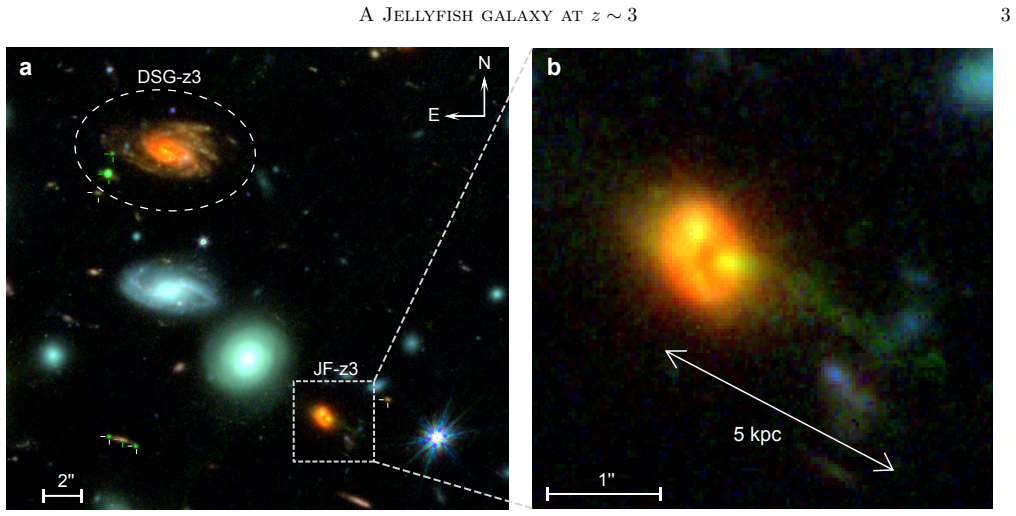
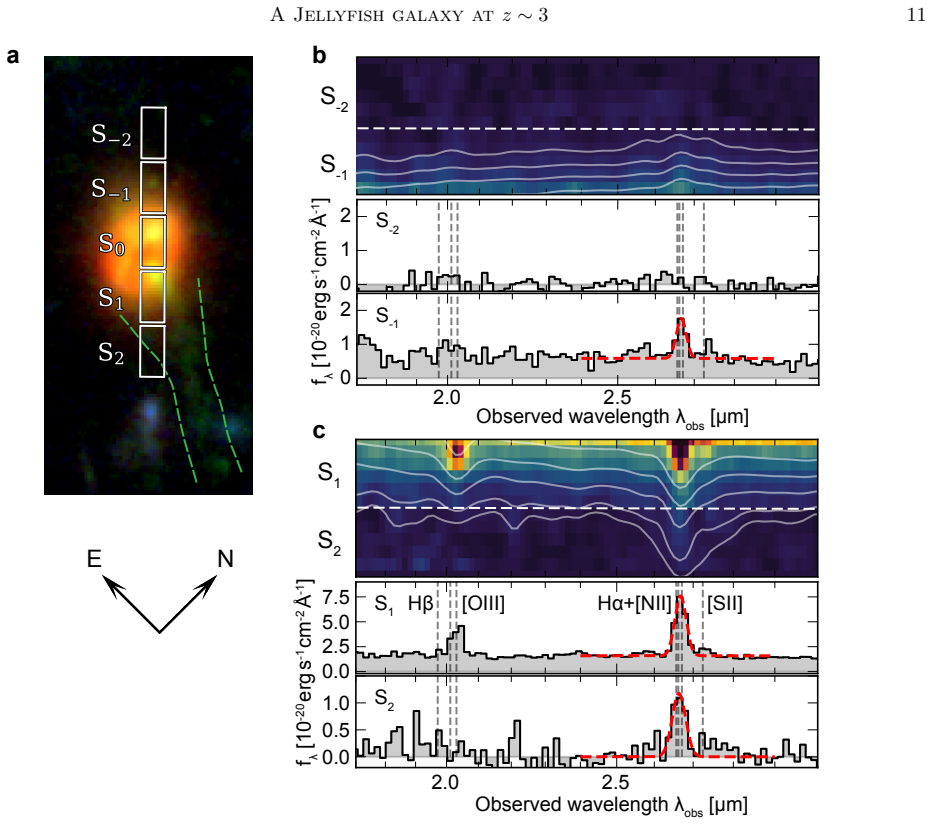
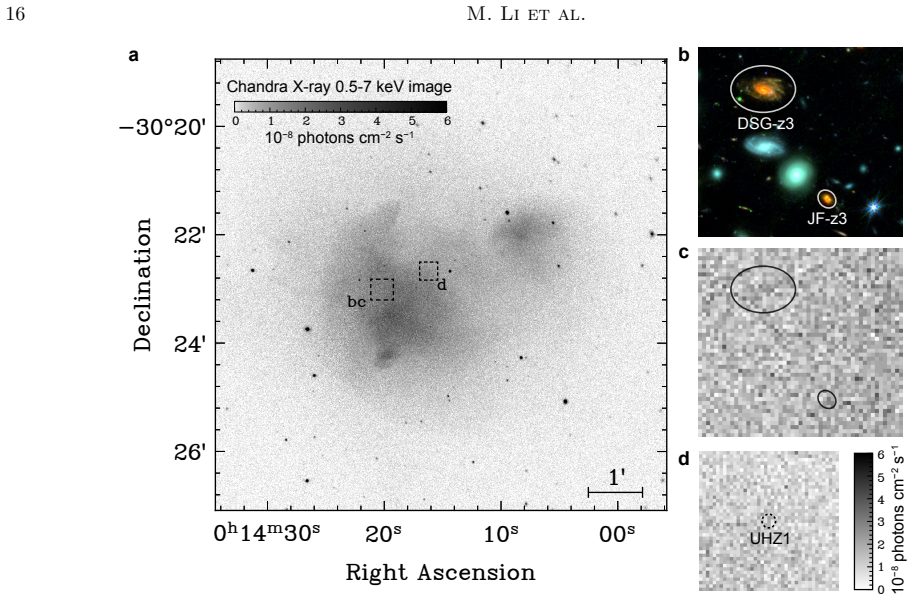
The central discovery is the observation of ongoing ram-pressure stripping in galaxy A2744-JF-z3 at z=3.06. Using JWST and ALMA, the authors find evidence for the removal of cold gas and dust that coincides with the end of star formation, marking the earliest known case of this environmental quenching mechanism.
What carries the argument
Ram-pressure stripping driven by the galaxy's motion through the dense intra-group medium, which removes the interstellar gas and dust as shown by the spectroscopic and continuum observations.
If this is right
- RPS operates effectively at z>3 despite simulation predictions of reduced incidence.
- The stripping is highly stochastic and impulsive due to clumpy structures in the intra-group and circumgalactic medium.
- Environmental quenching via RPS extends into the epoch of galaxy assembly in protoclusters.
- RPS serves as a key pathway for rapid quenching in nascent galaxy groups at high redshift.
Where Pith is reading between the lines
- This mechanism could account for some of the massive quiescent galaxies found in early-universe surveys.
- Galaxy formation models should include more detailed treatments of clumpy gas distributions to predict RPS rates at high redshift.
- Targeted observations of other high-redshift groups might reveal how common this process is during cosmic dawn.
Load-bearing premise
The observed gas and dust removal is attributed to ram-pressure stripping based on spectroscopic diagnostics and SED modeling, rather than alternative mechanisms like AGN activity or mergers.
What would settle it
If additional data showed no evidence of stripped gas tails or velocity offsets expected from ram pressure, or if the dust and gas deficits could be fully explained by internal galaxy processes alone.
Figures




read the original abstract
Understanding how galaxies ignite and extinguish their star formation remains a cornerstone question in modern astrophysics. Recent JWST surveys have revealed an overabundance of massive quiescent galaxies in the first billion years of the Universe, challenging current models of galaxy evolution. In the nearby Universe, ram pressure stripping (RPS) is a major environmental mechanism capable of rapidly shutting down star formation, yet direct observation remains scarce at redshift $z\gtrsim1$, and its role at $z>2$ is even poorly constrained by simulations. Here, we utilize JWST and ALMA observations to present direct evidence of RPS in the post-starburst galaxy A2744-JF-z3, residing in a galaxy group at redshift 3.06, the earliest such detection to date. Spectroscopic diagnostics and spectral energy distribution modeling reveal the ongoing removal of cold gas and dust, coincident with the abrupt cessation of star formation. Contrary to hydrodynamical simulations that predict a reduced incidence of RPS at high redshift, our results instead imply that RPS can operate at $z>3$, suggesting a highly stochastic and impulsive stripping within a clumpy, filamentary intra-group and circumgalactic medium. These observations extend environmental quenching well into the epoch of galaxy assembly, highlighting RPS as a previously overlooked decisive pathway to rapid quenching in nascent groups and protoclusters in the early Universe.
Editorial analysis
A structured set of objections, weighed in public.
Referee Report
Summary. The paper reports JWST and ALMA observations of the post-starburst galaxy A2744-JF-z3 at z=3.06 in a galaxy group, claiming the earliest direct evidence of ram-pressure stripping (RPS). Spectroscopic diagnostics and SED modeling are used to infer ongoing removal of cold gas and dust coincident with abrupt quenching, implying RPS operates efficiently at z>3 in a clumpy intra-group medium contrary to simulations.
Significance. If the attribution to RPS holds after rigorous exclusion of alternatives, the result would be significant as the highest-redshift direct detection of environmental quenching via RPS, extending such processes into the epoch of galaxy assembly and indicating that simulations may underestimate the role of stochastic stripping in nascent groups and protoclusters.
major comments (2)
- [Abstract and spectroscopic diagnostics section] Abstract and the section presenting spectroscopic diagnostics: the claim of 'direct evidence' of RPS relies on line ratios, gas masses, and morphological features, but the manuscript does not quantify how these observables uniquely exclude AGN-driven outflows or merger-induced gas removal; at z=3.06 the expected intra-group medium density is low, so a concrete test (e.g., comparison of observed velocity gradients or tail orientations to RPS versus wind models) is needed to support the central attribution.
- [SED modeling and ALMA analysis] The SED modeling and ALMA gas-mass section: the inference of ongoing cold-gas removal is load-bearing for the RPS interpretation, yet the text does not report the full posterior distributions, systematic uncertainties from dust-temperature assumptions, or explicit comparison to post-starburst templates that could mimic the observed deficit without external stripping.
minor comments (2)
- [Figures] Figure captions should explicitly state the spatial resolution of the JWST and ALMA data and whether the reported morphological features (e.g., tails) are resolved or inferred from integrated spectra.
- [Introduction] The introduction would benefit from a brief reference to the specific hydrodynamical simulations cited as predicting reduced RPS incidence at high redshift.
Simulated Author's Rebuttal
We thank the referee for their detailed and insightful report. Their comments have prompted us to clarify and strengthen several aspects of our analysis. Below, we respond point by point to the major comments.
read point-by-point responses
-
Referee: [Abstract and spectroscopic diagnostics section] Abstract and the section presenting spectroscopic diagnostics: the claim of 'direct evidence' of RPS relies on line ratios, gas masses, and morphological features, but the manuscript does not quantify how these observables uniquely exclude AGN-driven outflows or merger-induced gas removal; at z=3.06 the expected intra-group medium density is low, so a concrete test (e.g., comparison of observed velocity gradients or tail orientations to RPS versus wind models) is needed to support the central attribution.
Authors: We have revised the spectroscopic diagnostics section to include a quantitative assessment of how the line ratios, gas masses, and morphological features distinguish ram-pressure stripping from AGN-driven outflows and merger-induced processes. Specifically, we compare the observed [OIII]/Hβ and other line ratios to standard AGN diagnostic diagrams and outflow models, showing consistency with star-formation dominated ionization rather than AGN. For the morphological features, we now present a direct comparison of the velocity field and tail orientation with both RPS and galactic wind models, finding better agreement with RPS predictions. Regarding the intra-group medium density, we discuss that while average densities are low, the clumpy nature inferred from the group environment allows for localized high-density regions capable of efficient stripping, consistent with our observations of gas removal. We believe these additions provide the concrete test requested. revision: yes
-
Referee: [SED modeling and ALMA analysis] The SED modeling and ALMA gas-mass section: the inference of ongoing cold-gas removal is load-bearing for the RPS interpretation, yet the text does not report the full posterior distributions, systematic uncertainties from dust-temperature assumptions, or explicit comparison to post-starburst templates that could mimic the observed deficit without external stripping.
Authors: In response to this comment, we have updated the SED modeling and ALMA gas-mass section to report the full posterior distributions from our fits. We now explicitly discuss the systematic uncertainties associated with dust temperature assumptions and how they affect the derived gas masses. Furthermore, we include a comparison with post-starburst templates from the literature, which shows that while some internal quenching can reduce star formation, the observed deficit in cold gas and dust requires an external mechanism such as ram-pressure stripping to fully account for the data. These revisions make the inference of ongoing cold-gas removal more robust. revision: yes
Circularity Check
No circularity: observational evidence from independent telescope data
full rationale
The paper's central claim rests on JWST and ALMA observations interpreted via standard spectroscopic diagnostics and SED modeling to attribute gas/dust removal to ram-pressure stripping. No load-bearing steps reduce by construction to the authors' own prior fits, self-citations, or ansatzes; the evidence chain is self-contained through external empirical data without any equations or parameters that are redefined as predictions.
Axiom & Free-Parameter Ledger
axioms (1)
- domain assumption Spectroscopic line ratios and velocity fields at high redshift can be unambiguously attributed to ram-pressure stripping when coincident with post-starburst signatures.
Reference graph
Works this paper leans on
-
[1]
2016, AJ, 152, 32, doi: 10.3847/0004-6256/152/2/32
Abramson, A., Kenney, J., Crowl, H., & Tal, T. 2016, AJ, 152, 32, doi: 10.3847/0004-6256/152/2/32
-
[2]
doi:10.1093/mnras/stv1062 , eprint =
Aird, J., Coil, A. L., Georgakakis, A., et al. 2015, MNRAS, 451, 1892, doi: 10.1093/mnras/stv1062
-
[3]
Alberts, S., & Noble, A. 2022, Univ, 8, 554, doi: 10.3390/universe8110554 ´Alvarez-M´ arquez, J., Colina, L., Crespo-Gomez, A., et al. 2026, arXiv, arXiv:2602.02323, doi: 10.48550/arXiv.2602.02323
-
[4]
Asplund, M., Grevesse, N., Sauval, A. J., & Scott, P. 2009, ARA&A, 47, 481, doi: 10.1146/annurev.astro.46.060407.145222
-
[5]
Baldry, I. K., Balogh, M. L., Bower, R. G., et al. 2006, MNRAS, 373, 469, doi: 10.1111/j.1365-2966.2006.11081.x
-
[6]
K., Glazebrook K., Brinkmann J., Ivezi \'c Z ., Lupton R
Baldry, I. K., Glazebrook, K., Brinkmann, J., et al. 2004, ApJ, 600, 681, doi: 10.1086/380092
-
[7]
Bezanson, R., Labbe, I., Whitaker, K. E., et al. 2024, ApJ, 974, 92, doi: 10.3847/1538-4357/ad66cf Bogd´ an,´A., Goulding, A. D., Natarajan, P., et al. 2024, NatAs, 8, 126, doi: 10.1038/s41550-023-02111-9
-
[8]
2022, A&ARv, 30, 3, doi: 10.1007/s00159-022-00140-3
Boselli, A., Fossati, M., & Sun, M. 2022, A&ARv, 30, 3, doi: 10.1007/s00159-022-00140-3
-
[9]
Boselli, A., Cuillandre, J. C., Fossati, M., et al. 2016, A&A, 587, A68, doi: 10.1051/0004-6361/201527795
-
[10]
2023, MNRAS, 525, 2087, doi: 10.1093/mnras/stad1704
Brinchmann, J. 2023, MNRAS, 525, 2087, doi: 10.1093/mnras/stad1704
-
[11]
Bruzual, G., & Charlot, S. 2003, MNRAS, 344, 1000, doi: 10.1046/j.1365-8711.2003.06897.x
-
[12]
2023,, 1.11.2 Zenodo, doi: 10.5281/zenodo.8140011 Calabr` o, A., Pentericci, L., Feltre, A., et al
Bushouse, H., Eisenhamer, J., Dencheva, N., et al. 2023,, 1.11.2 Zenodo, doi: 10.5281/zenodo.8140011 Calabr` o, A., Pentericci, L., Feltre, A., et al. 2023, A&A, 679, A80, doi: 10.1051/0004-6361/202347190
-
[13]
Calzetti, D., Armus, L., Bohlin, R. C., et al. 2000, ApJ, 533, 682, doi: 10.1086/308692
work page internal anchor Pith review doi:10.1086/308692 2000
-
[14]
Carnall, A. C., McLure, R. J., Dunlop, J. S., & Dav´ e, R. 2018, MNRAS, 480, 4379, doi: 10.1093/mnras/sty2169
-
[15]
Carnall, A. C., McLure, R. J., Dunlop, J. S., et al. 2019, Monthly Notices of the Royal Astronomical Society, 490, 417, doi: 10.1093/mnras/stz2544
-
[16]
Carnall, A. C., McLure, R. J., Dunlop, J. S., et al. 2023, Natur, 619, 716, doi: 10.1038/s41586-023-06158-6 CASA Team, Bean, B., Bhatnagar, S., et al. 2022, PASP, 134, 114501, doi: 10.1088/1538-3873/ac9642
-
[17]
Lehnert, M. D., & Prochaska, J. X. 2021, ApJ, 923, 200, doi: 10.3847/1538-4357/ac2b9d
-
[18]
2016, MNRAS, 462, 1415, doi: 10.1093/mnras/stw1756
Chevallard, J., & Charlot, S. 2016, MNRAS, 462, 1415, doi: 10.1093/mnras/stw1756
-
[19]
2021, PASA, 38, e035, doi: 10.1017/pasa.2021.18
Cortese, L., Catinella, B., & Smith, R. 2021, PASA, 38, e035, doi: 10.1017/pasa.2021.18
-
[20]
Cramer, W. J., Kenney, J. D. P., Sun, M., et al. 2019, ApJ, 870, 63, doi: 10.3847/1538-4357/aaefff
-
[21]
Cramer, W. J., Kenney, J. D. P., Tonnesen, S., et al. 2021, ApJ, 921, 22, doi: 10.3847/1538-4357/ac1793
-
[22]
Dannerbauer, H., Lehnert, M. D., Emonts, B., et al. 2017, A&A, 608, A48, doi: 10.1051/0004-6361/201730449 D’Eugenio, F., P´ erez-Gonz´ alez, P. G., Maiolino, R., et al. 2024, NatAs, 8, 1443, doi: 10.1038/s41550-024-02345-1
-
[23]
Dey, A., Schlegel, D. J., Lang, D., et al. 2019, AJ, 157, 168, doi: 10.3847/1538-3881/ab089d
-
[24]
Duras, F., Bongiorno, A., Ricci, F., et al. 2020, A&A, 636, A73, doi: 10.1051/0004-6361/201936817
-
[25]
Ebeling, H., Stephenson, L. N., & Edge, A. C. 2014, ApJL, 781, L40, doi: 10.1088/2041-8205/781/2/L40
-
[26]
E., Bialek, J., Busha, M., et al
Evrard, A. E., Bialek, J., Busha, M., et al. 2008, ApJ, 672, 122, doi: 10.1086/521616 Falc´ on-Barroso, J., S´ anchez-Bl´ azquez, P., Vazdekis, A., et al. 2011, A&A, 532, A95, doi: 10.1051/0004-6361/201116842
-
[27]
2016, MNRAS, 455, 2028, doi: 10.1093/mnras/stv2400
Fossati, M., Fumagalli, M., Boselli, A., et al. 2016, MNRAS, 455, 2028, doi: 10.1093/mnras/stv2400
-
[28]
Fruscione, A., McDowell, J. C., Allen, G. E., et al. 2006, in Society of Photo-Optical Instrumentation Engineers (SPIE) Conference Series, Vol. 6270, Observatory Operations: Strategies, Processes, and Systems, ed. D. R. Silva & R. E. Doxsey, 62701V, doi: 10.1117/12.671760
-
[29]
Furtak, L. J., Zitrin, A., Weaver, J. R., et al. 2023, MNRAS, 523, 4568, doi: 10.1093/mnras/stad1627 Gaia Collaboration, Brown, A. G. A., Vallenari, A., et al. 2018, A&A, 616, A1, doi: 10.1051/0004-6361/201833051 Gaia Collaboration, Vallenari, A., Brown, A. G. A., et al. 2023, A&A, 674, A1, doi: 10.1051/0004-6361/202243940
-
[30]
doi:10.1038/s41586-024-07191-9 , arxivId =
Glazebrook, K., Nanayakkara, T., Schreiber, C., et al. 2024, Natur, 628, 277, doi: 10.1038/s41586-024-07191-9
-
[31]
, year = 1972, month = aug, volume =
Gunn, J. E., & Gott, III, J. R. 1972, ApJ, 176, 1, doi: 10.1086/151605
-
[32]
Hamadouche, M. L., McLure, R. J., Carnall, A., et al. 2024, arXiv, arXiv:2412.09592, doi: 10.48550/arXiv.2412.09592
-
[33]
Hartley, A. I., Nelson, E. J., Suess, K. A., et al. 2023, MNRAS, 522, 3138, doi: 10.1093/mnras/stad1162
-
[34]
Hunter, T. R., Indebetouw, R., Brogan, C. L., et al. 2023, PASP, 135, 074501, doi: 10.1088/1538-3873/ace216
-
[35]
K., Shimizu, I., Iwata, I., & Tanaka, M
Inoue, A. K., Shimizu, I., Iwata, I., & Tanaka, M. 2014, MNRAS, 442, 1805, doi: 10.1093/mnras/stu936
-
[36]
Izotov, Y. I., & Thuan, T. X. 2016, MNRAS, 457, 64, doi: 10.1093/mnras/stv2957 J´ achym, P., Sun, M., Kenney, J. D. P., et al. 2017, ApJ, 839, 114, doi: 10.3847/1538-4357/aa6af5 J´ achym, P., Kenney, J. D. P., Sun, M., et al. 2019, ApJ, 883, 145, doi: 10.3847/1538-4357/ab3e6c 18M. Li et al
-
[37]
Jin, S., Sillassen, N. B., Magdis, G. E., et al. 2024, A&A, 683, L4, doi: 10.1051/0004-6361/202348540
-
[38]
Jones, A. P., & Nuth, J. A. 2011, A&A, 530, A44, doi: 10.1051/0004-6361/201014440
-
[39]
Kenney, J. D. P., Abramson, A., & Bravo-Alfaro, H. 2015, AJ, 150, 59, doi: 10.1088/0004-6256/150/2/59
-
[40]
C., Remus, R.-S., Seidel, B., et al
Kimmig, L. C., Remus, R.-S., Seidel, B., et al. 2025, ApJ, 979, 15, doi: 10.3847/1538-4357/ad9472
-
[41]
Koo, B.-C., Raymond, J. C., & Kim, H.-J. 2016, JKAS, 49, 109, doi: 10.5303/JKAS.2016.49.3.109
-
[42]
Kravtsov, A. V., & Borgani, S. 2012, ARA&A, 50, 353, doi: 10.1146/annurev-astro-081811-125502
-
[43]
Kron, R. G. 1980, ApJS, 43, 305, doi: 10.1086/190669
-
[44]
G., Staveley-Smith, L., de Blok, W
Kroupa, P. 2001, MNRAS, 322, 231, doi: 10.1046/j.1365-8711.2001.04022.x Labb´ e, I., van Dokkum, P., Nelson, E., et al. 2023, Natur, 616, 266, doi: 10.1038/s41586-023-05786-2
-
[45]
Lagos, C. d. P., Bravo, M., Tobar, R., et al. 2024, MNRAS, 531, 3551, doi: 10.1093/mnras/stae1024
-
[46]
2022, MNRAS, 509, 3938, doi: 10.1093/mnras/stab3280
Laudari, S., J´ achym, P., Sun, M., et al. 2022, MNRAS, 509, 3938, doi: 10.1093/mnras/stab3280
-
[47]
Byler, N. 2017, ApJ, 837, 170, doi: 10.3847/1538-4357/aa5ffe
-
[48]
2024, ApJS, 275, 27, doi: 10.3847/1538-4365/ad812c
Li, M., Zhang, H., Cai, Z., et al. 2024, ApJS, 275, 27, doi: 10.3847/1538-4365/ad812c
-
[49]
J., D’Eugenio, F., Maiolino, R., et al
Looser, T. J., D’Eugenio, F., Maiolino, R., et al. 2024, Natur, 629, 53, doi: 10.1038/s41586-024-07227-0
-
[50]
M., Koekemoer, A., Coe, D., et al
Lotz, J. M., Koekemoer, A., Coe, D., et al. 2017, ApJ, 837, 97, doi: 10.3847/1538-4357/837/1/97
-
[51]
Lovell, C. C., Roper, W., Vijayan, A. P., et al. 2023, MNRAS, 525, 5520, doi: 10.1093/mnras/stad2550
-
[52]
2025, NatAs, 9, 128, doi: 10.1038/s41550-024-02391-9
Lu, S., Daddi, E., Maraston, C., et al. 2025, NatAs, 9, 128, doi: 10.1038/s41550-024-02391-9
-
[53]
2018, NatAs, 2, 695, doi: 10.1038/s41550-018-0558-1
Man, A., & Belli, S. 2018, NatAs, 2, 695, doi: 10.1038/s41550-018-0558-1
-
[54]
2006, ApJ, 652, 85, doi: 10.1086/508143
Maraston, C., Daddi, E., Renzini, A., et al. 2006, ApJ, 652, 85, doi: 10.1086/508143
-
[55]
Moretti, A., Paladino, R., Poggianti, B. M., et al. 2020, ApJ, 889, 9, doi: 10.3847/1538-4357/ab616a
-
[56]
2025, ApJ, 982, 153, doi: 10.3847/1538-4357/adb30f
Morishita, T., Liu, Z., Stiavelli, M., et al. 2025, ApJ, 982, 153, doi: 10.3847/1538-4357/adb30f
-
[57]
P., Matthee, J., Kramarenko, I., et al
Naidu, R. P., Matthee, J., Kramarenko, I., et al. 2024, arXiv, arXiv:2410.01874, doi: 10.48550/arXiv.2410.01874
-
[58]
2024, NatSR, 14, 3724, doi: 10.1038/s41598-024-52585-4
Nanayakkara, T., Glazebrook, K., Jacobs, C., et al. 2024, NatSR, 14, 3724, doi: 10.1038/s41598-024-52585-4
-
[59]
2024, ApJL, 960, L1, doi:10.3847/2041-8213/ad0e76
Natarajan, P., Pacucci, F., Ricarte, A., et al. 2024, ApJL, 960, L1, doi: 10.3847/2041-8213/ad0e76
-
[60]
Oke, J. B., & Gunn, J. E. 1983, ApJ, 266, 713, doi: 10.1086/160817
-
[61]
Peng, Y.-j., Lilly, S. J., Kovaˇ c, K., et al. 2010, ApJ, 721, 193, doi: 10.1088/0004-637X/721/1/193
-
[62]
D., Sivaramakrishnan, A., Lajoie, C.-P., et al
Perrin, M. D., Sivaramakrishnan, A., Lajoie, C.-P., et al. 2014, in Society of Photo-Optical Instrumentation Engineers (SPIE) Conference Series, Vol. 9143, Space Telescopes and Instrumentation 2014: Optical, Infrared, and Millimeter Wave, ed. J. M. Oschmann, Jr., M. Clampin, G. G. Fazio, & H. A. MacEwen, 91433X, doi: 10.1117/12.2056689 Planck Collaboratio...
-
[63]
M., Ignesti, A., Gitti, M., et al
Poggianti, B. M., Ignesti, A., Gitti, M., et al. 2019, ApJ, 887, 155, doi: 10.3847/1538-4357/ab5224
-
[64]
H., Bezanson, R., Labbe, I., et al
Price, S. H., Bezanson, R., Labbe, I., et al. 2025, ApJ, 982, 51, doi: 10.3847/1538-4357/adaec1
-
[65]
Rieke, M. J., Kelly, D. M., Misselt, K., et al. 2023, PASP, 135, 028001, doi: 10.1088/1538-3873/acac53
-
[66]
Roberts, I. D., Balogh, M. L., Sok, V., et al. 2026, ApJ, 998, 285, doi: 10.3847/1538-4357/ae3824
-
[67]
Sage, L. J. 1990, A&A, 239, 125
1990
-
[68]
Shapley, A. E., Sanders, R. L., Topping, M. W., et al. 2025, ApJ, 980, 242, doi: 10.3847/1538-4357/adad68
-
[69]
F., Faucher-Gigu` ere, C.-A., et al
Shen, X., Hopkins, P. F., Faucher-Gigu` ere, C.-A., et al. 2020, MNRAS, 495, 3252, doi: 10.1093/mnras/staa1381
-
[70]
Simons, R. C., Peeples, M. S., Tumlinson, J., et al. 2020, ApJ, 905, 167, doi: 10.3847/1538-4357/abc5b8
-
[71]
L., Jauzac, M., Acebron, A., et al
Steinhardt, C. L., Jauzac, M., Acebron, A., et al. 2020, ApJS, 247, 64, doi: 10.3847/1538-4365/ab75ed
-
[72]
Suess, K. A., Weaver, J. R., Price, S. H., et al. 2024, ApJ, 976, 101, doi: 10.3847/1538-4357/ad75fe
-
[73]
2022, ApJ, 935, 110, doi: 10.3847/1538-4357/ac8158
Treu, T., Roberts-Borsani, G., Bradac, M., et al. 2022, ApJ, 935, 110, doi: 10.3847/1538-4357/ac8158
-
[74]
2025, MNRAS, 536, 777, doi: 10.1093/mnras/stae2625
Vani, A., Ayromlou, M., Kauffmann, G., & Springel, V. 2025, MNRAS, 536, 777, doi: 10.1093/mnras/stae2625
-
[75]
Veilleux, S., Cecil, G., & Bland-Hawthorn, J. 2005, ARA&A, 43, 769, doi: 10.1146/annurev.astro.43.072103.150610
-
[76]
2015, A&A, 582, A6, doi: 10.1051/0004-6361/201526551
Verdugo, C., Combes, F., Dasyra, K., Salom´ e, P., & Braine, J. 2015, A&A, 582, A6, doi: 10.1051/0004-6361/201526551
-
[77]
2024, MNRAS, 529, 1299, doi: 10.1093/mnras/stae323
Vikaeus, A., Zackrisson, E., Wilkins, S., et al. 2024, MNRAS, 529, 1299, doi: 10.1093/mnras/stae323
-
[78]
2025, NatAs, 9, 165, doi: 10.1038/s41550-024-02376-8
Wang, B., Peng, Y., & Cappellari, M. 2025, NatAs, 9, 165, doi: 10.1038/s41550-024-02376-8
-
[79]
and Henry, Alaina and Brammer, Gabriel and Strait, Victoria and Brada
Wang, X., Jones, T., Vulcani, B., et al. 2022, ApJL, 938, L16, doi: 10.3847/2041-8213/ac959e
-
[80]
Wilkins, S. M., Lovell, C. C., Irodotou, D., et al. 2024, MNRAS, 527, 7965, doi: 10.1093/mnras/stad3558
discussion (0)
Sign in with ORCID, Apple, or X to comment. Anyone can read and Pith papers without signing in.