Recognition: unknown
Adaptive Spiking Neurons for Vision and Language Modeling
Pith reviewed 2026-05-10 14:25 UTC · model grok-4.3
The pith
Trainable parameters let spiking neurons learn adaptive firing dynamics for vision and language tasks.
A machine-rendered reading of the paper's core claim, the machinery that carries it, and where it could break.
Core claim
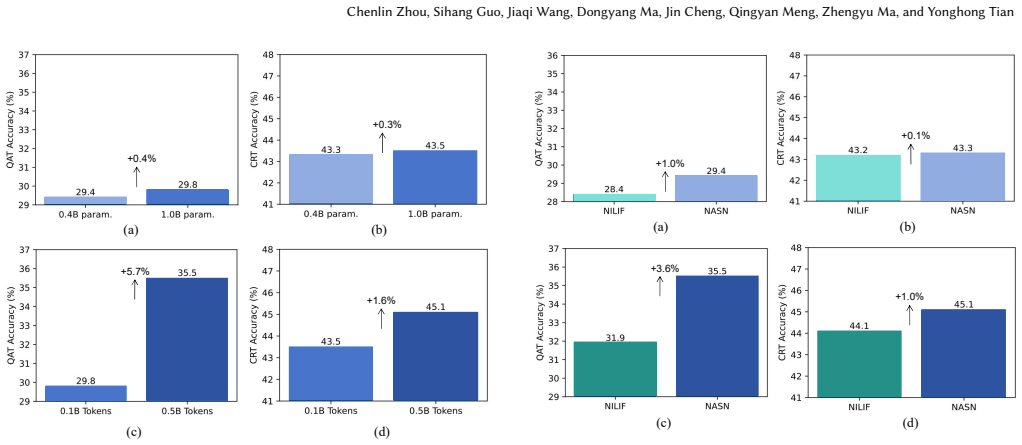
We propose the Adaptive Spiking Neuron (ASN), which incorporates trainable parameters to learn membrane potential dynamics and enable adaptive firing. ASN adopts an integer training and spike inference paradigm, facilitating efficient SNN training. To further enhance robustness, we propose a specialized variant of ASN, the Normalized Adaptive Spiking Neuron (NASN), which integrates normalization to stabilize training. We evaluate our neuron model on 19 datasets spanning five distinct tasks in both vision and language modalities, demonstrating the effectiveness and versatility of the ASN family.
What carries the argument
The Adaptive Spiking Neuron (ASN), a neuron model that adds trainable parameters to control membrane potential dynamics and produce adaptive firing.
If this is right
- ASN supports efficient training through integer operations and spike-based inference.
- The same neuron works across vision and language tasks on 19 different datasets.
- The NASN variant adds normalization that reduces training instability.
- A functional perspective on neuron design supplies rules for creating future spiking neurons.
Where Pith is reading between the lines
- The trainable-parameter approach could extend to other spiking-neuron variants beyond the two presented.
- Because the method already covers two modalities, it may reduce the need for modality-specific neuron redesigns.
- If the integer training scheme preserves accuracy at scale, it would lower the compute cost of building large spiking models.
Load-bearing premise
That trainable parameters added to spiking neurons will create stable adaptive firing and raise performance without overfitting or training collapse across tasks.
What would settle it
A controlled experiment in which ASN and a standard non-adaptive spiking neuron are trained on the same vision or language dataset and the ASN version shows no accuracy gain or exhibits repeated training divergence.
Figures

read the original abstract
Regarded as the third generation of neural networks, Spiking Neural Networks (SNNs) have garnered significant traction due to their biological plausibility and energy efficiency. Recent advancements in large models necessitate spiking neurons capable of high performance, adaptability, and training efficiency. In this work, we first propose a novel functional perspective that provides general guidance for designing the new generation of spiking neurons. Following the insightful guidelines, we propose the Adaptive Spiking Neuron (ASN), which incorporates trainable parameters to learn membrane potential dynamics and enable adaptive firing. ASN adopts an integer training and spike inference paradigm, facilitating efficient SNN training. To further enhance robustness, we propose a specialized variant of ASN, the Normalized Adaptive Spiking Neuron (NASN), which integrates normalization to stabilize training. We evaluate our neuron model on 19 datasets spanning five distinct tasks in both vision and language modalities, demonstrating the effectiveness and versatility of the ASN family. Our ASN family is expected to become the new generation of general-purpose spiking neurons.
Editorial analysis
A structured set of objections, weighed in public.
Referee Report
Summary. The manuscript proposes a novel functional perspective to guide the design of spiking neurons. From this, it derives the Adaptive Spiking Neuron (ASN) that incorporates trainable parameters to learn membrane potential dynamics and enable adaptive firing. ASN adopts an integer training and spike inference paradigm for efficiency. A normalized variant (NASN) is introduced to stabilize training. The ASN family is evaluated on 19 datasets across five tasks in vision and language modalities, with claims of demonstrating effectiveness and versatility as a new generation of general-purpose spiking neurons.
Significance. If the central claims hold with proper validation, the work could advance spiking neural networks by supplying a design principle for adaptive neurons that maintain efficiency while scaling to multi-modal large models. The cross-modality evaluation on 19 datasets would support broader applicability of SNNs beyond vision-only tasks. However, the absence of supporting derivations, baselines, and ablations in the text makes the significance difficult to gauge at present.
major comments (3)
- [Abstract] Abstract: the assertion of effectiveness on 19 datasets spanning five tasks supplies no baselines, quantitative metrics, ablation results, or training details, so the central performance claims cannot be evaluated.
- [Abstract] Abstract: the novel functional perspective is presented as providing general guidance for designing spiking neurons, but no derivation, equations, or demonstration of independence from the proposed trainable parameters is given, leaving the guidance circular.
- [Abstract] Abstract: no analysis or ablation isolates the effect of the trainable membrane parameters on adaptive firing (versus simply adding capacity), nor shows how NASN normalization interacts with the integer training/spike inference split to prevent instability or overfitting on long-sequence language tasks.
minor comments (1)
- [Abstract] Abstract: specify the exact five tasks and the 19 datasets to allow readers to assess the scope of the evaluation.
Simulated Author's Rebuttal
We thank the referee for their insightful comments, which have helped us identify areas for improvement in the manuscript. We provide detailed responses to each major comment below.
read point-by-point responses
-
Referee: [Abstract] Abstract: the assertion of effectiveness on 19 datasets spanning five tasks supplies no baselines, quantitative metrics, ablation results, or training details, so the central performance claims cannot be evaluated.
Authors: The abstract is intended as a summary. However, to allow evaluation of the claims, we will revise the abstract to include key baseline comparisons and quantitative metrics from our experiments. revision: yes
-
Referee: [Abstract] Abstract: the novel functional perspective is presented as providing general guidance for designing spiking neurons, but no derivation, equations, or demonstration of independence from the proposed trainable parameters is given, leaving the guidance circular.
Authors: We will revise the manuscript to include a detailed derivation of the functional perspective, including equations, and demonstrate its independence from the specific trainable parameters in ASN to avoid any perception of circularity. revision: yes
-
Referee: [Abstract] Abstract: no analysis or ablation isolates the effect of the trainable membrane parameters on adaptive firing (versus simply adding capacity), nor shows how NASN normalization interacts with the integer training/spike inference split to prevent instability or overfitting on long-sequence language tasks.
Authors: We agree that additional analysis is needed. We will include new ablations that isolate the contribution of the trainable membrane parameters and examine the interaction of NASN normalization with the integer training and spike inference approach, particularly for language tasks to address concerns about instability and overfitting. revision: yes
Circularity Check
No circularity: design proposal with independent empirical validation
full rationale
The paper first introduces a novel functional perspective as general guidance, then follows it to define ASN with trainable membrane parameters and an integer-training/spike-inference split, plus NASN with added normalization. No equations, self-citations, or uniqueness theorems are invoked that reduce the claimed adaptive-firing benefit or performance gains to the inputs by construction. The 19-dataset evaluation across vision and language tasks supplies external falsifiable evidence, so the derivation chain remains self-contained rather than tautological.
Axiom & Free-Parameter Ledger
free parameters (1)
- trainable parameters for membrane potential dynamics
axioms (1)
- ad hoc to paper A novel functional perspective provides general guidance for designing new spiking neurons
invented entities (2)
-
Adaptive Spiking Neuron (ASN)
no independent evidence
-
Normalized Adaptive Spiking Neuron (NASN)
no independent evidence
Reference graph
Works this paper leans on
-
[1]
Yonatan Bisk, Rowan Zellers, Jianfeng Gao, Yejin Choi, et al. 2020. Piqa: Reasoning about physical commonsense in natural language. InProceedings of the AAAI conference on artificial intelligence, Vol. 34. 7432–7439
2020
-
[2]
Yongqiang Cao, Yang Chen, and Deepak Khosla. 2015. Spiking deep convolutional neural networks for energy-efficient object recognition.International Journal of Computer Vision113, 1 (2015), 54–66
2015
-
[3]
Christopher Clark, Kenton Lee, Ming-Wei Chang, Tom Kwiatkowski, Michael Collins, and Kristina Toutanova. 2019. Boolq: Exploring the surprising difficulty of natural yes/no questions.arXiv preprint arXiv:1905.10044(2019)
work page internal anchor Pith review arXiv 2019
-
[4]
Peter Clark, Isaac Cowhey, Oren Etzioni, Tushar Khot, Ashish Sabharwal, Carissa Schoenick, and Oyvind Tafjord. 2018. Think you have solved question answering? try arc, the ai2 reasoning challenge.arXiv preprint arXiv:1803.05457(2018)
work page internal anchor Pith review Pith/arXiv arXiv 2018
-
[5]
Jia Deng, Wei Dong, Richard Socher, Li-Jia Li, Kai Li, and Li Fei-Fei. 2009. Ima- genet: A large-scale hierarchical image database. InProceedings of the IEEE/CVF Conference on Computer Vision and Pattern Recognition (CVPR). 248–255
2009
-
[6]
Jacob Devlin, Ming-Wei Chang, Kenton Lee, and Kristina Toutanova. 2019. Bert: Pre-training of deep bidirectional transformers for language understanding. In Proceedings of the 2019 conference of the North American chapter of the association for computational linguistics: human language technologies, volume 1 (long and short papers). 4171–4186
2019
-
[7]
Wei Fang, Yanqi Chen, Jianhao Ding, Zhaofei Yu, Timothée Masquelier, Ding Chen, Liwei Huang, Huihui Zhou, Guoqi Li, and Yonghong Tian. 2023. Spiking- Jelly: An open-source machine learning infrastructure platform for spike-based intelligence.Science Advances9, 40 (2023), eadi1480. doi:10.1126/sciadv.adi1480 arXiv:https://www.science.org/doi/pdf/10.1126/sc...
-
[8]
Wei Fang, Zhaofei Yu, Yanqi Chen, Tiejun Huang, Timoth Masquelier, and Yonghong Tian. 2022. Deep Residual Learning in Spiking Neural Networks. InProceedings of the International Conference on Neural Information Processing Systems (NeurIPS), Vol. 34. 21056–21069
2022
-
[9]
Wei Fang, Zhaofei Yu, Yanqi Chen, Timothée Masquelier, Tiejun Huang, and Yonghong Tian. 2021. Incorporating learnable membrane time constant to enhance learning of spiking neural networks. InProceedings of the IEEE/CVF International Conference on Computer Vision (ICCV). 2661–2671
2021
-
[10]
Wei Fang, Zhaofei Yu, Zhaokun Zhou, Ding Chen, Yanqi Chen, Zhengyu Ma, Timothée Masquelier, and Yonghong Tian. 2023. Parallel spiking neurons with high efficiency and ability to learn long-term dependencies.Advances in Neural Information Processing Systems36 (2023), 53674–53687
2023
-
[11]
Yuetong Fang, Deming Zhou, Ziqing Wang, Hongwei Ren, ZeCui Zeng, Lusong Li, Renjing Xu, et al. 2025. Spiking Neural Networks Need High-Frequency Infor- mation. InThe Thirty-ninth Annual Conference on Neural Information Processing Systems
2025
-
[12]
Wulfram Gerstner, Werner M Kistler, Richard Naud, and Liam Paninski. 2014. Neuronal dynamics: From single neurons to networks and models of cognition. Cambridge University Press
2014
-
[13]
Dan Hendrycks and Kevin Gimpel. 2016. Gaussian error linear units (gelus). arXiv preprint arXiv:1606.08415(2016)
work page internal anchor Pith review Pith/arXiv arXiv 2016
- [14]
-
[15]
Alex Krizhevsky. 2009. Learning multiple layers of features from tiny images. (2009)
2009
-
[16]
Zhenxin Lei, Man Yao, Jiakui Hu, Xinhao Luo, Yanye Lu, Bo Xu, and Guoqi Li
-
[17]
InProceedings of the AAAI Conference on Artificial Intelligence, Vol
Spike2former: Efficient spiking transformer for high-performance image segmentation. InProceedings of the AAAI Conference on Artificial Intelligence, Vol. 39. 1364–1372
-
[18]
Anton Lozhkov, Loubna Ben Allal, Leandro von Werra, and Thomas Wolf. 2024. FineWeb-Edu: the Finest Collection of Educational Content. doi:10.57967/hf/2497
-
[19]
Xinhao Luo, Man Yao, Yuhong Chou, Bo Xu, and Guoqi Li. 2024. Integer-valued training and spike-driven inference spiking neural network for high-performance and energy-efficient object detection. InEuropean Conference on Computer Vision. Springer, 253–272
2024
- [20]
-
[21]
Wolfgang Maass. 1997. Networks of spiking neurons: the third generation of neural network models.Neural networks10, 9 (1997), 1659–1671
1997
-
[22]
Todor Mihaylov, Peter Clark, Tushar Khot, and Ashish Sabharwal. 2018. Can a suit of armor conduct electricity? a new dataset for open book question answering. arXiv preprint arXiv:1809.02789(2018)
work page internal anchor Pith review arXiv 2018
-
[23]
Yuqi Pan, Yupeng Feng, Jinghao Zhuang, Siyu Ding, Han Xu, Zehao Liu, Bohan Sun, Yuhong Chou, Xuerui Qiu, Anlin Deng, et al. 2025. SpikingBrain: Spiking Brain-inspired Large Models.arXiv preprint arXiv:2509.05276(2025)
work page internal anchor Pith review arXiv 2025
-
[24]
Bo Peng, Eric Alcaide, Quentin Anthony, Alon Albalak, Samuel Arcadinho, Stella Biderman, Huanqi Cao, Xin Cheng, Michael Chung, Matteo Grella, et al. 2023. Rwkv: Reinventing rnns for the transformer era.arXiv preprint arXiv:2305.13048 (2023)
work page internal anchor Pith review arXiv 2023
-
[25]
Kaushik Roy, Akhilesh Jaiswal, and Priyadarshini Panda. 2019. Towards Spike- based Machine Intelligence With Neuromorphic Computing.Nature575, 7784 (2019), 607–617
2019
-
[26]
Bodo Rueckauer, Iulia-Alexandra Lungu, Yuhuang Hu, Michael Pfeiffer, and Shih-Chii Liu. 2017. Conversion of continuous-valued deep networks to efficient event-driven networks for image classification.Frontiers in neuroscience11 (2017), 682
2017
-
[27]
Keisuke Sakaguchi, Ronan Le Bras, Chandra Bhagavatula, and Yejin Choi. 2021. Winogrande: An adversarial winograd schema challenge at scale.Commun. ACM 64, 9 (2021), 99–106
2021
- [28]
-
[29]
Alex Wang, Amanpreet Singh, Julian Michael, Felix Hill, Omer Levy, and Samuel R Bowman. 2018. GLUE: A multi-task benchmark and analysis platform for natural language understanding.arXiv preprint arXiv:1804.07461(2018)
work page internal anchor Pith review arXiv 2018
-
[30]
Yuchen Wang, Malu Zhang, Yi Chen, and Hong Qu. 2022. Signed Neuron with Memory: Towards Simple, Accurate and High-Efficient ANN-SNN Conversion. InInternational Joint Conference on Artificial Intelligence
2022
- [31]
-
[32]
Xingrun Xing, Zheng Zhang, Ziyi Ni, Shitao Xiao, Yiming Ju, Siqi Fan, Yequan Wang, Jiajun Zhang, and Guoqi Li. 2024. SpikeLM: Towards General Spike- Driven Language Modeling via Elastic Bi-Spiking Mechanisms. InInternational Conference on Machine Learning. PMLR, 54698–54714
2024
-
[33]
An Yang, Baosong Yang, Binyuan Hui, Bo Zheng, Bowen Yu, Chang Zhou, Cheng- peng Li, Chengyuan Li, Dayiheng Liu, Fei Huang, Guanting Dong, Haoran Wei, Huan Lin, Jialong Tang, Jialin Wang, Jian Yang, Jianhong Tu, Jianwei Zhang, Jianxin Ma, Jin Xu, Jingren Zhou, Jinze Bai, Jinzheng He, Junyang Lin, Kai Dang, Keming Lu, Keqin Chen, Kexin Yang, Mei Li, Mingfen...
work page internal anchor Pith review Pith/arXiv arXiv 2024
- [34]
-
[35]
Man Yao, Jiakui Hu, Zhaokun Zhou, Li Yuan, Yonghong Tian, Bo Xu, and Guoqi Li. 2023. Spike-driven transformer.Advances in neural information processing systems36 (2023), 64043–64058
2023
-
[36]
Man Yao, Xuerui Qiu, Tianxiang Hu, Jiakui Hu, Yuhong Chou, Keyu Tian, Jianxing Liao, Luziwei Leng, Bo Xu, and Guoqi Li. 2025. Scaling spike-driven transformer with efficient spike firing approximation training.IEEE Transactions on Pattern Analysis and Machine Intelligence(2025)
2025
-
[37]
Rowan Zellers, Ari Holtzman, Yonatan Bisk, Ali Farhadi, and Yejin Choi
-
[38]
Hellaswag: Can a machine really finish your sentence?arXiv preprint arXiv:1905.07830(2019)
work page internal anchor Pith review arXiv 1905
- [39]
-
[40]
Chenlin Zhou, Sihang Guo, Jiaqi Wang, Dongyang Ma, Kaiwei Che, Baiyu Chen, Qingyan Meng, Zhengyu Ma, and Yonghong Tian. 2026. Winner-Take-All Spiking Transformer for Language Modeling. arXiv:2604.11321 [cs.NE] https://arxiv. org/abs/2604.11321
work page internal anchor Pith review Pith/arXiv arXiv 2026
-
[41]
Chenlin Zhou, Liutao Yu, Zhaokun Zhou, Han Zhang, Jiaqi Wang, Huihui Zhou, Zhengyu Ma, and Yonghong Tian. 2026. Spikingformer: A key foundation model for spiking neural networks. InProceedings of the AAAI Conference on Artificial Intelligence, Vol. 40. 2236–2244
2026
-
[42]
Chenlin Zhou, Han Zhang, Liutao Yu, Yumin Ye, Zhaokun Zhou, Liwei Huang, Zhengyu Ma, Xiaopeng Fan, Huihui Zhou, and Yonghong Tian. 2024. Direct training high-performance deep spiking neural networks: a review of theories and methods.Frontiers in Neuroscience18 (2024), 1383844
2024
-
[43]
Chenlin Zhou, Han Zhang, Zhaokun Zhou, Liutao Yu, Liwei Huang, Xiaopeng Fan, Li Yuan, Zhengyu Ma, Huihui Zhou, and Yonghong Tian. 2024. Qkformer: Hierarchical spiking transformer using qk attention.Advances in Neural Infor- mation Processing Systems37 (2024), 13074–13098
2024
-
[44]
Chenlin Zhou, Han Zhang, Zhaokun Zhou, Liutao Yu, Zhengyu Ma, Huihui Zhou, Xiaopeng Fan, and Yonghong Tian. 2023. Enhancing the performance of transformer-based spiking neural networks by SNN-optimized downsampling with precise gradient backpropagation.arXiv preprint arXiv:2305.05954(2023)
-
[45]
Zhaokun Zhou, Yuesheng Zhu, Chao He, Yaowei Wang, Shuicheng YAN, Yonghong Tian, and Li Yuan. 2023. Spikformer: When Spiking Neural Net- work Meets Transformer. InThe Eleventh International Conference on Learning Representations. https://openreview.net/forum?id=frE4fUwz_h
2023
- [46]
discussion (0)
Sign in with ORCID, Apple, or X to comment. Anyone can read and Pith papers without signing in.