Recognition: unknown
Multiwavelength Study of Blue Straggler Stars in Tombaugh 2: Evidence for Binary Mass Transfer and Constraints on Cluster Dynamical State
Pith reviewed 2026-05-10 15:49 UTC · model grok-4.3
The pith
Binary mass transfer forms many blue straggler stars in Tombaugh 2, shown by their hot stripped companions in ultraviolet data.
A machine-rendered reading of the paper's core claim, the machinery that carries it, and where it could break.
Core claim
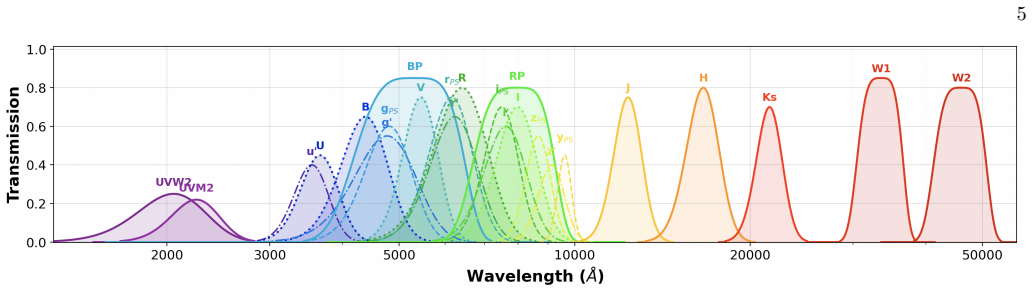
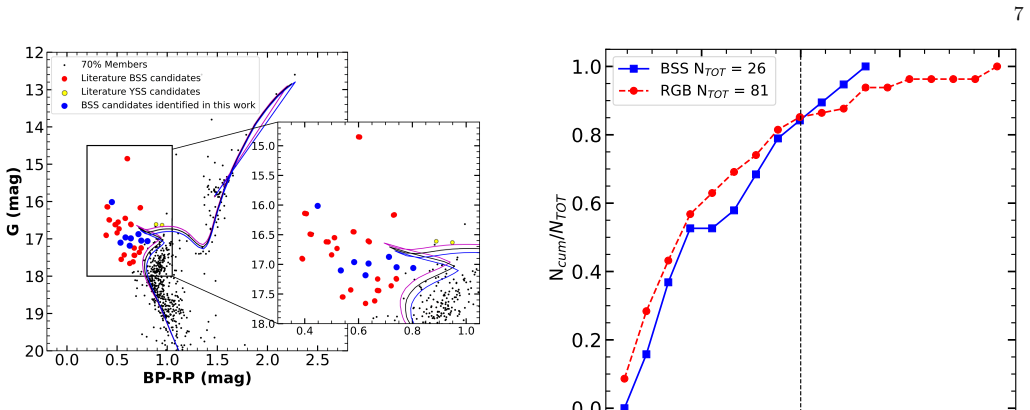
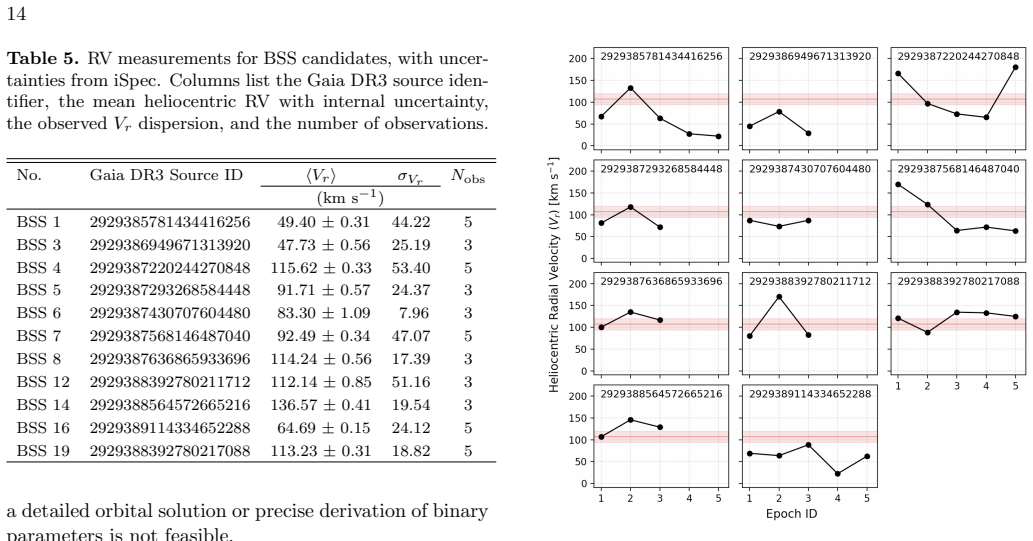
We identify 26 BSS candidates and 2 YSS candidates in Tombaugh 2. Spectral energy distributions from UV, optical, and IR data show that nine BSSs (32 percent) possess significant ultraviolet excess; binary decomposition yields companion temperatures of roughly 1.5 to 8 times 10^4 K and radii 0.04 to 0.28 solar radii, consistent with stripped proto-white dwarfs or young hot remnants produced by recent mass transfer. A slight central concentration of the BSS population, combined with these companions and radial-velocity variability in several systems, points to binary mass transfer as a dominant formation route, with no detectable signature of merger-driven formation.
What carries the argument
Binary SED decomposition of the ultraviolet excess that isolates the hot, low-luminosity companion component from the BSS primary.
If this is right
- Binary mass transfer supplies a substantial fraction of the BSS population in low-density open clusters of intermediate age.
- Optical-infrared photometry alone misses most hot compact companions, so ultraviolet observations are required to detect them.
- The cluster's King-model structure and weak mass segregation are consistent with limited dynamical processing at 1.74 Gyr.
- Multi-epoch radial-velocity monitoring independently verifies the binary nature of systems already flagged by ultraviolet excess.
- Merger products appear absent, implying that dynamical encounters are rare in this outer-disk environment.
Where Pith is reading between the lines
- The same ultraviolet-plus-spectroscopy approach applied to other outer-disk clusters could test whether mass transfer remains the dominant channel at larger Galactocentric radii.
- The temperatures and radii of the detected companions suggest mass-transfer episodes occurred within the last few hundred million years, providing a rough clock for recent binary evolution.
- If mass transfer dominates BSS formation here, the fraction of BSSs with detectable hot companions may decline in older clusters as the companions cool below UV detectability.
Load-bearing premise
The ultraviolet excess and SED fits uniquely trace stripped companions from mass transfer rather than unrelated hot sources or fitting errors, and the 26 BSS candidates are genuine cluster members free of significant field contamination.
What would settle it
High-resolution spectroscopy or deeper UV imaging that finds no radial-velocity variations and no hot-component signatures in the nine UV-excess candidates would falsify the mass-transfer interpretation.
Figures





read the original abstract
We present a focused multiwavelength study of blue straggler stars (BSSs) in the intermediate-age open cluster Tombaugh 2, located in the outer Galactic disk, to constrain the dominant formation pathways of BSSs in a low-density environment. Cluster members are identified using Gaia DR3 astrometry through a Gaussian Mixture Model, yielding a clean sample of high-probability members. Color-magnitude diagram analysis indicates an age of 1.74 Gyr. The radial surface density profile is well described by a King model, indicating a centrally concentrated overall structure, while the cluster exhibits only weak or no clear evidence of mass segregation among its stellar populations. We identify 26 BSS candidates and 2 YSS candidates. Spectral energy distributions constructed from ultraviolet, optical, and infrared photometry reveal that 9 BSSs (32%) exhibit significant ultraviolet excess, indicating an additional hot component. Binary SED decomposition identifies stripped companions with effective temperatures Teff $\sim$ (1.5-8) $\times$ 10$^4$ K and radii R $\sim$ 0.04-0.28 R_$\odot$, consistent with proto-white dwarfs, extremely low-mass pre-helium white dwarfs, and young hot remnants formed through recent mass transfer. A slight central concentration of BSSs, together with stripped companions, suggests that binary mass transfer is an important formation channel, with no evidence for merger-driven formation. Multi-epoch VLT/FLAMES spectroscopy reveals radial-velocity variability in several systems, providing independent evidence for binarity. Our results highlight that optical-infrared photometric analyses alone may fail to detect hot compact companions, while spectroscopy and ultraviolet observations provide complementary constraints, with ultraviolet data offering a direct probe of such companions in intermediate-age open clusters.
Editorial analysis
A structured set of objections, weighed in public.
Referee Report
Summary. The paper conducts a multiwavelength investigation of blue straggler stars (BSSs) in the intermediate-age open cluster Tombaugh 2. Cluster membership is determined via Gaussian Mixture Model on Gaia DR3 data, identifying 26 BSS candidates. Analysis of spectral energy distributions (SEDs) from UV, optical, and IR photometry reveals UV excess in 9 BSSs, which are modeled as having hot stripped companions consistent with proto-white dwarfs from binary mass transfer. The BSSs show a slight central concentration, and multi-epoch spectroscopy shows radial velocity variability in some, supporting binary mass transfer as an important formation channel in this low-density environment, with no evidence for mergers.
Significance. If the SED decompositions robustly identify stripped companions and the radial distribution is statistically significant, the results provide observational support for binary mass transfer as a dominant BSS formation mechanism in low-density open clusters. The study highlights the limitations of optical-IR photometry alone and the complementary role of UV and spectroscopic data. Strengths include the use of Gaia for clean membership and the multi-epoch RV measurements.
major comments (3)
- [Radial surface density profile analysis] The assertion of a 'slight central concentration' of the 26 BSS candidates is presented without a quantitative statistical comparison, such as a Kolmogorov-Smirnov test p-value against the King model fit to the overall cluster or to the turnoff stars. This quantification is necessary to support the claim that the distribution favors mass transfer over other channels.
- [Binary SED decomposition] The identification of stripped companions in the 9 UV-excess BSSs via SED fitting (Teff ~1.5-8e4 K, R~0.04-0.28 Rsun) does not include explicit tests for alternative explanations, such as single-star models with adjusted extinction, fitting artifacts, or contamination by unrelated hot sources. Details on error propagation, goodness-of-fit metrics, and completeness corrections are needed to establish uniqueness.
- [Membership selection via GMM] While the GMM on Gaia DR3 is described for general members, the paper should provide specific membership probabilities or contamination estimates for the BSS subset to confirm they are not affected by field star interlopers, which is critical for the sample of 26 candidates.
minor comments (2)
- [Abstract] The abstract could briefly mention the statistical methods used for radial profiles and any error analysis for SED fits to better contextualize the claims.
- [Overall presentation] Notation for radii (R_⊙) and temperatures could be standardized for clarity across the text and figures.
Simulated Author's Rebuttal
We thank the referee for the constructive review and positive assessment of our work. We address each major comment below and have revised the manuscript accordingly to incorporate the suggested improvements.
read point-by-point responses
-
Referee: [Radial surface density profile analysis] The assertion of a 'slight central concentration' of the 26 BSS candidates is presented without a quantitative statistical comparison, such as a Kolmogorov-Smirnov test p-value against the King model fit to the overall cluster or to the turnoff stars. This quantification is necessary to support the claim that the distribution favors mass transfer over other channels.
Authors: We agree that a quantitative test is needed to support the claim of slight central concentration. In the revised manuscript we will add a Kolmogorov-Smirnov test comparing the radial cumulative distribution of the 26 BSS candidates to both the King-model fit of all cluster members and to the turnoff-star subsample, reporting the resulting p-values. revision: yes
-
Referee: [Binary SED decomposition] The identification of stripped companions in the 9 UV-excess BSSs via SED fitting (Teff ~1.5-8e4 K, R~0.04-0.28 Rsun) does not include explicit tests for alternative explanations, such as single-star models with adjusted extinction, fitting artifacts, or contamination by unrelated hot sources. Details on error propagation, goodness-of-fit metrics, and completeness corrections are needed to establish uniqueness.
Authors: We have added explicit validation in the revision. Single-star models with varied extinction produce significantly higher reduced chi-squared values than the binary models; we now report these comparisons, include photometric error propagation, list reduced chi-squared for each fit, and discuss completeness of the UV detections. Gaia astrometry consistency for all candidates makes unrelated hot-source contamination unlikely. revision: yes
-
Referee: [Membership selection via GMM] While the GMM on Gaia DR3 is described for general members, the paper should provide specific membership probabilities or contamination estimates for the BSS subset to confirm they are not affected by field star interlopers, which is critical for the sample of 26 candidates.
Authors: We will add a table (or appendix) listing the individual GMM membership probabilities for each of the 26 BSS candidates. We also include the mean probability (>0.9) and an estimate of expected field contamination derived from the probability threshold and local field density, confirming the sample is robust against interlopers. revision: yes
Circularity Check
No significant circularity; purely observational analysis
full rationale
The paper performs standard observational analysis: Gaia DR3 GMM for membership, CMD fitting for age (1.74 Gyr), King-model fit to radial density, SED construction from UV/optical/IR photometry to detect UV excess in 9/26 BSSs, binary decomposition yielding Teff and R for companions, and multi-epoch spectroscopy for RV variability. No equations, derivations, or predictions are presented that reduce to fitted inputs by construction. No self-citations are invoked as load-bearing uniqueness theorems or ansatzes. Central claims rest on direct measurements and empirical interpretation without self-referential loops. This matches the expected non-circular outcome for a data-driven study.
Axiom & Free-Parameter Ledger
free parameters (1)
- Cluster age =
1.74 Gyr
axioms (2)
- domain assumption Gaia DR3 proper motions and parallaxes reliably separate cluster members from field stars via Gaussian Mixture Model
- domain assumption Ultraviolet excess in SEDs indicates an additional hot stellar component rather than other astrophysical effects
Reference graph
Works this paper leans on
-
[1]
, " * write output.state after.block = add.period write newline
ENTRY address archivePrefix author booktitle chapter doi edition editor eprint howpublished institution journal key month number organization pages publisher school series title misctitle type volume year version url label extra.label sort.label short.list INTEGERS output.state before.all mid.sentence after.sentence after.block FUNCTION init.state.consts ...
-
[2]
write newline
" write newline "" before.all 'output.state := FUNCTION format.url url empty "" new.block "" url * "" * if FUNCTION format.eprint eprint empty "" archivePrefix empty "" archivePrefix "arXiv" = new.block " " eprint * " " * new.block " " eprint * " " * if if if FUNCTION format.doi doi empty "" " " doi * " " * if FUNCTION format.pid doi empty eprint empty ur...
-
[3]
thebibliography [1] 20pt to REFERENCES 6pt =0pt \@twocolumntrue 12pt -12pt 10pt plus 3pt =0pt =0pt =1pt plus 1pt =0pt =0pt -12pt =13pt plus 1pt =20pt =13pt plus 1pt \@M =10000 =-1.0em =0pt =0pt 0pt =0pt =1.0em @enumiv\@empty 10000 10000 `\.\@m \@noitemerr \@latex@warning Empty `thebibliography' environment \@ifnextchar \@reference \@latexerr Missing key o...
-
[4]
K., Vaidya, K., & Bhattacharya, S
Agarwal, M., Rao, K. K., Vaidya, K., & Bhattacharya, S. 2021, title ML-MOC: machine learning (kNN and GMM) based membership determination for open clusters, Monthly Notices of the Royal Astronomical Society, 502, 2582
2021
-
[5]
Astronomy & Astrophysics , author =
Ahumada , J. A., & Lapasset , E. 2007, title New catalogue of blue stragglers in open clusters , , 463, 789, 10.1051/0004-6361:20054590
-
[6]
Althaus , L. G., Miller Bertolami , M. M., & C \'o rsico , A. H. 2013, title New evolutionary sequences for extremely low-mass white dwarfs. Homogeneous mass and age determinations and asteroseismic prospects , , 557, A19, 10.1051/0004-6361/201321868
-
[7]
2011, MNRAS, 411, 955, doi: 10.1111/j.1365-2966.2010.17731.x
Andreuzzi , G., Bragaglia , A., Tosi , M., & Marconi , G. 2011, title Old open clusters and the Galactic metallicity gradient: Berkeley 20, Berkeley 66 and Tombaugh 2 , , 412, 1265, 10.1111/j.1365-2966.2010.17986.x
-
[8]
2018, title Estimating distance from parallaxes
Bailer-Jones, C., Rybizki, J., Fouesneau, M., Mantelet, G., & Andrae, R. 2018, title Estimating distance from parallaxes. IV. Distances to 1.33 billion stars in Gaia data release 2, The Astronomical Journal, 156, 58
2018
-
[9]
K., Vaidya, K., Agarwal, M., & Bhattacharya, S
Balan, S., Rao, K. K., Vaidya, K., Agarwal, M., & Bhattacharya, S. 2024, title Dynamical Evolution of Four Old Galactic Open Clusters Traced by Their Constituent Stars with Gaia DR3, The Astronomical Journal, 168, 204
2024
-
[10]
Baumgardt , H., & Makino , J. 2003, title Dynamical evolution of star clusters in tidal fields , , 340, 227, 10.1046/j.1365-8711.2003.06286.x
-
[11]
2008, title VOSA: virtual observatory SED analyzer
Bayo , A., Rodrigo , C., Barrado Y Navascu \'e s , D., et al. 2008, title VOSA: virtual observatory SED analyzer. An application to the Collinder 69 open cluster , , 492, 277, 10.1051/0004-6361:200810395
- [12]
-
[13]
Belwal, K., Bisht, D., Jiang, I.-G., et al. 2025, title Unveiling dynamics and variability in open clusters: insights from a comprehensive analysis of six galactic clusters, Monthly Notices of the Royal Astronomical Society, 544, 988
2025
-
[14]
Bensby , T., Feltzing , S., & Lundstr \"o m , I. 2003, title Elemental abundance trends in the Galactic thin and thick disks as traced by nearby F and G dwarf stars , , 410, 527, 10.1051/0004-6361:20031213
-
[15]
2014, A&A, 569, A111, doi: 10.1051/0004-6361/201423945
Blanco-Cuaresma , S., Soubiran , C., Heiter , U., & Jofr \'e , P. 2014, title Determining stellar atmospheric parameters and chemical abundances of FGK stars with iSpec , , 569, A111, 10.1051/0004-6361/201423945
-
[16]
Blouin , S., Dufour , P., & Allard , N. F. 2018, title A New Generation of Cool White Dwarf Atmosphere Models. I. Theoretical Framework and Applications to DZ Stars , , 863, 184, 10.3847/1538-4357/aad4a9
-
[17]
Bonatto , C., & Bica , E. 2005, title Detailed analysis of open clusters: A mass function break and evidence of a fundamental plane , , 437, 483, 10.1051/0004-6361:20042516
-
[18]
The Astrophysical Journal Supplement Series , author =
Bovy, J. 2015, title galpy: A p ython Library for G alactic Dynamics, The Astrophysical Journal Supplement Series, 216, 29, 10.1088/0067-0049/216/2/29
-
[19]
2012, MNRAS, 427, 127, doi: 10.1111/j.1365-2966.2012.21948.x
Bressan , A., Marigo , P., Girardi , L., et al. 2012, title PARSEC: stellar tracks and isochrones with the PAdova and TRieste Stellar Evolution Code , , 427, 127, 10.1111/j.1365-2966.2012.21948.x
-
[20]
G., Vallenari, A., Prusti, T., et al
Brown, A. G., Vallenari, A., Prusti, T., et al. 2021 , title Gaia Early Data Release 3-Summary of the contents and survey properties, Astronomy & Astrophysics, 649, A1
2021
-
[21]
Astronomy & Astrophysics , author =
Cantat-Gaudin, T., Anders, F., Castro-Ginard, A., et al. 2020, title Painting a portrait of the Galactic disc with its stellar clusters, Astronomy and Astrophysics, 640, A1, 10.1051/0004-6361/202038192
-
[22]
A., Clayton, G
Cardelli, J. A., Clayton, G. C., & Mathis, J. S. 1989, title The relationship between infrared, optical, and ultraviolet extinction, Astrophysical Journal, Part 1 (ISSN 0004-637X), vol. 345, Oct. 1, 1989, p. 245-256., 345, 245
1989
-
[23]
Casagrande, L., & VandenBerg, D. A. 2018, title On the use of Gaia magnitudes and new tables of bolometric corrections, Monthly Notices of the Royal Astronomical Society: Letters, 479, L102
2018
-
[24]
G., & Kurucz , R
Castelli , F., Gratton , R. G., & Kurucz , R. L. 1997, title New grids of ATLAS9 model atmospheres. , , 318, 841
1997
-
[25]
Castelli , F., & Kurucz , R. L. 2003, title New Grids of ATLAS9 Model Atmospheres , in IAU Symposium, Vol. 210, Modelling of Stellar Atmospheres, ed. N. Piskunov , W. W. Weiss , & D. F. Gray , A20
2003
-
[26]
C ak rl , \"O ., & Hoyman , B. 2025, title Two additional members of a newly identified group of pulsating pre-He white dwarfs , , 539, 967, 10.1093/mnras/staf522
-
[27]
Chand , K., Panthi , A., & Vaidya , K. 2026, title UOCS-XIX. A Multiwavelength Study of Open Cluster Trumpler 5: Cluster Properties and Exotic Populations , , 171, 165, 10.3847/1538-3881/ae3c0d
-
[28]
Chand , K., Rao , K., Vaidya , K., & Panthi , A. 2024, title Characterization of blue and yellow straggler stars of Berkeley 39 using Swift/UVOT , arXiv e-prints, arXiv:2409.12062, 10.48550/arXiv.2409.12062
-
[29]
2023, title Gaia Data Release 3, astrophysics, 674, A41
Collaboration, G., Bailer-Jones, C., Teyssier, D., et al. 2023, title Gaia Data Release 3, astrophysics, 674, A41
2023
-
[30]
2011, MNRAS, 411, 955, doi: 10.1111/j.1365-2966.2010.17731.x
Co s kuno g lu, B., Ak, S., Bilir, S., et al. 2011, title Local stellar kinematics from RAVE data - I. Local standard of rest , Monthly Notices of the Royal Astronomical Society, 412, 1237, 10.1111/j.1365-2966.2010.17983.x
-
[31]
1967, title Nearest neighbor pattern classification, IEEE transactions on information theory, 13, 21
Cover, T., & Hart, P. 1967, title Nearest neighbor pattern classification, IEEE transactions on information theory, 13, 21
1967
-
[32]
Davies , M. B., Piotto , G., & de Angeli , F. 2004, title Blue straggler production in globular clusters , , 349, 129, 10.1111/j.1365-2966.2004.07474.x
-
[33]
P., Laird, N
Dempster, A. P., Laird, N. M., & Rubin, D. B. 1977, title Maximum likelihood from incomplete data via the EM algorithm, Journal of the royal statistical society: series B (methodological), 39, 1
1977
-
[34]
Donada , J., Anders , F., Jordi , C., et al. 2023, title The multiplicity fraction in 202 open clusters from Gaia , , 675, A89, 10.1051/0004-6361/202245219
-
[35]
Fitzpatrick , E. L. 1999, title Correcting for the Effects of Interstellar Extinction , , 111, 63, 10.1086/316293
-
[36]
Foreman-Mackey , D., Hogg , D. W., Lang , D., & Goodman , J. 2013, title emcee: The MCMC Hammer , , 125, 306, 10.1086/670067
-
[37]
2008, MNRAS, 388, 1803, doi: 10.1111/j.1365-2966.2008.13522.x 30
Frinchaboy , P. M., Marino , A. F., Villanova , S., et al. 2008, title Tombaugh 2: the first open cluster with a significant abundance spread or embedded in a cold stellar stream? , , 391, 39, 10.1111/j.1365-2966.2008.13875.x
-
[38]
Gaia Collaboration , Brown , A. G. A., Vallenari , A., et al. 2021, title Gaia Early Data Release 3. Summary of the contents and survey properties , , 649, A1, 10.1051/0004-6361/202039657
-
[39]
2018, title A Machine-learning-based Investigation of the Open Cluster M67, The Astrophysical Journal, 869, 9
Gao, X. 2018, title A Machine-learning-based Investigation of the Open Cluster M67, The Astrophysical Journal, 869, 9
2018
-
[40]
e., et al
Gehrels, N., Chincarini, G., Giommi, P. e., et al. 2004, title The Swift gamma-ray burst mission, The Astrophysical Journal, 611, 1005
2004
-
[41]
Gelman , A., & Rubin , D. B. 1992, title Inference from Iterative Simulation Using Multiple Sequences , Statistical Science, 7, 457, 10.1214/ss/1177011136
-
[42]
Gosnell , N. M., Mathieu , R. D., Geller , A. M., et al. 2014, title Detection of White Dwarf Companions to Blue Stragglers in the Open Cluster NGC 188: Direct Evidence for Recent Mass Transfer , , 783, L8, 10.1088/2041-8205/783/1/L8
-
[44]
Gosnell , N. M., Mathieu , R. D., Geller , A. M., et al. 2015 b , title Implications for the Formation of Blue Straggler Stars from HST Observations of Old Open Cluster White Dwarf Companions , , 814, 163, 10.1088/0004-637X/814/2/163
-
[45]
1976, title Stellar collisions in globular clusters, Astrophysical Letters, Vol
Hills, J., & Day, C. 1976, title Stellar collisions in globular clusters, Astrophysical Letters, Vol. 17, p. 87, 17, 87
1976
-
[46]
2004, title Design of the Pan-STARRS telescopes, Astronomische Nachrichten: Astronomical Notes, 325, 636
Hodapp, K., Kaiser, N., Aussel, H., et al. 2004, title Design of the Pan-STARRS telescopes, Astronomische Nachrichten: Astronomical Notes, 325, 636
2004
-
[47]
L., & Reffert, S
Hunt, E. L., & Reffert, S. 2023, title Improving the open cluster census-II. An all-sky cluster catalogue with Gaia DR3, Astronomy & Astrophysics, 673, A114
2023
-
[48]
Indebetouw , R., Mathis , J. S., Babler , B. L., et al. 2005, title Mid-Infrared Extinction Mapping toward the Galactic Center , , 619, 931, 10.1086/426679
-
[49]
Istrate , A. G., Marchant , P., Tauris , T. M., et al. 2016, title Models of low-mass helium white dwarfs including gravitational settling, thermal and chemical diffusion, and rotational mixing , , 595, A35, 10.1051/0004-6361/201628874
-
[50]
Jadhav, V. V. 2024, Binary\_SED\_Fitting: v3.4.2, v3.4.2 Zenodo, 10.5281/zenodo.13928317
-
[51]
V., Pandey , S., Subramaniam , A., & Sagar , R
Jadhav , V. V., Pandey , S., Subramaniam , A., & Sagar , R. 2021, title UOCS. IV. Discovery of diverse hot companions to blue stragglers in the old open cluster King 2 , Journal of Astrophysics and Astronomy, 42, 89, 10.1007/s12036-021-09746-y
-
[52]
V., Roy, K., Joshi, N., & Subramaniam, A
Jadhav, V. V., Roy, K., Joshi, N., & Subramaniam, A. 2021, title High Mass-ratio Binary Population in Open Clusters: Segregation of early type binaries and an increasing binary fraction with mass, The Astronomical Journal, 162, 264
2021
-
[53]
Jadhav , V. V., Sindhu , N., & Subramaniam , A. 2019, title UVIT Open Cluster Study. II. Detection of Extremely Low Mass White Dwarfs and Post-Mass Transfer Binaries in M67 , , 886, 13, 10.3847/1538-4357/ab4b43
-
[54]
V., Subramaniam , A., & Sagar , R
Jadhav , V. V., Subramaniam , A., & Sagar , R. 2024, title UOCS. XIV. Uncovering extremely low-mass white dwarfs and blue lurkers in NGC 752 , , 688, A152, 10.1051/0004-6361/202450780
-
[55]
M., Torres , S., Rebassa-Mansergas , A., et al
Jim \'e nez-Esteban , F. M., Torres , S., Rebassa-Mansergas , A., et al. 2018, title A white dwarf catalogue from Gaia-DR2 and the Virtual Observatory , , 480, 4505, 10.1093/mnras/sty2120
-
[56]
The Astronomical Journal , author =
King, I. 1962, title The structure of star clusters. I. an empirical density law, Astronomical Journal, 67, 471, 10.1086/108756
-
[57]
Knigge , C., Leigh , N., & Sills , A. 2009, title A binary origin for `blue stragglers' in globular clusters , , 457, 288, 10.1038/nature07635
-
[58]
2010, title White dwarf spectra and atmosphere models , , 81, 921
Koester , D. 2010, title White dwarf spectra and atmosphere models , , 81, 921. 1004.0348
-
[59]
Lamers , H. J. G. L. M., Gieles , M., Bastian , N., et al. 2005, title An analytical description of the disruption of star clusters in tidal fields with an application to Galactic open clusters , , 441, 117, 10.1051/0004-6361:20042241
-
[60]
Lanzoni , B., Sanna , N., Ferraro , F. R., et al. 2007, title A Panchromatic Study of the Globular Cluster NGC 1904. I. The Blue Straggler Population , , 663, 1040, 10.1086/518688
-
[61]
2011, title An analytic model for blue straggler formation in globular clusters, Monthly Notices of the Royal Astronomical Society, 416, 1410
Leigh, N., Sills, A., & Knigge, C. 2011, title An analytic model for blue straggler formation in globular clusters, Monthly Notices of the Royal Astronomical Society, 416, 1410
2011
-
[62]
D., Stello, D., Vanderburg, A., & Sandquist, E
Leiner, E., Mathieu, R. D., Stello, D., Vanderburg, A., & Sandquist, E. 2016, title The K2 M67 Study: An Evolved Blue Straggler in M67 from K2 Mission Asteroseismology, The Astrophysical Journal Letters, 832, L13
2016
-
[63]
Leonard, P. J. 1989, title Stellar collisions in globular clusters and the blue straggler problem, Astronomical Journal (ISSN 0004-6256), vol. 98, July 1989, p. 217-226. Research supported by the University of Toronto., 98, 217
1989
-
[64]
Li , C., Zhong , J., Qin , S., et al. 2024, title A fast-rotating blue straggler star in the tidal tail of the open cluster NGC 752 , , 686, A215, 10.1051/0004-6361/202449393
-
[65]
Li , Z., Chen , X., Chen , H.-L., & Han , Z. 2019, title Formation of Extremely Low-mass White Dwarfs in Double Degenerates , , 871, 148, 10.3847/1538-4357/aaf9a1
-
[66]
2021, title Gaia early data release 3-the astrometric solution, Astronomy & Astrophysics, 649, A2
Lindegren, L., Klioner, S., Hern \'a ndez, J., et al. 2021, title Gaia early data release 3-the astrometric solution, Astronomy & Astrophysics, 649, A2
2021
-
[67]
R., Schiavon, R
Majewski, S. R., Schiavon, R. P., Frinchaboy, P. M., et al. 2017, title The apache point observatory galactic evolution experiment (APOGEE), The Astronomical Journal, 154, 94
2017
-
[68]
Marks , M., Kroupa , P., & Oh , S. 2011, title An analytical description of the evolution of binary orbital-parameter distributions in N-body computations of star clusters , , 417, 1684, 10.1111/j.1365-2966.2011.19257.x
-
[69]
Maxted , P. F. L., Serenelli , A. M., Miglio , A., et al. 2013, title Multi-periodic pulsations of a stripped red-giant star in an eclipsing binary system , , 498, 463, 10.1038/nature12192
-
[70]
1964, title Extended main-sequence of some stellar clusters, Monthly Notices of the Royal Astronomical Society, 128, 147
McCrea, W. 1964, title Extended main-sequence of some stellar clusters, Monthly Notices of the Royal Astronomical Society, 128, 147
1964
-
[71]
2000, title Finite mixture models, A wiley-interscience publication
McLachlan, G. 2000, title Finite mixture models, A wiley-interscience publication
2000
-
[72]
Momany , Y., Held , E. V., Saviane , I., et al. 2007, title The blue plume population in dwarf spheroidal galaxies. Genuine blue stragglers or young stellar population? , , 468, 973, 10.1051/0004-6361:20067024
-
[73]
A., Wolf, C., Bessell, M
Onken, C. A., Wolf, C., Bessell, M. S., et al. 2024, title SkyMapper southern survey: data release 4, Publications of the Astronomical Society of Australia, 41, e061
2024
-
[74]
Pal , H., Subramaniam , A., Reddy , A. B. S., & Jadhav , V. V. 2024, title Discovery of a Barium Blue Straggler Star in M67 and ``Sighting'' of Its White Dwarf Companion , , 970, L39, 10.3847/2041-8213/ad6316
-
[75]
Panei , J. A., Althaus , L. G., Chen , X., & Han , Z. 2007, title Full evolution of low-mass white dwarfs with helium and oxygen cores , , 382, 779, 10.1111/j.1365-2966.2007.12400.x
-
[76]
2024, MNRAS, 527, 10335, doi: 10.1093/mnras/stad3887
Panthi , A., & Vaidya , K. 2024, title UOCS-XII. A study of open cluster NGC 6940 using UVIT/AstroSat cluster properties and exotic populations , , 527, 10335, 10.1093/mnras/stad3887
-
[77]
Panthi , A., Vaidya , K., Jadhav , V., et al. 2022, title UOCS -VIII. UV study of the open cluster NGC 2506 using ASTROSAT★ , , 516, 5318, 10.1093/mnras/stac2421
-
[78]
2002, title Installation and commissioning of FLAMES, the VLT Multifibre Facility , The Messenger, 110, 1
Pasquini , L., Avila , G., Blecha , A., et al. 2002, title Installation and commissioning of FLAMES, the VLT Multifibre Facility , The Messenger, 110, 1
2002
-
[79]
B., & Fabrycky, D
Perets, H. B., & Fabrycky, D. C. 2009, title On the triple origin of blue stragglers, The Astrophysical Journal, 697, 1048
2009
-
[80]
E., Schilbach , E., Kharchenko , N
Piskunov , A. E., Schilbach , E., Kharchenko , N. V., R \"o ser , S., & Scholz , R. D. 2007, title Towards absolute scales for the radii and masses of open clusters , , 468, 151, 10.1051/0004-6361:20077073
-
[81]
2024, title The Deeper Studies of IC 2488 and IC 2714, The Astrophysical Journal, 967, 94
Qiu, J.-S., Zhu, Q.-F., Li, X.-Z., Xu, X.-H., & Zheng, H. 2024, title The Deeper Studies of IC 2488 and IC 2714, The Astrophysical Journal, 967, 94
2024
discussion (0)
Sign in with ORCID, Apple, or X to comment. Anyone can read and Pith papers without signing in.