Recognition: unknown
Particle Dynamics in Constant Synthetic Non-Abelian Fields
Pith reviewed 2026-05-10 14:00 UTC · model grok-4.3
The pith
Particles in constant non-Abelian gauge fields follow unbounded trajectories and color-dependent paths absent from the Abelian case.
A machine-rendered reading of the paper's core claim, the machinery that carries it, and where it could break.
Core claim
In constant non-Abelian background fields that generate uniform color magnetic fields or combined color electric and magnetic fields, the coupled evolution of real-space motion and internal color degrees of freedom produces rich, nontrivial trajectories that are qualitatively distinct from the electrodynamic Abelian case, notably including unbounded paths in a constant color magnetic field; these trajectories encode signatures of the underlying gauge sources.
What carries the argument
The coupled evolution of real-space position and internal color degrees of freedom under the non-Abelian generalization of the Lorentz force.
If this is right
- Unbounded trajectories appear even when the color magnetic field is constant.
- Particle paths carry detectable signatures of the gauge-field sources.
- The motion differs qualitatively from the bounded cyclotron orbits of the Abelian case.
- The classical solutions provide the starting point for a quantum treatment of the same backgrounds.
Where Pith is reading between the lines
- Engineered synthetic non-Abelian fields in cold-atom or photonic platforms could be used to test for these unbounded paths directly.
- Quantum corrections to the classical motion may convert the unbounded classical escape into bounded but delocalized states.
- The source-encoding property of the trajectories suggests a possible readout method for the color charge distribution in the background.
Load-bearing premise
The background non-Abelian gauge fields are constant in space and time and therefore produce uniform color magnetic fields or uniform combined color electric and magnetic fields.
What would settle it
Numerical integration of the classical equations of motion for a colored test particle in a uniform color magnetic field, checking whether any trajectory component grows without bound.
Figures





read the original abstract
Yang-Mills theory has extended well beyond its original role in describing the strong force and now emerges as an effective theory in condensed matter, ultracold atomic, and photonic systems. In these systems, the theory has been successful in explaining phenomena such as the spin-Hall effect, spin transport, and controlling the polarisation of light. Moreover, the ability to engineer and control synthetic non-Abelian gauge fields in these systems enables us to explore aspects of gauge dynamics inaccessible to high-energy experiments. In all the above mentioned cases, the state of the system evolves in an effective external Yang-Mills field. Thus, the study of test particle dynamics in such background fields is interesting in both the classical and quantum mechanical regimes. The background non-Abelian (color) gauge fields considered in this study are constant, and they generate uniform color magnetic fields or combined color electric and magnetic fields -- which are relevant configurations. Despite the apparent simplicity of these backgrounds, the coupled evolution of real space motion and internal color degrees of freedom results in rich, nontrivial behaviour that is qualitatively distinct from the electrodynamic (Abelian) case, such as unbounded trajectories in a constant color magnetic field. In particular, particle trajectories encode signatures of the underlying gauge sources. Finally, the classical dynamics presented in this paper serves as a precursor to the complete quantum mechanical treatment to follow.
Editorial analysis
A structured set of objections, weighed in public.
Referee Report
Summary. The manuscript studies the classical dynamics of test particles carrying non-Abelian color charge in externally imposed constant Yang-Mills backgrounds, employing the Wong equations. It shows that the coupled evolution of real-space trajectories and internal color degrees of freedom produces qualitatively distinct behavior from the Abelian (electromagnetic) case, notably unbounded motion in a uniform color magnetic field and trajectories that encode information about the underlying gauge sources. The work is presented as a classical precursor to a subsequent quantum-mechanical treatment and is motivated by synthetic gauge fields realizable in condensed-matter, ultracold-atom, and photonic platforms.
Significance. If the central results hold, the paper supplies a concrete, experimentally relevant illustration of how non-Abelian gauge dynamics differ from Maxwell electrodynamics even in the simplest constant-field configurations. By grounding the analysis in the standard Wong equations and focusing on backgrounds that can be engineered in synthetic systems, it offers a clear bridge between high-energy gauge theory and tabletop realizations of spin transport or polarization control. The explicit demonstration that color precession can prevent closed cyclotron orbits is a useful benchmark for future numerical or quantum studies.
major comments (2)
- [§3.1, Eq. (8)] §3.1 and Eq. (8): the statement that trajectories remain unbounded for a constant color magnetic field relies on the time-dependent rotation of the effective Lorentz force due to color precession. An analytical argument (e.g., a conserved quantity or phase-space analysis) showing that the motion cannot eventually close should be supplied; the present numerical examples alone do not rigorously exclude eventual bounding for all initial conditions.
- [§4] §4, the combined color-electric and color-magnetic case: the paper asserts that particle trajectories encode signatures of the gauge sources, yet no quantitative measure (e.g., a Fourier spectrum or Lyapunov exponent) is given to distinguish these signatures from Abelian cases. A concrete diagnostic that survives ensemble averaging over color orientations would strengthen the claim.
minor comments (3)
- The abstract and introduction cite the relevance to spin-Hall and polarization phenomena but do not reference the original Wong equations or subsequent reviews on classical non-Abelian dynamics; adding these would improve context.
- [Figure 2] Figure 2 (color-magnetic trajectories) lacks axis labels on the color-charge components and does not indicate the integration time step or method used; this makes it difficult to assess numerical convergence of the reported unbounded motion.
- [§2] Notation for the color charge Q^a and the structure constants f^{abc} is introduced without an explicit statement that the adjoint representation is used throughout; a brief reminder in §2 would aid readability.
Simulated Author's Rebuttal
We thank the referee for the positive assessment of our work and the recommendation for minor revision. The comments are constructive and have prompted us to strengthen the manuscript with additional analysis. We address each major comment below.
read point-by-point responses
-
Referee: [§3.1, Eq. (8)] §3.1 and Eq. (8): the statement that trajectories remain unbounded for a constant color magnetic field relies on the time-dependent rotation of the effective Lorentz force due to color precession. An analytical argument (e.g., a conserved quantity or phase-space analysis) showing that the motion cannot eventually close should be supplied; the present numerical examples alone do not rigorously exclude eventual bounding for all initial conditions.
Authors: We agree that the numerical examples alone leave open the possibility of eventual bounding for some special initial conditions, and that an analytical argument is needed for rigor. In the revised manuscript we have added a phase-space analysis to §3.1. We note that the color charge vector Q^a precesses according to the Wong equation dQ^a/dt = g f^{abc} A^b_μ v^μ Q^c, which for constant color-magnetic background produces a uniform rotation of the effective force direction in the plane perpendicular to the instantaneous velocity. Because this rotation is incommensurate with the cyclotron frequency for generic initial color orientations, no fixed-radius closed orbit can be sustained. We further show that the quantity |v|^2 + (g/2m) Q·B is not conserved (unlike the Abelian case), allowing secular growth in the kinetic energy component aligned with the rotating force. This argument holds for all initial conditions except a measure-zero set of perfectly aligned color vectors, which we now state explicitly. revision: yes
-
Referee: [§4] §4, the combined color-electric and color-magnetic case: the paper asserts that particle trajectories encode signatures of the gauge sources, yet no quantitative measure (e.g., a Fourier spectrum or Lyapunov exponent) is given to distinguish these signatures from Abelian cases. A concrete diagnostic that survives ensemble averaging over color orientations would strengthen the claim.
Authors: We appreciate the suggestion for a quantitative diagnostic. In the revised §4 we have added a Fourier spectral analysis of the position and velocity time series for representative color-electric plus color-magnetic backgrounds. The spectra exhibit sidebands at the color-precession frequency that are absent in the corresponding Abelian trajectories. To address ensemble averaging, we have computed the spectra after averaging over 500 random initial color orientations drawn from the SU(2) Haar measure; the non-Abelian sidebands remain visible above the broadened background, whereas the Abelian spectra collapse to the pure cyclotron peak. We have also included a brief estimate of the largest Lyapunov exponent obtained from the linearized Wong equations, which is positive only in the non-Abelian case and quantifies the sensitivity to initial color orientation. These additions provide the requested concrete, ensemble-robust distinction. revision: yes
Circularity Check
No significant circularity detected
full rationale
The paper derives particle trajectories from the standard Wong equations for a color-charged test particle in an externally imposed constant Yang-Mills background. The constancy of the gauge field (and resulting uniform color magnetic or combined E/B fields) is an explicit modeling choice stated in the abstract and setup. The coupled real-space and color-charge evolution follows directly from the non-Abelian field-strength tensor and adjoint representation dynamics; the reported unbounded trajectories and qualitative distinction from the Abelian case are consequences of these equations rather than any fitted parameter, self-definition, or load-bearing self-citation. No step reduces the claimed results to the inputs by construction.
Axiom & Free-Parameter Ledger
axioms (2)
- domain assumption Yang-Mills theory serves as an effective description in condensed matter, ultracold atomic, and photonic systems
- domain assumption Constant background fields generate uniform color magnetic or combined electric-magnetic configurations
Reference graph
Works this paper leans on
-
[1]
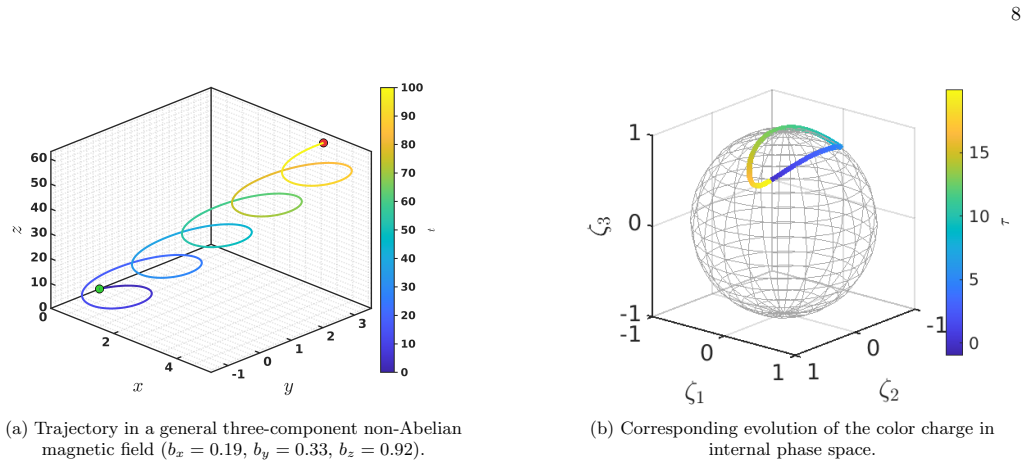
One Component Magnetic Field The simplest field configuration is a color magnetic field with a single spatial and color component. This 3 field can be generated with the following choice of gauge fields ⃗Ax =A xˆe2, ⃗Ay =A yˆe1, ⃗ϕ= ⃗Az = 0 (5) The associated color magnetic field is ⃗Bi =gA xAyˆe3 ≡Bˆe3δiz (6) The gauge potentials that generate this field...
-
[2]
Since all the components are constant, we can perform a global bi- orthogonal transformation- a singular value decomposi- tion (SVD) [29], to bring it to the canonical form
Three Component Magnetic Field A more general case arises when all the three com- ponents of the vector potential survive. Since all the components are constant, we can perform a global bi- orthogonal transformation- a singular value decomposi- tion (SVD) [29], to bring it to the canonical form. In this SVD basis, the gauge potential has the form ⃗Ai = (A...
-
[3]
This combination of fields generated by (4) is bi-orthogonal to each other
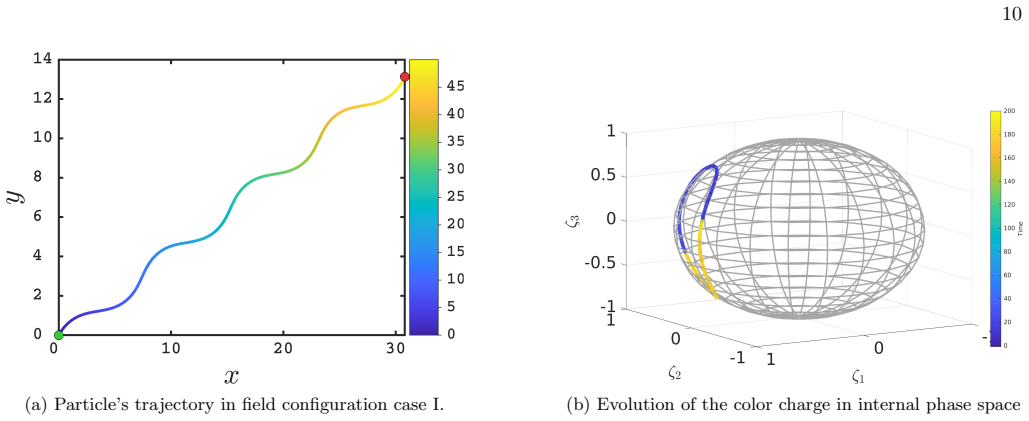
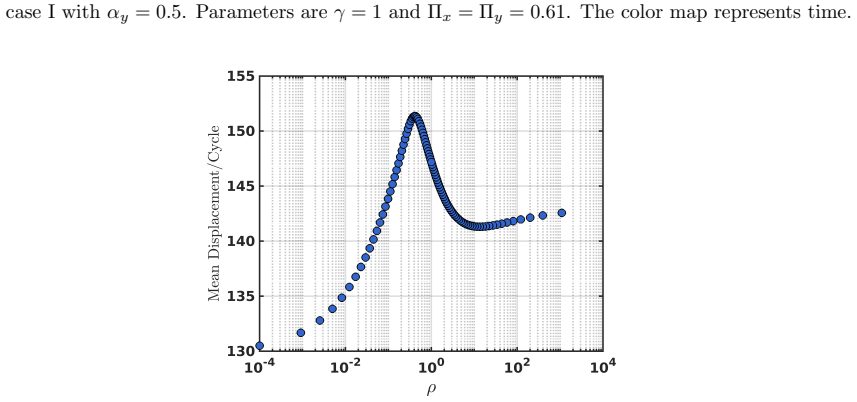
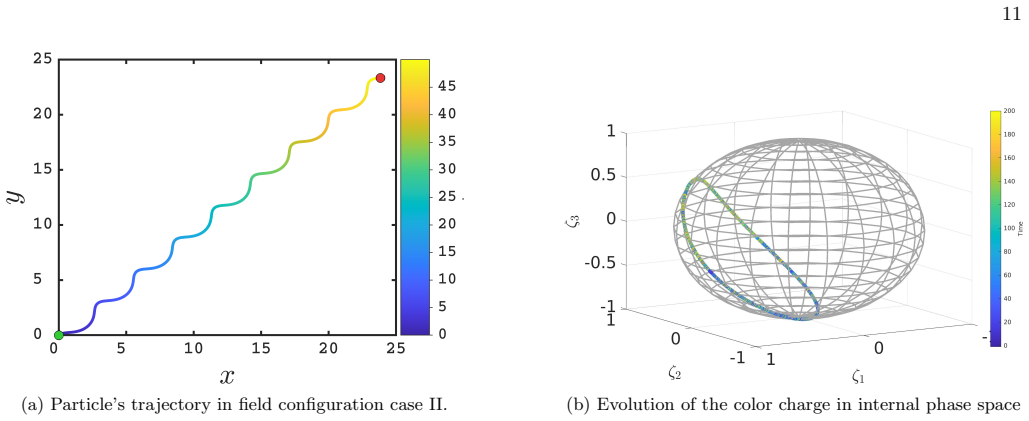
Combined Color electric and Magnetic fields A combination of color electric and color magnetic fields arises when both scalar and vector potentials are present. This combination of fields generated by (4) is bi-orthogonal to each other. Which means, if we freeze the color degree of freedom and take the inner product in the real space, the product turns ou...
2019
-
[4]
C. N. Yang and R. L. Mills, Conservation of isotopic spin and isotopic gauge invariance, Phys. Rev.96, 191 (1954)
1954
-
[5]
Osterloh, M
K. Osterloh, M. Baig, L. Santos, P. Zoller, and M. Lewen- stein, Cold atoms in non-abelian gauge potentials: From the hofstadter ”moth” to lattice gauge theory, Phys. Rev. Lett.95, 010403 (2005)
2005
-
[6]
Dalibard, F
J. Dalibard, F. Gerbier, G. Juzeli¯ unas, and P. ¨Ohberg, Colloquium: Artificial gauge potentials for neutral atoms, Rev. Mod. Phys.83, 1523 (2011)
2011
-
[7]
Y. Yang, C. Peng, D. Zhu, H. Buljan, J. D. Joannopoulos, B. Zhen, and M. Soljaˇ ci´ c, Syn- thesis and observation of non-abelian gauge fields in real space, Science365, 1021 (2019), https://www.science.org/doi/pdf/10.1126/science.aay3183
-
[8]
Polimeno, A
L. Polimeno, A. Fieramosca, G. Lerario, L. D. Marco, M. D. Giorgi, D. Ballarini, L. Dominici, V. Ardizzone, M. Pugliese, C. T. Prontera, V. Maiorano, G. Gigli, C. Leblanc, G. Malpuech, D. D. Solnyshkov, and D. San- vitto, Experimental investigation of a non-abelian gauge field in 2d perovskite photonic platform, Optica8, 1442 (2021)
2021
-
[9]
Y. Yang, B. Yang, G. Ma, J. Li, S. Zhang, and C. T. Chan, Non-abelian physics in light and sound, Science383, eadf9621 (2024), https://www.science.org/doi/pdf/10.1126/science.adf9621
-
[10]
S. G. Tan, S.-H. Chen, C. S. Ho, C.-C. Huang, M. B. Jalil, C. R. Chang, and S. Murakami, Yang–mills physics in spintronics, Physics Reports882, 1 (2020), yang-Mills physics in spintronics
2020
-
[11]
Hao and G
Q. Hao and G. Xiao, Giant spin hall effect and switching induced by spin-transfer torque in a W/co40fe40b20/MgO structure with perpendicular magnetic anisotropy, Phys. Rev. Appl.3, 034009 (2015)
2015
-
[12]
Hu, D.-F
S. Hu, D.-F. Shao, H. Yang, C. Pan, Z. Fu, M. Tang, Y. Yang, W. Fan, S. Zhou, E. Y. Tsymbal, and X. Qiu, Efficient perpendicular magnetization switching by a magnetic spin hall effect in a noncollinear antiferromag- net, Nature Communications13, 4447 (2022)
2022
-
[13]
Sheng, Y
L. Sheng, Y. Chen, S. Yuan, X. Liu, Z. Zhang, H. Jing, L.-M. Kuang, and X. Zhou, Photonic spin hall effect: Physics, manipulations, and applications, Progress in Quantum Electronics91-92, 100484 (2023)
2023
-
[14]
Y. M. Cho, Non-abelian superconductivity: An effective- field theory for two-gap superconductivity, Phys. Rev. B 72, 212516 (2005)
2005
-
[15]
Nitta, T
J. Nitta, T. Akazaki, H. Takayanagi, and T. Enoki, Gate control of spin-orbit interaction in an inverted i n 0.53 g a 0.47 as/i n 0.52 a l 0.48 as heterostructure, Physical Review Letters78, 1335 (1997)
1997
-
[16]
Grundler, Large rashba splitting in inas quantum wells due to electron wave function penetration into the barrier layers, Physical review letters84, 6074 (2000)
D. Grundler, Large rashba splitting in inas quantum wells due to electron wave function penetration into the barrier layers, Physical review letters84, 6074 (2000)
2000
-
[17]
Caviglia, M
A. Caviglia, M. Gabay, S. Gariglio, N. Reyren, C. Can- cellieri, and J.-M. Triscone, Tunable rashba spin-orbit in- teraction at oxide interfaces, Physical review letters104, 126803 (2010)
2010
-
[18]
Ruseckas, G
J. Ruseckas, G. Juzeli¯ unas, P. ¨Ohberg, and M. Fleis- chhauer, Non-abelian gauge potentials for ultracold atoms with degenerate dark states, Phys. Rev. Lett.95, 010404 (2005)
2005
-
[19]
nuclear physics
E. Rico, M. Dalmonte, P. Zoller, D. Banerjee, M. B¨ ogli, P. Stebler, and U.-J. Wiese, So (3)“nuclear physics” with ultracold gases, Annals of physics393, 466 (2018)
2018
-
[20]
B. M. Anderson, G. Juzeli¯ unas, V. M. Galitski, and I. B. Spielman, Synthetic 3d spin-orbit coupling, Physical re- view letters108, 235301 (2012)
2012
-
[21]
B. M. Anderson, I. B. Spielman, and G. Juzeli¯ unas, Magnetically generated spin-orbit coupling for ultracold atoms, Physical review letters111, 125301 (2013)
2013
-
[22]
C. S. Madasu, C. Mitra, L. Gabardos, K. D. Rathod, T. Zanon-Willette, C. Miniatura, F. Chevy, C. C. Kwong, and D. Wilkowski, Experimental realization of a su (3) color-orbit coupling in an ultracold gas, Nature Commu- nications16, 8448 (2025)
2025
-
[23]
Liang, Z
Q. Liang, Z. Dong, J.-S. Pan, H. Wang, H. Li, Z. Yang, W. Yi, and B. Yan, Chiral dynamics of ultracold atoms under a tunable su (2) synthetic gauge field, Nature Physics20, 1738 (2024)
2024
-
[24]
Liu and J
F. Liu and J. Li, Gauge field optics with anisotropic me- dia, Physical Review Letters114, 103902 (2015)
2015
-
[25]
Chen, R.-Y
Y. Chen, R.-Y. Zhang, Z. Xiong, Z. H. Hang, J. Li, J. Q. Shen, and C. Chan, Non-abelian gauge field optics, Na- ture communications10, 3125 (2019)
2019
-
[26]
B. Liu, T. Xu, and Z. H. Hang, A general recipe to ob- serve non-abelian gauge field in metamaterials, Nanopho- tonics14, 1135 (2025)
2025
-
[27]
S. Bhat, A. Das, B. Paradkar, and V. Ravishankar, Ex- perimental signatures for identifying distinct origins of color field generation, New Journal of Physics27, 103801 (2025)
2025
-
[28]
S. Bhat, A. Das, V. Ravishankar, and B. Paradkar, Novel instabilities in counter-streaming nonabelian fluids, Fun- damental Plasma Physics11, 100056 (2024)
2024
-
[29]
For the background review of Yang-Mills dynamics, one can refer to the following standard treatments [7, 25, 27, 33]
-
[30]
S. K. Wong, Field and particle equations for the classical yang-mills field and particles with isotopic spin, Il Nuovo Cimento A (1965-1970)65, 689 (1970)
1965
-
[31]
T. T. Wu and C. N. Yang, Some remarks about unquan- tized non-abelian gauge fields, Phys. Rev. D12, 3843 (1975)
1975
-
[32]
Bhatia,Matrix Analysis, Vol
R. Bhatia,Matrix Analysis, Vol. 169 (Springer, 1997)
1997
-
[33]
Whittaker and G
E. Whittaker and G. Watson,A Course of Modern Anal- 13 ysis, Dover Books on Mathematics (Dover Publications, 2020)
2020
-
[34]
Zohar, J
E. Zohar, J. I. Cirac, and B. Reznik, Quantum simula- tions of gauge theories with ultracold atoms: Local gauge invariance from angular-momentum conservation, Phys- ical Review A—Atomic, Molecular, and Optical Physics 88, 023617 (2013)
2013
-
[35]
J. C. Halimeh, I. P. McCulloch, B. Yang, and P. Hauke, Tuning the topologicalθ-angle in cold-atom quantum simulators of gauge theories, PRX Quantum3, 040316 (2022)
2022
-
[36]
A. D. Boozer, Classical yang-mills theory, American Journal of Physics79, 925 (2011), https://doi.org/10.1119/1.3606478. Appendix A: Particle Motion in Field Configuration III As mentioned in the main text, the most general com- bination of maximally non-Abelian electric and magnetic fields is realised when all components of the vector po- tential and sca...
discussion (0)
Sign in with ORCID, Apple, or X to comment. Anyone can read and Pith papers without signing in.