Recognition: unknown
The Great Escape of ionizing photons during Cosmic Morning
Pith reviewed 2026-05-10 14:06 UTC · model grok-4.3
The pith
Faint galaxies at redshift 6 directly emit ionizing photons with an escape fraction near 80 percent.
A machine-rendered reading of the paper's core claim, the machinery that carries it, and where it could break.
Core claim
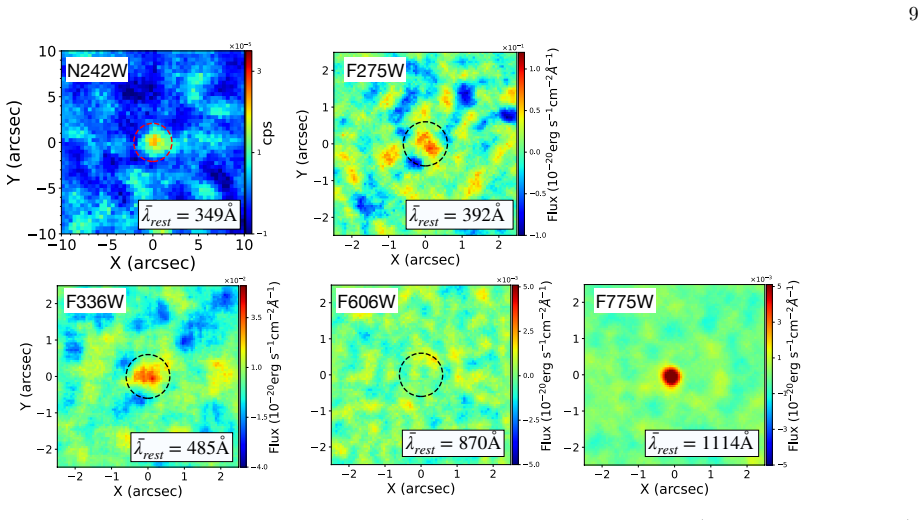
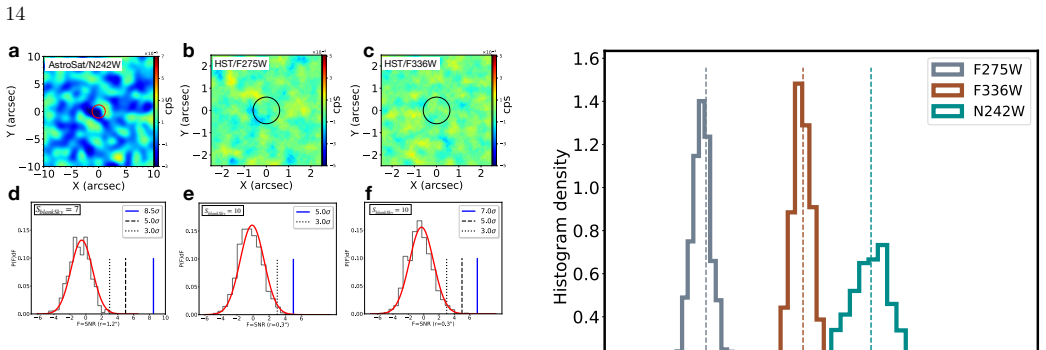
We report the first direct detection of ionizing photons at rest-frame wavelengths 350Å, 392Å, and 485Å using deep UV imaging from AstroSat and HST. These photons emerge from a stacked sample of spectroscopically confirmed Lyα emitters at 5.9<z<6.0. These detections imply a higher transparency of the interstellar and intergalactic media to ionizing radiation than predicted by current models. The stacked spectrum for faint galaxies with M_UV=-18.77±0.05 exhibits a hard slope and produces log10 ξ_ion^true = 25.86 ± 0.02 Hz erg^{-1} with escape fraction f_esc ≃ 0.8. Individual galaxies show very blue UV continua, young ages <6 Myr, and low metallicities, indicating hot massive stars. Photons >
What carries the argument
The stacked spectrum from AstroSat and HST UV imaging of high-redshift Lyα emitters that allows direct measurement of the ionizing continuum flux and calculation of the escape fraction.
Load-bearing premise
The short UV wavelength flux in the stack originates only from the target high-redshift galaxies without foreground contamination or background subtraction issues.
What would settle it
If the measured flux at 350-485 angstroms is shown to be zero or due to contamination in a reanalysis with better data reduction, the detection claim would be falsified.
Figures







read the original abstract
The end of the Cosmic Dark Age marked the onset of reionization, driven by extreme-UV photons from the first galaxies. Direct detection of such photons has remained challenging due to strong intergalactic attenuation. Here, we report the first direct detection of ionizing photons at rest-frame wavelengths $350\r{A}$, $392\r{A}$, and $485\r{A}$, using deep UV imaging from two independent space observatories: AstroSat and HST. These photons emerge from a stacked sample of spectroscopically confirmed Ly$\alpha$ emitters at $5.9<z<6.0$ in the Hubble Ultra Deep Field identified with VLT/MUSE and JWST/NIRSpec. These detections imply a higher transparency of the interstellar and intergalactic media to ionizing radiation than predicted by current models. The stacked spectrum, representative of faint galaxies with $M_{\mathrm{UV}}=-18.77\pm0.05$ ($\sim0.1L^{\ast}$), exhibits a hard slope ($-2.3\pm0.1$) and produces ionizing photons with $\text{log}_{10}\xi_{\text{ion}}^{true}$ = $25.86 \pm 0.02$ Hz erg$^{-1}$ and escape fraction $f_{esc}\simeq 0.8$. Individual measurements reveal very blue UV continua ($\beta \leq -3$) for three galaxies), young ages ($< 6$ Myr for four), and low metallicities ($Z \sim 0.02 - 0.05\ Z_{\odot}$ for two), indicating the possible presence of very hot, massive stars capable of producing enough ionizing photons to drive cosmic reionization, thereby providing new constraints on its sources. Furthermore, detection of photons with energies $>24.6\ $eV provide evidence that HeI reionization has begun by this epoch.
Editorial analysis
A structured set of objections, weighed in public.
Referee Report
Summary. The paper claims the first direct detection of ionizing photons at rest-frame 350Å, 392Å, and 485Å from a stacked sample of spectroscopically confirmed Lyα emitters at 5.9<z<6.0 in the HUDF, using AstroSat UVIT and HST imaging. The stacked spectrum of faint galaxies (M_UV=-18.77) exhibits a hard UV slope (-2.3±0.1), yielding log10 ξ_ion^true=25.86±0.02 Hz erg^{-1} and f_esc≃0.8, which the authors interpret as evidence for higher IGM/ISM transparency than current models predict, young low-metallicity stars driving reionization, and the onset of HeI reionization.
Significance. If the stacked far-UV detections prove robust, the result would be significant for reionization studies: it supplies direct observational constraints on ionizing-photon escape from sub-L* galaxies at Cosmic Morning, potentially resolving the photon-budget shortfall and highlighting the role of very young, hot stellar populations. The dual-observatory approach and spectroscopic confirmation add weight to the measurement if systematics are controlled.
major comments (2)
- [Abstract] Abstract: the headline detection of ionizing photons at 350–485Å and the derived f_esc≃0.8 rest on the assumption that the stacked flux originates exclusively from the target z≈5.9–6.0 Lyα emitters. No quantitative information is given on stacking weights, aperture extraction, source masking, foreground-interloper rejection, or null tests, which is load-bearing because IGM transmission at these wavelengths is expected to be <<1 and even small contaminants would inflate the signal.
- [Results (derived quantities)] The conversion from observed stacked fluxes to intrinsic ξ_ion^true and f_esc: the manuscript states the final values but does not specify the IGM transmission curve, ISM absorption model, or SED assumptions used to correct for attenuation. Because the claimed f_esc is unusually high (≃0.8), a sensitivity analysis to these choices is required to substantiate the claim of higher transparency than models predict.
minor comments (2)
- [Abstract] The abstract notes data from two independent observatories but does not describe cross-calibration or how the AstroSat and HST measurements were combined in the stack.
- [Abstract] Notation: the units of ξ_ion are given as Hz erg^{-1}; confirm this is consistent throughout and matches standard usage (erg^{-1} Hz).
Simulated Author's Rebuttal
We thank the referee for their positive assessment of the potential significance of our results and for the constructive comments that will improve the clarity and robustness of the manuscript. We address each major comment below.
read point-by-point responses
-
Referee: [Abstract] Abstract: the headline detection of ionizing photons at 350–485Å and the derived f_esc≃0.8 rest on the assumption that the stacked flux originates exclusively from the target z≈5.9–6.0 Lyα emitters. No quantitative information is given on stacking weights, aperture extraction, source masking, foreground-interloper rejection, or null tests, which is load-bearing because IGM transmission at these wavelengths is expected to be <<1 and even small contaminants would inflate the signal.
Authors: We agree that quantitative documentation of the stacking procedure is essential given the expected low IGM transmission. The manuscript describes the selection of spectroscopically confirmed Lyα emitters, the use of AstroSat UVIT and HST imaging, and the stacking approach, but we acknowledge that explicit details on stacking weights, aperture sizes, source masking criteria, interloper rejection methods, and null-test results are not presented at the level of specificity required. We will revise the Methods section to include these quantitative elements, along with an estimate of the contamination fraction derived from the multiwavelength HUDF data and results from null tests (stacking at random positions and on control samples). This will strengthen the demonstration that the signal originates from the target galaxies. revision: yes
-
Referee: [Results (derived quantities)] The conversion from observed stacked fluxes to intrinsic ξ_ion^true and f_esc: the manuscript states the final values but does not specify the IGM transmission curve, ISM absorption model, or SED assumptions used to correct for attenuation. Because the claimed f_esc is unusually high (≃0.8), a sensitivity analysis to these choices is required to substantiate the claim of higher transparency than models predict.
Authors: We agree that explicit specification of the correction models and a sensitivity analysis are needed to support the derived quantities and the interpretation of high transparency. The manuscript applies standard IGM transmission models at z≈6 and SED templates for young low-metallicity populations to convert observed fluxes to intrinsic ξ_ion^true and f_esc, but these are not stated in detail nor tested for sensitivity. We will revise the relevant sections to specify the exact IGM transmission curve, ISM absorption assumptions, and SED models used, and we will add a sensitivity analysis varying these inputs (e.g., alternative UVB models, dust geometries, and stellar population parameters). The analysis will demonstrate the range of f_esc values consistent with the data. revision: yes
Circularity Check
No circularity: derived quantities follow from external data and standard models
full rationale
The paper's central results (stacked far-UV detections at 350–485 Å, log ξ_ion^true = 25.86, f_esc ≃ 0.8) are obtained by measuring fluxes in AstroSat UVIT and HST data on a MUSE/NIRSpec-selected Lyα-emitter stack, then applying standard IGM transmission curves and SED-based intrinsic production estimates. No equation in the provided text defines ξ_ion or f_esc in terms of themselves, renames a fit as a prediction, or invokes a self-citation as the sole justification for a uniqueness theorem or ansatz. The conversion steps rely on externally calibrated transmission models and galaxy SED libraries whose assumptions are independent of the present measurements. Minor dependence on assumed SED shapes for the intrinsic ionizing output does not constitute circularity under the stated criteria, as it does not reduce the reported values to the paper's own inputs by construction.
Axiom & Free-Parameter Ledger
free parameters (1)
- log10 ξ_ion^true
axioms (1)
- domain assumption The intergalactic and interstellar media attenuation at these wavelengths is correctly modeled by current prescriptions
Reference graph
Works this paper leans on
-
[1]
Alavi, A., Colbert, J., Teplitz, H. I., et al. 2020, ApJ, 904, 59, doi: 10.3847/1538-4357/abbd43 Astropy-Specutils Development Team. 2019, Specutils: Spectroscopic analysis and reduction, Astrophysics Source Code Library, record ascl:1902.012. http://ascl.net/1902.012 24
-
[2]
Atek, H., Labbé, I., Furtak, L. J., et al. 2024, Nature, 626, 975, doi: 10.1038/s41586-024-07043-6
-
[3]
2023, A&A, 670, A4, doi: 10.1051/0004-6361/202244187
Bacon, R., Brinchmann, J., Conseil, S., et al. 2023, A&A, 670, A4, doi: 10.1051/0004-6361/202244187
-
[4]
D., D’Aloisio, A., Christenson, H
Becker, G. D., D’Aloisio, A., Christenson, H. M., et al. 2021, MNRAS, 508, 1853, doi: 10.1093/mnras/stab2696
-
[5]
Bertin, E., & Arnouts, S. 1996, A&AS, 117, 393, doi: 10.1051/aas:1996164
-
[6]
2017, ApJL, 837, L12, doi: 10.3847/2041-8213/aa5ff7
Bian, F., Fan, X., McGreer, I., Cai, Z., & Jiang, L. 2017, ApJL, 837, L12, doi: 10.3847/2041-8213/aa5ff7
-
[7]
Bosman, S. E. I., Davies, F. B., Becker, G. D., et al. 2022, MNRAS, 514, 55, doi: 10.1093/mnras/stac1046
-
[8]
Bouwens, R. J., Illingworth, G. D., Oesch, P. A., et al. 2010, ApJL, 709, L133, doi: 10.1088/2041-8205/709/2/L133
-
[9]
Bouwens, R. J., Illingworth, G. D., Labbe, I., et al. 2011, Nature, 469, 504, doi: 10.1038/nature09717
-
[10]
Bouwens, R. J., Oesch, P. A., Stefanon, M., et al. 2021, AJ, 162, 47, doi: 10.3847/1538-3881/abf83e
-
[11]
Bunker, A. J., Cameron, A. J., Curtis-Lake, E., et al. 2023, arXiv e-prints, arXiv:2306.02467, doi: 10.48550/arXiv.2306.02467 —. 2024, A&A, 690, A288, doi: 10.1051/0004-6361/202347094
-
[12]
Crighton, N. H. M., Murphy, M. T., Prochaska, J. X., et al. 2015, MNRAS, 452, 217, doi: 10.1093/mnras/stv1182
-
[13]
Cullen et al.MNRAS, 540(3):2176–2194, July 2025
Cullen, F., Carnall, A. C., Scholte, D., et al. 2025, MNRAS, 540, 2176, doi: 10.1093/mnras/staf838
-
[14]
Curtis-Lake, E., Cameron, A. J., Bunker, A. J., et al. 2025, arXiv e-prints, arXiv:2510.01033, doi: 10.48550/arXiv.2510.01033 D’Eugenio, F., Cameron, A. J., Scholtz, J., et al. 2025, ApJS, 277, 4, doi: 10.3847/1538-4365/ada148
work page internal anchor Pith review Pith/arXiv arXiv doi:10.48550/arxiv.2510.01033 2025
-
[15]
2024, ApJL, 963, L23, doi: 10.3847/2041-8213/ad2344 D’Odorico, V., Bañados, E., Becker, G
Dhiwar, S., Saha, K., Maulick, S., et al. 2024, ApJL, 963, L23, doi: 10.3847/2041-8213/ad2344 D’Odorico, V., Bañados, E., Becker, G. D., et al. 2023, MNRAS, 523, 1399, doi: 10.1093/mnras/stad1468
-
[16]
J., et al., 2025, @doi [ ] 10.3847/1538-4365/ae1137 , 281, 50
Eisenstein, D. J., Johnson, B. D., Robertson, B., et al. 2025, ApJS, 281, 50, doi: 10.3847/1538-4365/ae1137
-
[17]
Ellis, R. S., McLure, R. J., Dunlop, J. S., et al. 2013, ApJL, 763, L7, doi: 10.1088/2041-8205/763/1/L7
-
[18]
2017, Frontiers in Astronomy and Space Sciences, 4, 32, doi: 10.3389/fspas.2017.00032
Feltre, A., Charlot, S., Mignoli, M., et al. 2017, Frontiers in Astronomy and Space Sciences, 4, 32, doi: 10.3389/fspas.2017.00032
-
[19]
Fletcher, T. J., Tang, M., Robertson, B. E., et al. 2019, ApJ, 878, 87, doi: 10.3847/1538-4357/ab2045
-
[20]
Flury, S. R., Jaskot, A. E., Ferguson, H. C., et al. 2022a, ApJS, 260, 1, doi: 10.3847/1538-4365/ac5331 —. 2022b, ApJ, 930, 126, doi: 10.3847/1538-4357/ac61e4 Förster Schreiber, N. M., & Wuyts, S. 2020, ARA&A, 58, 661, doi: 10.1146/annurev-astro-032620-021910
-
[21]
Giavalisco, M., Ferguson, H. C., Koekemoer, A. M., et al. 2004, ApJL, 600, L93, doi: 10.1086/379232
-
[22]
Grogin, N. A., Kocevski, D. D., Faber, S. M., et al. 2011, ApJS, 197, 35, doi: 10.1088/0067-0049/197/2/35
-
[23]
Gunn, J. E., & Peterson, B. A. 1965, ApJ, 142, 1633, doi: 10.1086/148444
-
[24]
Gupta, A., Trott, C. M., Jaiswar, R., et al. 2024, arXiv e-prints, arXiv:2403.13285, doi: 10.48550/arXiv.2403.13285
-
[25]
Herenz, E. C. 2023, Astronomische Nachrichten, 344, e20220091, doi: 10.1002/asna.20220091
-
[26]
Illingworth, G., Magee, D., Bouwens, R., et al. 2016, arXiv e-prints, arXiv:1606.00841, doi: 10.48550/arXiv.1606.00841
-
[27]
Illingworth, G. D., Magee, D., Oesch, P. A., et al. 2013, ApJS, 209, 6, doi: 10.1088/0067-0049/209/1/6
-
[28]
Inoue, A. K., & Iwata, I. 2008, MNRAS, 387, 1681, doi: 10.1111/j.1365-2966.2008.13350.x
-
[29]
K., Shimizu, I., Iwata, I., & Tanaka, M
Inoue, A. K., Shimizu, I., Iwata, I., & Tanaka, M. 2014, MNRAS, 442, 1805, doi: 10.1093/mnras/stu936
-
[30]
I., Orlitová, I., Schaerer, D., et al
Izotov, Y. I., Orlitová, I., Schaerer, D., et al. 2016a, Nature, 529, 178, doi: 10.1038/nature16456
-
[31]
Izotov, Y. I., Schaerer, D., Thuan, T. X., et al. 2016b, MNRAS, 461, 3683, doi: 10.1093/mnras/stw1205
-
[32]
I., Schaerer, D., Worseck, G., et al
Izotov, Y. I., Schaerer, D., Worseck, G., et al. 2018a, MNRAS, 474, 4514, doi: 10.1093/mnras/stx3115
-
[33]
I., Worseck, G., Schaerer, D., et al
Izotov, Y. I., Worseck, G., Schaerer, D., et al. 2021, MNRAS, 503, 1734, doi: 10.1093/mnras/stab612 —. 2018b, MNRAS, 478, 4851, doi: 10.1093/mnras/sty1378
-
[34]
2020, ApJ, 888, 109, doi: 10.3847/1538-4357/ab5fdc
Ji, Z., Giavalisco, M., Vanzella, E., et al. 2020, ApJ, 888, 109, doi: 10.3847/1538-4357/ab5fdc
-
[35]
Jiang, L., Cohen, S. H., Windhorst, R. A., et al. 2020, ApJ, 889, 90, doi: 10.3847/1538-4357/ab64ea
-
[36]
Keating, L. C., Weinberger, L. H., Kulkarni, G., et al. 2020, MNRAS, 491, 1736, doi: 10.1093/mnras/stz3083
-
[37]
Kerutt, J., Oesch, P. A., Wisotzki, L., et al. 2024, A&A, 684, A42, doi: 10.1051/0004-6361/202346656
-
[38]
Laseter, I. H., Maseda, M. V., Curti, M., et al. 2024, A&A, 681, A70, doi: 10.1051/0004-6361/202347133
-
[39]
Lee, K.-G., Cen, R., Gott, III, J. R., & Trac, H. 2008, ApJ, 675, 8, doi: 10.1086/525520
-
[40]
C., Fuller, S., Bradač, M., et al
Lemaux, B. C., Fuller, S., Bradač, M., et al. 2021, MNRAS, 504, 3662, doi: 10.1093/mnras/stab924
-
[41]
2025, A&A, 704, A328, doi: 10.1051/0004-6361/202556410
Liu, Y., Mascia, S., Pentericci, L., et al. 2025, A&A, 704, A328, doi: 10.1051/0004-6361/202556410
-
[42]
1995, ApJ, 441, 18, doi: 10.1086/175332 Ma´ ız Apell´ aniz, J
Madau, P. 1995, ApJ, 441, 18, doi: 10.1086/175332
-
[43]
Madau, P., Haardt, F., & Rees, M. J. 1999, ApJ, 514, 648, doi: 10.1086/306975
-
[44]
Makan, K., Worseck, G., Davies, F. B., et al. 2021, ApJ, 912, 38, doi: 10.3847/1538-4357/abee17 25
-
[45]
Malhotra, S., Rhoads, J. E., Pirzkal, N., et al. 2005, ApJ, 626, 666, doi: 10.1086/430047
-
[46]
2021, MNRAS, 507, 524, doi: 10.1093/mnras/stab2187 —
Marques-Chaves, R., Schaerer, D., Álvarez-Márquez, J., et al. 2021, MNRAS, 507, 524, doi: 10.1093/mnras/stab2187 —. 2022, MNRAS, 517, 2972, doi: 10.1093/mnras/stac2893
-
[47]
2024, A&A, 685, A3, doi: 10.1051/0004-6361/202347884
Mascia, S., Pentericci, L., Calabrò, A., et al. 2024, A&A, 685, A3, doi: 10.1051/0004-6361/202347884
-
[48]
V., Bacon, R., Franx, M., et al
Maseda, M. V., Bacon, R., Franx, M., et al. 2018, ApJL, 865, L1, doi: 10.3847/2041-8213/aade4b
-
[49]
Maseda, M. V., Bacon, R., Lam, D., et al. 2020, MNRAS, 493, 5120, doi: 10.1093/mnras/staa622
-
[50]
2026, ApJ, 996, 16, doi: 10.3847/1538-4357/ae196f
Maulick, S., & Saha, K. 2026, ApJ, 996, 16, doi: 10.3847/1538-4357/ae196f
-
[51]
Maulick, S., Saha, K., & Rutkowski, M. J. 2025, ApJ, 984, 40, doi: 10.3847/1538-4357/adc10e
-
[52]
Merlin, E., Santini, P., Paris, D., et al. 2024, A&A, 691, A240, doi: 10.1051/0004-6361/202451409 Meštrić, U., Vanzella, E., Upadhyaya, A., et al. 2023, A&A, 673, A50, doi: 10.1051/0004-6361/202345895
-
[53]
A., Roberts-Borsani, G., Oesch, P
Meyer, R. A., Roberts-Borsani, G., Oesch, P. A., & Ellis, R. S. 2025, MNRAS, 542, 1952, doi: 10.1093/mnras/staf1312
-
[54]
1993, MNRAS, 262, 273, doi: 10.1093/mnras/262.1.273 Møller, P., & Jakobsen, P
Miralda-Escude, J. 1993, MNRAS, 262, 273, doi: 10.1093/mnras/262.1.273 Møller, P., & Jakobsen, P. 1990, A&A, 228, 299
-
[55]
Momcheva, I. G., Brammer, G. B., van Dokkum, P. G., et al. 2016, ApJS, 225, 27, doi: 10.3847/0067-0049/225/2/27
-
[56]
Naidu, R. P., Tacchella, S., Mason, C. A., et al. 2020, ApJ, 892, 109, doi: 10.3847/1538-4357/ab7cc9
-
[57]
Nestor, D. B., Shapley, A. E., Steidel, C. C., & Siana, B. 2011, ApJ, 736, 18, doi: 10.1088/0004-637X/736/1/18
-
[58]
Oke, J. B., & Gunn, J. E. 1983, ApJ, 266, 713, doi: 10.1086/160817
-
[59]
Olivier, G. M., Berg, D. A., Chisholm, J., et al. 2022, ApJ, 938, 16, doi: 10.3847/1538-4357/ac8f2c
-
[60]
2025, ApJS, 276, 52, doi: 10.3847/1538-4365/ad9906
Pandey, P., & Saha, K. 2025, ApJS, 276, 52, doi: 10.3847/1538-4365/ad9906
-
[61]
Rafelski, M., Teplitz, H. I., Gardner, J. P., et al. 2015, AJ, 150, 31, doi: 10.1088/0004-6256/150/1/31
-
[62]
Reddy, N. A., Oesch, P. A., Bouwens, R. J., et al. 2018, ApJ, 853, 56, doi: 10.3847/1538-4357/aaa3e7
-
[63]
J., Robertson, B., Tacchella, S., et al
Rieke, M. J., Robertson, B., Tacchella, S., et al. 2023, ApJS, 269, 16, doi: 10.3847/1538-4365/acf44d
-
[64]
E., Dahle, H., Chisholm, J., et al
Rivera-Thorsen, T. E., Dahle, H., Chisholm, J., et al. 2019, Science, 366, 738, doi: 10.1126/science.aaw0978
-
[65]
Rivera-Thorsen, T. E., Le Reste, A., Hayes, M. J., et al. 2026, A&A, 707, L7, doi: 10.1051/0004-6361/202558750
-
[66]
Robertson, B. E. 2022, ARA&A, 60, 121, doi: 10.1146/annurev-astro-120221-044656
-
[67]
Robertson, B. E., Ellis, R. S., Dunlop, J. S., McLure, R. J., & Stark, D. P. 2010, Nature, 468, 49, doi: 10.1038/nature09527
-
[68]
J., Scarlata, C., Haardt, F., et al
Rutkowski, M. J., Scarlata, C., Haardt, F., et al. 2016, ApJ, 819, 81, doi: 10.3847/0004-637X/819/1/81
-
[69]
2009, WFC3 SMOV Program 11798: UVIS PSF Core Modulation, Instrument Science Report WFC3 2009-20, 9 pages
Sabbi, E. 2009, WFC3 SMOV Program 11798: UVIS PSF Core Modulation, Instrument Science Report WFC3 2009-20, 9 pages
2009
-
[70]
2013, UVIS PSF Spatial & Temporal Variations, Instrument Science Report WFC3 2013-011, 10 pages
Sabbi, E., & Bellini, A. 2013, UVIS PSF Spatial & Temporal Variations, Instrument Science Report WFC3 2013-011, 10 pages
2013
-
[71]
Saha, K., Tandon, S. N., Simmonds, C., et al. 2020, Nature Astronomy, 4, 1185, doi: 10.1038/s41550-020-1173-5
-
[72]
2024, ApJS, 275, 28, doi: 10.3847/1538-4365/ad7e2a
Saha, K., Maulick, S., Pandey, P., et al. 2024, ApJS, 275, 28, doi: 10.3847/1538-4365/ad7e2a
-
[73]
Saxena, A., Bunker, A. J., Jones, G. C., et al. 2024, A&A, 684, A84, doi: 10.1051/0004-6361/202347132
-
[74]
2024, arXiv e-prints, arXiv:2404.09015, doi: 10.48550/arXiv.2404.09015
Scarlata, C., Hayes, M., Panagia, N., et al. 2024, arXiv e-prints, arXiv:2404.09015, doi: 10.48550/arXiv.2404.09015
-
[75]
Schaerer, D. 2003, A&A, 397, 527, doi: 10.1051/0004-6361:20021525
-
[76]
Scholte, D., Cullen, F., Carnall, A. C., et al. 2025, MNRAS, 540, 1800, doi: 10.1093/mnras/staf834
-
[77]
2025a, arXiv e-prints, arXiv:2510.01034
Scholtz, J., Carniani, S., Parlanti, E., et al. 2025, arXiv e-prints, arXiv:2510.01034, doi: 10.48550/arXiv.2510.01034
-
[78]
Shapley, A. E., Steidel, C. C., Strom, A. L., et al. 2016, ApJL, 826, L24, doi: 10.3847/2041-8205/826/2/L24
-
[79]
Siana, B., Teplitz, H. I., Ferguson, H. C., et al. 2010, ApJ, 723, 241, doi: 10.1088/0004-637X/723/1/241
-
[80]
Simons, R. C., Papovich, C., Momcheva, I. G., et al. 2023, ApJS, 266, 13, doi: 10.3847/1538-4365/acc517
discussion (0)
Sign in with ORCID, Apple, or X to comment. Anyone can read and Pith papers without signing in.