Recognition: unknown
Investigating the effect of sensitivity of KAGRA on sky localization of gravitational-wave sources from compact binary coalescences
Pith reviewed 2026-05-10 12:57 UTC · model grok-4.3
The pith
Adding KAGRA improves sky localization of binary neutron star mergers even at its current low sensitivity by adding new baselines and directional constraints.
A machine-rendered reading of the paper's core claim, the machinery that carries it, and where it could break.
Core claim
The addition of KAGRA to the global gravitational-wave detector network introduces new baselines and complementary antenna response patterns that can enhance sky localization for compact binary coalescences. Sky maps are constructed with a radiometric, coherence-based framework, allowing isolation of geometric and timing contributions from individual detectors. Even at its current sensitivity of ∼10 Mpc, KAGRA provides measurable improvements by breaking degeneracies through additional baselines and directional constraints. As sensitivity increases, improvements in signal-to-noise ratio and timing precision lead to substantial reductions in localization area, with a binary neutron star range
What carries the argument
A systematic injection study of binary neutron star signals analyzed with a radiometric coherence-based sky localization framework that separates geometric and timing effects from each detector.
If this is right
- The fraction of events localized within 100 square degrees rises when KAGRA joins the network.
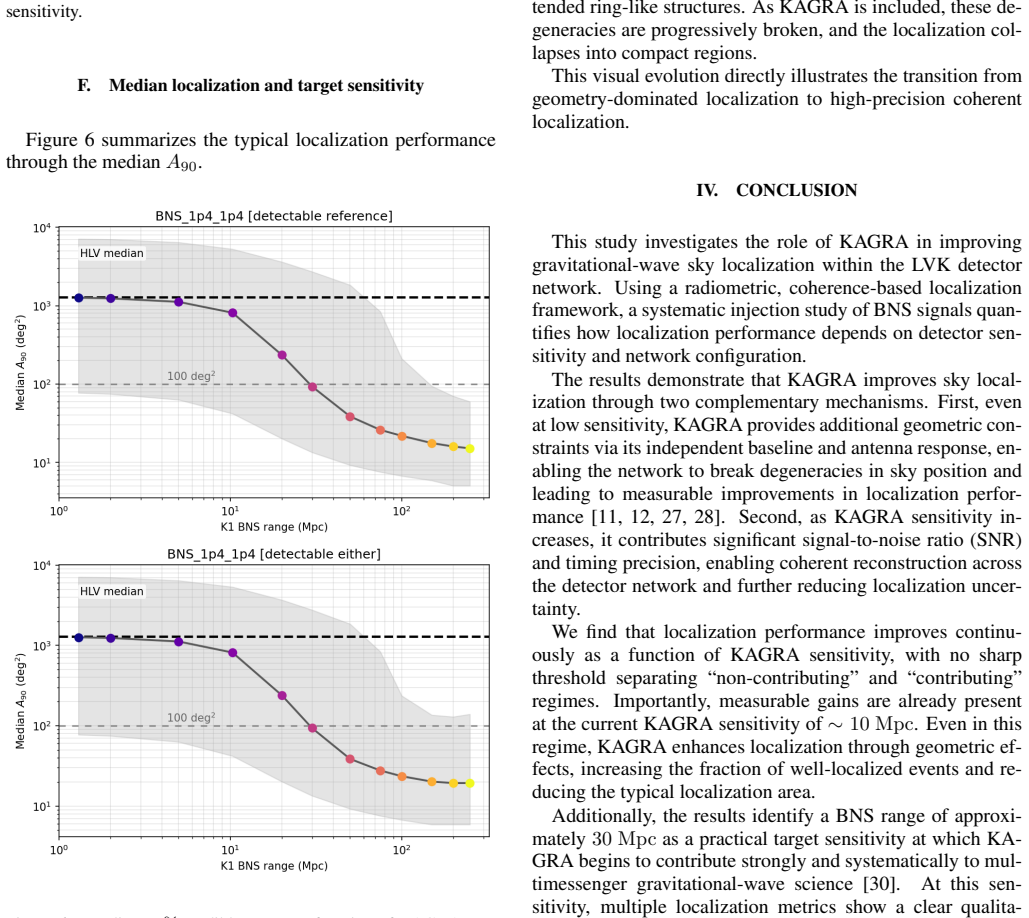
- Median 90-percent credible sky areas shrink as KAGRA sensitivity climbs from 10 to 30 megaparsecs.
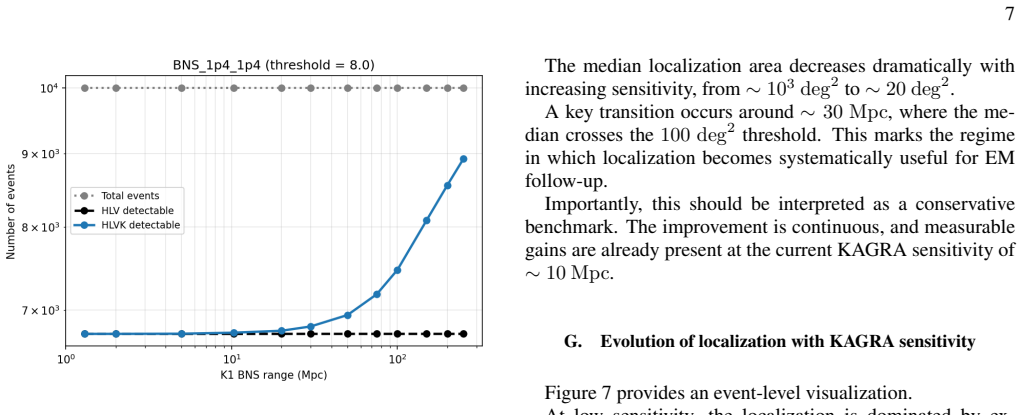
- KAGRA raises the total number of detectable binary neutron star events by recovering lower signal-to-noise signals.
- A KAGRA range near 30 megaparsecs marks a practical threshold for producing sky maps useful for electromagnetic follow-up.
Where Pith is reading between the lines
- Geographic spread of detectors may matter more than raw sensitivity for initial multimessenger campaigns.
- Similar gains could appear when other planned detectors in new locations join future networks.
- The same baseline-breaking effect should be checked for black-hole mergers and other source classes.
Load-bearing premise
The radiometric method for turning signal arrival times and strengths into sky positions, together with the chosen models of neutron-star merger waveforms and detector noise, match how the real network and analysis will behave.
What would settle it
Real gravitational-wave events from the operating LIGO-Virgo-KAGRA network show no reduction in sky area uncertainty when KAGRA data are added to the same events processed without it.
Figures



read the original abstract
The addition of KAGRA to the global gravitational-wave detector network introduces new baselines and complementary antenna response patterns that can enhance sky localization for compact binary coalescences. We investigate KAGRA's role in the LIGO-Virgo-KAGRA network using a systematic injection study of binary neutron star signals. Sky maps are constructed with a radiometric, coherence-based framework, allowing isolation of geometric and timing contributions from individual detectors. Localization performance is quantified using the fraction of events localized within $100~\mathrm{deg}^2$, cumulative area distributions, and the median $90%$ credible region. We also assess KAGRA's impact on detection rates by varying its sensitivity over a wide range. Even at its current sensitivity of $\sim10~\mathrm{Mpc}$, KAGRA provides measurable improvements by breaking degeneracies through additional baselines and directional constraints. As sensitivity increases, improvements in signal-to-noise ratio and timing precision lead to substantial reductions in localization area. We identify a binary neutron star range of $\sim30~\mathrm{Mpc}$ as a practical benchmark for reliable localization suitable for electromagnetic follow-up, noting this as a conservative estimate. In addition, KAGRA increases the number of detectable events by enabling lower signal-to-noise detections. These results demonstrate that even a modest-sensitivity detector can significantly enhance network performance through geometric complementarity, highlighting the importance of a geographically distributed network for multimessenger gravitational-wave astronomy.
Editorial analysis
A structured set of objections, weighed in public.
Referee Report
Summary. The manuscript presents a systematic injection study of binary neutron star coalescences into simulated LIGO-Virgo-KAGRA networks. Using a radiometric coherence-based pipeline to generate sky maps, it quantifies localization performance via the fraction of events within 100 deg², cumulative area distributions, and median 90% credible regions. The central result is that KAGRA at its current ~10 Mpc range already yields measurable improvements by breaking degeneracies through new baselines and antenna patterns; further sensitivity gains produce larger reductions in localization area, with ~30 Mpc identified as a practical benchmark for electromagnetic follow-up utility. The study also notes increased detection rates from lower-SNR events.
Significance. If the radiometric results are confirmed to match standard Bayesian localization, the work supplies concrete sensitivity thresholds and geometric benchmarks that clarify when a modest-range detector like KAGRA meaningfully augments network performance for multimessenger astronomy. It reinforces the value of geographic distribution even before full design sensitivity is reached.
major comments (1)
- [Abstract and methods] Abstract and methods (radiometric coherence framework): the headline claim that KAGRA at ~10 Mpc produces measurable sky-localization gains rests entirely on areas derived from the radiometric coherence pipeline. No cross-validation against standard Bayesian tools (BAYESTAR or LALInference) on the same injections is reported. Without this comparison, it is unclear whether the reported reductions in 90% credible area and increases in the fraction inside 100 deg² reflect genuine information gain from the additional baselines or method-specific biases in how the coherence approach handles timing and antenna-pattern constraints.
minor comments (1)
- [Abstract] The abstract states that KAGRA 'increases the number of detectable events by enabling lower signal-to-noise detections,' but the quantitative impact on detection rates is not broken out separately from the localization metrics; a dedicated table or figure isolating this effect would improve clarity.
Simulated Author's Rebuttal
We thank the referee for their constructive review and positive assessment of the work's significance. We address the major comment on the radiometric coherence framework below.
read point-by-point responses
-
Referee: [Abstract and methods] Abstract and methods (radiometric coherence framework): the headline claim that KAGRA at ~10 Mpc produces measurable sky-localization gains rests entirely on areas derived from the radiometric coherence pipeline. No cross-validation against standard Bayesian tools (BAYESTAR or LALInference) on the same injections is reported. Without this comparison, it is unclear whether the reported reductions in 90% credible area and increases in the fraction inside 100 deg² reflect genuine information gain from the additional baselines or method-specific biases in how the coherence approach handles timing and antenna-pattern constraints.
Authors: We appreciate the referee highlighting this point. Our analysis compares sky localization for identical injections using the exact same radiometric coherence pipeline, both with and without KAGRA (and across KAGRA sensitivity ranges). Any method-specific biases in timing or antenna-pattern handling would therefore apply equally to the LV and LVK cases, leaving the reported relative improvements attributable to KAGRA's additional baselines and directional constraints. These geometric effects are explicitly modeled in the coherence framework. While we agree that a direct comparison to BAYESTAR or LALInference on the same set would strengthen absolute-area claims, it is not necessary to demonstrate the differential gains from network expansion, which is the central focus. We will add a clarifying paragraph in the methods and discussion sections of the revised manuscript to make this distinction explicit. revision: partial
Circularity Check
No significant circularity: forward simulation study with fixed models
full rationale
The paper conducts an injection study of binary neutron star signals into a modeled LIGO-Virgo-KAGRA network, constructs sky maps via a radiometric coherence framework, and quantifies localization metrics (90% credible area, fraction within 100 deg²) as direct outputs of those simulations. Detector sensitivities are varied as inputs, not fitted to the localization results. The framework is applied uniformly without redefining its outputs as inputs or invoking self-citations as load-bearing uniqueness theorems. Results follow from geometric/timing properties of the network rather than any self-referential reduction.
Axiom & Free-Parameter Ledger
free parameters (1)
- KAGRA sensitivity benchmarks
axioms (1)
- domain assumption Binary neutron star waveforms and detector noise follow standard general-relativity and Gaussian-stationary models
Reference graph
Works this paper leans on
-
[1]
The sources are dis- tributed uniformly in comoving volume [29, 46, 47], such that the luminosity distance followsp(d)∝d 2, within the range d∈[40,200] Mpc
Injection population We generate a total of 10000 compact binary coalescence signals with component masses fixed at1.4M ⊙–1.4M ⊙, rep- resentative of typical BNS systems. The sources are dis- tributed uniformly in comoving volume [29, 46, 47], such that the luminosity distance followsp(d)∝d 2, within the range d∈[40,200] Mpc. This range is chosen to probe...
-
[2]
Detector configuration and sensitivity modeling We consider a reference detector network consisting of H1, L1, and V1, and a test network that includes K1 in addition. The detector sensitivities are modeled using PSD representa- tive of the O4a configuration for LIGO [49, 50], the O3 con- figuration for Virgo [51, 52], and O4 simulation estimate for KAGRA...
-
[3]
non-contributing
Analysis For each realization and ASD scaling, matched filtering is performed to compute the SNR in each detector. Events are required to satisfy a network SNR threshold ofρnet ≥8in the reference network. Each signal is embedded in stationary Gaussian noise con- sistent with the detector PSDs. Matched filtering is then used to identify candidate triggers ...
-
[4]
B. P. Abbott et al. (LIGO Scientific, Virgo), Phys. Rev. Lett. 116, 061102 (2016), 1602.03837
work page internal anchor Pith review arXiv 2016
- [6]
- [7]
-
[8]
A. G. Abac et al. (LIGO Scientific, VIRGO, KAGRA) (2025), 2508.18083
work page internal anchor Pith review Pith/arXiv arXiv 2025
- [9]
-
[10]
J. Aasi et al. (LIGO Scientific), Class. Quant. Grav.32, 074001 (2015), 1411.4547
work page internal anchor Pith review arXiv 2015
- [11]
- [12]
- [13]
-
[14]
Triangulation of gravitational wave sources with a network of detectors,
S. Fairhurst, New J. Phys.11, 123006 (2009), [Erratum: New J.Phys. 13, 069602 (2011)], 0908.2356
-
[15]
S. Fairhurst, Class. Quant. Grav.28, 105021 (2011), 1010.6192
- [16]
- [17]
- [18]
- [19]
-
[20]
Determining the Hubble constant from gravitational wave observations of merging compact binaries
S. Nissanke, D. E. Holz, N. Dalal, S. A. Hughes, J. L. Sievers, and C. M. Hirata (2013), 1307.2638
work page Pith review arXiv 2013
- [21]
-
[22]
R. Magee and S. Borhanian, Astrophys. J.935, 139 (2022), 2201.11841
-
[23]
S. Sachdev et al., Astrophys. J. Lett.905, L25 (2020), 2008.04288
- [24]
-
[25]
S. Nissanke, M. Kasliwal, and A. Georgieva, Astrophys. J.767, 124 (2013), 1210.6362
- [26]
- [27]
- [28]
- [29]
-
[30]
T. Tsutsui, K. Cannon, and L. Tsukada, Phys. Rev. D103, 043011 (2021), 2005.08163
- [31]
-
[32]
B. P. Abbott et al. (LIGO Scientific, Virgo), Phys. Rev. Lett. 119, 161101 (2017), 1710.05832
work page internal anchor Pith review arXiv 2017
-
[33]
B. P. Abbott et al. (LIGO Scientific, Virgo, Fermi GBM, IN- TEGRAL, IceCube, AstroSat Cadmium Zinc Telluride Im- ager Team, IPN, Insight-Hxmt, ANTARES, Swift, AGILE Team, 1M2H Team, Dark Energy Camera GW-EM, DES, DLT40, GRAWITA, Fermi-LAT, ATCA, ASKAP, Las Cum- bres Observatory Group, OzGrav, DWF (Deeper Wider Faster Program), AST3, CAASTRO, VINROUGE, MAS...
work page Pith review arXiv 2017
- [34]
- [35]
-
[36]
Coherent method for detection of gravitational wave bursts
S. Klimenko, I. Yakushin, A. Mercer, and G. Mitselmakher, Class. Quant. Grav.25, 114029 (2008), 0802.3232
work page Pith review arXiv 2008
- [37]
-
[38]
P. Jaranowski, A. Krolak, and B. F. Schutz, Phys. Rev. D58, 063001 (1998), gr-qc/9804014
-
[39]
A. Buonanno, B. Iyer, E. Ochsner, Y . Pan, and B. S. Sathyaprakash, Phys. Rev. D80, 084043 (2009), 0907.0700
work page Pith review arXiv 2009
-
[40]
C. Cutler and E. E. Flanagan, Phys. Rev. D49, 2658 (1994), gr-qc/9402014
work page Pith review arXiv 1994
-
[41]
J. Veitch et al., Phys. Rev. D91, 042003 (2015), 1409.7215
work page Pith review arXiv 2015
-
[42]
Bilby: A user-friendly Bayesian inference library for gravitational-wave astronomy
G. Ashton et al., Astrophys. J. Suppl.241, 27 (2019), 1811.02042
work page internal anchor Pith review arXiv 2019
-
[43]
E. Poisson and C. M. Will, Phys. Rev. D52, 848 (1995), gr- qc/9502040
- [44]
-
[45]
K. C. Cannon, Phys. Rev. D75, 123003 (2007), URL https://link.aps.org/doi/10.1103/PhysRevD. 75.123003
-
[46]
Sensitivity curves for searches for gravitational-wave backgrounds
E. Thrane and J. D. Romano, Phys. Rev. D88, 124032 (2013), 1310.5300
work page Pith review arXiv 2013
-
[47]
A. Nishizawa, A. Taruya, K. Hayama, S. Kawamura, and M.-a. Sakagami, Phys. Rev. D79, 082002 (2009), 0903.0528
-
[48]
K. M. G ´orski, E. Hivon, A. J. Banday, B. D. Wandelt, F. K. Hansen, M. Reinecke, and M. Bartelman, Astrophys. J.622, 759 (2005), astro-ph/0409513
work page internal anchor Pith review arXiv 2005
- [49]
-
[50]
Abbottet al.(LIGO Scientific and Virgo Collaboration), Astrophys
R. Abbott et al. (LIGO Scientific, Virgo), Astrophys. J. Lett. 913, L7 (2021), 2010.14533
- [51]
-
[52]
LIGO Scientific Collaboration, Virgo Collaboration, and KA- GRA Collaboration,GWTC-4.0 Cumulative Search Sensitiv- ity Estimates(2025), URLhttps://doi.org/10.5281/ zenodo.16740128
2025
- [53]
-
[54]
LIGO Scientific Collaboration, Virgo Collaboration, and KA- GRA Collaboration, Tech. Rep. LIGO-T2200043-v3, LIGO Scientific Collaboration (2022), URLhttps://dcc.ligo. org/LIGO-T2200043/public
2022
-
[55]
F. Acernese et al. (Virgo), Class. Quant. Grav.40, 185006 (2023), 2210.15633
- [56]
- [57]
-
[58]
M. Vallisneri, Phys. Rev. D77, 042001 (2008), gr-qc/0703086
work page Pith review arXiv 2008
-
[59]
A. G. Abac et al. (LIGO Scientific, VIRGO, KAGRA) (2025), 2508.18082
work page internal anchor Pith review arXiv 2025
-
[60]
Abbottet al.(KAGRA, VIRGO, LIGO Scientific), Astrophys
R. Abbott et al. (KAGRA, VIRGO, LIGO Scientific), Astro- phys. J. Suppl.267, 29 (2023), 2302.03676
-
[61]
R. Abbott et al. (LIGO Scientific, Virgo), SoftwareX13, 100658 (2021), 1912.11716
discussion (0)
Sign in with ORCID, Apple, or X to comment. Anyone can read and Pith papers without signing in.