Recognition: unknown
PostureObjectstitch: Anomaly Image Generation Considering Assembly Relationships in Industrial Scenarios
Pith reviewed 2026-05-10 14:13 UTC · model grok-4.3
The pith
A diffusion model generates industrial anomaly images that respect component assembly poses and relationships.
A machine-rendered reading of the paper's core claim, the machinery that carries it, and where it could break.
Core claim
PostureObjectStitch separates multi-view images into high-frequency, texture, and RGB features via condition decoupling, then adapts these features across diffusion time-steps through temporal modulation to build consistent coarse-to-fine outputs. A conditional loss strengthens key industrial elements while a geometric prior directs component placement to satisfy assembly relationships.
What carries the argument
Condition decoupling of multi-view inputs into separate feature streams, combined with temporal modulation in diffusion and a geometric prior that enforces assembly relationships.
If this is right
- The generated images can supplement limited real anomaly data to train stronger industrial detection models.
- Progressive generation maintains multi-view consistency while adding fine details only after coarse structure is set.
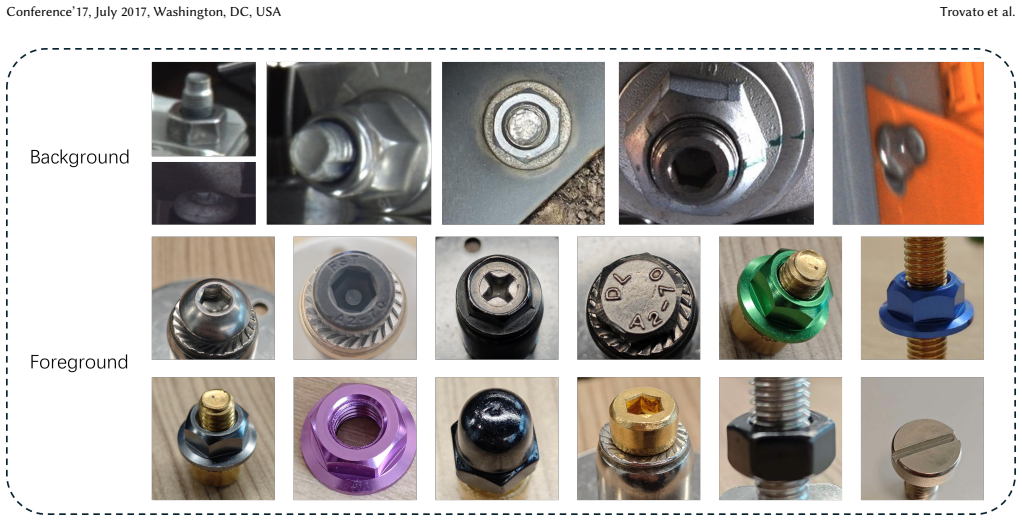
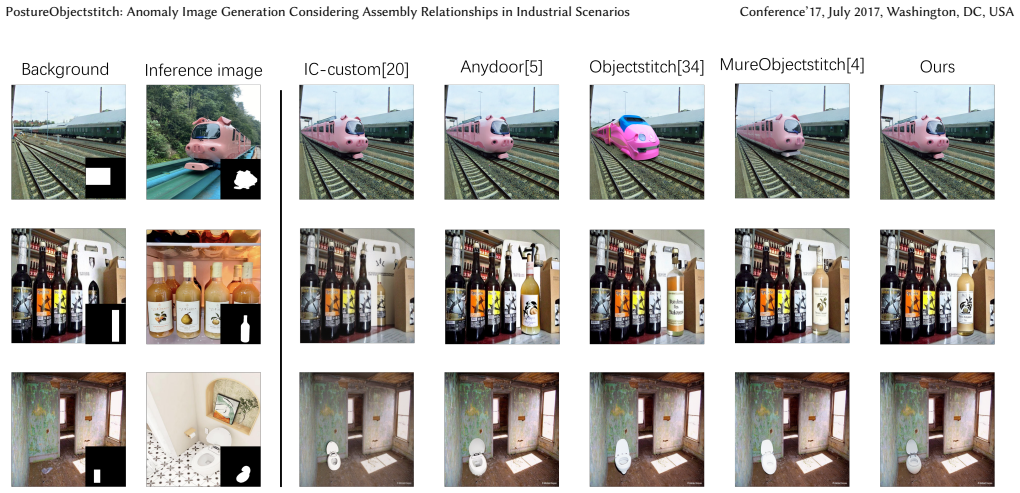
- The method is shown to outperform prior techniques on the MureCom dataset and the contributed DreamAssembly dataset.
- Downstream anomaly detection performance improves when models are trained with the assembly-aware synthetic images.
Where Pith is reading between the lines
- Similar geometric priors could be tested in other constrained generation tasks such as robotic scene assembly or mechanical part layouts.
- The feature decoupling step may help diffusion models in any domain where multiple input views must remain consistent with physical structure.
- If the prior scales without heavy tuning, it offers a route to reduce manual labeling in quality-control pipelines for complex products.
Load-bearing premise
The geometric prior and conditional loss together force generated images to show correct component positions and semantics without creating new misalignments or visual artifacts.
What would settle it
Quantitative metrics or visual checks on real assembled industrial images showing that generated parts are often rotated or shifted relative to each other in violation of the claimed assembly rules.
Figures




read the original abstract
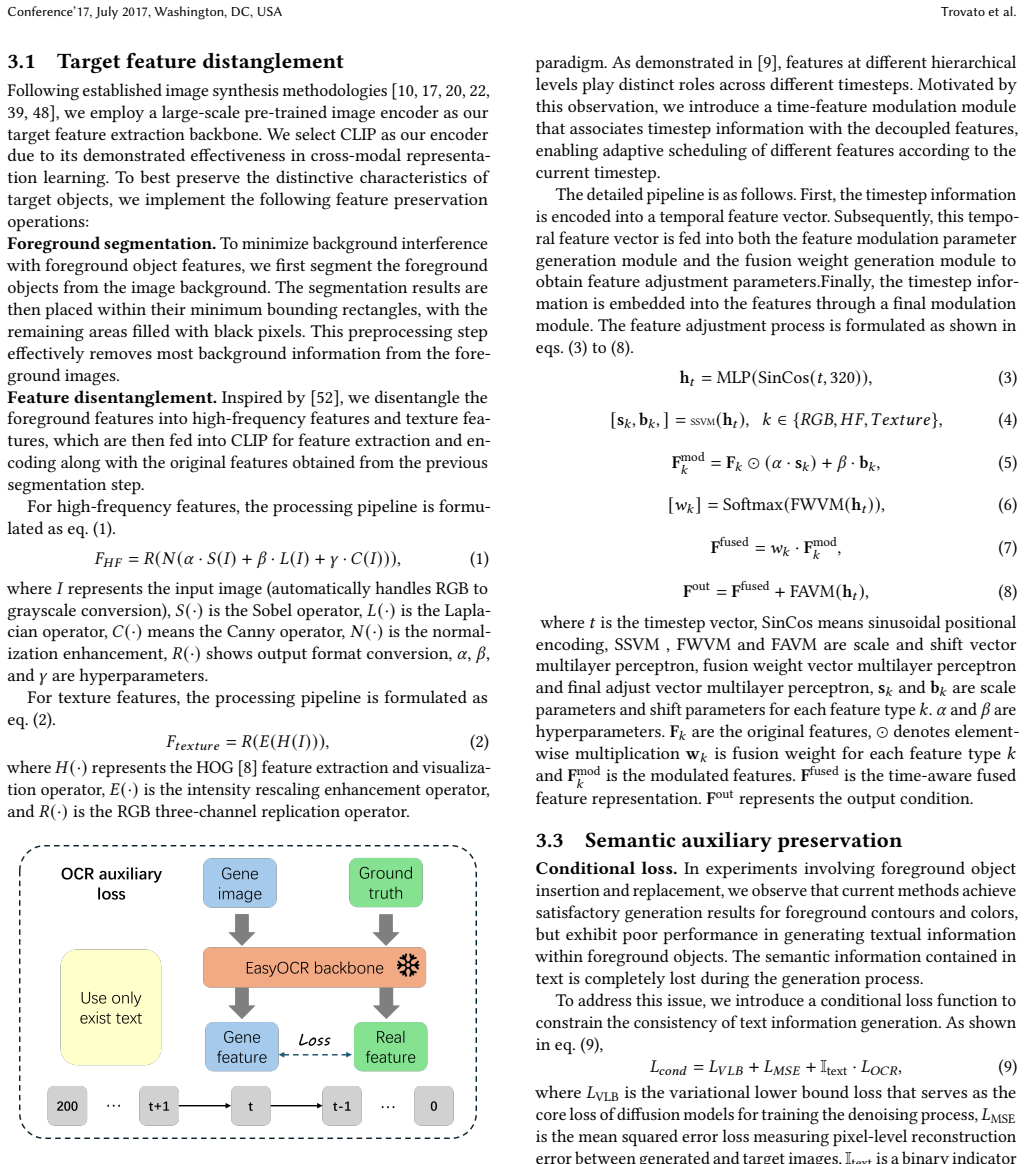
Image generation technology can synthesize condition-specific images to supplement real-world industrial anomaly data and enhance anomaly detection model performance. Existing generation techniques rarely account for the pose and orientation of industrial components in assembly, making the generated images difficult to utilize for downstream application. To solve this, we propose a novel image synthesis approach, called PostureObjectStitch, that achieves accurate generation to meet the requirement of industrial assembly. A condition decoupling approach is introduced to separate input multi-view images into high-frequency, texture, and RGB features. The feature temporal modulation mechanism adapts these features across diffusion model time-steps, enabling progressive generation from coarse to fine details while maintaining consistency. To ensure semantic accuracy, we introduce a conditional loss that enhances critical industrial elements and a geometric prior that guides component positioning for correct assembly relationships. Comprehensive experimental results on the MureCom dataset, our newly contributed DreamAssembly dataset, and the downstream application validate the outstanding performance of our method.
Editorial analysis
A structured set of objections, weighed in public.
Referee Report
Summary. The manuscript proposes PostureObjectStitch, a diffusion-based image synthesis method for generating anomaly images of industrial components that respects assembly relationships. It decouples multi-view inputs into high-frequency, texture, and RGB features, applies feature temporal modulation across diffusion timesteps for coarse-to-fine generation, introduces a conditional loss to emphasize critical elements, and employs a geometric prior to enforce correct component positioning. The approach is evaluated on the MureCom dataset, the newly contributed DreamAssembly dataset, and a downstream anomaly detection task, with claims of superior performance over existing methods.
Significance. If the central claims are substantiated, the work addresses an important gap in synthetic data generation for industrial anomaly detection by explicitly modeling assembly poses and relationships, which prior diffusion-based approaches largely ignore. The release of the DreamAssembly dataset represents a concrete, reusable contribution that could benchmark future methods in this domain. The combination of geometric priors with conditional losses in a diffusion framework offers a technically grounded direction for controllable generation in structured scenes.
major comments (1)
- [Experimental Results] The central technical claim—that the geometric prior and conditional loss successfully enforce correct assembly relationships and semantic accuracy—rests on indirect evidence from downstream anomaly detection gains rather than direct quantitative validation. No metrics for pose deviation, component alignment error, overlap, or geometric fidelity on the generated DreamAssembly outputs are reported, leaving open the possibility that performance improvements arise from texture realism or other factors unrelated to the proposed priors.
Simulated Author's Rebuttal
We thank the referee for their constructive feedback and for recognizing the importance of modeling assembly relationships in industrial anomaly image generation. We address the single major comment below.
read point-by-point responses
-
Referee: The central technical claim—that the geometric prior and conditional loss successfully enforce correct assembly relationships and semantic accuracy—rests on indirect evidence from downstream anomaly detection gains rather than direct quantitative validation. No metrics for pose deviation, component alignment error, overlap, or geometric fidelity on the generated DreamAssembly outputs are reported, leaving open the possibility that performance improvements arise from texture realism or other factors unrelated to the proposed priors.
Authors: We agree that direct quantitative metrics would provide stronger and more isolated evidence for the contribution of the geometric prior and conditional loss. The current evaluation relies on downstream anomaly detection performance on DreamAssembly (plus qualitative results), which demonstrates practical utility but does not directly quantify geometric fidelity. In the revised manuscript we will add explicit metrics on the generated DreamAssembly outputs, including pose deviation, component alignment error, and overlap ratios, computed by comparing synthesized assemblies against the known ground-truth configurations provided in the dataset. These will be reported alongside the existing downstream results to better separate the effect of the proposed priors from general improvements in texture or realism. revision: yes
Circularity Check
No significant circularity; novel components added to standard diffusion models
full rationale
The paper proposes independent additions (condition decoupling, feature temporal modulation, conditional loss, geometric prior) to diffusion models and contributes a new DreamAssembly dataset. These are described as new mechanisms for enforcing assembly relationships and semantic accuracy rather than being defined in terms of the outputs they produce or fitted to the target results by construction. Experimental validation on MureCom, DreamAssembly, and downstream tasks is presented without any quoted reduction of predictions to inputs, self-citation chains, or ansatz smuggling. The derivation chain is self-contained.
Axiom & Free-Parameter Ledger
free parameters (1)
- loss weighting coefficients
axioms (1)
- domain assumption Diffusion models conditioned on decoupled multi-view features can produce consistent progressive generation from coarse to fine while preserving assembly semantics.
invented entities (1)
-
geometric prior
no independent evidence
Reference graph
Works this paper leans on
- [1]
-
[2]
James Betker, Gabriel Goh, Li Jing,†TimBrooks, Jianfeng Wang, Linjie Li,†Lon- gOuyang,†JuntangZhuang,†JoyceLee,†YufeiGuo,†WesamManassra,†Praful- laDhariwal,†CaseyChu,†YunxinJiao, and Aditya Ramesh. [n. d.]. Improving Im- age Generation with Better Captions. https://api.semanticscholar.org/CorpusID: 264403242
- [3]
- [4]
- [5]
- [6]
- [7]
-
[8]
N. Dalal and B. Triggs. 2005. Histograms of oriented gradients for human detec- tion. In2005 IEEE Computer Society Conference on Computer Vision and Pattern Recognition (CVPR’05), Vol. 1. 886–893 vol. 1. doi:10.1109/CVPR.2005.177
-
[9]
Dale Decatur, Thibault Groueix, Wang Yifan, Rana Hanocka, Vladimir Kim, and Matheus Gadelha. 2025. Reusing Computation in Text-to-Image Diffusion for Efficient Generation of Image Sets. InProceedings of the IEEE/CVF International Conference on Computer Vision. 16482–16491
2025
- [10]
-
[11]
An Image is Worth One Word: Personalizing Text-to-Image Generation using Textual Inversion
Rinon Gal, Yuval Alaluf, Yuval Atzmon, Or Patashnik, Amit H. Bermano, Gal Chechik, and Daniel Cohen-Or. 2022. An Image is Worth One Word: Personalizing Text-to-Image Generation using Textual Inversion. arXiv:2208.01618 [cs.CV] https://arxiv.org/abs/2208.01618
work page internal anchor Pith review arXiv 2022
-
[12]
Yuchao Gu, Xintao Wang, Jay Zhangjie Wu, Yujun Shi, Yunpeng Chen, Zihan Fan, Wuyou Xiao, Rui Zhao, Shuning Chang, Weijia Wu, Yixiao Ge, Ying Shan, and Mike Zheng Shou. 2023. Mix-of-Show: Decentralized Low-Rank Adaptation for Multi-Concept Customization of Diffusion Models. arXiv:2305.18292 [cs.CV] https://arxiv.org/abs/2305.18292
- [13]
- [14]
- [15]
- [16]
- [17]
- [18]
- [19]
-
[20]
Yaowei Li, Xiaoyu Li, Zhaoyang Zhang, Yuxuan Bian, Gan Liu, Xinyuan Li, Jiale Xu, Wenbo Hu, Yating Liu, Lingen Li, Jing Cai, Yuexian Zou, Yancheng He, and Ying Shan. 2025. IC-Custom: Diverse Image Customization via In-Context Learning. arXiv:2507.01926 [cs.CV] https://arxiv.org/abs/2507.01926
- [22]
- [23]
- [24]
-
[25]
Alex Nichol, Prafulla Dhariwal, Aditya Ramesh, Pranav Shyam, Pamela Mishkin, Bob McGrew, Ilya Sutskever, and Mark Chen. 2022. GLIDE: Towards Photo- realistic Image Generation and Editing with Text-Guided Diffusion Models. arXiv:2112.10741 [cs.CV] https://arxiv.org/abs/2112.10741
work page internal anchor Pith review arXiv 2022
-
[26]
Dustin Podell, Zion English, Kyle Lacey, Andreas Blattmann, Tim Dockhorn, Jonas Müller, Joe Penna, and Robin Rombach. 2023. SDXL: Improving Latent Diffusion Models for High-Resolution Image Synthesis. arXiv:2307.01952 [cs.CV] https://arxiv.org/abs/2307.01952
work page internal anchor Pith review arXiv 2023
-
[27]
Alec Radford, Jong Wook Kim, Chris Hallacy, Aditya Ramesh, Gabriel Goh, Sandhini Agarwal, Girish Sastry, Amanda Askell, Pamela Mishkin, Jack Clark, Gretchen Krueger, and Ilya Sutskever. 2021. Learning Transferable Visual Models From Natural Language Supervision. arXiv:2103.00020 [cs.CV] https://arxiv.org/ abs/2103.00020
work page internal anchor Pith review Pith/arXiv arXiv 2021
-
[28]
Aditya Ramesh, Prafulla Dhariwal, Alex Nichol, Casey Chu, and Mark Chen
-
[29]
Hierarchical Text-Conditional Image Generation with CLIP Latents
Hierarchical Text-Conditional Image Generation with CLIP Latents. arXiv:2204.06125 [cs.CV] https://arxiv.org/abs/2204.06125
work page internal anchor Pith review arXiv
-
[30]
Robin Rombach, Andreas Blattmann, Dominik Lorenz, Patrick Esser, and Björn Ommer. 2022. High-Resolution Image Synthesis with Latent Diffusion Models. arXiv:2112.10752 [cs.CV] https://arxiv.org/abs/2112.10752
work page Pith review arXiv 2022
- [31]
- [32]
-
[33]
Photorealistic Text-to-Image Diffusion Models with Deep Language Understanding
Chitwan Saharia, William Chan, Saurabh Saxena, Lala Li, Jay Whang, Emily Den- ton, Seyed Kamyar Seyed Ghasemipour, Burcu Karagol Ayan, S. Sara Mahdavi, Rapha Gontijo Lopes, Tim Salimans, Jonathan Ho, David J Fleet, and Mohammad Norouzi. 2022. Photorealistic Text-to-Image Diffusion Models with Deep Lan- guage Understanding. arXiv:2205.11487 [cs.CV] https:/...
work page internal anchor Pith review arXiv 2022
-
[34]
Kihyuk Sohn, Nataniel Ruiz, Kimin Lee, Daniel Castro Chin, Irina Blok, Huiwen Chang, Jarred Barber, Lu Jiang, Glenn Entis, Yuanzhen Li, Yuan Hao, Irfan Essa, Michael Rubinstein, and Dilip Krishnan. 2023. StyleDrop: Text-to-Image Genera- tion in Any Style. arXiv:2306.00983 [cs.CV] https://arxiv.org/abs/2306.00983
- [35]
- [36]
- [37]
- [38]
-
[39]
Andrey Voynov, Qinghao Chu, Daniel Cohen-Or, and Kfir Aberman
-
[40]
P+: Extended textual conditioning in text-to-image generation.arXiv preprint arXiv:2303.09522, 2023
P+: Extended Textual Conditioning in Text-to-Image Generation. arXiv:2303.09522 [cs.CV] https://arxiv.org/abs/2303.09522
- [41]
-
[42]
Zhou Wang, A.C. Bovik, H.R. Sheikh, and E.P. Simoncelli. 2004. Image quality assessment: from error visibility to structural similarity.IEEE Transactions on Image Processing13, 4 (2004), 600–612. doi:10.1109/TIP.2003.819861
- [43]
-
[44]
Felix Wimbauer, Bichen Wu, Edgar Schoenfeld, Xiaoliang Dai, Ji Hou, Zijian He, Artsiom Sanakoyeu, Peizhao Zhang, Sam Tsai, Jonas Kohler, Christian Rupprecht, Daniel Cremers, Peter Vajda, and Jialiang Wang. 2024. Cache Me if You Can: Accelerating Diffusion Models through Block Caching. arXiv:2312.03209 [cs.CV] https://arxiv.org/abs/2312.03209
- [45]
- [46]
- [47]
- [48]
-
[49]
Hu Ye, Jun Zhang, Sibo Liu, Xiao Han, and Wei Yang. 2023. IP-Adapter: Text Compatible Image Prompt Adapter for Text-to-Image Diffusion Models. arXiv:2308.06721 [cs.CV] https://arxiv.org/abs/2308.06721
work page internal anchor Pith review arXiv 2023
- [50]
- [51]
-
[52]
Efros, Eli Shechtman, and Oliver Wang
Richard Zhang, Phillip Isola, Alexei A. Efros, Eli Shechtman, and Oliver Wang
-
[53]
Efros, Eli Shechtman, and Oliver Wang
The Unreasonable Effectiveness of Deep Features as a Perceptual Metric. arXiv:1801.03924 [cs.CV] https://arxiv.org/abs/1801.03924
- [54]
-
[55]
Zibo Zhao, Zeqiang Lai, Qingxiang Lin, Yunfei Zhao, Haolin Liu, Shuhui Yang, Yifei Feng, Mingxin Yang, Sheng Zhang, Xianghui Yang, et al. 2025. Hunyuan3d 2.0: Scaling diffusion models for high resolution textured 3d assets generation. arXiv preprint arXiv:2501.12202(2025)
work page Pith review arXiv 2025
-
[56]
Wenbing Zhu, Lidong Wang, Ziqing Zhou, Chengjie Wang, Yurui Pan, Ruoyi Zhang, Zhuhao Chen, Linjie Cheng, Bin-Bin Gao, Jiangning Zhang, Zhenye Gan, Yuxie Wang, Yulong Chen, Shuguang Qian, Mingmin Chi, Bo Peng, and Lizhuang Ma. 2025. Real-IAD D3: A Real-World 2D/Pseudo-3D/3D Dataset for Industrial Anomaly Detection. arXiv:2504.14221 [cs.CV] https://arxiv.or...
discussion (0)
Sign in with ORCID, Apple, or X to comment. Anyone can read and Pith papers without signing in.