Recognition: unknown
Digital Guardians: The Past and The Future of Cyber-Physical Resilience
Pith reviewed 2026-05-10 12:38 UTC · model grok-4.3
The pith
Resilience in cyber-physical systems emerges from integrating five themes that link hardware, software, human users, learning adaptation, proactive measures, recovery strategies, and trust mechanisms.
A machine-rendered reading of the paper's core claim, the machinery that carries it, and where it could break.
Core claim
Resilience in cyber-physical systems is the fundamental ability to maintain safety and critical functionality despite adverse perturbations that include security attacks, environmental disruptions, and hardware or software failures. The survey frames the field through five interconnected themes required in an integrated whole: resilience as a system-wide property emerging from interactions between hardware, software, and human users; solutions for learning-enabled systems that operate in data-scarce, imbalanced, or noisy environments; proactive measures such as verification, testing, and redundancy; recovery mechanisms that move beyond traditional fault models to design just-good-enough str
What carries the argument
The five interconnected themes that together supply the systematic roadmap for achieving real-world resilience in cyber-physical systems.
Load-bearing premise
The five themes are both necessary and sufficient when integrated, and the examples from transportation and medical systems represent the main challenges across all cyber-physical systems.
What would settle it
A concrete counterexample would be a cyber-physical system built by fully integrating the five themes that nevertheless loses critical safety functions during a realistic combined perturbation such as a cyber attack coinciding with sensor failure in an autonomous vehicle or medical device.
Figures


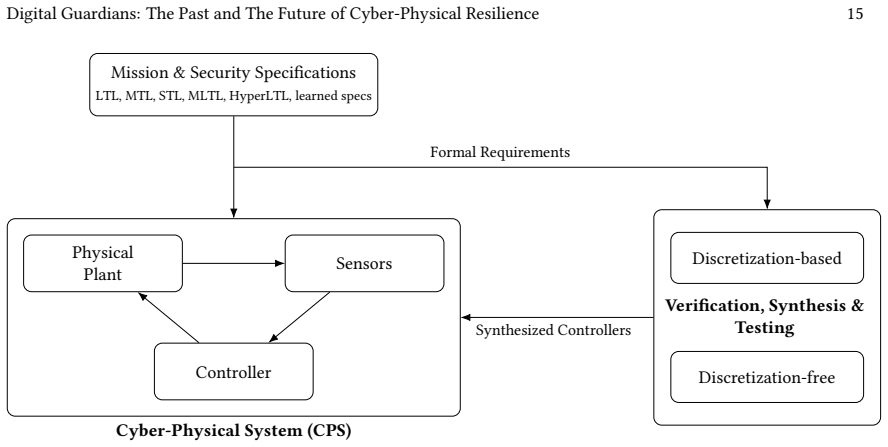


read the original abstract
Resilience in cyber-physical systems (CPS) is the fundamental ability to maintain safety and critical functionality despite adverse "perturbations," which includes security attacks, environmental disruptions, and hardware or software failures. This survey provides a comprehensive review of CPS resilience, framing the field through five interconnected themes that are required in an integrated whole to achieve real-world resilience. The article first posits that resilience is a system-wide property emerging from interactions between hardware, software, and human users. Second, it addresses the challenges of learning-enabled CPS, which often operate in data-scarce environments characterized by imbalanced or noisy data, requiring innovative solutions like synthetic data generation and foundation model adaptation. Third, the survey examines proactive measures for resilience, which include distinctive aspects of verification, testing, and redundancy. Fourth, it explores recovery mechanisms, moving beyond traditional fault models to design "just good enough" recovery strategies that prioritize safety-critical functions during perturbations. Finally, it highlights the central role of the human, focusing on the different levels of human intervention, the necessity of trust calibration, and the requirement for explainable AI to support human-CPS teaming. These themes are illustrated through representative application domains, primarily Connected and Autonomous Transportation Systems (CATS) and Medical CPS (MCPS). By integrating the five interconnected themes, this survey provides a systematic roadmap for achieving the resilient CPS in increasingly complex and adversarial environments.
Editorial analysis
A structured set of objections, weighed in public.
Referee Report
Summary. This survey reviews resilience in cyber-physical systems (CPS), defined as the ability to maintain safety and critical functionality despite perturbations such as security attacks, environmental disruptions, and failures. It organizes the literature around five interconnected themes presented as required in an integrated whole: (1) resilience as a system-wide property emerging from hardware-software-human interactions; (2) challenges in learning-enabled CPS operating in data-scarce, imbalanced, or noisy environments, with solutions including synthetic data generation and foundation model adaptation; (3) proactive measures encompassing verification, testing, and redundancy; (4) recovery mechanisms that extend beyond traditional fault models via 'just good enough' strategies prioritizing safety-critical functions; and (5) the human role, including levels of intervention, trust calibration, and explainable AI for human-CPS teaming. The themes are illustrated with Connected and Autonomous Transportation Systems (CATS) and Medical CPS (MCPS) as representative domains, with the goal of providing a systematic roadmap for resilient CPS in complex and adversarial environments.
Significance. If the synthesis of prior work is accurate and balanced, the paper provides a useful organizational framework that connects technical, proactive, recovery, and human-centric aspects of CPS resilience. This integration is timely for fields like autonomous systems and medical devices, where adversarial threats and data limitations are prominent. The survey's contribution is primarily structural rather than the introduction of new theorems or quantitative results; its value lies in highlighting interconnections and offering a roadmap that could guide interdisciplinary research and design practices.
major comments (1)
- Abstract: The framing asserts that the five themes 'are required in an integrated whole to achieve real-world resilience,' yet the provided text offers no explicit criteria, literature mapping, or argument demonstrating necessity and sufficiency. This organizational assertion is central to the roadmap claim; without justification in the introduction or a dedicated section showing why these themes (and not others) collectively suffice, the claim risks appearing as an ungrounded synthesis choice rather than a substantiated conclusion.
minor comments (3)
- Abstract and introduction: The term 'just good enough' recovery is introduced without an immediate definition, citation to prior literature, or contrast to traditional fault-tolerance models; adding a brief clarifying sentence or reference would improve accessibility for readers outside the subfield.
- The manuscript should include a table or explicit subsection summarizing how the five themes map onto the challenges in CATS and MCPS, to make the illustrative role of the domains more concrete and traceable.
- Ensure that discussions of foundation models and synthetic data in learning-enabled CPS cite recent surveys or benchmarks specific to CPS constraints (e.g., real-time or safety-critical requirements) rather than general ML literature alone.
Simulated Author's Rebuttal
We thank the referee for the constructive feedback and positive overall assessment of the survey. We address the single major comment below and commit to revisions that strengthen the presentation of our framework.
read point-by-point responses
-
Referee: Abstract: The framing asserts that the five themes 'are required in an integrated whole to achieve real-world resilience,' yet the provided text offers no explicit criteria, literature mapping, or argument demonstrating necessity and sufficiency. This organizational assertion is central to the roadmap claim; without justification in the introduction or a dedicated section showing why these themes (and not others) collectively suffice, the claim risks appearing as an ungrounded synthesis choice rather than a substantiated conclusion.
Authors: We acknowledge that the abstract states the integrated necessity of the five themes without providing selection criteria or a sufficiency argument in that section alone. The manuscript motivates each theme through dedicated literature reviews and demonstrates their interconnections (and the insufficiency of partial approaches) via the CATS and MCPS case studies. To make this explicit and address the concern, we will expand the introduction with a new subsection that (1) describes how the themes emerged from surveying recurring gaps across the CPS resilience literature, (2) provides a high-level mapping of representative works to each theme, and (3) argues for collective sufficiency by showing that technical, proactive, recovery, and human-centric elements must interact to handle the full range of perturbations discussed. This revision will ground the roadmap claim in the surveyed evidence rather than leaving it as an organizational assertion. revision: yes
Circularity Check
No significant circularity
full rationale
This is a literature survey that organizes prior work into five themes without any derivations, equations, fitted parameters, or quantitative predictions. The central claims are organizational assertions about interconnected themes and representative domains, drawn from synthesis of external literature rather than self-referential definitions or self-citation chains that reduce the result to its inputs by construction. No load-bearing steps exist that could be flagged under the enumerated circularity patterns.
Axiom & Free-Parameter Ledger
Reference graph
Works this paper leans on
-
[1]
Fardin Abdi Taghi Abad, Renato Mancuso, Stanley Bak, Or Dantsker, and Marco Caccamo. 2016. Reset-based recovery for real-time cyber-physical systems with temporal safety constraints. In2016 IEEE 21st International Conference on Emerging Technologies and Factory Automation (ETFA). IEEE, 1–8
2016
-
[2]
Fardin Abdi, Chien-Ying Chen, Monowar Hasan, Songran Liu, Sibin Mohan, and Marco Caccamo. 2018. Guaranteed Physical Security with Restart-Based Design for Cyber-Physical Systems. In2018 ACM/IEEE 9th International Conference on Cyber-Physical Systems (ICCPS). 10–21. https://doi.org/10.1109/ICCPS.2018.00010
-
[3]
Fardin Abdi, Chien-Ying Chen, Monowar Hasan, Songran Liu, Sibin Mohan, and Marco Caccamo. 2019. Preserving Physical Safety Under Cyber Attacks.IEEE Internet of Things Journal6, 4 (2019), 6285–6300. https://doi.org/10.1109/JIOT.2018.2889866
-
[4]
Aastha Acharya, Rebecca Russell, and Nisar R. Ahmed. 2022. Competency Assessment for Autonomous Agents using Deep Generative Models. In 2022 IEEE/RSJ International Conference on Intelligent Robots and Systems (IROS). 8211–8218. https://doi.org/10.1109/IROS47612.2022.9981991 ISSN: 2153-0866
-
[5]
Guy Ackerson and K Fu. 1970. On state estimation in switching environments.IEEE transactions on automatic control15, 1 (1970), 10–17
1970
-
[6]
Ben Adcock and Nick Dexter. 2021. The gap between theory and practice in function approximation with deep neural networks.SIAM Journal on Mathematics of Data Science3, 2 (2021), 624–655
2021
-
[7]
Devansh Ramgopal Agrawal, Ruichang Chen, and Dimitra Panagou. 2024. gatekeeper: Online Safety Verification and Control for Nonlinear Systems in Dynamic Environments.IEEE Transactions on Robotics40 (2024), 4358–4375. https://doi.org/10.1109/TRO.2024.3454415
-
[8]
Devansh R Agrawal and Dimitra Panagou. 2021. Safe control synthesis via input constrained control barrier functions. In2021 60th IEEE Conference on Decision and Control. 6113–6118
2021
-
[9]
Devansh R Agrawal, Hardik Parwana, Ryan K Cosner, Ugo Rosolia, Aaron D Ames, and Dimitra Panagou. 2021. A constructive method for designing safe multirate controllers for differentially-flat systems.IEEE Control Systems Letters6 (2021), 2138–2143
2021
-
[10]
Asrar Ahmed, Pradeep Varakantham, Yossiri Adulyasak, and Patrick Jaillet. 2013. Regret based robust solutions for uncertain Markov decision processes. In27th International Conference on Neural Information Processing Systems
2013
-
[11]
R. Alur, P. Černý, and S. Zdancewic. 2006. Preserving Secrecy Under Refinement. InAutomata, Languages and Programming. Springer Berlin Heidelberg, 107–118
2006
-
[12]
R. Alur, T. Henzinger, G. Lafferriere, and G. J. Pappas. 2000. Discrete abstractions of hybrid systems.Proc. IEEE88, 7 (July 2000), 971–984
2000
-
[13]
Alur and T
R. Alur and T. A. Henzinger. 1990. Real-time Logics: Complexity and Expressiveness. InLICS. IEEE, 390–401
1990
-
[14]
Alejandro Barredo Arrieta, Natalia Díaz-Rodríguez, Javier Del Ser, Adrien Bennetot, Siham Tabik, Alberto Barbado, Salvador García, Sergio Gil-López, Daniel Molina, Richard Benjamins, et al . 2020. Explainable Artificial Intelligence (XAI): Concepts, taxonomies, opportunities and challenges toward responsible AI.Information fusion58 (2020), 82–115
2020
-
[15]
Asarin, O
E. Asarin, O. Maler, and A. Pnueli. 1995. Reachability analysis of dynamical systems having piecewise-constant derivatives.Theoretical Computer Science138 (1995), 35–66
1995
-
[16]
Kıvanç Atilgan, Burak E Onuk, Pınar Köksal Coşkun, Fahri G Yeşil, Cemal Aslan, Abdullah Çolak, Aksüyek S Çelebi, and Hüseyin Bozbaş. 2021. Remote patient monitoring after cardiac surgery: the utility of a novel telemedicine system.Journal of Cardiac Surgery36, 11 (2021), 4226–4234
2021
-
[17]
Peter Auer, Thomas Jaksch, and Ronald Ortner. 2008. Near-optimal regret bounds for reinforcement learning.Advances in neural information processing systems21 (2008)
2008
-
[18]
Alexis Aurandt, Phillip Jones, and Kristin Yvonne Rozier. 2022. Runtime Verification Triggers Real-time, Autonomous Fault Recovery on the CySat-I. InProceedings of the 14th NASA Formal Methods Symposium (NFM 2022) (Lecture Notes in Computer Science (LNCS), Vol. 13260). Springer, Cham, Caltech, California, USA
2022
-
[19]
Baier and J
C. Baier and J. P. Katoen. 2008.Principles of model checking. The MIT Press
2008
- [20]
-
[21]
Ezio Bartocci. 2018. Monitoring, Learning and Control of Cyber-Physical Systems with STL (Tutorial). InRuntime Verification, Christian Colombo and Martin Leucker (Eds.). Springer International Publishing, Cham, 35–42
2018
-
[22]
2017.Formal methods for discrete-time dynamical systems
Calin Belta, Boyan Yordanov, and Ebru Aydin Gol. 2017.Formal methods for discrete-time dynamical systems. Vol. 89. Springer
2017
-
[23]
Alessia Benevento, María Santos, Giuseppe Notarstefano, Kamran Paynabar, Matthieu Bloch, and Magnus Egerstedt. 2020. Multi-robot coordination for estimation and coverage of unknown spatial fields. In2020 IEEE International Conference on Robotics and Automation. 7740–7746
2020
-
[24]
Melanie Berg and Kenneth A LaBel. 2016. Verification of triple modular redundancy (TMR) insertion for reliable and trusted systems. In2016 MRQW Microelectronics Reliability and Qualification Working Meeting
2016
-
[25]
Mitchell Black, Ehsan Arabi, and Dimitra Panagou. 2021. A fixed-time stable adaptation law for safety-critical control under parametric uncertainty. In2021 European Control Conference (ECC). IEEE, 1328–1333
2021
-
[26]
Mitchell Black, Georgios Fainekos, Bardh Hoxha, Danil Prokhorov, and Dimitra Panagou. 2023. Safety under uncertainty: Tight bounds with risk-aware control barrier functions. In2023 IEEE International Conference on Robotics and Automation (ICRA). IEEE, 12686–12692
2023
- [27]
-
[28]
Joseph Breeden and Dimitra Panagou. 2021. High relative degree control barrier functions under input constraints. In2021 60th IEEE Conference on Decision and Control. IEEE, 6119–6124
2021
-
[29]
Tom Brown, Benjamin Mann, Nick Ryder, Melanie Subbiah, Jared D Kaplan, Prafulla Dhariwal, Arvind Neelakantan, Pranav Shyam, Girish Sastry, Amanda Askell, et al. 2020. Language models are few-shot learners.Advances in neural information processing systems33 (2020), 1877–1901
2020
-
[30]
L Campo, P Mookerjee, and Y Bar-Shalom. 1991. State estimation for systems with sojourn-time-dependent Markov model switching.IEEE Trans. Automat. Control36, 2 (1991), 238–243
1991
-
[31]
Mathilde Caron, Hugo Touvron, Ishan Misra, Hervé Jégou, Julien Mairal, Piotr Bojanowski, and Armand Joulin. 2021. Emerging properties in self-supervised vision transformers. InProceedings of the IEEE/CVF international conference on computer vision. 9650–9660
2021
-
[32]
Cassandras and S
C. Cassandras and S. Lafortune. 1999.Introduction to discrete event systems. Kluwer Academic Publishers, Boston, MA
1999
-
[33]
Beatrice Cassottana, Muhammad M Roomi, Daisuke Mashima, and Giovanni Sansavini. 2023. Resilience analysis of cyber-physical systems: A review of models and methods.Risk Analysis43, 11 (2023), 2359–2379
2023
-
[34]
Matthew Cavorsi, Lorenzo Sabattini, and Stephanie Gil. 2023. Multirobot adversarial resilience using control barrier functions.IEEE Transactions on Robotics40 (2023), 797–815
2023
- [35]
-
[36]
Yash Chandak, Georgios Theocharous, Shiv Shankar, Sridhar Mahadevan, Martha White, and Philip S Thomas. 2020. Optimizing for the Future in Non-Stationary MDPs.Thirty-seventh International Conference on Machine Learning (ICML)(2020)
2020
-
[37]
Bingfeng Chen, Zhifeng Hao, Xiaofeng Cai, Ruichu Cai, Wen Wen, Jian Zhu, and Guangqiang Xie. 2019. Embedding Logic Rules Into Recurrent Neural Networks.IEEE Access7 (2019). https://doi.org/10.1109/ACCESS.2019.2892140
-
[38]
Hudson, and Kung Yao
Chiao En Chen, Flavio Lorenzelli, Ralph E. Hudson, and Kung Yao. 2008. Stochastic maximum-likelihood DOA estimation in the presence of unknown nonuniform noise.IEEE Transactions on Signal Processing56, 7 (2008), 3038–3044
2008
-
[39]
Chien-Ying Chen, Debopam Sanyal, and Sibin Mohan. 2021. Indistinguishability Prevents Scheduler Side Channels in Real-Time Systems. In Proceedings of the 2021 ACM SIGSAC Conference on Computer and Communications Security(Virtual Event, Republic of Korea)(CCS ’21). Association for Computing Machinery, New York, NY, USA, 666–684. https://doi.org/10.1145/346...
-
[40]
Hongkai Chen, Shan Lin, Scott A Smolka, and Nicola Paoletti. 2022. An STL-based formulation of resilience in cyber-physical systems. In International Conference on Formal Modeling and Analysis of Timed Systems. Springer, 117–135
2022
- [41]
-
[42]
Glen Chou, Dmitry Berenson, and Necmiye Ozay. 2020. Uncertainty-Aware Constraint Learning for Adaptive Safe Motion Planning from Demonstrations. In4th Conference on Robot Learning, CoRL 2020, 16-18 November 2020, Virtual Event / Cambridge, MA, USA (Proceedings of Machine Learning Research, Vol. 155), Jens Kober, Fabio Ramos, and Claire J. Tomlin (Eds.). P...
2020
-
[43]
Glen Chou, Dmitry Berenson, and Necmiye Ozay. 2021. Learning constraints from demonstrations with grid and parametric representations.Int. J. Robotics Res.40, 10-11 (2021). https://doi.org/10.1177/02783649211035177
-
[44]
Glen Chou, Necmiye Ozay, and Dmitry Berenson. 2022. Safe Output Feedback Motion Planning from Images via Learned Perception Modules and Contraction Theory. InAlgorithmic Foundations of Robotics XV - Proceedings of the Fifteenth Workshop on the Algorithmic Foundations of Robotics, W AFR 2022, College Park, MD, USA, 22-24 June, 2022 (Springer Proceedings in...
2022
-
[45]
Michael R Clarkson and Fred B Schneider. 2010. Hyperproperties.Journal of Computer Security18, 6 (2010), 1157–1210
2010
-
[46]
Matthew Cleaveland, Pengyuan Lu, Oleg Sokolsky, Insup Lee, and Ivan Ruchkin. 2025. Conservative Perception Models for Probabilistic Verification. https://doi.org/10.48550/arXiv.2503.18077 arXiv:2503.18077 [cs] version: 2
-
[47]
2017.Framework for Cyber -Physical Systems: Volume 2, Working Group Reports
Cyber-Physical Systems Public Working Group. 2017.Framework for Cyber -Physical Systems: Volume 2, Working Group Reports. NIST Special Publication 1500-202. National Institute of Standards and Technology (NIST), U.S. Department of Commerce. https://doi.org/10.6028/NIST.SP.1500- 202 163 pp
-
[48]
James Bruster Dabney. 2021. Using Assume-Guarantee Contracts in Autonomous Spacecraft. Flight Software Workshop (FSW) Online: https: //www.youtube.com/watch?v=zrtyiyNf674
2021
-
[49]
James B. Dabney, Julia M. Badger, and Pavan Rajagopal. 2021. Adding a Verification View for an Autonomous Real-Time System Architecture. In Proceedings of SciTech Forum (2021-0566). AIAA, Online. https://doi.org/10.2514/6.2021-0566
-
[50]
James B Dabney, Julia M Badger, and Pavan Rajagopal. 2023. Trustworthy Autonomy for Gateway Vehicle System Manager. In2023 IEEE Space Computing Conference (SCC). IEEE, 57–62
2023
-
[51]
James Bruster Dabney, Pavan Rajagopal, and Julia M. Badger. 2022. Using Assume-Guarantee Contracts for Developmental Verification of Autonomous Spacecraft. Flight Software Workshop (FSW) Online: https://www.youtube.com/watch?v=HFnn6TzblPg
2022
-
[52]
György Dán and Henrik Sandberg. 2010. Stealth attacks and protection schemes for state estimators in power systems. In2010 first IEEE international conference on smart grid communications. IEEE, 214–219
2010
-
[53]
Giuseppe De Giacomo and Moshe Y. Vardi. 2013. Linear Temporal Logic and Linear Dynamic Logic on Finite Traces. In23rd International Joint Conference on Artificial Intelligence (IJCAI). AAAI Press, 854–860
2013
-
[54]
Atsushi Deguchi et al. 2020. From smart city to society 5.0.Society5 (2020), 43–65. Manuscript submitted to ACM CSUR 34 Bagchi, et al
2020
-
[55]
2013.Global Precipitation Measurement (GPM) Safety Inhibit Timeline Tool
Shirley Dion. 2013.Global Precipitation Measurement (GPM) Safety Inhibit Timeline Tool. Technical Report GSFC.ABS.7501.2012. NASA Goddard Space Flight Center, Greenbelt, MD, United States. https://ntrs.nasa.gov/citations/20130000831
-
[56]
Rahul Dixit, Ratne Babu Chinnam, and Harpreet Singh. 2020. Artificial intelligence and machine learning in sparse/inaccurate data situations. In 2020 IEEE Aerospace Conference. IEEE
2020
-
[57]
Alexandre Donzé. 2013. On Signal Temporal Logic. InRuntime Verification, Axel Legay and Saddek Bensalem (Eds.). Springer Berlin Heidelberg, Berlin, Heidelberg, 382–383
2013
-
[58]
Viet Quoc Duong, Qiong Wu, Zhengyi Zhou, Eric Zavesky, WenLing Hsu, Han Zhao, and Huajie Shao. 2024. A General-Purpose Multi-Modal OOD Detection Framework.Transactions on Machine Learning Research(2024)
2024
-
[59]
Mica R Endsley. 2017. From here to autonomy: lessons learned from human–automation research.Human factors59, 1 (2017), 5–27
2017
-
[60]
H Erzberger and K Heere. 2010. Algorithm and operational concept for resolving short-range conflicts.Proc. IMechE G J. Aerosp. Eng.224, 2 (2010), 225–243. https://doi.org/10.1243/09544100JAERO546 arXiv:http://pig.sagepub.com/content/224/2/225.full.pdf+html
-
[61]
Xiaocong Fan, Sooyoung Oh, Michael McNeese, John Yen, Haydee Cuevas, Laura Strater, and Mica R Endsley. 2008. The influence of agent reliability on trust in human-agent collaboration. InProceedings of the 15th European conference on Cognitive ergonomics: the ergonomics of cool interaction. 1–8
2008
-
[62]
Marco Faroni, Manuel Beschi, and Nicola Pedrocchi. 2022. Safety-aware time-optimal motion planning with uncertain human state estimation. IEEE Robotics and Automation Letters7, 4 (2022), 12219–12226
2022
-
[63]
Michael Fisher, Viviana Mascardi, Kristin Yvonne Rozier, Holger Schlingloff, Michael Winikoff, and Neil Yorke-Smith. 2021. Towards a Framework for Certification of Reliable Autonomous Systems. In20th International Conference on Autonomous Agents and Multiagent Systems (AAMAS) (Journal-first (JAAMAS) track). Springer
2021
-
[64]
Sébastien Forestier, Rémy Portelas, Yoan Mollard, and Pierre-Yves Oudeyer. 2022. Intrinsically motivated goal exploration processes with automatic curriculum learning.Journal of Machine Learning Research23, 152 (2022), 1–41
2022
-
[65]
Dylan Foster and Max Simchowitz. 2020. Logarithmic regret for adversarial online control. InInternational Conference on Machine Learning. 3211–3221
2020
- [66]
-
[67]
Scott Fujimoto, Herke Hoof, and David Meger. 2018. Addressing function approximation error in actor-critic methods. InInternational conference on machine learning. 1587–1596
2018
-
[68]
Kunal Garg, James Usevitch, Joseph Breeden, Mitchell Black, Devansh Agrawal, Hardik Parwana, and Dimitra Panagou. 2024. Advances in the theory of control barrier functions: Addressing practical challenges in safe control synthesis for autonomous and robotic systems.Annual Reviews in Control57 (2024), 100945
2024
-
[69]
Yuang Geng, Jake Brandon Baldauf, Souradeep Dutta, Chao Huang, and Ivan Ruchkin. 2024. Bridging Dimensions: Confident Reachability for High- Dimensional Controllers. InProc. of the International Symposium on Formal Methods (FM). Milano, Italy. https://doi.org/10.48550/arXiv.2311.04843 arXiv:2311.04843 [cs]
-
[70]
Girard and G
A. Girard and G. J. Pappas. 2007. Approximation metrics for discrete and continuous systems.IEEE Trans. Automat. Control25, 5 (May 2007), 782–798
2007
-
[71]
Girard, G
A. Girard, G. Pola, and P. Tabuada. 2010. Approximately bisimilar symbolic models for incrementally stable switched systems.IEEE Trans. Automat. Control55, 1 (January 2010), 116–126
2010
-
[72]
Jianping Gou, Baosheng Yu, Stephen J Maybank, and Dacheng Tao. 2021. Knowledge distillation: A survey.International Journal of Computer Vision129, 6 (2021), 1789–1819
2021
-
[73]
Shu Guo, Quan Wang, Lihong Wang, Bin Wang, and Li Guo. 2016. Jointly embedding knowledge graphs and logical rules. InProceedings of the 2016 conference on empirical methods in natural language processing. 192–202
2016
-
[74]
David Ha and Jürgen Schmidhuber. 2018. World Models. InProc. of NeurIPS. https://doi.org/10.5281/zenodo.1207631 arXiv:1803.10122 [cs, stat]
-
[75]
Abigail Hammer, Matthew Cauwels, Benjamin Hertz, Phillip Jones, and Kristin Yvonne Rozier. 2021. Integrating Runtime Verification into an Automated UAS Traffic Management System.Innovations in Systems and Software Engineering: A NASA Journal(July 2021). https://doi.org/10.100 7/s11334-021-00407-5
2021
-
[76]
Yuze He, Li Ma, Zhehao Jiang, Yi Tang, and Guoliang Xing. 2021. VI-eye: semantic-based 3D point cloud registration for infrastructure-assisted autonomous driving. InProceedings of the 27th Annual International Conference on Mobile Computing and Networking (MobiCom). 573–586
2021
-
[77]
Benjamin Hertz, Zachary Luppen, and Kristin Yvonne Rozier. 2021. Integrating Runtime Verification into a Sounding Rocket Control System. In NASA Formal Methods - 13th International Symposium, NFM 2021, Virtual Event, May 24-28, 2021, Proceedings (Lecture Notes in Computer Science, Vol. 12673), Aaron Dutle, Mariano M. Moscato, Laura Titolo, César A. Muñoz,...
-
[78]
2006.Resilience engineering: Concepts and precepts
Erik Hollnagel, David D Woods, and Nancy Leveson. 2006.Resilience engineering: Concepts and precepts. Ashgate Publishing, Ltd
2006
-
[79]
Timothy Hospedales, Antreas Antoniou, Paul Micaelli, and Amos Storkey. 2021. Meta-learning in neural networks: A survey.IEEE Transactions on Pattern Analysis and Machine Intelligence(2021)
2021
-
[80]
Edward J Hu, Yelong Shen, Phillip Wallis, Zeyuan Allen-Zhu, Yuanzhi Li, Shean Wang, Lu Wang, and Weizhu Chen. 2022. LoRA: Low-Rank Adaptation of Large Language Models. InInternational Conference on Learning Representations. https://openreview.net/forum?id=nZeVKeeFYf9 Manuscript submitted to ACM CSUR Digital Guardians: The Past and The Future of Cyber-Phys...
2022
discussion (0)
Sign in with ORCID, Apple, or X to comment. Anyone can read and Pith papers without signing in.