Recognition: unknown
A cord algebra for tori in three-space
Pith reviewed 2026-05-10 11:07 UTC · model grok-4.3
The pith
The cord algebra of a thin torus around a knot equals the cord algebra of the knot itself.
A machine-rendered reading of the paper's core claim, the machinery that carries it, and where it could break.
Core claim
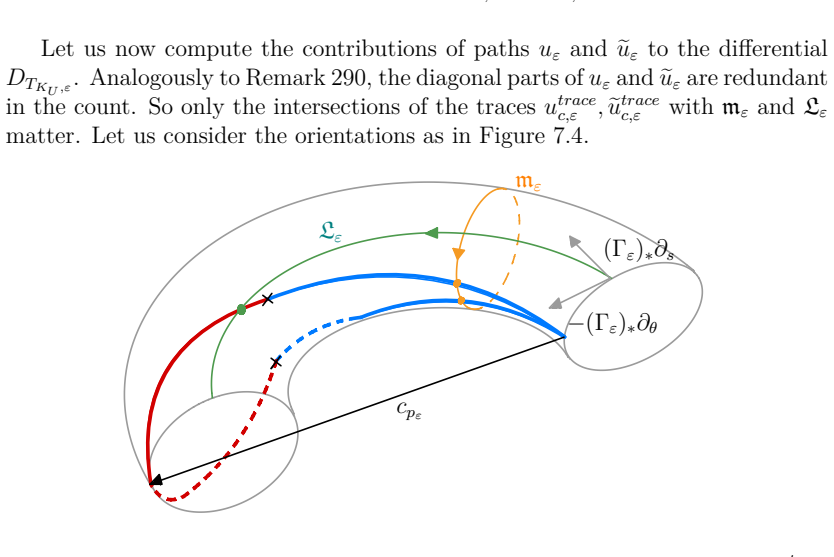
Given a thin torus T_K around a knot K in R^3, Morse models of the cord algebra Cord(T_K) are constructed with Z and loop space coefficients. Multiple time scale dynamics identify Cord(T_K; Z) with Cord(K; Z). In combination with prior results this relates Cord(T_K) to the zeroth-degree Legendrian contact homology LCH_0 of one component of the unit conormal bundle over T_K. The definition is motivated by J-holomorphic curves with boundary on the Lagrangian submanifold L^*_+ T_K union R^3 that has an arboreal singularity along T_K.
What carries the argument
Morse models of the cord algebra Cord(T_K) for the thin torus, identified with Cord(K) through multiple time scale dynamics.
Load-bearing premise
The Morse models for the cord algebra of the torus are valid and multiple time scale dynamics can be applied to equate the integer version with the knot's cord algebra.
What would settle it
An explicit computation of both algebras for the unknot or trefoil that shows they are not isomorphic as algebras would disprove the identification.
Figures








read the original abstract
Given a thin torus $T_K$ around a knot $K\subset \mathbb{R}^3$, we construct Morse models of cord algebra $Cord(T_K)$ with $\mathbb{Z}$ and loop space coefficients. Using the Multiple time scale dynamics we identify $Cord(T_K; \mathbb{Z})$ with $Cord(K; \mathbb{Z})$. In combination with the works of Cieliebak-Ekholm-Latschev-Ng and Petrak this indirectly relates $Cord(T_K)$ to $0$-th degree Legendrian contact homology $LCH_0(\mathcal{L}^\ast_+ T_K)$ of one component of the unit conormal bundle over $T_K$. Our definition of $Cord(T_K)$ is motivated by $J$-holomorphic curves with boundary on the Lagrangian submanifold $L^\ast_+ T_K\cup\mathbb{R}^3$ with an arboreal singularity along the torus $T_K$.
Editorial analysis
A structured set of objections, weighed in public.
Referee Report
Summary. Given a thin torus T_K around a knot K in R^3, the manuscript constructs Morse models for the cord algebra Cord(T_K) with Z and loop space coefficients. It applies multiple time scale dynamics to identify Cord(T_K; Z) with Cord(K; Z). Combined with prior results of Cieliebak-Ekholm-Latschev-Ng and Petrak, this yields an indirect relation between Cord(T_K) and the degree-0 Legendrian contact homology LCH_0 of one component of the unit conormal bundle over T_K. The definition of Cord(T_K) is motivated by counts of J-holomorphic curves on the Lagrangian L^*_+ T_K union R^3 with an arboreal singularity along T_K.
Significance. If the identification holds, the work supplies a new geometric model for cord algebras on tori and a bridge to Legendrian contact homology, potentially enabling new computations or relations between symplectic invariants and classical knot invariants. The motivation via arboreal singularities and the use of multiple time scale dynamics constitute a technically distinctive approach.
major comments (1)
- The central identification Cord(T_K; Z) ≅ Cord(K; Z) via multiple time scale dynamics is load-bearing for the main claim, yet the abstract provides no explicit Morse model, no statement of the time-scale equations, and no verification that the identification is independent of the definitions already present in the cited works of Cieliebak-Ekholm-Latschev-Ng and Petrak.
minor comments (1)
- The notation L^*_+ T_K for the unit conormal bundle component is introduced without a local coordinate description or reference to its precise embedding in the cotangent bundle.
Simulated Author's Rebuttal
We thank the referee for their report and the opportunity to clarify the manuscript. We address the single major comment below and will revise the abstract accordingly.
read point-by-point responses
-
Referee: The central identification Cord(T_K; Z) ≅ Cord(K; Z) via multiple time scale dynamics is load-bearing for the main claim, yet the abstract provides no explicit Morse model, no statement of the time-scale equations, and no verification that the identification is independent of the definitions already present in the cited works of Cieliebak-Ekholm-Latschev-Ng and Petrak.
Authors: The abstract is intentionally concise, but the body of the manuscript provides the requested details. Section 2 constructs the Morse model for Cord(T_K) explicitly, with generators given by cords on the torus and differentials counted via J-holomorphic curves on the Lagrangian with arboreal singularity. Section 3 introduces the multiple time scale dynamical system, stating the slow-fast ODEs on T_K that govern the identification. The equivalence Cord(T_K; Z) ≅ Cord(K; Z) is verified by showing that the chain complex of the time-scale system recovers the standard generators and relations of the knot cord algebra through direct limiting analysis, without presupposing the algebraic presentations in the cited works; the dynamical construction supplies an independent geometric proof of the isomorphism. We will revise the abstract to include a brief description of the Morse model and the time-scale equations. revision: yes
Circularity Check
No significant circularity in the derivation chain
full rationale
The paper constructs Morse models for Cord(T_K) motivated by J-holomorphic curves on the Lagrangian L^*_+ T_K union R^3 with an arboreal singularity. It then applies multiple time scale dynamics as an independent dynamical tool to identify Cord(T_K; Z) with Cord(K; Z). The indirect relation to LCH_0 is obtained by combining the result with prior independent works of Cieliebak-Ekholm-Latschev-Ng and Petrak. No load-bearing step reduces by construction to the paper's own inputs, fitted parameters, or self-citations; the central claims remain externally grounded and self-contained.
Axiom & Free-Parameter Ledger
axioms (2)
- domain assumption Multiple time scale dynamics can be used to identify Cord(T_K; Z) with Cord(K; Z)
- domain assumption The cord algebra definition is valid when motivated by J-holomorphic curves with boundary on L^*_+ T_K union R^3 having an arboreal singularity along T_K
Reference graph
Works this paper leans on
-
[1]
Symplectic cohomology and viterbo’s theorem.arXiv preprint arXiv:1312.3354,
[Abo13] Mohammed Abouzaid. Symplectic cohomology and Viterbo’s theorem.arXiv preprint arXiv:1312.3354,
-
[2]
Fiber Floer cohomology and conormal stops.arXiv preprint arXiv:1912.02547,
[Asp19] Johan Asplund. Fiber Floer cohomology and conormal stops.arXiv preprint arXiv:1912.02547,
-
[3]
Chern-Simons Theory and string topology.arXiv preprint arXiv:2312.05922,
[CV23] Kai Cieliebak and Evgeny Volkov. Chern-Simons Theory and string topology.arXiv preprint arXiv:2312.05922,
-
[4]
Knot contact homology and open Gromov–Witten theory
[Ekh18] Tobias Ekholm. Knot contact homology and open Gromov–Witten theory. InProceedings of the International Congress of Mathematicians: Rio de Janeiro 2018, pages 1063–1086. World Scientific,
2018
-
[5]
The moduli space of gradient flow lines and Morse homology
[FN20] Urs Frauenfelder and Robert Nicholls. The moduli space of gradient flow lines and Morse homology. arXiv preprint arXiv:2005.10799,
-
[6]
Lagrange multipliers and adiabatic limits i.arXiv preprint arXiv:2210.11221,
[FW22a] Urs Frauenfelder and Joa Weber. Lagrange multipliers and adiabatic limits i.arXiv preprint arXiv:2210.11221,
-
[7]
Framed knot contact homology.arXiv preprint math/0407071,
[Ng04] Lenhard Ng. Framed knot contact homology.arXiv preprint math/0407071,
-
[8]
Legendrian non-isotopic unit conormal bundles in high dimensions.arXiv preprint arXiv:2410.15936,
[Oka24] Yukihiro Okamoto. Legendrian non-isotopic unit conormal bundles in high dimensions.arXiv preprint arXiv:2410.15936,
discussion (0)
Sign in with ORCID, Apple, or X to comment. Anyone can read and Pith papers without signing in.