Recognition: unknown
Upper bound of ejecta mass in a nova outburst
Pith reviewed 2026-05-10 09:33 UTC · model grok-4.3
The pith
Nuclear burning limits nova ejecta to at most 2.6 times the accreted mass for massive white dwarfs.
A machine-rendered reading of the paper's core claim, the machinery that carries it, and where it could break.
Core claim
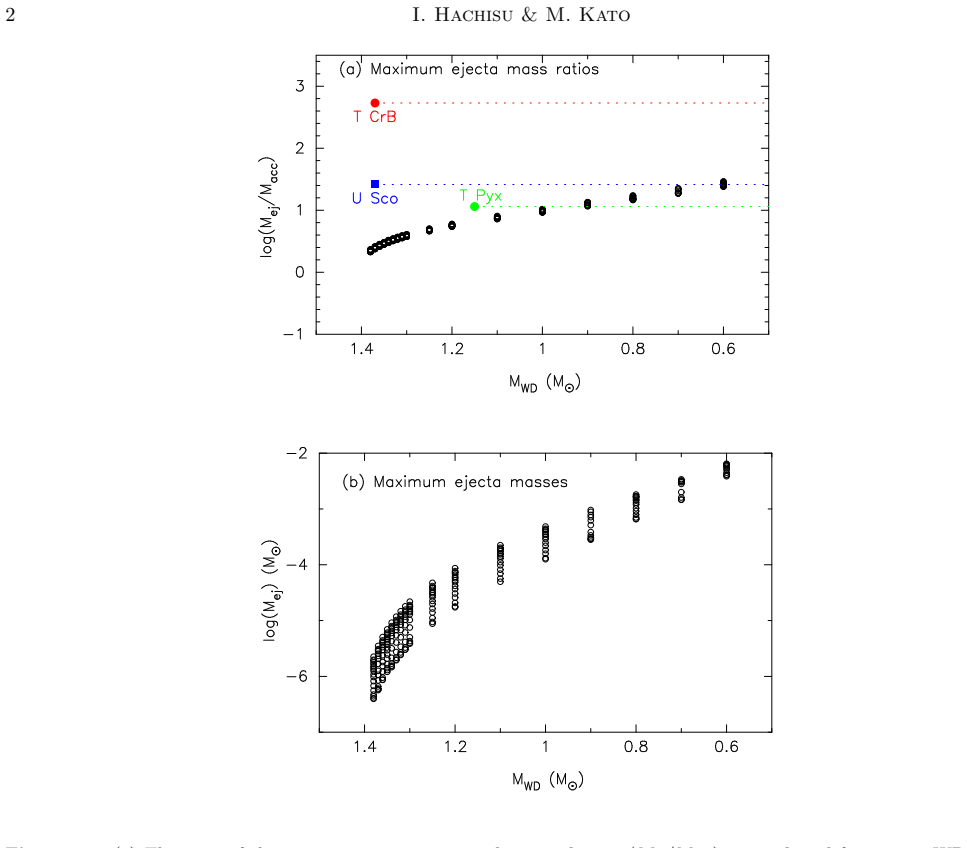
From the energy balance with nuclear burning at thermonuclear runaway, the maximum ratio of ejecta mass to accreted mass reaches only ≲ 2.6 for a 1.37 M_⊙ white dwarf, showing that hydrogen nuclear burning releases insufficient energy to expel the much larger ejecta masses claimed from orbital period changes in recurrent novae U Sco and T CrB.
What carries the argument
Energy balance between nuclear energy generation during thermonuclear runaway and the kinetic energy required to eject the envelope, applied across white dwarf masses and accretion rates to set an upper bound on M_ej/M_acc.
If this is right
- Recurrent novae cannot experience net white dwarf mass loss at the levels claimed from orbital period changes.
- White dwarf masses in systems like U Sco and T CrB remain near the Chandrasekhar limit and stay viable Type Ia supernova progenitors.
- The upper bound on the ejecta-to-accreted mass ratio holds across the full range of white dwarf masses from 0.6 to 1.38 solar masses.
- Inclusion of frictional mass ejection in the common envelope phase produces no significant increase in the allowed ratio.
Where Pith is reading between the lines
- Orbital period changes after novae may reflect effects other than net mass ejection, such as angular momentum loss or structural readjustment.
- If the reported high ratios prove accurate by other means, the energy accounting would require additional sources beyond nuclear burning.
- The bound supplies a testable prediction for future high-precision mass-loss measurements in other recurrent novae.
Load-bearing premise
Energy released by nuclear burning plus minor frictional contributions is the dominant and limiting factor setting the maximum ejecta mass, with no other unaccounted energy sources or highly efficient ejection channels allowing substantially larger ratios.
What would settle it
Direct, independent measurement of both ejected and accreted masses in a single nova outburst on a white dwarf near 1.37 solar masses that yields a ratio exceeding 2.6.
Figures

read the original abstract
We present the maximum ejecta mass $(M_{\rm ej})_{\rm max}$ and the maximum ratio of ejecta mass and accreted mass $(M_{\rm ej}/M_{\rm acc})_{\rm max}$ of a nova for various white dwarf (WD) masses ($M_{\rm WD}=0.6$ - 1.38 $M_\odot$) and mass accretion rates ($\dot{M}_{\rm acc}=1\times 10^{-11}$ - $3\times 10^{-7} ~M_\odot$ yr$^{-1}$) based on the energy balance with nuclear burning. These maximum values serve as an upper bound of mass ejection for individual novae. Recently, B. E. Schaefer concluded that the WD masses in the recurrent novae U Sco and T CrB decreased at nova explosions, because the ejected mass is much larger than the accreted mass, i.e., $M_{\rm ej}/M_{\rm acc}= 26$ and $540$, respectively. These values are derived from the orbital period change at the nova explosions. Recurrent novae have been considered to be a progenitor system of Type Ia supernovae (SNe Ia) because their WD masses are now close to, and will possibly grow up to, 1.38 $M_\odot$ at which WDs explode as SNe Ia. From the different view point of energy generation at the thermonuclear runaway, we have obtained the much smaller value of the maximum ratio of $M_{\rm ej}/M_{\rm acc}\lesssim 2.6$ for a $1.37 ~M_\odot$ WD. This conclusion simply means that the nuclear (hydrogen) burning cannot release energy enough to expel such a large ejecta mass as B. E. Schaefer's claims. We also conclude that $(M_{\rm ej}/M_{\rm acc})_{\rm max}$ hardly increases even if we include the effect of frictional mass ejection process in the common envelope phase of a nova.
Editorial analysis
A structured set of objections, weighed in public.
Referee Report
Summary. The manuscript derives upper bounds on nova ejecta mass M_ej and the ratio M_ej/M_acc by equating nuclear energy release from hydrogen burning (q × M_acc) plus a frictional term to the gravitational binding energy needed to unbind M_ej. For a 1.37 M_⊙ white dwarf it obtains (M_ej/M_acc)_max ≲ 2.6, far below the ratios 26 and 540 inferred by Schaefer from orbital-period changes in U Sco and T CrB. The paper concludes that nuclear burning cannot supply enough energy for such large ejecta masses and that adding common-envelope frictional ejection does not materially raise the bound.
Significance. If the energy-balance limit is robust, the result supplies a largely parameter-free theoretical ceiling that directly challenges dynamical inferences of extreme mass loss in recurrent novae and thereby supports the possibility of net white-dwarf growth toward the Chandrasekhar mass. The approach relies on standard nuclear yields and white-dwarf potentials rather than fitted parameters from the critiqued work.
major comments (2)
- [Abstract and conclusion] Abstract and concluding paragraph: the claim that frictional ejection 'hardly increases' the maximum ratio is load-bearing for the rejection of Schaefer’s ratios. The manuscript does not report the adopted common-envelope efficiency α or the orbital-shrinkage factor used to evaluate ΔE_orb. For α ≈ 1 and a spiral-in by a factor ≳2 (plausible for short-period systems), the added energy term can raise the available budget by a factor of several, potentially pushing the bound well above 2.6 and closer to the claimed values.
- [Energy-balance section] Energy-balance derivation (implicit in the abstract statement of the 2.6 limit): the calculation equates nuclear energy release to binding energy but does not quantify the fraction of nuclear energy lost to radiation, neutrinos, or incomplete burning. Even a modest reduction in effective yield would lower the numerical ceiling further and strengthen the tension with Schaefer’s numbers; the manuscript should state the assumed burning efficiency explicitly.
minor comments (1)
- [Abstract] The abstract lists a range of WD masses and accretion rates but does not reference the table or figure that tabulates the resulting (M_ej)_max and (M_ej/M_acc)_max values for each combination.
Simulated Author's Rebuttal
We thank the referee for the careful reading and constructive comments on our manuscript. We address each major comment below and have revised the manuscript to provide the requested clarifications on parameters and assumptions.
read point-by-point responses
-
Referee: [Abstract and conclusion] Abstract and concluding paragraph: the claim that frictional ejection 'hardly increases' the maximum ratio is load-bearing for the rejection of Schaefer’s ratios. The manuscript does not report the adopted common-envelope efficiency α or the orbital-shrinkage factor used to evaluate ΔE_orb. For α ≈ 1 and a spiral-in by a factor ≳2 (plausible for short-period systems), the added energy term can raise the available budget by a factor of several, potentially pushing the bound well above 2.6 and closer to the claimed values.
Authors: We adopted the maximum common-envelope efficiency α = 1 together with an orbital shrinkage factor of 2 (standard for the short-period systems under discussion) when evaluating the frictional contribution ΔE_orb. Even with these optimistic values the additional energy term remains small relative to the nuclear yield for a 1.37 M_⊙ white dwarf, raising (M_ej/M_acc)_max only from 2.6 to ~3.0. This is still far below the ratios 26 and 540. The revised manuscript now states α = 1 and the shrinkage factor explicitly and reports the resulting numerical value. revision: yes
-
Referee: [Energy-balance section] Energy-balance derivation (implicit in the abstract statement of the 2.6 limit): the calculation equates nuclear energy release to binding energy but does not quantify the fraction of nuclear energy lost to radiation, neutrinos, or incomplete burning. Even a modest reduction in effective yield would lower the numerical ceiling further and strengthen the tension with Schaefer’s numbers; the manuscript should state the assumed burning efficiency explicitly.
Authors: The quoted limit of 2.6 is obtained by assuming the entire nuclear energy release q × M_acc is available for unbinding, i.e., 100 % efficiency with zero losses to radiation, neutrinos or incomplete burning. This is the theoretical upper bound; any realistic inefficiency would only decrease the achievable ratio and thereby strengthen the discrepancy with the orbital-period inferences. The revised energy-balance section now states this full-efficiency assumption explicitly. revision: yes
Circularity Check
Energy-balance upper bound is independent of critiqued orbital data
full rationale
The derivation equates nuclear energy release (standard q per unit mass from hydrogen burning) plus a frictional term to the gravitational binding energy required to eject M_ej from the WD surface. This produces the stated (M_ej/M_acc)_max ≲ 2.6 limit for a 1.37 M_⊙ WD directly from tabulated nuclear yields and WD potentials; the result does not reuse or fit any orbital-period-change measurements, does not rename a known empirical pattern, and contains no self-citation that supplies the central numerical bound. The frictional contribution is evaluated within the same energy-balance framework rather than being fitted to the target ratio, so the upper limit remains an independent physical constraint.
Axiom & Free-Parameter Ledger
axioms (2)
- domain assumption Nuclear burning of accreted hydrogen releases a fixed energy per unit mass that can be used for ejection.
- ad hoc to paper The maximum ejecta mass is limited by the energy balance between nuclear release and gravitational binding, with frictional effects adding only marginally.
Reference graph
Works this paper leans on
-
[1]
Chen, H.-L., Woods, T. E., Yungelson, L. R., et al. 2019, MNRAS, 490, 1678, https://doi.org/10.1093/mnras/stz2644
-
[2]
Chomiuk, L., Metzger, B. D., & Shen, K. J. 2021, Annual Review of Astronomy and Astrophysics, 59, 48, https://doi.org/10.1146/annurev-astro-112420-114502
-
[3]
1999, ApJL, 517, L47, https://doi.org/10.1086/312027
Hachisu, I., & Kato, M. 1999, ApJL, 517, L47, https://doi.org/10.1086/312027
-
[4]
2001, ApJ, 558, 323, https://doi.org/10.1086/321601
Hachisu, I., & Kato, M. 2001, ApJ, 558, 323, https://doi.org/10.1086/321601
-
[5]
2021, ApJS, 253, 27, https://doi.org/10.3847/1538-4365/abd31e
Hachisu, I., & Kato, M. 2021, ApJS, 253, 27, https://doi.org/10.3847/1538-4365/abd31e
-
[6]
2000, ApJL, 528, L97, https://doi.org/10.1086/312428
Hachisu, I., Kato, M., Kato, T., & Matsumoto, K. 2000, ApJL, 528, L97, https://doi.org/10.1086/312428
-
[7]
1996, ApJL, 470, L97, https://doi.org/10.1086/310303
Hachisu, I., Kato, M., & Nomoto, K. 1996, ApJL, 470, L97, https://doi.org/10.1086/310303
-
[8]
1999b, ApJ, 522, 487, https://doi.org/10.1086/307608
Hachisu, I., Kato, M., & Nomoto, K. 1999b, ApJ, 522, 487, https://doi.org/10.1086/307608
-
[9]
2010, ApJ, 724, L212, https://doi.org/10.1088/2041-8205/724/2/L212
Hachisu, I., Kato, M., & Nomoto, K. 2010, ApJ, 724, L212, https://doi.org/10.1088/2041-8205/724/2/L212
-
[10]
1999a, ApJ, 519, 314, https://doi.org/10.1086/307370
Hachisu, I., Kato, M., Nomoto, K., & Umeda, H. 1999a, ApJ, 519, 314, https://doi.org/10.1086/307370
-
[11]
Hachisu, I., Saio, H., Kato, M., Henze, M., & Shafter, A. W. 2020, ApJ, 902, 91, https://doi.org/10.3847/1538-4357/abb5fa
-
[12]
Han, Z., & Podsiadlowski, Ph. 2004, MNRAS, 350, 1301, https://doi.org/10.1111/j.1365-2966.2004.07713.x
-
[13]
Hinkle, K. H., Nagarajan, P., Fekel, F. C., et al. 2025, ApJ, 983, 76, https://doi.org/10.3847/1538-4357/adbe63
-
[14]
1982, ApJ, 259, 244, https://doi.org/10.1086/160164
Iben, I., Jr. 1982, ApJ, 259, 244, https://doi.org/10.1086/160164
-
[15]
Kato, M., 1983, PASJ, 35, 507, https://doi.org/10.1093/pasj/35.4.507
-
[16]
Kato, M., & Hachisu, I., 1994, ApJ, 437, 802, https://doi.org/10.1086/175041
-
[17]
2012, BASI, 40, 393, https://doi.org/10.48550/arXiv.1212.2295
Kato, M., & Hachisu, I. 2012, BASI, 40, 393, https://doi.org/10.48550/arXiv.1212.2295
-
[18]
2025, ApJ, 988, 112, https://doi.org/10.3847/1538-4357/ade231
Kato, M., Hachisu, I., & Saio, H. 2025, ApJ, 988, 112, https://doi.org/10.3847/1538-4357/ade231
-
[19]
2014, ApJ, 793, 136, https://doi.org/10.1088/0004-637X/793/2/136
Kato, M., Saio, H., Hachisu, I., & Nomoto, K. 2014, ApJ, 793, 136, https://doi.org/10.1088/0004-637X/793/2/136
-
[20]
2022, PASJ, 74, 1005, https://doi.org/10.1093/pasj/psac051
Kato, M., Saio, H., & Hachisu, I. 2022, PASJ, 74, 1005, https://doi.org/10.1093/pasj/psac051
-
[21]
Li, X.-D., & van den Heuvel, E. P. J. 1997, A&A, 322, L9
1997
-
[22]
2014, ARA&A, 52, 107, https://doi.org/10.1146/annurev-astro-082812-141031
Maoz, D., Mannucci, F., & Nelemans, G. 2014, ARA&A, 52, 107, https://doi.org/10.1146/annurev-astro-082812-141031
-
[23]
1980, PASJ, 32, 473
Nariai, K., Nomoto, K., & Sugimoto, D. 1980, PASJ, 32, 473
1980
-
[24]
1995, ApJ, 445, 789, https://doi.org/10.1086/175741 12 I
Prialnik, D., & Kovetz, A. 1995, ApJ, 445, 789, https://doi.org/10.1086/175741 12 I. Hachisu & M. Kato
-
[25]
Schaefer, B. E., & Myers, G. 2025, ApJ, 991, 110, https://doi.org/10.3847/1538-4357/adf961
-
[26]
Schaefer, B. E. 2025, ApJ, 991, 111, https://doi.org/10.3847/1538-4357/adfa16
-
[27]
Schaefer, B. E. 2026, ApJ, 1000, 219, https://doi.org/10.3847/1538-4357/ae3aa2
-
[28]
Shen, Ken J., & Quataert, E. 2022, ApJ, 938, 31, https://doi.org/10.3847/1538-4357/ac9136
-
[29]
M., Acierno, M.J., & Tomczyk, S
Sion, E. M., Acierno, M.J., & Tomczyk, S. 1979, ApJ, 230, 832, https://doi.org/10.1086/157143
-
[30]
Sparks, W. M., Starrfield, S., & Truran J. W. 1978, ApJ, 220, 1063, https://doi.org/10.1086/155992
-
[31]
Sparks, W. M., & Sion, E. M. 2021, ApJ, 914, 5, https://doi.org/10.3847/1538-4357/abf2bc
-
[32]
2001, MNRAS, 322, 231, doi: 10.1046/j.1365-8711.2001.04022.x
Marsh, T. R., & Smith, D. A. 2001, MNRAS, 327, 1323, https://doi.org/10.1046/j.1365-8711.2001.04828.x
-
[33]
Uthas, H., Knigge, C., & Steeghs, D. 2010, MNRAS, 409, 237, https://doi.org/10.1111/j.1365-2966.2010.17046.x
-
[34]
Yaron, O., Prialnik, D., Shara, M. M., & Kovetz, A. 2005, ApJ, 623, 398, https://doi.org/10.1086/428435
discussion (0)
Sign in with ORCID, Apple, or X to comment. Anyone can read and Pith papers without signing in.