Recognition: unknown
Structure and Large-Scale Kinematics of Young Stellar Populations in the NGC 6357 and NGC 6334 Giant Molecular Cloud Complex
Pith reviewed 2026-05-10 10:27 UTC · model grok-4.3
The pith
The G352 giant molecular cloud complex is a proto-OB association whose stellar groups are not gravitationally bound to each other and whose filament has a pitch angle inconsistent with a spiral arm.
A machine-rendered reading of the paper's core claim, the machinery that carries it, and where it could break.
Core claim
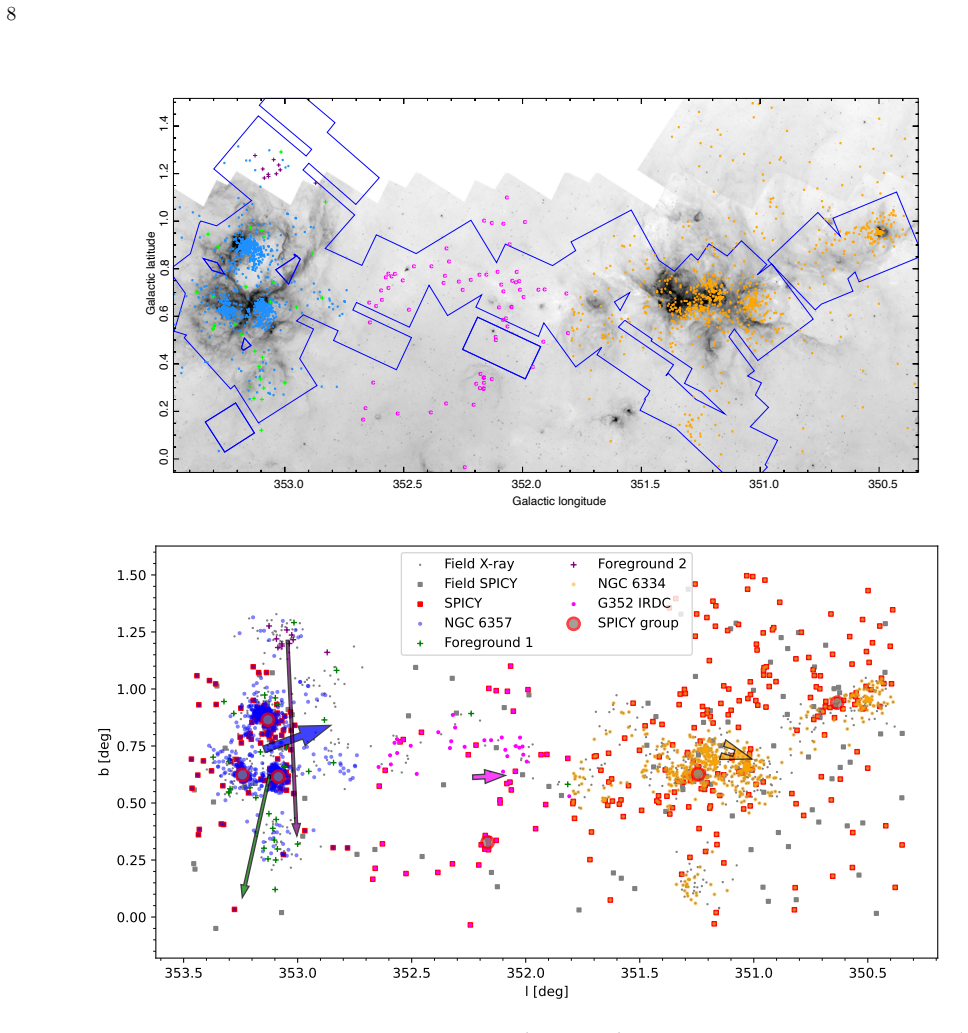
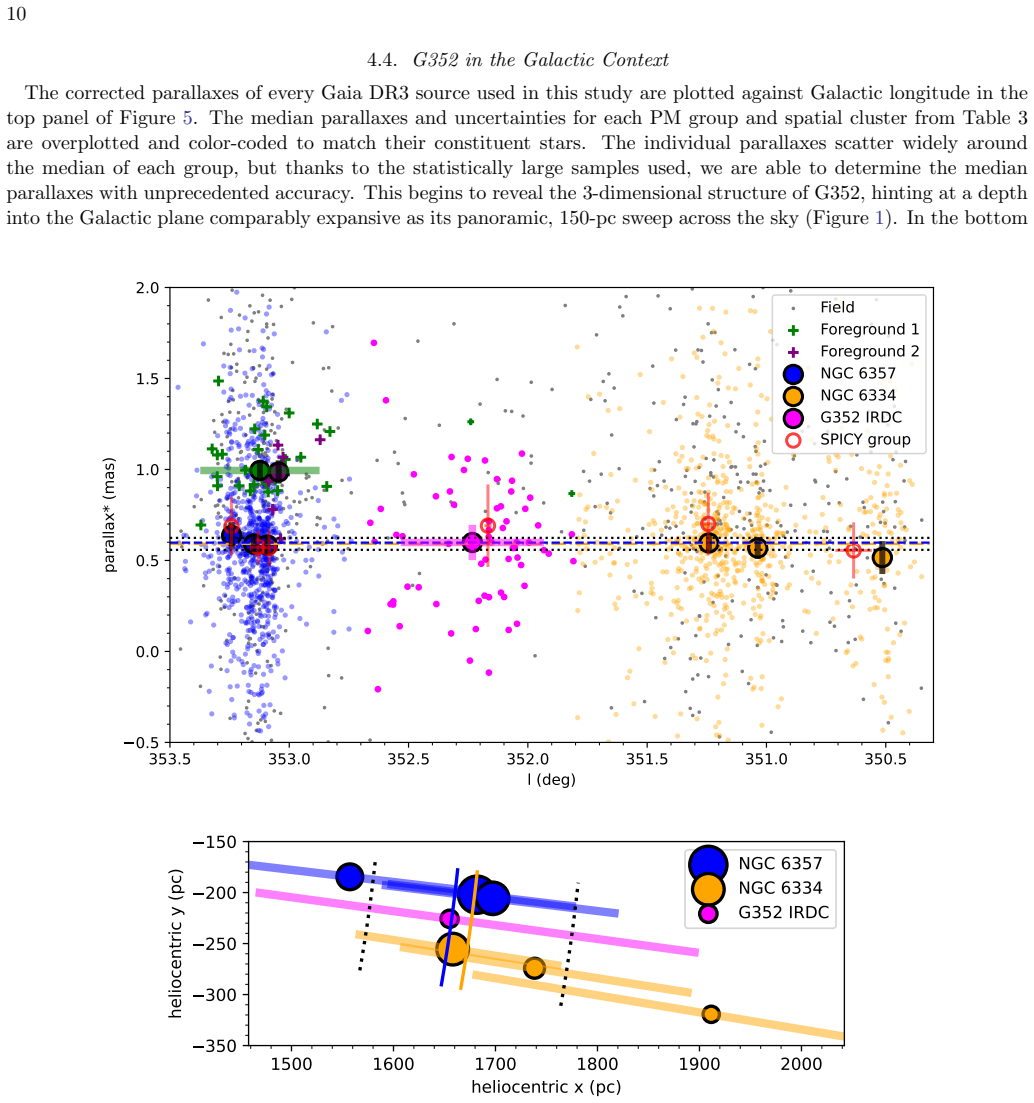
The authors identify 1727 young stellar members of G352 by cross-matching Chandra X-ray point sources and Spitzer mid-infrared excess sources to Gaia DR3. They map the complex in three dimensions, revise the mean distance to 1670 pc with a longitude-dependent trend, measure peculiar velocities (NGC 6357 groups trailing circular motion by ~8 km/s while NGC 6334 is consistent with it), and conclude that the stellar groups are not gravitationally bound to each other and that the GMC filament's steep pitch angle is inconsistent with a spiral arm, making G352 a proto-OB association.
What carries the argument
Cross-matching of Chandra X-ray point sources and Spitzer mid-infrared excess sources with Gaia DR3 to select young stellar members and derive their parallaxes and proper motions.
If this is right
- The various stellar groups within G352 are not gravitationally bound to each other.
- G352 qualifies as a proto-OB association rather than a bound structure.
- The GMC filament has a steep pitch angle inconsistent with alignment along a galactic spiral arm.
- NGC 6357 clusters exhibit peculiar velocities trailing Galactic circular motion by roughly 8 km/s.
- NGC 6334 stars are more consistent with circular orbits while GM1-24 shows distinct proper motion and smaller parallax.
Where Pith is reading between the lines
- Large filamentary molecular clouds elsewhere in the Galaxy may commonly represent early, dynamically decoupled stages of OB associations.
- The observed distance gradient along the filament could be tested with deeper astrometric data to determine whether it reflects sequential star formation.
- Rapid kinematic decoupling implies that early stellar feedback quickly erases initial gravitational links within such complexes.
Load-bearing premise
That cross-matching Chandra X-ray point sources and Spitzer mid-IR excess sources to Gaia DR3 reliably selects true young stellar members of G352 without significant field-star contamination or systematic biases in parallax and proper-motion measurements.
What would settle it
A spectroscopic survey of the candidate members that checks for youth indicators such as lithium absorption or strong H-alpha emission and independently verifies the Gaia-based distances and velocities.
Figures




read the original abstract
We map the three-dimensional structure and large-scale kinematics of the young stellar populations in the G352 giant molecular cloud (GMC) complex. In radio and infrared images, G352 appears as long filament extending ~$3^{\circ}$ (~150 pc) parallel to the Galactic midplane. It connects the NGC 6357 and NGC 6334 giant H II regions and the GM1-24 compact H II region. We identify 1727 stellar members of G352 via matching large catalogs of Chandra X-ray point sources and Spitzer mid-infrared excess sources to the Gaia DR3 astrometric catalog. Our catalog of 11,470 X-ray point sources ranks among the three largest contiguous X-ray survey datasets ever assembled for a massive star-forming complex. We revise the mean heliocentric distance of G352 to $1670\pm 80$ pc, with the median parallaxes of seven constituent groups exhibiting a trend toward increasing distance with decreasing Galactic longitude. We identify two foreground stellar groups superimposed on NGC 6357 that may belong to the Sag OB4 association. The three massive clusters in NGC 6357 exhibit peculiar velocities that trail Galactic circular motion by ${\sim}8$ km/s, while the stars associated with NGC 6334 are more consistent with a circular orbit. GM1-24 has a distinct proper motion and smaller parallax compared to NGC 6334. The steep pitch angle of the GMC filament into the sky appears inconsistent with a spiral arm. The various stellar groups are not gravitationally bound to each other, making G352 a proto-OB association.
Editorial analysis
A structured set of objections, weighed in public.
Referee Report
Summary. The paper maps the 3D structure and large-scale kinematics of young stellar populations in the G352 GMC complex (connecting NGC 6357, NGC 6334, and GM1-24) by cross-matching 11,470 Chandra X-ray sources and Spitzer mid-IR excess objects to Gaia DR3, yielding 1727 members across seven groups. It revises the mean distance to 1670±80 pc with a longitude-distance trend, reports ~8 km/s peculiar velocity offsets for NGC 6357 clusters, finds the groups mutually unbound (hence a proto-OB association), and argues the GMC filament's steep pitch angle is inconsistent with a spiral arm.
Significance. If the membership selection holds, the work delivers one of the largest contiguous X-ray datasets for a massive star-forming complex and provides concrete 3D kinematic constraints on a ~150 pc filament, supporting the proto-OB association picture and offering a test case for Galactic structure interpretations. The scale of the catalog and the direct use of public Gaia data are clear strengths.
major comments (2)
- [§3] §3: The selection of 1727 Gaia-matched members from the 11,470 X-ray and Spitzer sources provides no quantitative contamination estimate (offset control fields, Besançon predictions, or hardness-ratio cuts). This selection is load-bearing for every subsequent claim, including the median parallaxes, the ~8 km/s peculiar velocity offset, the relative velocity dispersion used to argue against binding, and the longitude-distance trend.
- [§4–5] §4–5: The conclusion that the seven groups are not gravitationally bound (and thus form a proto-OB association) rests directly on the measured parallaxes and proper motions of the selected sample. Without an assessment of field-star contamination or astrometric bias, the reported velocity offsets and dispersions cannot be shown to be robust against even 15–20% interlopers.
minor comments (2)
- The abstract states error bars on distance and velocity differences but does not summarize the membership criteria or contamination controls; a brief explicit statement would improve readability.
- Table or figure captions listing the seven groups should include the exact number of members and median parallax per group for quick reference.
Simulated Author's Rebuttal
We thank the referee for their careful and constructive review of our manuscript. The concerns regarding the lack of a quantitative contamination estimate in the membership selection are well-taken, as this underpins the reliability of the kinematic and structural results. We will revise the paper to include such an assessment using available models and data, while maintaining that the core conclusions remain supported. Below we address each major comment in turn.
read point-by-point responses
-
Referee: [§3] The selection of 1727 Gaia-matched members from the 11,470 X-ray and Spitzer sources provides no quantitative contamination estimate (offset control fields, Besançon predictions, or hardness-ratio cuts). This selection is load-bearing for every subsequent claim, including the median parallaxes, the ~8 km/s peculiar velocity offset, the relative velocity dispersion used to argue against binding, and the longitude-distance trend.
Authors: We agree that an explicit quantitative contamination estimate was not provided in the original manuscript. The selection leverages the established effectiveness of Chandra X-ray sources (sensitive to young, magnetically active stars) combined with Spitzer mid-IR excess (tracing circumstellar material), a combination shown in the literature to yield low field-star contamination rates (typically <10-15%) in massive star-forming regions. To address the referee's point directly, we will add to the revised §3 a contamination estimate derived from the Besançon Galactic model, predicting the expected number of field stars that would satisfy our X-ray, IR-excess, and Gaia matching criteria. We will also apply hardness-ratio filtering to the X-ray catalog as an additional purity check. These steps will quantify the impact on the reported parallaxes, velocities, and trends. revision: yes
-
Referee: [§4–5] The conclusion that the seven groups are not gravitationally bound (and thus form a proto-OB association) rests directly on the measured parallaxes and proper motions of the selected sample. Without an assessment of field-star contamination or astrometric bias, the reported velocity offsets and dispersions cannot be shown to be robust against even 15–20% interlopers.
Authors: The referee correctly identifies that unaccounted contamination could affect the robustness of the unbound conclusion and the ~8 km/s peculiar velocity offsets. The current analysis shows the groups exhibit coherent but mutually inconsistent motions, with dispersions too large for gravitational binding across the 150-pc scale. To demonstrate resilience, the revised §§4–5 will incorporate the contamination estimate from the Besançon analysis and include a sensitivity test: we will inject synthetic 15–20% interlopers (sampled from Gaia sources in adjacent control fields) and recompute the velocity dispersions and binding criteria. We anticipate the proto-OB association interpretation will hold, but this addition will make the claim quantitatively defensible against the referee's concern. revision: yes
Circularity Check
No circularity: purely observational catalog cross-matching and kinematic measurements
full rationale
The paper's analysis consists of cross-matching Chandra X-ray and Spitzer IR-excess catalogs to Gaia DR3 astrometry (Section 3), computing median parallaxes and proper motions for seven groups, revising the distance to 1670±80 pc, calculating peculiar velocities (~8 km/s offset for NGC 6357 clusters), and assessing gravitational binding via velocity dispersions and spatial separations. These are direct statistical summaries of external public catalog data with no fitted models, no predictions of the input data, no self-definitional equations, and no load-bearing self-citations. The binding conclusion follows from comparing observed velocity dispersions to expected escape velocities given the measured distances and masses; the pitch-angle claim follows from the observed longitude-distance trend. No step reduces to its own inputs by construction. Membership selection is a potential contamination risk (as noted by the skeptic), but that is a data-quality issue, not circularity.
Axiom & Free-Parameter Ledger
free parameters (1)
- mean heliocentric distance =
1670 pc
axioms (2)
- domain assumption Gaia DR3 parallaxes and proper motions accurately reflect the true distances and velocities of the young stellar sources after standard corrections
- domain assumption Cross-matched X-ray and mid-IR excess sources are genuine young stellar members of G352 rather than field contaminants
Reference graph
Works this paper leans on
-
[1]
Antalova, A., & Graham, J. A. 1976, Bulletin of the Astronomical Institutes of Czechoslovakia, 27, 193 Astropy Collaboration, Robitaille, T. P., Tollerud, E. J., et al. 2013, A&A, 558, A33, doi: 10.1051/0004-6361/201322068 Astropy Collaboration, Price-Whelan, A. M., Sip˝ ocz, B. M., et al. 2018, AJ, 156, 123, doi: 10.3847/1538-3881/aabc4f
-
[2]
Benjamin, R. A., Churchwell, E., Babler, B. L., et al. 2003, PASP, 115, 953, doi: 10.1086/376696
-
[3]
Binder, B. A., & Povich, M. S. 2018, ApJ, 864, 136, doi: 10.3847/1538-4357/aad7b2 14 18909 18908 18910 19705 2574 23294 21680 21679 1-2 keV: 135 2-3 keV: 180 3-8 keV: 312 25:00 24:00 23:00 22:00 21:00 17:20:00 -34:40:0050:00-35:00:0010:0020:0030:0040:00 (a) 1560 ACIS sources 17:24:00 22:00 -34:40:00-35:00:0020:0040:00 (b) G352 IRDC bridge ACIS 0.5-7 keV d...
-
[4]
Brogan, C. L., Hunter, T. R., Cyganowski, C. J., et al. 2016, ApJ, 832, 187, doi: 10.3847/0004-637X/832/2/187
-
[5]
2022, ACIS Extract software package, Zenodo, doi: 10.5281/zenodo.6084540
Broos, P., & Townsley, L. 2022, ACIS Extract software package, Zenodo, doi: 10.5281/zenodo.6084540
-
[6]
2012, AE: ACIS Extract, Astrophysics Source Code Library, record ascl:1203.001
Broos, P., Townsley, L., Getman, K., & Bauer, F. 2012, AE: ACIS Extract, Astrophysics Source Code Library, record ascl:1203.001. http://ascl.net/1203.001
2012
-
[7]
Broos, P. S., Townsley, L. K., Feigelson, E. D., et al. 2010, ApJ, 714, 1582, doi: 10.1088/0004-637X/714/2/1582
-
[8]
Castro-Ginard, A., Penoyre, Z., Casey, A. R., et al. 2024, A&A, 688, A1, doi: 10.1051/0004-6361/202450172
-
[9]
1996, in Proc
Ester, M., Kriegel, H.-P., Sander, J., & Xu, X. 1996, in Proc. of 2nd International Conference on Knowledge Discovery and, 226–231
1996
-
[10]
Frediani, J., Bik, A., Ram´ ırez-Tannus, M. C., et al. 2025, A&A, 701, A14, doi: 10.1051/0004-6361/202555718
-
[11]
Fruscione, A., McDowell, J. C., Allen, G. E., et al. 2006, in Society of Photo-Optical Instrumentation Engineers (SPIE) Conference Series, Vol. 6270, Observatory Operations: Strategies, Processes, and Systems, ed. D. R. Silva & R. E. Doxsey, 62701V, doi: 10.1117/12.671760
-
[12]
2018, PASJ, 70, S41, doi: 10.1093/pasj/psy017 Gaia Collaboration, Prusti, T., de Bruijne, J
Fukui, Y., Kohno, M., Yokoyama, K., et al. 2018, PASJ, 70, S41, doi: 10.1093/pasj/psy017 Gaia Collaboration, Prusti, T., de Bruijne, J. H. J., et al. 2016, A&A, 595, A1, doi: 10.1051/0004-6361/201629272 Gaia Collaboration, Vallenari, A., Brown, A. G. A., et al. 2023, A&A, 674, A1, doi: 10.1051/0004-6361/202243940
-
[13]
Getman, K. V., Feigelson, E. D., Kuhn, M. A., et al. 2014, ApJ, 787, 108, doi: 10.1088/0004-637X/787/2/108 GRAVITY Collaboration, Abuter, R., Amorim, A., et al. 2019, A&A, 625, L10, doi: 10.1051/0004-6361/201935656
-
[14]
A 3D Dust Map Based on Gaia, Pan-STARRS 1 and 2MASS
Finkbeiner, D. 2019, ApJ, 887, 93, doi: 10.3847/1538-4357/ab5362
work page internal anchor Pith review doi:10.3847/1538-4357/ab5362 2019
-
[15]
L., & Maghakian, T
Gyulbudaghian, A. L., & Maghakian, T. Y. 1977, Soviet Astronomy Letters, 3, 58
1977
-
[16]
A., & Mandel, E
Joye, W. A., & Mandel, E. 2003, in Astronomical Society of the Pacific Conference Series, Vol. 295, Astronomical Data Analysis Software and Systems XII, ed. H. E
2003
-
[17]
Kuhn, M. A., Benjamin, R. A., & Singh, S. S. 2026, MNRAS, 546, stag305, doi: 10.1093/mnras/stag305
-
[18]
Kuhn, M. A., de Souza, R. S., Krone-Martins, A., et al. 2021a, ApJS, 254, 33, doi: 10.3847/1538-4365/abe465
-
[19]
Kuhn, M. A., Hillenbrand, L. A., Sills, A., Feigelson, E. D., & Getman, K. V. 2019, ApJ, 870, 32, doi: 10.3847/1538-4357/aaef8c
-
[20]
Kuhn, M. A., Benjamin, R. A., Zucker, C., et al. 2021b, A&A, 651, L10, doi: 10.1051/0004-6361/202141198
-
[21]
Parallax bias versus magnitude, colour, and position
Lindegren, L., Bastian, U., Biermann, M., et al. 2021, A&A, 649, A4, doi: 10.1051/0004-6361/202039653 Mel’nik, A. M., & Dambis, A. K. 2017, MNRAS, 472, 3887, doi: 10.1093/mnras/stx2225
-
[22]
2011, Journal of Machine Learning Research, 12, 2825 15 Piˇ smiˇ s, P
Pedregosa, F., Varoquaux, G., Gramfort, A., et al. 2011, Journal of Machine Learning Research, 12, 2825 15 Piˇ smiˇ s, P. 1959, Boletin de los Observatorios Tonantzintla y Tacubaya, 2, 37
2011
-
[23]
Povich, M. S., Busk, H. A., Feigelson, E. D., Townsley, L. K., & Kuhn, M. A. 2017, ApJ, 838, 61, doi: 10.3847/1538-4357/aa5b99
-
[24]
Povich, M. S., Kuhn, M. A., Getman, K. V., et al. 2013, ApJS, 209, 31, doi: 10.1088/0067-0049/209/2/31 Ram´ ırez-Tannus, M. C., Poorta, J., Bik, A., et al. 2020, A&A, 633, A155, doi: 10.1051/0004-6361/201935941 Ram´ ırez-Tannus, M. C., Bik, A., Cuijpers, L., et al. 2023, ApJL, 958, L30, doi: 10.3847/2041-8213/ad03f8 Ram´ ırez-Tannus, M. C., Bik, A., Getma...
-
[25]
Reid, M. J., Menten, K. M., Brunthaler, A., et al. 2019, ApJ, 885, 131, doi: 10.3847/1538-4357/ab4a11 Roman Galactic Plane Survey Definition Committee. 2025, arXiv e-prints, arXiv:2511.07494, doi: 10.48550/arXiv.2511.07494
-
[26]
Russeil, D., Adami, C., Bouret, J. C., et al. 2017, A&A, 607, A86, doi: 10.1051/0004-6361/201629870
-
[27]
2010, A&A, 515, A55, doi: 10.1051/0004-6361/200913632
Russeil, D., Zavagno, A., Motte, F., et al. 2010, A&A, 515, A55, doi: 10.1051/0004-6361/200913632
-
[28]
2020, A&A, 642, A21, doi: 10.1051/0004-6361/202037674
Russeil, D., Zavagno, A., Nguyen, A., et al. 2020, A&A, 642, A21, doi: 10.1051/0004-6361/202037674
-
[29]
2016, A&A, 587, A135, doi: 10.1051/0004-6361/201424484
Russeil, D., Tig´ e, J., Adami, C., et al. 2016, A&A, 587, A135, doi: 10.1051/0004-6361/201424484
-
[30]
Taylor, M. B. 2005, in Astronomical Society of the Pacific Conference Series, Vol. 347, Astronomical Data Analysis Software and Systems XIV, ed. P. Shopbell, M. Britton, & R. Ebert, 29
2005
-
[31]
Townsley, L. K., Broos, P. S., Garmire, G. P., et al. 2018, ApJS, 235, 43, doi: 10.3847/1538-4365/aaaf67 —. 2014, ApJS, 213, 1, doi: 10.1088/0067-0049/213/1/1
-
[32]
Townsley, L. K., Broos, P. S., Garmire, G. P., & Povich, M. S. 2019, ApJS, 244, 28, doi: 10.3847/1538-4365/ab345b
-
[33]
Townsley, L. K., Broos, P. S., Corcoran, M. F., et al. 2011, ApJS, 194, 1, doi: 10.1088/0067-0049/194/1/1
-
[34]
Walborn, N. R., Howarth, I. D., Lennon, D. J., et al. 2002, AJ, 123, 2754, doi: 10.1086/339831
-
[35]
2013, ApJ, 778, 96, doi: 10.1088/0004-637X/778/2/96
Willis, S., Marengo, M., Allen, L., et al. 2013, ApJ, 778, 96, doi: 10.1088/0004-637X/778/2/96
-
[36]
Wright, N. J., Drake, J. J., Guarcello, M. G., et al. 2023, The Astrophysical Journal Supplement Series, 269, 7, doi: 10.3847/1538-4365/acdd62
-
[37]
Zucker, C., Saydjari, A. K., Speagle, J. S., et al. 2025, ApJ, 992, 39, doi: 10.3847/1538-4357/adfbe6
discussion (0)
Sign in with ORCID, Apple, or X to comment. Anyone can read and Pith papers without signing in.