Recognition: unknown
Classifying spaces for families of virtually abelian subgroups of surface braid groups
Pith reviewed 2026-05-10 08:32 UTC · model grok-4.3
The pith
For pure braid groups on surfaces with non-negative Euler characteristic and at least one boundary or puncture, the minimal dimension of a model for the classifying space of virtually abelian subgroups of rank at most n equals the virtual 3
A machine-rendered reading of the paper's core claim, the machinery that carries it, and where it could break.
Core claim
The central discovery is that for G the pure braid group of a surface with non-negative Euler characteristic having at least one boundary or puncture, and for the family F_n of virtually abelian subgroups of rank at most n, the minimal dimension of a model for E_{F_n} G equals vcd(G) + n. The authors prove this for n ≥ 1 and extend it to the full braid group of the sphere, with the application yielding the dimension for the family of amenable subgroups.
What carries the argument
The classifying space E_{F_n} G, where F_n is the family of all virtually abelian subgroups of G of rank at most n, and its minimal model dimension compared to the virtual cohomological dimension vcd(G).
If this is right
- The result allows explicit computation of dimensions for classifying spaces in these braid groups for any n.
- It provides the minimal dimension for the family of amenable subgroups as a special case when n is chosen appropriately.
- The equality holds similarly for the full braid group of the sphere.
- These dimensions relate to the cohomology of the groups with respect to the families of subgroups.
Where Pith is reading between the lines
- If the result extends to closed surfaces, it could unify classifications across all surface types.
- The method might apply to other families of subgroups in braid groups or mapping class groups.
- Computations of these dimensions could inform K-theory or stable homotopy for these groups.
Load-bearing premise
The surfaces must have non-negative Euler characteristic and at least one boundary component or puncture for the dimension equality to hold without further conditions.
What would settle it
A counterexample would be a specific surface braid group where the computed minimal dimension of E_{F_n}G differs from vcd(G) + n, such as by direct calculation for small n and small surfaces.
Figures
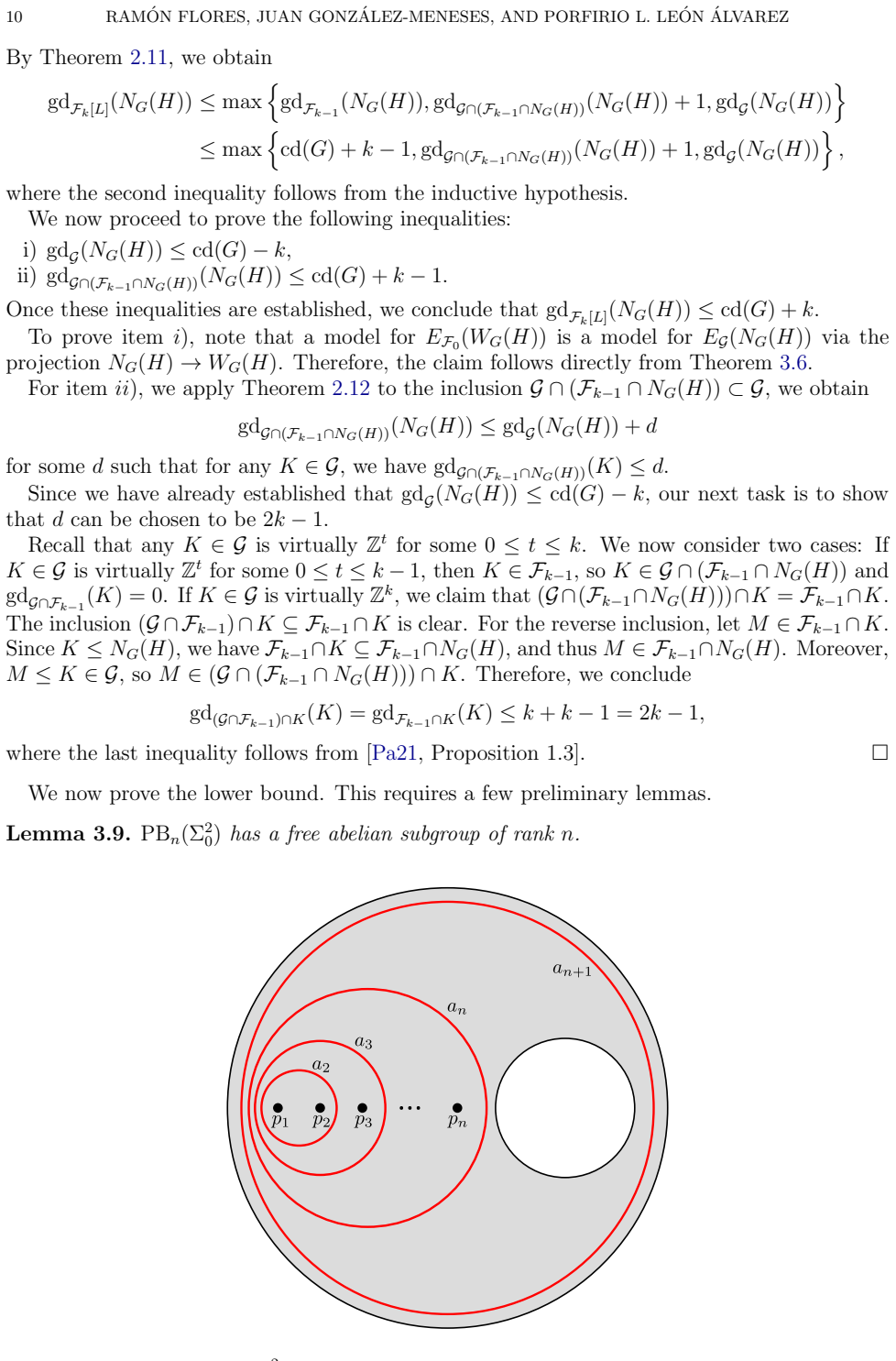

read the original abstract
Given a group $G$ and an integer $n \geq 0$, let $\mathcal{F}_n$ denote the family of all virtually abelian subgroups of $G$ of rank at most $n$. In this article, we show that for each $n \geq 1$, the minimal dimension of a model for the classifying space $E_{\mathcal{F}_n}G$ for the pure braid group of a surface of non-negative Euler characteristic with at least one boundary component or one puncture is equal to the virtual cohomological dimension of $G$ plus $n$. We prove an analogous result for the full braid group of the sphere. As an application, we compute the minimal dimension of a model for the classifying space associated to the family of amenable subgroups of pure surface braid groups.
Editorial analysis
A structured set of objections, weighed in public.
Referee Report
Summary. The manuscript proves that for each n ≥ 1, the minimal dimension of a model for the classifying space E_{F_n}G equals vcd(G) + n, where G is the pure braid group of a surface of non-negative Euler characteristic with at least one boundary component or puncture, and F_n is the family of virtually abelian subgroups of rank at most n. An analogous result is established for the full braid group of the sphere. As an application, the minimal dimension is computed for the classifying space associated to the family of amenable subgroups of pure surface braid groups.
Significance. If the central equality holds, the result supplies explicit, computable dimensions for classifying spaces of families of subgroups in surface braid groups, which directly aids homological computations and the study of their geometric and algebraic properties. The additive formula dim E_{F_n}G = vcd(G) + n is clean and leverages standard facts about virtually abelian groups and virtual cohomological dimension. The extension to amenable subgroups provides a concrete application that connects the main theorem to broader questions about amenable actions and classifying spaces.
minor comments (3)
- The abstract states the result for n ≥ 1 while F_n is defined for n ≥ 0; a brief remark on the n = 0 case (or why it is excluded) would clarify the scope.
- In the introduction and main theorem statement, ensure that the surface hypotheses (non-negative Euler characteristic, boundary/puncture condition) are repeated verbatim for consistency with the abstract.
- The bibliography should include the most recent references on classifying spaces for families and virtual cohomological dimension of braid groups to strengthen the contextual framing.
Simulated Author's Rebuttal
We thank the referee for the positive summary of our results, the assessment of their significance, and the recommendation for minor revision. No specific major comments were raised in the report.
Circularity Check
No circularity: standard classifying-space dimension result derived from independent definitions
full rationale
The central claim equates the minimal dimension of a model for E_{F_n}G to vcd(G) + n using the standard definitions of the family F_n (virtually abelian subgroups of rank ≤ n) and the classifying space E_F G. These are external, well-established notions in equivariant homotopy theory and do not depend on the paper's computation. The abstract and stated theorem contain no self-definitional loops, fitted inputs renamed as predictions, or load-bearing self-citations that reduce the result to its own inputs. The proof is therefore self-contained against external benchmarks in group cohomology and Bredon theory.
Axiom & Free-Parameter Ledger
axioms (2)
- domain assumption Virtual cohomological dimension is well-defined and additive in the stated way for these groups
- standard math Existence of models for E_{F_n}G of finite dimension for these groups
Reference graph
Works this paper leans on
- [1]
-
[2]
L¨ uck and D
[LM00] W. L¨ uck and D. Meintrup. On the universal space for group actions with compact isotropy. In Geometry and topology: Aarhus (1998), volume 258 ofContemp. Math., pages 293–305. Amer. Math. Soc., Providence, RI,
1998
-
[3]
[LM25] P. L. Le´ on ´Alvarez and I. Morales. Asymptotic and cohomological dimension of surface braid groups and poly-surface groups.arXiv e-prints, page arXiv:2506.10706, June
work page internal anchor Pith review Pith/arXiv arXiv
discussion (0)
Sign in with ORCID, Apple, or X to comment. Anyone can read and Pith papers without signing in.