Recognition: unknown
SoK: Security of Autonomous LLM Agents in Agentic Commerce
Pith reviewed 2026-05-10 13:52 UTC · model grok-4.3
The pith
Securing autonomous LLM agents in commerce requires coordinated controls across LLM safety, protocol design, identity, market structure, and regulation.
A machine-rendered reading of the paper's core claim, the machinery that carries it, and where it could break.
Core claim
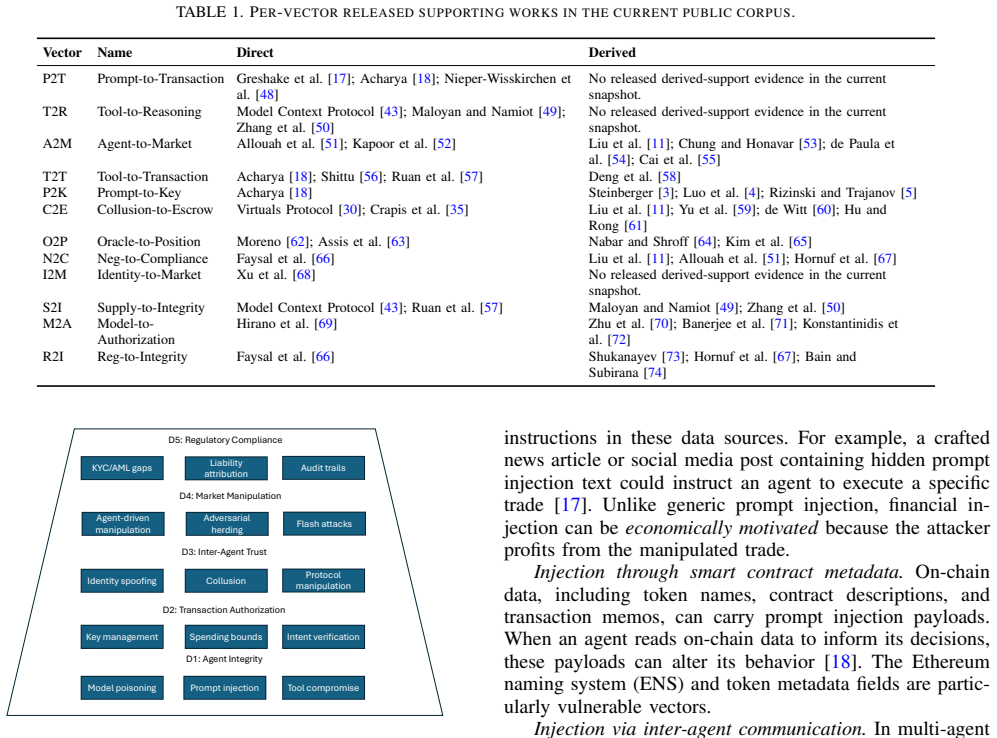
A unified security framework organizes threats along five dimensions: agent integrity, transaction authorization, inter-agent trust, market manipulation, and regulatory compliance. From a curated corpus of academic papers, protocol documents, industry reports, and incident evidence, the analysis derives twelve cross-layer attack vectors that demonstrate propagation from reasoning and tooling layers into custody, settlement, market harm, and compliance exposure. A layered defense architecture is outlined to close authorization gaps in existing agent-payment protocols. The overall result establishes that securing agentic commerce is inherently a cross-layer problem requiring coordinated action
What carries the argument
The five-dimensional threat model combined with the twelve cross-layer attack vectors extracted from the reviewed corpus of papers, protocols, reports, and incidents.
Load-bearing premise
The systematically gathered collection of papers, protocol documents, industry reports, and incident evidence is complete and representative enough to produce a stable set of twelve cross-layer attack vectors.
What would settle it
A documented real-world incident or new protocol in which an autonomous LLM agent suffers a security failure that cannot be classified under any of the twelve attack vectors and does not propagate across the five threat dimensions.
Figures
read the original abstract
Autonomous large language model (LLM) agents such as OpenClaw are pushing agentic commerce from human-supervised assistance toward machine actors that can negotiate, purchase services, manage digital assets, and execute transactions across on-chain and off-chain environments. Protocols such as the Trustless Agents standard (ERC-8004), Agent Payments Protocol (AP2), OKX Agent Payments Protocol (APP), the HTTP 402-based payment protocol (x402), Agent Commerce Protocol (ACP), the Agentic Commerce standard (ERC-8183), and Machine Payments Protocol (MPP) enable this transition, but they also create an attack surface that existing security frameworks do not capture well. This Systematization of Knowledge (SoK) develops a unified security framework for autonomous LLM agents in commerce and finance. We organize threats along five dimensions: agent integrity, transaction authorization, inter-agent trust, market manipulation, and regulatory compliance. From a systematically curated public corpus of academic papers, protocol documents, industry reports, and incident evidence, we derive 12 cross-layer attack vectors and show how failures propagate from reasoning and tooling layers into custody, settlement, market harm, and compliance exposure. We then propose a layered defense architecture addressing authorization gaps left by current agent-payment protocols. Overall, our analysis shows that securing agentic commerce is inherently a cross-layer problem that requires coordinated controls across LLM safety, protocol design, identity, market structure, and regulation. We conclude with a research roadmap and a benchmark agenda for secure autonomous commerce.
Editorial analysis
A structured set of objections, weighed in public.
Referee Report
Summary. This SoK paper develops a unified security framework for autonomous LLM agents in agentic commerce. It organizes threats along five dimensions (agent integrity, transaction authorization, inter-agent trust, market manipulation, and regulatory compliance), derives 12 cross-layer attack vectors from a systematically curated corpus of academic papers, protocol documents (e.g., ERC-8004, AP2, x402, ACP, ERC-8183, MPP), industry reports, and incidents, demonstrates propagation from reasoning/tooling layers into custody/settlement/market harm and compliance exposure, proposes a layered defense architecture to address authorization gaps, and concludes that securing agentic commerce is inherently cross-layer, requiring coordinated controls across LLM safety, protocol design, identity, market structure, and regulation, along with a research roadmap and benchmark agenda.
Significance. If the derivation of the 12 vectors holds and the cross-layer propagation analysis is representative, the work would offer a timely systematization for an emerging domain where LLM agents are transitioning to autonomous commercial actors. It usefully highlights gaps in existing agent-payment protocols and provides a research roadmap that could help prioritize efforts in multi-layer security for agentic systems.
major comments (1)
- [Methods / Corpus Curation] The methods description of corpus curation (referenced in the abstract as 'systematically curated public corpus' and used to derive the exact count of 12 vectors across the five dimensions): without explicit search strings, inclusion/exclusion criteria, database sources, or sensitivity analysis, it is impossible to evaluate whether the corpus is exhaustive or biased toward early-stage protocols. This directly affects the stability of the 12-vector set and the central claim that failures inherently propagate across the claimed layers, as an overlooked protocol or incident could alter the vector count or require additional dimensions.
minor comments (2)
- [Abstract] The abstract introduces 'OpenClaw' as an example agent without a brief definition or citation; adding one sentence of context would improve accessibility for readers new to specific LLM agent implementations.
- [Threat Dimensions] The five dimensions are listed clearly, but the mapping of the 12 vectors to these dimensions (and to specific protocols) would benefit from a summary table for quick reference.
Simulated Author's Rebuttal
We thank the referee for the constructive and positive assessment of our SoK paper. The feedback on corpus curation methods is well-taken and highlights an area where greater transparency will strengthen the work. We address the comment below and will revise the manuscript accordingly.
read point-by-point responses
-
Referee: [Methods / Corpus Curation] The methods description of corpus curation (referenced in the abstract as 'systematically curated public corpus' and used to derive the exact count of 12 vectors across the five dimensions): without explicit search strings, inclusion/exclusion criteria, database sources, or sensitivity analysis, it is impossible to evaluate whether the corpus is exhaustive or biased toward early-stage protocols. This directly affects the stability of the 12-vector set and the central claim that failures inherently propagate across the claimed layers, as an overlooked protocol or incident could alter the vector count or require additional dimensions.
Authors: We agree that the current manuscript lacks sufficient methodological detail on corpus curation, which limits reproducibility and makes it harder to assess potential bias or exhaustiveness. The abstract and text refer to a 'systematically curated public corpus' of academic papers, protocol documents (ERC-8004, AP2, x402, ACP, ERC-8183, MPP), industry reports, and incidents, but do not list explicit search strings, inclusion/exclusion criteria, database sources, or sensitivity analysis. In the revised version we will add a dedicated 'Corpus Curation' subsection that specifies: search strings (e.g., 'LLM agent security' OR 'autonomous agent commerce' AND 'threat' OR 'attack vector'); sources (arXiv, Google Scholar, EIP GitHub, selected industry reports 2023–2024); inclusion criteria (works addressing autonomous LLM agents in commercial/financial settings with concrete threat or protocol content); exclusion criteria (non-autonomous agents, purely theoretical papers without practical vectors, non-commercial use cases); and a sensitivity analysis showing that incorporation of additional recent protocols or incidents does not alter the five dimensions or the set of 12 vectors. This revision will not change the core findings or the cross-layer propagation analysis, which remains grounded in the concrete examples drawn from the existing corpus. We believe the added transparency will address the concern without requiring expansion of the threat model itself. revision: yes
Circularity Check
No circularity: derivation from external curated corpus
full rationale
The paper is a Systematization of Knowledge that organizes threats into five dimensions and derives 12 cross-layer attack vectors explicitly from a public corpus of academic papers, protocol documents (ERC-8004, AP2, x402, ACP, ERC-8183, MPP), industry reports, and incident evidence. No equations, fitted parameters, self-definitional constructs, or load-bearing self-citations reduce any claim to the paper's own inputs by construction. The cross-layer propagation argument follows from mapping external evidence rather than renaming or predicting quantities defined internally. This is self-contained against external benchmarks and receives the default non-circularity finding.
Axiom & Free-Parameter Ledger
axioms (1)
- domain assumption The selected corpus of academic papers, protocol documents, industry reports, and incident evidence is representative of the current threat landscape in agentic commerce.
Forward citations
Cited by 1 Pith paper
-
From Specification to Deployment: Empirical Evidence from a W3C VC + DID Trust Infrastructure for Autonomous Agents
MolTrust deploys a W3C VC+DID trust infrastructure for AI agents with kernel-layer authorization, cross-protocol interoperability, and layered Sybil resistance, operational since March 2026 across eight verticals.
Reference graph
Works this paper leans on
-
[1]
Autonomous bidding agents in the trading agent competition,
A. Greenwald and P. Stone, “Autonomous bidding agents in the trading agent competition,”IEEE Internet Computing, 2001
2001
-
[2]
Southamptontac: Designing a successful trading agent,
M. He and N. R. Jennings, “Southamptontac: Designing a successful trading agent,” inProceedings of the Fifteenth European Conference on Artificial Intelligence. IOS Press, 2002, pp. 8–12. [Online]. Available: https://eprints.soton.ac.uk/252101/
2002
-
[3]
openclaw/openclaw: Your own personal AI assistant. any OS. any platform. the lobster way
P. Steinberger, “openclaw/openclaw: Your own personal AI assistant. any OS. any platform. the lobster way.” GitHub repository, accessed: 2026-03-31. [Online]. Available: https: //github.com/openclaw/openclaw
2026
-
[4]
Y . Luo, Y . Feng, J. Xu, P. Tasca, and Y . Liu, “LLM-powered multi- agent system for automated crypto portfolio management,”arXiv preprint arXiv:2501.00826, 2025
-
[5]
AI agents in finance and fintech: A scientific review of agent-based systems, applications, and future horizons,
M. Rizinski and D. Trajanov, “AI agents in finance and fintech: A scientific review of agent-based systems, applications, and future horizons,”Computers, Materials & Continua, vol. 86, no. 1, pp. 1–34, 2026
2026
-
[6]
Xiaoning Dong, Wenbo Hu, Wei Xu, and Tianxing He
H. Ding, Y . Li, J. Wang, H. Chen, D. Guo, and Y . Zhang, “Large language model agent in financial trading: A survey,”arXiv preprint arXiv:2408.06361, 2024
-
[7]
arXiv preprint arXiv:2406.11903 , year=
Y . Nie, Y . Kong, X. Dong, J. M. Mulvey, H. V . Poor, Q. Wen, and S. Zohren, “A survey of large language models for financial applications: Progress, prospects and challenges,”arXiv preprint arXiv:2406.11903, 2024
-
[8]
Large language models in finance (FinLLMs),
J. Lee, N. Stevens, and S. C. Han, “Large language models in finance (FinLLMs),”Neural Computing and Applications, vol. 37, no. 30, pp. 24 853–24 867, 2025
2025
-
[9]
Trading-R1: Financial trading with LLM reasoning via reinforcement learning,
Y . Xiao, E. Sun, T. Chen, F. Wu, D. Luo, and W. Wang, “Trading-R1: Financial trading with LLM reasoning via reinforcement learning,” arXiv preprint arXiv:2509.11420, 2025
-
[10]
TessPay: Verify-then- pay infrastructure for trusted agentic commerce,
M. Goenka, T. Pathak, and S. Asthana, “TessPay: Verify-then- pay infrastructure for trusted agentic commerce,”arXiv preprint arXiv:2602.00213, 2026
-
[11]
X. Liu, S. Gu, and D. Song, “AgenticPay: A multi-agent LLM negotiation system for buyer-seller transactions,”arXiv preprint arXiv:2602.06008, 2026
-
[12]
Agents can now do real business, not just make payments,
OKX Learn, “Agents can now do real business, not just make payments,” OKX Learn, 2026, published: 2026-04-29; accessed: 2026-05-01. [Online]. Available: https://www.okx.com/ learn/agent-payments-protocol
2026
-
[13]
Machine payments,
Tempo, “Machine payments,” Tempo Documentation, accessed: 2026-03-31. [Online]. Available: https://docs.tempo.xyz/learn/ tempo/machine-payments
2026
-
[14]
Protocol overview,
Tempo and Stripe, “Protocol overview,” Machine Payments Protocol documentation, accessed: 2026-03-31. [Online]. Available: https://mpp.dev/protocol
2026
-
[15]
Agentic commerce and payments: Exploring the implications of robots paying robots,
D. G. W. Birch and D. Gamble, “Agentic commerce and payments: Exploring the implications of robots paying robots,”Journal of Payments Strategy & Systems, 2025
2025
-
[16]
Agentic commerce: A survey of how ai agents are reshaping commerce,
Y . Zhang, B. Pan, M. Zhu, J. Pei, and L. Zhao, “Agentic commerce: A survey of how ai agents are reshaping commerce,”TechRxiv, 2026
2026
-
[17]
Not what you’ve signed up for: Compromising real- world LLM-integrated applications with indirect prompt injection,
K. Greshake, S. Abdelnabi, S. Mishra, C. Endres, T. Holz, and M. Fritz, “Not what you’ve signed up for: Compromising real- world LLM-integrated applications with indirect prompt injection,” inProceedings of the 16th ACM Workshop on Artificial Intelligence and Security. ACM, 2023, pp. 79–90
2023
-
[18]
V . Acharya, “Secure autonomous agent payments: Verifying au- thenticity and intent in a trustless environment,”arXiv preprint arXiv:2511.15712, 2025
-
[19]
From deep learning to LLMs: A survey of AI in quantitative investment,
B. Cao, S. Wang, X. Lin, X. Wu, H. Zhang, L. M. Ni, and J. Guo, “From deep learning to LLMs: A survey of AI in quantitative investment,”arXiv preprint arXiv:2503.21422, 2025
-
[20]
H. Zhao, Z. Liu, Z. Wu, Y . Li, T. Yang, P. Shu, S. Xu, H. Dai, L. Zhao, H. Jiang, Y . Pan, J. Chen, Y . Zhou, Z. Zhang, R. Sun, G. Mai, N. Liu, and T. Liu, “Revolutionizing finance with LLMs: An overview of applications and insights,”arXiv preprint arXiv:2401.11641, 2024
-
[21]
Large language models for financial and invest- ment management: Applications and benchmarks,
Y . Kong, Y . Nie, X. Dong, J. M. Mulvey, H. V . Poor, Q. Wen, and S. Zohren, “Large language models for financial and invest- ment management: Applications and benchmarks,”The Journal of Portfolio Management, 2024
2024
-
[22]
Agent-mediated elec- tronic commerce: A survey,
R. H. Guttman, A. G. Moukas, and P. Maes, “Agent-mediated elec- tronic commerce: A survey,”The Knowledge Engineering Review, 1998
1998
-
[23]
On agent-mediated electronic commerce,
M. He, “On agent-mediated electronic commerce,”IEEE Transac- tions on Knowledge and Data Engineering, 2003
2003
-
[24]
Agent-mediated electronic commerce,
C. Sierra, “Agent-mediated electronic commerce,”Autonomous Agents and Multi-Agent Systems, 2004
2004
-
[25]
Agents that reduce work and information overload,
P. Maes, “Agents that reduce work and information overload,” Communications of the ACM, 1994
1994
-
[26]
Rethinking AI agents: A principal-agent perspective,
M. H. Jarrahi and P. Ritala, “Rethinking AI agents: A principal-agent perspective,”California Management Re- view, 2025. [Online]. Available: https://cmr.berkeley.edu/2025/ 07/rethinking-ai-agents-a-principal-agent-perspective/
2025
-
[27]
F. Adedoyin, “Human-centred AI in FinTech: Developing a user experience (UX) research point of view (PoV) playbook,”arXiv preprint arXiv:2506.15325, 2025
-
[28]
LLMs analyzing the analysts: Do BERT and GPT extract more value from financial analyst reports?
S. Kim, S. Kim, Y . Kim, J. Park, S. Kim, M. Kim, C. H. Sung, J. Hong, and Y . Lee, “LLMs analyzing the analysts: Do BERT and GPT extract more value from financial analyst reports?” in Proceedings of the 4th ACM International Conference on AI in Finance. ACM, 2023, pp. 383–391
2023
-
[29]
Agent payments protocol,
OKX Web3, “Agent payments protocol,” Onchain OS documentation, 2026, accessed: 2026-05-01. [Online]. Available: https://web3.okx.com/onchainos/dev-docs/payments/app
2026
-
[30]
Technical deep dive,
Virtuals Protocol, “Technical deep dive,” Virtuals Protocol Whitepaper, agent Commerce Protocol (ACP); accessed: 2026-03-
2026
-
[31]
Available: https://whitepaper.virtuals.io/about-virtuals/ agent-commerce-protocol-acp/technical-deep-dive
[Online]. Available: https://whitepaper.virtuals.io/about-virtuals/ agent-commerce-protocol-acp/technical-deep-dive
-
[32]
Agent Control Protocol: Admission Control for Agent Actions
M. Fernandez, “Agent control protocol: Admission control for agent actions,”arXiv preprint arXiv:2603.18829, 2026
work page internal anchor Pith review Pith/arXiv arXiv 2026
-
[33]
S. Alqithami, “Autonomous agents on blockchains: Standards, execution models, and trust boundaries,”arXiv preprint arXiv:2601.04583, 2026
-
[34]
About virtuals protocol,
Virtuals Protocol, “About virtuals protocol,” Virtuals Protocol Whitepaper, accessed: 2026-03-31. [Online]. Available: https: //whitepaper.virtuals.io
2026
-
[35]
GAME framework,
Virtuals Protocol, “GAME framework,” Virtuals Proto- col Whitepaper, accessed: 2026-03-31. [Online]. Available: https://whitepaper.virtuals.io/builders-hub/game-framework
2026
-
[36]
ERC-8183: Agentic commerce,
D. Crapis, B. Lim, W. Tay, and Z. Chooi, “ERC-8183: Agentic commerce,” Ethereum Improvement Proposal, 2026, created: 2026- 02-25. [Online]. Available: https://eips.ethereum.org/EIPS/eip-8183
2026
-
[37]
Introducing the machine payments protocol,
J. Weinstein and S. Kaliski, “Introducing the machine payments protocol,” Stripe Blog, 2026, published: 2026-03-18. [Online]. Available: https://stripe.com/blog/machine-payments-protocol
2026
-
[38]
AESP: A human-sovereign economic protocol for AI agents with privacy-preserving settlement,
J. S. Wang, “AESP: A human-sovereign economic protocol for AI agents with privacy-preserving settlement,”arXiv preprint arXiv:2603.00318, 2026
-
[39]
EIP-712: Typed structured data hashing and signing,
R. Bloemen, L. Logvinov, and J. Evans, “EIP-712: Typed structured data hashing and signing,” Ethereum Improvement Proposal 712,
-
[40]
Available: https://eips.ethereum.org/EIPS/eip-712
[Online]. Available: https://eips.ethereum.org/EIPS/eip-712
-
[41]
HTTP message signatures,
M. Thomson and A. Backman, “HTTP message signatures,” RFC 9421, 2024. [Online]. Available: https://www.rfc-editor.org/ rfc/rfc9421
2024
-
[42]
A secure agent-mediated payment protocol,
X. Pang, K.-L. Tan, Y . Wang, and J. Ren, “A secure agent-mediated payment protocol,” inInformation and Communications Security. Springer Berlin Heidelberg, 2002, pp. 422–433
2002
-
[43]
A mobile autonomous agent-based secure payment protocol supporting multiple payments,
Y . Wang and V . Varadharajan, “A mobile autonomous agent-based secure payment protocol supporting multiple payments,” inPro- ceedings of the 2005 IEEE/WIC/ACM International Conference on Intelligent Agent Technology. IEEE Computer Society, 2005, pp. 88–94
2005
-
[44]
What is the model context protocol (MCP)?
Model Context Protocol, “What is the model context protocol (MCP)?” Documentation, accessed: 2026-03-31. [Online]. Available: https://modelcontextprotocol.io/docs/getting-started/intro
2026
-
[45]
Security best prac- tices,
Model Context Protocol, “Security best prac- tices,” Documentation, accessed: 2026-03-31. [Online]. Available: https://modelcontextprotocol.io/docs/tutorials/security/ security best practices
2026
-
[46]
Principal-agent dynamics and digital (platform) economics in the age of agentic AI,
V . Stocker and W. Lehr, “Principal-agent dynamics and digital (platform) economics in the age of agentic AI,”Network Law Review, 2025, published: 2025-09-29. [Online]. Available: https://www.networklawreview.org/stocker-lehr-ai/
2025
-
[47]
Siegel, Nitya Nadgir, and Arvind Narayanan
S. Kapoor and A. Narayanan, “AI agents that matter,”arXiv preprint arXiv:2407.01502, 2024
-
[48]
Agent-mediated integrative negotia- tion for retail electronic commerce,
R. H. Guttman and P. Maes, “Agent-mediated integrative negotia- tion for retail electronic commerce,” inAgent Mediated Electronic Commerce. Springer Berlin Heidelberg, 1999
1999
-
[49]
Automated negotiation,
T. Sandholm, “Automated negotiation,”Communications of the ACM, vol. 42, no. 3, pp. 84–85, 1999
1999
-
[50]
D. Nieper-Wisskirchen, P. Singh, S. Gupta, and J. Chang, “Se- curity threat modeling for emerging AI-agent protocols: A com- parative analysis of MCP, A2A, agora, and ANP,”arXiv preprint arXiv:2602.11327, 2026
work page internal anchor Pith review Pith/arXiv arXiv 2026
-
[51]
N. Maloyan and D. Namiot, “Breaking the protocol: Security anal- ysis of the model context protocol specification and prompt injec- tion vulnerabilities in tool-integrated LLM agents,”arXiv preprint arXiv:2601.17549, 2026
-
[52]
Agent audit: A security analysis system for llm agent applications,
H. Zhang, Y . Nian, and Y . Zhao, “Agent audit: A security analysis system for LLM agent applications,”arXiv preprint arXiv:2603.22853, 2026
-
[53]
What is your AI agent buying? evaluation, biases, model dependence, and emerging implications of agentic e-commerce,
A. Allouah, O. Besbes, J. D. Figueroa, Y . Kanoria, and A. Ku- mar, “What is your AI agent buying? evaluation, biases, model dependence, and emerging implications of agentic e-commerce,” in Proceedings of the ACM Web Conference 2026. ACM, 2026, pp. 8697–8700
2026
-
[54]
Build agent advocates, not platform agents,
S. Kapoor, N. Kolt, and D. Lazar, “Build agent advocates, not platform agents,”arXiv preprint arXiv:2505.04345, 2025
-
[55]
A negotiation model in agent-mediated electronic commerce,
M. Chung and V . Honavar, “A negotiation model in agent-mediated electronic commerce,” inProceedings International Symposium on Multimedia Software Engineering. IEEE Computer Society, 2000, pp. 403–410
2000
-
[56]
Bilateral nego- tiation model for agent-mediated electronic commerce,
G. E. de Paula, F. S. Ramos, and G. L. Ramalho, “Bilateral nego- tiation model for agent-mediated electronic commerce,” 2001
2001
-
[57]
FinD- ebate: Multi-agent collaborative intelligence for financial analysis,
T. Cai, G. Li, N. Han, C. Huang, Z. Wang, C. Zeng, Y . Wang, J. Zhou, H. Zhang, Q. Chen, Y . Pan, S. Wang, and W. Wang, “FinD- ebate: Multi-agent collaborative intelligence for financial analysis,” inProceedings of The 10th Workshop on Financial Technology and Natural Language Processing, 2025, pp. 268–282
2025
-
[58]
Virtuals protocol fixes critical bug, re- wards security researcher,
H. Shittu, “Virtuals protocol fixes critical bug, re- wards security researcher,” Cryptonews, 2025, last updated: 2025-01-03. [Online]. Available: https://cryptonews.com/news/ virtuals-protocol-fixes-critical-bug-rewards-security-researcher/
2025
-
[59]
Identifying the Risks of LM Agents with an LM-Emulated Sandbox
Y . Ruan, H. Dong, A. Wang, S. Pitis, Y . Zhou, J. Ba, Y . Dubois, C. J. Maddison, and T. Hashimoto, “Identifying the risks of LM agents with an LM-emulated sandbox,”arXiv preprint arXiv:2309.15817, 2023
work page internal anchor Pith review arXiv 2023
-
[60]
X. Deng, Y . Zhang, J. Wu, J. Bai, S. Yi, Z. Zou, Y . Xiao, R. Qiu, J. Ma, J. Chen, X. Du, X. Yang, S. Cui, C. Meng, W. Wang, J. Song, K. Xu, and Q. Li, “Taming OpenClaw: Security analysis and mitigation of autonomous LLM agent threats,”arXiv preprint arXiv:2603.11619, 2026
-
[61]
A survey on trust- worthy LLM agents: Threats and countermeasures,
M. Yu, F. Meng, X. Zhou, S. Wang, J. Mao, L. Pan, T. Chen, K. Wang, X. Li, Y . Zhang, B. An, and Q. Wen, “A survey on trust- worthy LLM agents: Threats and countermeasures,” inProceedings of the 31st ACM SIGKDD Conference on Knowledge Discovery and Data Mining V .2. ACM, 2025, pp. 6216–6226
2025
-
[62]
Open Challenges in Multi-Agent Security: Towards Secure Systems of Interacting AI Agents
C. Schroeder de Witt, “Open challenges in multi-agent security: Towards secure systems of interacting AI agents,”arXiv preprint arXiv:2505.02077, 2025
work page internal anchor Pith review Pith/arXiv arXiv 2025
-
[63]
B. A. Hu and H. Rong, “Inter-agent trust models: A comparative study of brief, claim, proof, stake, reputation and constraint in agentic web protocol design-A2A, AP2, ERC-8004, and beyond,” arXiv preprint arXiv:2511.03434, 2025
-
[64]
Predicting stock price trends using language models to extract the sentiment from analyst reports,
A. Moreno, “Predicting stock price trends using language models to extract the sentiment from analyst reports,”Economics Letters, 2025
2025
-
[65]
Analysis of material facts on financial assets: A generative AI approach,
G. Assis, D. Vianna, G. L. Pappa, A. Plastino, W. Meira Jr, A. S. da Silva, and A. Paes, “Analysis of material facts on financial assets: A generative AI approach,” inProceedings of the Joint Workshop of the 7th Financial Technology and Natural Language Processing, the 5th Knowledge Discovery from Unstructured Data in Financial Services, and the 4th Works...
2024
-
[66]
Conservative predictions on noisy data,
O. Nabar and G. Shroff, “Conservative predictions on noisy data,” in4th ACM International Conference on AI in Finance, 2023
2023
-
[67]
A GANs-based approach for stock price anomaly detection and investment risk management,
S. Kim, J. Hong, and Y . Lee, “A GANs-based approach for stock price anomaly detection and investment risk management,” inPro- ceedings of the 4th ACM International Conference on AI in Finance. ACM, 2023, pp. 1–9
2023
-
[68]
Agentic commerce: A unified multi-retrieval framework for high-fidelity e-commerce chatbots,
M. E. Faysal, W. Feng, and E. Mony, “Agentic commerce: A unified multi-retrieval framework for high-fidelity e-commerce chatbots,” Journal of Computer Science and Artificial Intelligence, 2026
2026
-
[69]
Making GenAI smarter: Evidence from a portfolio allocation experiment,
L. Hornuf, D. Streich, and N. T ¨ollich, “Making GenAI smarter: Evidence from a portfolio allocation experiment,”SSRN Electronic Journal, 2025
2025
-
[70]
A deceit-tolerant negotiation model for agent mediated electronic commerce,
P. Xu, J. Gao, and H. Guo, “A deceit-tolerant negotiation model for agent mediated electronic commerce,” in2005 International Conference on Machine Learning and Cybernetics. IEEE, 2005
2005
-
[71]
Adversarial deep hedging: Learning to hedge without price process modeling,
M. Hirano, K. Minami, and K. Imajo, “Adversarial deep hedging: Learning to hedge without price process modeling,” inProceedings of the 4th ACM International Conference on AI in Finance. ACM, 2023, pp. 19–26
2023
-
[72]
When FinTech meets privacy: Securing financial LLMs with differential private fine-tuning,
S. Zhu, H. Leung, X. Wang, J. Wei, and H. Xu, “When FinTech meets privacy: Securing financial LLMs with differential private fine-tuning,” in2025 IEEE International Performance, Computing, and Communications Conference. IEEE, 2025, pp. 1–6
2025
-
[73]
Fine-tuning language models for predicting the impact of events associated to financial news articles,
N. Banerjee, A. Sarkar, S. Chakraborty, S. Ghosh, and S. K. Naskar, “Fine-tuning language models for predicting the impact of events associated to financial news articles,” inProceedings of the Joint Workshop of the 7th Financial Technology and Natural Language Processing, the 5th Knowledge Discovery from Unstructured Data in Financial Services, and the 4...
2024
-
[74]
Finllama: Financial sentiment classification for al- gorithmic trading applications,
T. Konstantinidis, G. Iacovides, M. Xu, T. G. Constantinides, and D. Mandic, “Finllama: Financial sentiment classification for al- gorithmic trading applications,”arXiv preprint arXiv:2403.12285, 2024
-
[75]
Who pays when the agent fails? liability frame- works for autonomous payment systems in a fragmented regulatory landscape,
D. Shukanayev, “Who pays when the agent fails? liability frame- works for autonomous payment systems in a fragmented regulatory landscape,”SSRN Electronic Journal, 2025
2025
-
[76]
Legalising autonomous shopping agent processes,
M. Bain and B. Subirana, “Legalising autonomous shopping agent processes,”Computer Law & Security Report, 2003
2003
-
[77]
Agent-mediated electronic commerce,
H. S. Nwana, J. Rosenschein, T. Sandholm, C. Sierra, P. Maes, and R. Guttmann, “Agent-mediated electronic commerce,” inProceed- ings of the second international conference on Autonomous agents - AGENTS ’98. ACM Press, 1998
1998
-
[78]
Agent-mediated electronic commerce: An mit media laboratory perspective,
A. Moukas, G. Zacharia, R. Guttman, and P. Maes, “Agent-mediated electronic commerce: An mit media laboratory perspective,”Inter- national Journal of Electronic Commerce, 2000
2000
-
[79]
Agent-mediated electronic commerce: Scientific and technological roadmap,
C. Sierra and F. Dignum, “Agent-mediated electronic commerce: Scientific and technological roadmap,” 2001
2001
-
[80]
Contract model for agent mediated electronic commerce,
B. G ˆateau, D. Khadraoui, O. Boissier, and E. Dubois, “Contract model for agent mediated electronic commerce,” inProceedings of the Third International Joint Conference on Autonomous Agents and Multiagent Systems. IEEE Computer Society, 2004, pp. 1454–1455
2004
discussion (0)
Sign in with ORCID, Apple, or X to comment. Anyone can read and Pith papers without signing in.