Recognition: unknown
Preregistered Belief Revision Contracts
Pith reviewed 2026-05-10 10:23 UTC · model grok-4.3
The pith
Preregistered contracts with conservative fallback ensure social-only rounds cannot increase confidence or generate conformity-driven false certainty in multi-agent belief systems.
A machine-rendered reading of the paper's core claim, the machinery that carries it, and where it could break.
Core claim
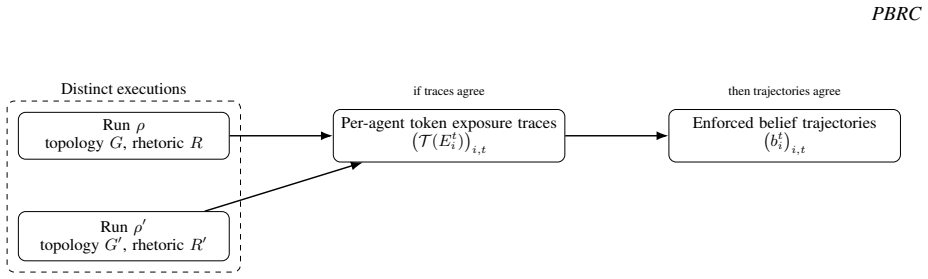
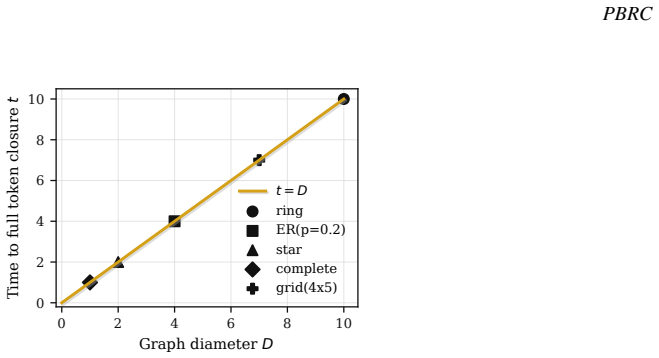
Under evidential PBRC contracts with conservative fallback, social-only rounds cannot increase confidence and cannot generate purely conformity-driven wrong-but-sure cascades. Auditable trigger protocols admit evidential normal forms that preserve belief trajectories and canonicalized audit traces. Sound enforcement yields epistemic accountability: any change of top hypothesis is attributable to a concrete validated witness set. For token-invariant contracts, enforced trajectories depend only on token-exposure traces; under flooding dissemination these traces are characterized exactly by truncated reachability, giving tight diameter bounds for universal evidence closure.
What carries the argument
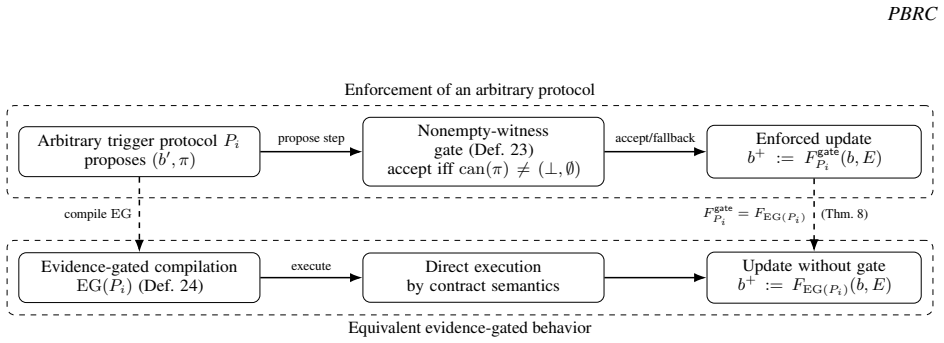
PBRC contracts that publicly fix first-order evidence triggers, admissible revision operators, a priority rule, and a fallback policy, accepting a non-fallback step only when it cites a preregistered trigger and supplies a nonempty set of externally validated evidence tokens.
If this is right
- Social-only rounds cannot increase confidence under evidential contracts with conservative fallback.
- Purely conformity-driven cascades to wrong-but-sure conclusions are blocked.
- Auditable trigger protocols admit evidential normal forms preserving belief trajectories and audit traces.
- Every change of top hypothesis is attributable to a concrete validated witness set.
- For token-invariant contracts, trajectories depend only on token-exposure traces characterized by truncated reachability under flooding dissemination.
Where Pith is reading between the lines
- The same contract structure could be used to enforce evidence-based updates in distributed AI planning systems where agents share messages but must remain tethered to external sensors.
- Specifying trace invariants in the companion contractual dynamic doxastic logic might allow automated verification of cascade suppression before deployment.
- The reported robustness-liveness trade-offs suggest that contract designers can tune trigger strictness to balance cascade prevention against timely belief convergence.
Load-bearing premise
Preregistered triggers can be defined in advance such that all relevant external evidence tokens are correctly validated and the conservative fallback policy is always applied when no trigger matches.
What would settle it
A run of the protocol in which agents raise confidence in a hypothesis after a social-only round that cites no matching preregistered trigger and supplies no validated witness tokens would falsify the central claim.
Figures







read the original abstract
Deliberative multi-agent systems allow agents to exchange messages and revise beliefs over time. While this interaction is meant to improve performance, it can also create dangerous conformity effects: agreement, confidence, prestige, or majority size may be treated as if they were evidence, producing high-confidence convergence to false conclusions. To address this, we introduce PBRC (Preregistered Belief Revision Contracts), a protocol-level mechanism that strictly separates open communication from admissible epistemic change. A PBRC contract publicly fixes first-order evidence triggers, admissible revision operators, a priority rule, and a fallback policy. A non-fallback step is accepted only when it cites a preregistered trigger and provides a nonempty witness set of externally validated evidence tokens. This ensures that every substantive belief change is both enforceable by a router and auditable after the fact. In this paper, (a) we prove that under evidential contracts with conservative fallback, social-only rounds cannot increase confidence and cannot generate purely conformity-driven wrong-but-sure cascades. (b) We show that auditable trigger protocols admit evidential PBRC normal forms that preserve belief trajectories and canonicalized audit traces. (c) We demonstrate that sound enforcement yields epistemic accountability: any change of top hypothesis is attributable to a concrete validated witness set. For token-invariant contracts, (d) we prove that enforced trajectories depend only on token-exposure traces; under flooding dissemination, these traces are characterized exactly by truncated reachability, giving tight diameter bounds for universal evidence closure. Finally, we introduce a companion contractual dynamic doxastic logic to specify trace invariants, and provide simulations illustrating cascade suppression, auditability, and robustness-liveness trade-offs.
Editorial analysis
A structured set of objections, weighed in public.
Referee Report
Summary. The paper introduces Preregistered Belief Revision Contracts (PBRC) as a protocol-level mechanism for deliberative multi-agent systems. A PBRC publicly fixes first-order evidence triggers, admissible revision operators, a priority rule, and a conservative fallback policy. Non-fallback belief revisions are admissible only when they cite a preregistered trigger and supply a nonempty set of externally validated evidence tokens. The authors claim four main results: (a) under evidential contracts with conservative fallback, social-only rounds cannot increase confidence and cannot produce purely conformity-driven wrong-but-sure cascades; (b) auditable trigger protocols admit evidential PBRC normal forms that preserve belief trajectories and canonicalized audit traces; (c) sound enforcement yields epistemic accountability, with any change of top hypothesis attributable to a concrete validated witness set; (d) for token-invariant contracts, enforced trajectories depend only on token-exposure traces, which under flooding dissemination are characterized exactly by truncated reachability, yielding tight diameter bounds for universal evidence closure. The paper also introduces a companion contractual dynamic doxastic logic for specifying trace invariants and presents simulations of cascade suppression, auditability, and robustness-liveness trade-offs.
Significance. If the central no-cascade and accountability results hold, the work supplies a concrete, enforceable protocol for separating open communication from admissible epistemic change, together with machine-checkable invariants and simulation evidence. This addresses a recognized failure mode in multi-agent deliberation and could inform the design of auditable belief-revision systems in AI. The combination of a new logic, explicit normal-form results, and diameter bounds on evidence closure constitutes a substantive formal contribution if the completeness assumptions can be discharged.
major comments (2)
- [Abstract] Abstract, claim (a): The proof that social-only rounds cannot increase confidence or generate conformity cascades rests on the assumption that the preregistered trigger set is exhaustive for every relevant external evidence token. The manuscript supplies no completeness argument showing that all admissible evidence types can be anticipated and fixed at contract time; without it the separation between communication and epistemic change holds only inside the closed world of the contract rather than for arbitrary evidence streams.
- [Abstract] Abstract, claim (d) and the reachability characterization: The claim that trajectories depend only on token-exposure traces and are bounded by truncated reachability presupposes that the conservative fallback is always triggered when no preregistered match exists. If an unforeseen evidence token evades the trigger set, the fallback policy cannot be guaranteed, collapsing the token-invariance result. No argument is given that the trigger definition can be made complete a priori.
minor comments (2)
- [Abstract] The abstract asserts the existence of proofs and a new logic but does not exhibit any derivation steps, definitions of the logic, or counter-example checks; this makes immediate verification of soundness difficult.
- [Abstract] Simulation details (parameter settings, number of agents, evidence-generation model, and statistical tests) are referenced but not described in the abstract; these should be expanded in the main text for reproducibility.
Simulated Author's Rebuttal
We thank the referee for the careful reading and for identifying the important scoping question around trigger completeness. The comments are well-taken and point to a genuine limitation in how the claims are currently phrased. We address each point below and will make targeted revisions to clarify the relative nature of the results.
read point-by-point responses
-
Referee: [Abstract] Abstract, claim (a): The proof that social-only rounds cannot increase confidence or generate conformity cascades rests on the assumption that the preregistered trigger set is exhaustive for every relevant external evidence token. The manuscript supplies no completeness argument showing that all admissible evidence types can be anticipated and fixed at contract time; without it the separation between communication and epistemic change holds only inside the closed world of the contract rather than for arbitrary evidence streams.
Authors: We agree that the no-cascade result is relative to the fixed contract. By definition, a PBRC only admits a non-fallback revision when the agent cites a preregistered trigger and supplies a nonempty validated witness set. Any social-only round or any token lacking a matching trigger is routed to the conservative fallback, which by construction cannot increase confidence in the manner required for a wrong-but-sure cascade. The formal argument therefore shows that, inside the contract, social influence alone cannot produce admissible epistemic change. We did not supply, and cannot supply, a general completeness theorem guaranteeing that every conceivable evidence token can be anticipated at contract time; such a result is impossible in an open environment. We will revise the abstract, the statement of claim (a), and the introduction to make this relativity explicit, stating that the separation between communication and admissible belief revision holds with respect to the preregistered triggers and the fallback policy for unmatched tokens. revision: partial
-
Referee: [Abstract] Abstract, claim (d) and the reachability characterization: The claim that trajectories depend only on token-exposure traces and are bounded by truncated reachability presupposes that the conservative fallback is always triggered when no preregistered match exists. If an unforeseen evidence token evades the trigger set, the fallback policy cannot be guaranteed, collapsing the token-invariance result. No argument is given that the trigger definition can be made complete a priori.
Authors: The enforcement mechanism itself guarantees the fallback: a revision step is accepted as non-fallback only if it references a preregistered trigger and provides evidence tokens. Consequently, any token outside the contract cannot support a non-fallback update and must invoke the conservative policy. The token-invariance theorem and the truncated-reachability characterization therefore apply to the exposure traces of tokens that are covered by the contract. We acknowledge that the manuscript contains no a-priori completeness argument for the trigger set, which would be impossible to obtain in general. We will revise the statement of claim (d), the surrounding formal development, and the discussion of diameter bounds to qualify the results as holding for the preregistered token types, with the fallback handling all others. This preserves the technical content while accurately delimiting its scope. revision: partial
Circularity Check
No circularity; proofs are conditional on explicitly defined contract model
full rationale
The paper defines PBRC contracts with preregistered triggers, admissible operators, priority rules, and conservative fallback as primitives. It then proves (a) and (d) that social-only rounds produce no confidence increase and no conformity cascades strictly inside that model. No step reduces a claimed prediction or theorem to a fitted parameter, self-referential definition, or load-bearing self-citation. The completeness of the trigger set is an explicit modeling assumption rather than a derived result that loops back to the conclusion. The derivation chain therefore remains self-contained and does not exhibit any of the enumerated circularity patterns.
Axiom & Free-Parameter Ledger
axioms (2)
- domain assumption External validation of evidence tokens is possible and reliable outside the agent group.
- domain assumption Conservative fallback policy can be defined and enforced by a router.
invented entities (1)
-
Preregistered Belief Revision Contract (PBRC)
no independent evidence
Reference graph
Works this paper leans on
-
[1]
Dahleh, Ilan Lobel, and Asu Ozdaglar
[Acemoglu et al.(2011)] Daron Acemoglu, Munther A. Dahleh, Ilan Lobel, and Asu Ozdaglar. Bayesian learning in social networks. The Review of Economic Studies, 78(4):1201–1236,
2011
-
[2]
Alchourrón, Peter Gärdenfors, and David Makinson
[Alchourrón et al.(1985)] Carlos E. Alchourrón, Peter Gärdenfors, and David Makinson. On the logic of theory change: Partial meet contraction and revision functions.Journal of Symbolic Logic, 50(2):510–530,
1985
-
[3]
Self-RAG: learning to retrieve, generate, and critique through self-reflection
[Asai et al.(2024)] Akari Asai et al. Self-RAG: learning to retrieve, generate, and critique through self-reflection. InInternational Conference on Learning Representations (ICLR),
2024
-
[4]
Self-RAG: Learning to Retrieve, Generate, and Critique through Self-Reflection
arXiv:2310.11511. [Asch(1951)] Solomon E. Asch. Effects of group pressure upon the modification and distortion of judgments. In Harold Guetzkow (Ed.),Groups, Leadership and Men, Carnegie Press,
work page internal anchor Pith review arXiv 1951
-
[5]
[Ashery et al.(2024)] Ariel Flint Ashery, Luca Maria Aiello, and Andrea Baronchelli. The dynamics of social conventions in LLM populations: spontaneous emergence, collective biases and tipping points.arXiv:2410.08948, 2024–2025. https: //arxiv.org/abs/2410.08948. [Ashery et al.(2025)] Ariel Flint Ashery, Luca Maria Aiello, and Andrea Baronchelli. Emergent...
-
[6]
doi:10.1126/sciadv.adu9368. https://pmc.ncbi. nlm.nih.gov/articles/PMC12077490/. 51 PBRC [Bala and Goyal(1998)] Venkatesh Bala and Sanjeev Goyal. Learning from neighbours.The Review of Economic Studies, 65(3):595– 621,
-
[7]
Banerjee
[Banerjee(1992)] Abhijit V . Banerjee. A simple model of herd behavior.The Quarterly Journal of Economics, 107(3):797–817,
1992
-
[8]
Conformity and social impact on ai agents, 2026
[Bellina et al.(2026)] A. Bellina, G. De Marzo, and D. Garcia. Conformity and social impact on AI agents.arXiv preprint arXiv:2601.05384,
-
[9]
A theory of fads, fashion, custom, and cultural change as informational cascades.Journal of Political Economy, 100(5):992–1026,
[Bikhchandani et al.(1992)] Sushil Bikhchandani, David Hirshleifer, and Ivo Welch. A theory of fads, fashion, custom, and cultural change as informational cascades.Journal of Political Economy, 100(5):992–1026,
1992
-
[10]
On the logic of iterated belief revision.Artificial Intelligence, 89(1–2):1–29,
[Darwiche and Pearl(1997)] Adnan Darwiche and Judea Pearl. On the logic of iterated belief revision.Artificial Intelligence, 89(1–2):1–29,
1997
-
[11]
[DeGroot(1974)] Morris H. DeGroot. Reaching a consensus.Journal of the American Statistical Association, 69(345):118–121,
1974
-
[12]
MIT Press,
[Fagin et al.(1995)] Fagin, R.; Halpern, J.Y .; Moses, Y .; Vardi, M.Y .Reasoning about Knowledge. MIT Press,
1995
-
[13]
MIT Press,
[Gardenfors(1988)] Gardenfors, P.Knowledge in Flux: Modeling the Dynamics of Epistemic States. MIT Press,
1988
-
[14]
Non-interactive verifiable computing: outsourcing computation to untrusted workers
[Gennaro et al.(2010)] Rosario Gennaro, Craig Gentry, and Bryan Parno. Non-interactive verifiable computing: outsourcing computation to untrusted workers. InCRYPTO, LNCS 6223, Springer,
2010
-
[15]
[Golub and Jackson(2010)] Benjamin Golub and Matthew O. Jackson. Naive learning in social networks and the wisdom of crowds. American Economic Journal: Microeconomics, 2(1):112–149,
2010
-
[17]
[Hansson(n.d.)] Sven Ove Hansson
https://arxiv.org/abs/2601.05606. [Hansson(n.d.)] Sven Ove Hansson. Logic of belief revision.Stanford Encyclopedia of Philosophy, entry. https://plato. stanford.edu/entries/logic-belief-revision/. [Harel et al.(2000)] David Harel, Dexter Kozen, and Jerzy Tiuryn.Dynamic Logic. MIT Press,
-
[18]
MetaGPT: Meta Programming for A Multi-Agent Collaborative Framework
[Hong et al.(2023)] Sirui Hong et al. MetaGPT: meta programming for a multi-agent collaborative framework. arXiv preprint arXiv:2308.00352,
work page internal anchor Pith review arXiv 2023
-
[19]
On the difference between updating a knowledge base and revising it
[Katsuno and Mendelzon(1991)] Katsuno, H.; Mendelzon, A.O. On the difference between updating a knowledge base and revising it. InProceedings of the Second International Conference on Principles of Knowledge Representation and Reasoning (KR),
1991
-
[20]
Secure audit logs to support computer forensics.ACM Transactions on Information and System Security, 2(2):159–176,
[Kelsey et al.(1999)] Kelsey, J.; Schneier, B.; Hall, C.; Wagner, D. Secure audit logs to support computer forensics.ACM Transactions on Information and System Security, 2(2):159–176,
1999
-
[21]
Merging information under constraints: a logical framework.Journal of Logic and Computation, 12(5):773–808,
[Konieczny and Pérez(2002)] Sébastien Konieczny and Ramon Pino Pérez. Merging information under constraints: a logical framework.Journal of Logic and Computation, 12(5):773–808,
2002
-
[22]
Logic based merging.Journal of Philosophical Logic, 40:239–270,
[Konieczny and Pérez(2011)] Sébastien Konieczny and Ramon Pino Pérez. Logic based merging.Journal of Philosophical Logic, 40:239–270,
2011
-
[23]
The psychology of social impact.American Psychologist, 36(4):343–356,
[Latané(1981)] Bibb Latané. The psychology of social impact.American Psychologist, 36(4):343–356,
1981
-
[24]
Leitgeb and K
[Leitgeb and Segerberg(2007)] H. Leitgeb and K. Segerberg. Dynamic doxastic logic: why, how, and where to?Synthese, 155:167–190,
2007
-
[25]
Retrieval-Augmented Generation for Knowledge-Intensive NLP Tasks
[Lewis et al.(2020)] Patrick Lewis, Ethan Perez, Aleksandra Piktus, Fabio Petroni, Vladimir Karpukhin, Naman Goyal, Heinrich Küttler, Mike Lewis, Wen-tau Yih, Tim Rocktäschel, Sebastian Riedel, and Douwe Kiela. Retrieval-augmented generation for knowledge-intensive NLP tasks. arXiv:2005.11401,
work page internal anchor Pith review arXiv 2020
-
[26]
CAMEL: Communicative Agents for "Mind" Exploration of Large Language Model Society
[Li et al.(2023)] Guohao Li, Hasan Abed Al Kader Hammoud, Hani Itani, Dmitrii Khizbullin, and Bernard Ghanem. CAMEL: Communicative agents for “mind” exploration of large language model society. arXiv:2303.17760,
work page internal anchor Pith review arXiv 2023
-
[27]
Encouraging Divergent Thinking in Large Language Models through Multi-Agent Debate
[Liang et al.(2023)] Tian Liang, Zhiwei He, Wenxiang Jiao, Xing Wang, Yan Wang, Rui Wang, Yujiu Yang, Shuming Shi, and Zhaopeng Tu. Encouraging divergent thinking in large language models through multi-agent debate. arXiv:2305.19118,
work page internal anchor Pith review arXiv 2023
-
[28]
[Lynch(1996)] N. A. Lynch.Distributed Algorithms. Morgan Kaufmann,
1996
-
[29]
Self-Refine: Iterative Refinement with Self-Feedback
[Madaan et al.(2023)] Aman Madaan et al. Self-refine: iterative refinement with self-feedback. arXiv preprint arXiv:2303.17651,
work page internal anchor Pith review arXiv 2023
-
[30]
Selfcheckgpt: Zero-resource black-box hallucination detection for generative large language models
[Manakul et al.(2023)] Potsawee Manakul et al. SelfCheckGPT: zero-resource black-box hallucination detection for generative large language models. arXiv preprint arXiv:2303.08896,
-
[31]
Teaching Language Models to Support Answers with Verified Quotes.CoRR, abs/2203.11147,
[Menick et al.(2022)] Jacob Menick et al. Teaching language models to support answers with verified quotes. arXiv preprint arXiv:2203.11147,
-
[32]
WebGPT: Browser-assisted question-answering with human feedback
[Nakano et al.(2021)] Reiichiro Nakano et al. WebGPT: browser-assisted question-answering with human feedback. arXiv preprint arXiv:2112.09332,
work page internal anchor Pith review arXiv 2021
-
[33]
52 PBRC [Necula(1997)] G. C. Necula. Proof-carrying code. InProceedings of the 24th ACM SIGPLAN–SIGACT Symposium on Principles of Programming Languages (POPL’97), pp. 106–119,
1997
-
[34]
Pinocchio: nearly practical verifiable computation
[Parno et al.(2013)] Bryan Parno, Jonathan Howell, Craig Gentry, and Mariana Raykova. Pinocchio: nearly practical verifiable computation. InIEEE Symposium on Security and Privacy (S&P),
2013
-
[35]
Review on computational trust and reputation models.Artificial Intelligence Review, 24:33–60,
[Sabater and Sierra(2005)] Sabater, J.; Sierra, C. Review on computational trust and reputation models.Artificial Intelligence Review, 24:33–60,
2005
-
[36]
Toolformer: Language Models Can Teach Themselves to Use Tools
[Schick et al.(2023)] Timo Schick et al. Toolformer: language models can teach themselves to use tools. arXiv preprint arXiv:2302.04761,
work page internal anchor Pith review arXiv 2023
-
[37]
[Schmidt and Tishkovsky(2008)] R. A. Schmidt and D. Tishkovsky. On combinations of propositional dynamic logic and doxastic modal logics.Journal of Logic, Language and Information, 17:109–129,
2008
-
[38]
Reflexion: Language Agents with Verbal Reinforcement Learning
[Shinn et al.(2023)] Noah Shinn, Benjamin Labash, and Ashwin Gopinath. Reflexion: language agents with verbal reinforcement learning. arXiv preprint arXiv:2303.11366,
work page internal anchor Pith review arXiv 2023
-
[39]
[Singh(1999)] Munindar P. Singh. An ontology for commitments in multiagent systems.Artificial Intelligence and Law, 7:97–113,
1999
-
[41]
https://arxiv.org/abs/2508.18321. [Spohn(2012)] Spohn, W.The Laws of Belief: Ranking Theory and Its Philosophical Applications. Oxford University Press,
-
[42]
Cambridge University Press,
[van Benthem(2011)] van Benthem, J.Logical Dynamics of Information and Interaction. Cambridge University Press,
2011
-
[43]
van Benthem and S
[van Benthem and Smets(2015)] J. van Benthem and S. Smets. Dynamic logics of belief change. In H. van Ditmarsch, J. Y . Halpern, W. van der Hoek, and B. Kooi (eds.),Handbook of Logics for Knowledge and Belief, pp. 299–368. College Publications,
2015
-
[44]
Springer,
[van Ditmarsch et al.(2007)] van Ditmarsch, H.; van der Hoek, W.; Kooi, B.Dynamic Epistemic Logic. Springer,
2007
-
[45]
[van Ditmarsch et al.(n.d.)] H. P. van Ditmarsch, W. van der Hoek, and B. Kooi. Dynamic epistemic logic.Stanford Encyclopedia of Philosophy, entry.https://plato.stanford.edu/entries/dynamic-epistemic/. [W3C(2013)] W3C. PROV-DM: the PROV data model. W3C Recommendation, 30 April
2013
-
[46]
Andrea Wynn, Harsh Satija, and Gillian Hadfield
[Weng et al.(2025)] Zhiyuan Weng, Guikun Chen, and Wenguan Wang. Do as we do, not as you think: the conformity of large language models.arXiv:2501.13381, 2025.https://arxiv.org/abs/2501.13381. [Wu et al.(2023)] Qingyun Wu et al. AutoGen: enabling next-gen LLM applications via multi-agent conversation. arXiv preprint arXiv:2308.08155,
-
[47]
ReAct: Synergizing Reasoning and Acting in Language Models
[Yao et al.(2022)] Shunyu Yao, Jeffrey Zhao, Dian Yu, Nan Du, Izhak Shafran, Karthik Narasimhan, and Yuan Cao. ReAct: Synergizing reasoning and acting in language models. arXiv:2210.03629,
work page internal anchor Pith review Pith/arXiv arXiv 2022
-
[48]
Flexible protocol specification and execution: applying social commitments
[Yolum and Singh(2002)] Yolum, P.; Singh, M.P. Flexible protocol specification and execution: applying social commitments. In Proceedings of the 1st International Joint Conference on Autonomous Agents and Multiagent Systems (AAMAS),
2002
discussion (0)
Sign in with ORCID, Apple, or X to comment. Anyone can read and Pith papers without signing in.