Recognition: unknown
A universal relationship between the variability timescale and black hole mass in black hole jetted and non-jetted accreting systems
Pith reviewed 2026-05-10 08:22 UTC · model grok-4.3
The pith
Mass-scaled DRW damping timescales in AGNs follow a linear relation with black hole mass (slope 0.35-0.50) for both jetted and non-jetted sources, supporting universal accretion physics.
A machine-rendered reading of the paper's core claim, the machinery that carries it, and where it could break.
Core claim
the mass-scaled characteristic timescales across the black hole mass exhibit a linear relationship with a slope of 0.35-0.50... supporting the presence of a universal accretion mechanism in AGNs across different mass scales... the properties and production mechanisms of relativistic jets may be largely independent of black hole mass.
Load-bearing premise
That the DRW model parameters extracted from ZTF light curves faithfully represent the intrinsic physical variability timescales without significant bias from sampling cadence, selection effects in the BAT AGN sample, or contamination by host-galaxy light.
Figures


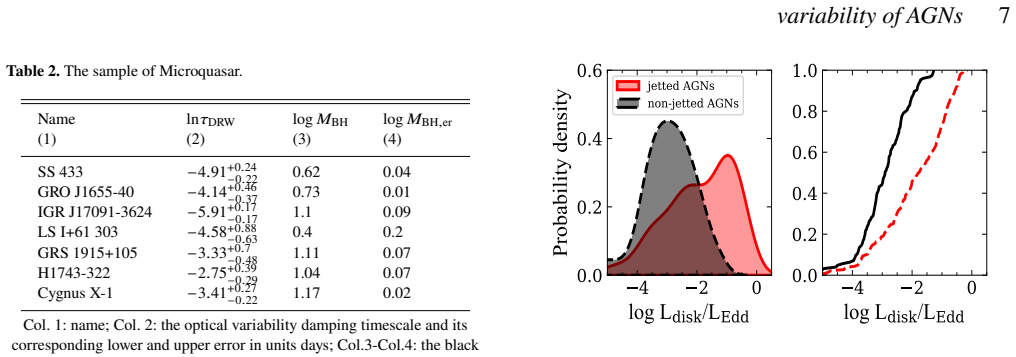
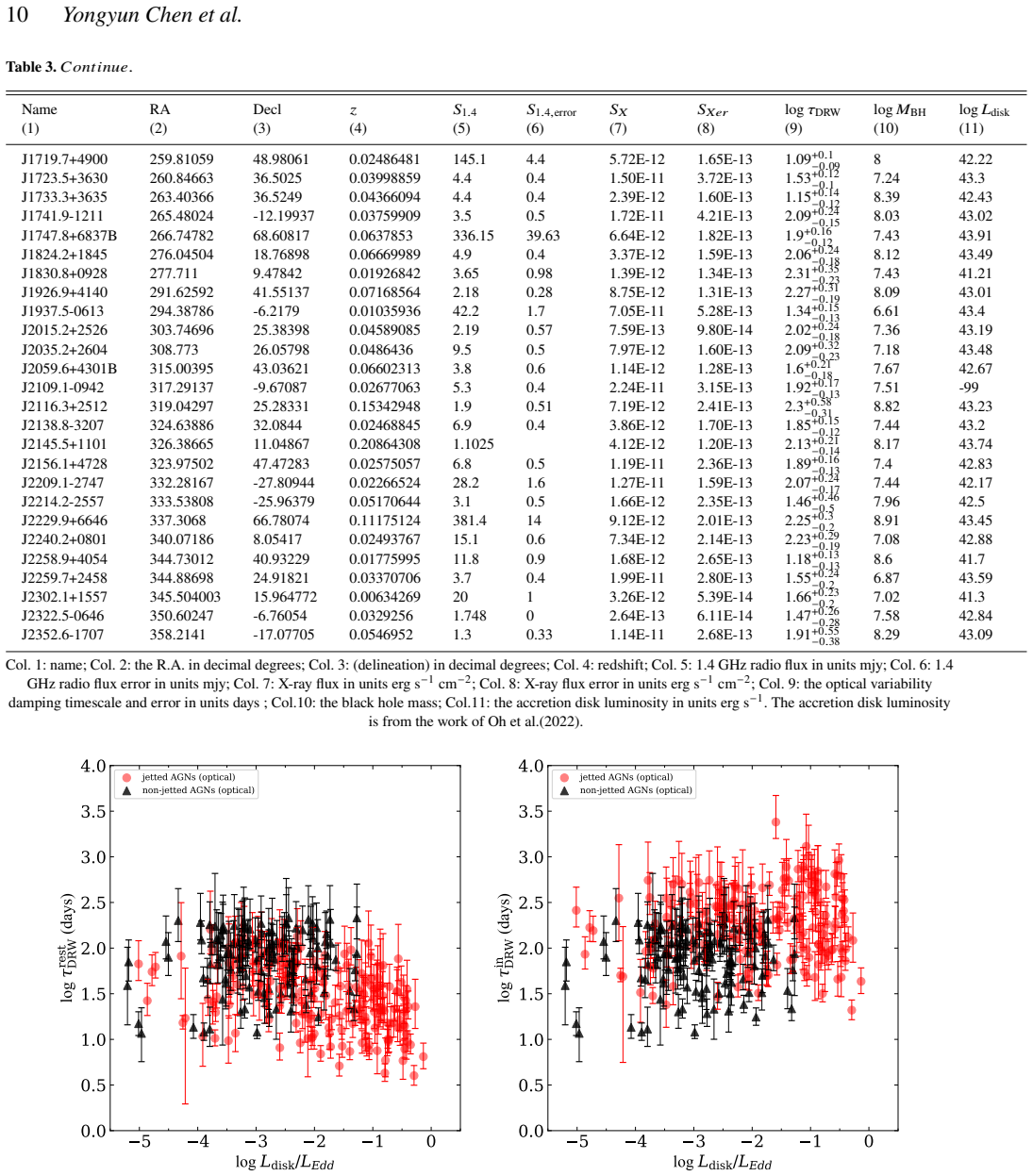
read the original abstract
A long-term variability study spanning a range of black hole mass systems, from microquasars hosting stellar-mass black holes to active galactic nuclei (AGNs) harboring supermassive black holes, provides new insights into the physics of relativistic jets. In this work, we investigate the optical variability of both jetted and nonjetted AGNs. We apply a stochastic process known as the Damped Random Walk (DRW) to model light curves from the Zwicky Transient Facility (ZTF) DR23. Our results show that the mass-scaled characteristic timescales across the black hole mass exhibit a linear relationship with a slope of 0.35-0.50. This analysis confirms a previously observed correlation between the damping timescales and black hole mass and extends it by incorporating 125 newly identified non-jetted AGNs selected from the Burst Alert Telescope (BAT) AGN catalogue. The derived slope of the relation between the damping timescales and black hole mass aligns with recent theoretical predictions, supporting the presence of a universal accretion mechanism in AGNs across different mass scales. Furthermore, our findings suggest a novel implication: the properties and production mechanisms of relativistic jets may be largely independent of black hole mass.
Editorial analysis
A structured set of objections, weighed in public.
Referee Report
Summary. The manuscript reports an empirical correlation between black-hole mass and DRW damping timescales extracted from ZTF DR23 optical light curves for a combined sample of jetted and non-jetted accreting systems spanning stellar-mass to supermassive black holes. After adding 125 newly selected non-jetted BAT AGNs, the authors fit a linear relation in log-log space and obtain a slope of 0.35–0.50; they interpret this as evidence for a universal accretion mechanism across mass scales and for jet properties being largely mass-independent.
Significance. If the reported slope survives rigorous checks for selection effects, sampling biases, and host-galaxy contamination, the result would strengthen the empirical foundation for mass-scaled variability timescales and provide a useful constraint on accretion-disk models. The extension to a larger non-jetted BAT sample is a concrete addition to the existing literature on the same correlation.
major comments (3)
- [§3] §3 (DRW fitting and sample construction): the manuscript does not describe how the 125 BAT AGNs were selected from the parent catalogue, what quality cuts were applied to the ZTF light curves, or how objects with DRW damping times comparable to or longer than the ~3 yr baseline were handled. Because the claimed relation predicts longer τ at higher M_BH, any systematic underestimation of τ for the supermassive end would directly affect the recovered slope; this must be quantified with injection-recovery tests or baseline-matched subsamples.
- [§4] §4 (linear fit and error analysis): the slope range 0.35–0.50 is quoted without reported uncertainties, covariance matrix, or details on whether the fit accounts for measurement errors on both axes and intrinsic scatter. The central claim that the slope “aligns with recent theoretical predictions” therefore cannot be evaluated for statistical significance or robustness against the known DRW degeneracy.
- [§5] §5 (interpretation of jet independence): the conclusion that “properties and production mechanisms of relativistic jets may be largely independent of black hole mass” rests on the similarity of the slope between jetted and non-jetted subsamples. No quantitative test (e.g., separate fits with slope-difference significance or comparison of residuals) is presented to support this inference.
minor comments (2)
- [Figure 1] Figure 1 and Table 1: axis labels and units for the mass-scaled timescale should be stated explicitly; the caption should clarify whether the plotted points include the new BAT sample or only literature values.
- [Abstract] The abstract states “slope of 0.35-0.50” while the text later quotes a single best-fit value; consistency between abstract and main text is needed.
Simulated Author's Rebuttal
We thank the referee for their constructive and detailed report. The comments highlight important aspects of sample construction, statistical robustness, and interpretation that we will address in a revised manuscript. Below we respond point by point to the major comments.
read point-by-point responses
-
Referee: [§3] §3 (DRW fitting and sample construction): the manuscript does not describe how the 125 BAT AGNs were selected from the parent catalogue, what quality cuts were applied to the ZTF light curves, or how objects with DRW damping times comparable to or longer than the ~3 yr baseline were handled. Because the claimed relation predicts longer τ at higher M_BH, any systematic underestimation of τ for the supermassive end would directly affect the recovered slope; this must be quantified with injection-recovery tests or baseline-matched subsamples.
Authors: We agree that §3 requires additional detail on sample construction. The 125 non-jetted BAT AGNs were selected by cross-matching the Swift-BAT 105-month catalogue with ZTF DR23 sources having at least 40 epochs in the g or r band, excluding objects with known radio jets or blazar classifications, and applying a redshift cut z < 0.3 to ensure reliable black-hole mass estimates. Quality cuts on the light curves included a minimum signal-to-noise per epoch and removal of epochs flagged as poor quality by ZTF. For DRW fits, we rejected solutions where the recovered τ exceeded the light-curve baseline by more than a factor of ~1.5, as these are poorly constrained by the data. We acknowledge, however, that a quantitative assessment of bias is needed. In the revision we will expand §3 with a full description of the selection pipeline and quality cuts, and we will add injection-recovery tests that inject DRW light curves with known τ values (spanning the observed range) into the actual ZTF sampling and noise properties of our sample. We will also present results for baseline-matched subsamples to verify that the recovered slope remains stable. These additions will directly address the potential impact on the high-mass end. revision: yes
-
Referee: [§4] §4 (linear fit and error analysis): the slope range 0.35–0.50 is quoted without reported uncertainties, covariance matrix, or details on whether the fit accounts for measurement errors on both axes and intrinsic scatter. The central claim that the slope “aligns with recent theoretical predictions” therefore cannot be evaluated for statistical significance or robustness against the known DRW degeneracy.
Authors: We accept that the presentation of the linear fit in §4 is incomplete. The quoted slope range of 0.35–0.50 reflects the variation obtained from ordinary least-squares fits performed on different subsamples (full sample, jetted only, non-jetted only) and with different treatments of upper limits. In the revised manuscript we will replace this with a single, fully documented fit using orthogonal distance regression (or equivalent) that incorporates measurement uncertainties on both log τ and log M_BH, an estimate of intrinsic scatter, and bootstrap or MCMC-derived uncertainties and covariance matrix for the slope and intercept. We will also explicitly discuss the DRW parameter degeneracy between τ and σ, describe how it was mitigated in our fitting procedure (e.g., via informative priors or joint posterior sampling), and assess its residual effect on the slope uncertainty. These changes will allow readers to evaluate the statistical significance of the alignment with theoretical predictions. revision: yes
-
Referee: [§5] §5 (interpretation of jet independence): the conclusion that “properties and production mechanisms of relativistic jets may be largely independent of black hole mass” rests on the similarity of the slope between jetted and non-jetted subsamples. No quantitative test (e.g., separate fits with slope-difference significance or comparison of residuals) is presented to support this inference.
Authors: We agree that the inference of mass-independent jet properties would be strengthened by quantitative comparison. The current manuscript shows the jetted and non-jetted points overlapping on the same relation but does not report separate slope fits or a formal test of slope difference. In the revision we will add (i) independent linear fits to the jetted and non-jetted subsamples with full uncertainties, (ii) a statistical comparison of the two slopes (e.g., via a likelihood-ratio test or bootstrap difference distribution), and (iii) a residual analysis that quantifies whether the scatter or systematic offsets differ between the two populations. If the slopes remain consistent within uncertainties, this will provide a firmer basis for the interpretation; otherwise we will moderate the claim accordingly. revision: yes
Axiom & Free-Parameter Ledger
free parameters (1)
- slope of mass-timescale relation
axioms (1)
- domain assumption Damped Random Walk model accurately captures the characteristic variability timescale of AGN optical light curves
Reference graph
Works this paper leans on
-
[1]
write newline
" write newline "" before.all 'output.state := FUNCTION fin.entry write newline FUNCTION new.block output.state before.all = 'skip after.block 'output.state := if FUNCTION new.sentence output.state after.block = 'skip output.state before.all = 'skip after.sentence 'output.state := if if FUNCTION not #0 #1 if FUNCTION and 'skip pop #0 if FUNCTION or pop #1...
-
[2]
Abeysekara A. U., et al., 2018, @doi [ ] 10.1038/s41586-018-0688-8 , https://ui.adsabs.harvard.edu/abs/2018Natur.564E..38A 564, E38
-
[3]
Ajello M., et al., 2022, @doi [ ] 10.3847/1538-4365/ac9523 , https://ui.adsabs.harvard.edu/abs/2022ApJS..263...24A 263, 24
-
[4]
Ar \'e valo P., Churazov E., Lira P., S \'a nchez-S \'a ez P., Bernal S., Hern \'a ndez-Garc \' a L., L \'o pez-Navas E., Patel P., 2024, @doi [ ] 10.1051/0004-6361/202347080 , https://ui.adsabs.harvard.edu/abs/2024A&A...684A.133A 684, A133
-
[5]
Bahramian A., Rushton A., 2022, bersavosh/XRB-LrLx\_pub: update 20220908 , @doi 10.5281/zenodo.7059313
-
[6]
Baldassare V. F., Reines A. E., Gallo E., Greene J. E., 2015, @doi [ ] 10.1088/2041-8205/809/1/L14 , https://ui.adsabs.harvard.edu/abs/2015ApJ...809L..14B 809, L14
-
[7]
Baldassare V. F., Geha M., Greene J., 2018, @doi [ ] 10.3847/1538-4357/aae6cf , https://ui.adsabs.harvard.edu/abs/2018ApJ...868..152B 868, 152
-
[8]
Ballantyne D. R., 2007, @doi [Modern Physics Letters A] 10.1142/S0217732307024322 , https://ui.adsabs.harvard.edu/abs/2007MPLA...22.2397B 22, 2397
-
[9]
Bellan P. M., 2018, @doi [Plasma Physics and Controlled Fusion] 10.1088/1361-6587/aa85f9 , https://ui.adsabs.harvard.edu/abs/2018PPCF...60a4006B 60, 014006
-
[10]
Belloni T., Klein-Wolt M., M \'e ndez M., van der Klis M., van Paradijs J., 2000, @doi [ ] 10.48550/arXiv.astro-ph/0001103 , https://ui.adsabs.harvard.edu/abs/2000A&A...355..271B 355, 271
-
[11]
Blandford R. D., Payne D. G., 1982, @doi [ ] 10.1093/mnras/199.4.883 , https://ui.adsabs.harvard.edu/abs/1982MNRAS.199..883B 199, 883
-
[12]
Blandford R. D., Znajek R. L., 1977, @doi [ ] 10.1093/mnras/179.3.433 , https://ui.adsabs.harvard.edu/abs/1977MNRAS.179..433B 179, 433
-
[13]
Blandford R., Meier D., Readhead A., 2019, @doi [ ] 10.1146/annurev-astro-081817-051948 , https://ui.adsabs.harvard.edu/abs/2019ARA&A..57..467B 57, 467
-
[14]
, archivePrefix = "arXiv", eprint =
Bower G. C., Dexter J., Markoff S., Gurwell M. A., Rao R., McHardy I., 2015, @doi [ ] 10.1088/2041-8205/811/1/L6 , https://ui.adsabs.harvard.edu/abs/2015ApJ...811L...6B 811, L6
-
[15]
Brocksopp C., et al., 2002, @doi [ ] 10.1046/j.1365-8711.2002.05230.x , https://ui.adsabs.harvard.edu/abs/2002MNRAS.331..765B 331, 765
-
[16]
J., Shen, Y., Blaes, O., et al
Burke C. J., et al., 2021, @doi [Science] 10.1126/science.abg9933 , https://ui.adsabs.harvard.edu/abs/2021Sci...373..789B 373, 789
-
[17]
Burke C. J., et al., 2022, @doi [ ] 10.1093/mnras/stac2262 , https://ui.adsabs.harvard.edu/abs/2022MNRAS.516.2736B 516, 2736
-
[18]
Cai J. T., Kurtanidze S. O., Liu Y., Kurtanidze O. M., Nikolashvili M. G., Xiao H. B., Fan J. H., 2022, @doi [ ] 10.3847/1538-4365/ac666b , https://ui.adsabs.harvard.edu/abs/2022ApJS..260...47C 260, 47
-
[19]
Cann J. M., et al., 2020, @doi [ ] 10.3847/1538-4357/ab8b64 , https://ui.adsabs.harvard.edu/abs/2020ApJ...895..147C 895, 147
-
[20]
Cao X., Jiang D. R., 1999, @doi [ ] 10.1046/j.1365-8711.1999.02657.x , https://ui.adsabs.harvard.edu/abs/1999MNRAS.307..802C 307, 802
-
[21]
Chen Y. Y., Zhang X., Zhang H. J., Yu X. L., 2015, @doi [ ] 10.1093/mnras/stv658 , https://ui.adsabs.harvard.edu/abs/2015MNRAS.451.4193C 451, 4193
-
[22]
Chen Y., Gu Q., Fan J., Yu X., Ding N., Xiong D., Guo X., 2023a, @doi [ ] 10.3847/1538-4365/acc57f , https://ui.adsabs.harvard.edu/abs/2023ApJS..265...60C 265, 60
-
[23]
Chen Y., et al., 2023b, @doi [ ] 10.3847/1538-4365/ace444 , https://ui.adsabs.harvard.edu/abs/2023ApJS..268....6C 268, 6
-
[24]
Chen Y., Gu Q., Fan J., Yu X., Ding N., Guo X., Xiong D., 2023c, @doi [ ] 10.1093/mnras/stad065 , https://ui.adsabs.harvard.edu/abs/2023MNRAS.519.6199C 519, 6199
-
[25]
Chen Y., Gu Q., Yang J., Fan J., Yu X., Xiong D., Ding N., Guo X., 2024, @doi [Research in Astronomy and Astrophysics] 10.1088/1674-4527/ad8627 , https://ui.adsabs.harvard.edu/abs/2024RAA....24k5011C 24, 115011
-
[26]
Chen Y., Gu Q., Fan J., Xiong D., Yu X., Guo X., Ding N., Yi T.-F., 2025, @doi [ ] 10.3847/1538-4357/ae08ac , https://ui.adsabs.harvard.edu/abs/2025ApJ...993...50C 993, 50
-
[27]
Choudhury M., Rao A. R., 2004, in Tovmassian G., Sion E., eds, Revista Mexicana de Astronomia y Astrofisica Conference Series Vol. 20, Revista Mexicana de Astronomia y Astrofisica Conference Series. pp 203--203 ( @eprint arXiv astro-ph/0312601 ), @doi 10.48550/arXiv.astro-ph/0312601
work page internal anchor Pith review doi:10.48550/arxiv.astro-ph/0312601 2004
-
[28]
Corbel S., Fender R. P., Tzioumis A. K., Tomsick J. A., Orosz J. A., Miller J. M., Wijnands R., Kaaret P., 2002, @doi [Science] 10.1126/science.1075857 , https://ui.adsabs.harvard.edu/abs/2002Sci...298..196C 298, 196
-
[29]
Corbel S., Nowak M. A., Fender R. P., Tzioumis A. K., Markoff S., 2003, @doi [ ] 10.1051/0004-6361:20030090 , https://ui.adsabs.harvard.edu/abs/2003A&A...400.1007C 400, 1007
-
[30]
M., McHardy I
Czerny B., 2006, in Gaskell C. M., McHardy I. M., Peterson B. M., Sergeev S. G., eds, Astronomical Society of the Pacific Conference Series Vol. 360, AGN Variability from X-Rays to Radio Waves. p. 265
2006
-
[31]
Czerny B., Schwarzenberg-Czerny A., Loska Z., 1999, @doi [ ] 10.1046/j.1365-8711.1999.02196.x , https://ui.adsabs.harvard.edu/abs/1999MNRAS.303..148C 303, 148
-
[32]
Done C., Gierli \'n ski M., Kubota A., 2007, @doi [ ] 10.1007/s00159-007-0006-1 , https://ui.adsabs.harvard.edu/abs/2007A&ARv..15....1D 15, 1
-
[33]
Dunn R. J. H., Fender R. P., K \"o rding E. G., Belloni T., Cabanac C., 2010, @doi [ ] 10.1111/j.1365-2966.2010.16114.x , https://ui.adsabs.harvard.edu/abs/2010MNRAS.403...61D 403, 61
-
[34]
Foreman-Mackey D., Agol E., Ambikasaran S., Angus R., 2017, @doi [ ] 10.3847/1538-3881/aa9332 , https://ui.adsabs.harvard.edu/abs/2017AJ....154..220F 154, 220
-
[35]
Gallo E., Plotkin R. M., Jonker P. G., 2014, @doi [ ] 10.1093/mnrasl/slt152 , https://ui.adsabs.harvard.edu/abs/2014MNRAS.438L..41G 438, L41
-
[36]
Ghisellini G., Tavecchio F., Ghirlanda G., 2009, @doi [ ] 10.1111/j.1365-2966.2009.15397.x , https://ui.adsabs.harvard.edu/abs/2009MNRAS.399.2041G 399, 2041
-
[37]
Ghisellini G., Tavecchio F., Foschini L., Ghirlanda G., Maraschi L., Celotti A., 2010, @doi [ ] 10.1111/j.1365-2966.2009.15898.x , https://ui.adsabs.harvard.edu/abs/2010MNRAS.402..497G 402, 497
-
[38]
Ghisellini G., Tavecchio F., Maraschi L., Celotti A., Sbarrato T., 2014, @doi [ ] 10.1038/nature13856 , https://ui.adsabs.harvard.edu/abs/2014Natur.515..376G 515, 376
-
[39]
Estimating Black Hole Masses in Active Galaxies Using the Halpha Emission Line
Greene J. E., Ho L. C., 2005, @doi [ ] 10.1086/431897 , https://ui.adsabs.harvard.edu/abs/2005ApJ...630..122G 630, 122
-
[40]
Guo H., Wang J., Cai Z., Sun M., 2017, @doi [ ] 10.3847/1538-4357/aa8d71 , https://ui.adsabs.harvard.edu/abs/2017ApJ...847..132G 847, 132
-
[41]
Guo H., et al., 2020, @doi [ ] 10.1093/mnras/staa1803 , https://ui.adsabs.harvard.edu/abs/2020MNRAS.496.3636G 496, 3636
-
[42]
Gupta S., B \"o ttcher M., 2006, @doi [ ] 10.1086/508880 , https://ui.adsabs.harvard.edu/abs/2006ApJ...650L.123G 650, L123
-
[43]
Hurley D. J., Callanan P. J., Elebert P., Reynolds M. T., 2013, @doi [ ] 10.1093/mnras/stt001 , https://ui.adsabs.harvard.edu/abs/2013MNRAS.430.1832H 430, 1832
-
[44]
Iyer N., Nandi A., Mandal S., 2015, @doi [ ] 10.1088/0004-637X/807/1/108 , https://ui.adsabs.harvard.edu/abs/2015ApJ...807..108I 807, 108
-
[45]
S., Barr P., 1989, , https://ui.adsabs.harvard.edu/abs/1989A&A...226...59K 226, 59
Kaastra J. S., Barr P., 1989, , https://ui.adsabs.harvard.edu/abs/1989A&A...226...59K 226, 59
1989
-
[46]
L., 1998, @doi [ ] 10.1086/306105 , https://ui.adsabs.harvard.edu/abs/1998ApJ...504..671K 504, 671
Kawaguchi T., Mineshige S., Umemura M., Turner E. L., 1998, @doi [ ] 10.1086/306105 , https://ui.adsabs.harvard.edu/abs/1998ApJ...504..671K 504, 671
-
[47]
Kelly B. C., 2007, @doi [ ] 10.1086/519947 , https://ui.adsabs.harvard.edu/abs/2007ApJ...665.1489K 665, 1489
-
[48]
C., Bechtold, J., & Siemiginowska, A
Kelly B. C., Bechtold J., Siemiginowska A., 2009, @doi [ ] 10.1088/0004-637X/698/1/895 , https://ui.adsabs.harvard.edu/abs/2009ApJ...698..895K 698, 895
-
[49]
Kelly B. C., Becker A. C., Sobolewska M., Siemiginowska A., Uttley P., 2014, @doi [ ] 10.1088/0004-637X/788/1/33 , https://ui.adsabs.harvard.edu/abs/2014ApJ...788...33K 788, 33
-
[50]
Koljonen K. I. I., Hovatta T., 2021, @doi [ ] 10.1051/0004-6361/202039581 , https://ui.adsabs.harvard.edu/abs/2021A&A...647A.173K 647, A173
-
[51]
K \"o rding E., Falcke H., Corbel S., 2006, @doi [ ] 10.1051/0004-6361:20054144 , https://ui.adsabs.harvard.edu/abs/2006A&A...456..439K 456, 439
-
[52]
J., Ricci , C., Trakhtenbrot , B., et al
Koss M. J., et al., 2022, @doi [ ] 10.3847/1538-4365/ac6c05 , https://ui.adsabs.harvard.edu/abs/2022ApJS..261....2K 261, 2
-
[53]
Koz owski S., 2016, @doi [ ] 10.3847/0004-637X/826/2/118 , https://ui.adsabs.harvard.edu/abs/2016ApJ...826..118K 826, 118
-
[54]
Laor A., Behar E., 2008, @doi [ ] 10.1111/j.1365-2966.2008.13806.x , https://ui.adsabs.harvard.edu/abs/2008MNRAS.390..847L 390, 847
-
[55]
Liodakis I., et al., 2017, @doi [ ] 10.3847/1538-4357/aa9992 , https://ui.adsabs.harvard.edu/abs/2017ApJ...851..144L 851, 144
-
[56]
Liodakis I., Hovatta T., Huppenkothen D., Kiehlmann S., Max-Moerbeck W., Readhead A. C. S., 2018, @doi [ ] 10.3847/1538-4357/aae2b7 , https://ui.adsabs.harvard.edu/abs/2018ApJ...866..137L 866, 137
-
[57]
Livio M., Pringle J. E., King A. R., 2003, @doi [ ] 10.1086/375872 , https://ui.adsabs.harvard.edu/abs/2003ApJ...593..184L 593, 184
-
[58]
Lu K.-X., et al., 2019, @doi [ ] 10.3847/1538-4357/ab16e8 , https://ui.adsabs.harvard.edu/abs/2019ApJ...877...23L 877, 23
-
[59]
MacLeod C. L., et al., 2010, @doi [ ] 10.1088/0004-637X/721/2/1014 , https://ui.adsabs.harvard.edu/abs/2010ApJ...721.1014M 721, 1014
-
[60]
Markoff S., Falcke H., Fender R., 2001, @doi [ ] 10.1051/0004-6361:20010420 , https://ui.adsabs.harvard.edu/abs/2001A&A...372L..25M 372, L25
-
[61]
Markoff S., Nowak M. A., Wilms J., 2005, @doi [ ] 10.1086/497628 , https://ui.adsabs.harvard.edu/abs/2005ApJ...635.1203M 635, 1203
-
[62]
Mart \' nez-Palomera J., Lira P., Bhalla-Ladd I., F \"o rster F., Plotkin R. M., 2020, @doi [ ] 10.3847/1538-4357/ab5f5b , https://ui.adsabs.harvard.edu/abs/2020ApJ...889..113M 889, 113
-
[63]
Publications of the Astronomical Society of the Pacific , author =
Masci F. J., et al., 2019, @doi [ ] 10.1088/1538-3873/aae8ac , https://ui.adsabs.harvard.edu/abs/2019PASP..131a8003M 131, 018003
work page internal anchor Pith review doi:10.1088/1538-3873/aae8ac 2019
-
[64]
M., Koerding E., Knigge C., Uttley P., Fender R
McHardy I. M., Koerding E., Knigge C., Uttley P., Fender R. P., 2006, @doi [ ] 10.1038/nature05389 , https://ui.adsabs.harvard.edu/abs/2006Natur.444..730M 444, 730
-
[65]
Merloni A., Heinz S., di Matteo T., 2003, @doi [ ] 10.1046/j.1365-2966.2003.07017.x , https://ui.adsabs.harvard.edu/abs/2003MNRAS.345.1057M 345, 1057
-
[66]
Mirabel I. F., Rodr \' guez L. F., 1999, @doi [ ] 10.1146/annurev.astro.37.1.409 , https://ui.adsabs.harvard.edu/abs/1999ARA&A..37..409M 37, 409
-
[67]
A., Debnath D., Chakrabarti S
Molla A. A., Debnath D., Chakrabarti S. K., Mondal S., Jana A., Chatterjee D., 2016, in 41st COSPAR Scientific Assembly. pp E1.6--18--16
2016
-
[68]
Motta S. E., Belloni T. M., Stella L., Mu \ n oz-Darias T., Fender R., 2014, @doi [ ] 10.1093/mnras/stt2068 , https://ui.adsabs.harvard.edu/abs/2014MNRAS.437.2554M 437, 2554
-
[69]
Mukherjee S., Mitra K., Chatterjee R., 2019, @doi [ ] 10.1093/mnras/stz858 , https://ui.adsabs.harvard.edu/abs/2019MNRAS.486.1672M 486, 1672
-
[70]
Negi V., Joshi R., Chand K., Chand H., Wiita P., Ho L. C., Singh R. S., 2022, @doi [ ] 10.1093/mnras/stab3591 , https://ui.adsabs.harvard.edu/abs/2022MNRAS.510.1791N 510, 1791
-
[71]
S., Georganopoulos M., Guiriec S., Meyer E
Nemmen R. S., Georganopoulos M., Guiriec S., Meyer E. T., Gehrels N., Sambruna R. M., 2012, @doi [Science] 10.1126/science.1227416 , https://ui.adsabs.harvard.edu/abs/2012Sci...338.1445N 338, 1445
-
[72]
Nisbet D. M., Best P. N., 2016, @doi [ ] 10.1093/mnras/stv2450 , https://ui.adsabs.harvard.edu/abs/2016MNRAS.455.2551N 455, 2551
-
[73]
Oh K., et al., 2022, @doi [ ] 10.3847/1538-4365/ac5b68 , https://ui.adsabs.harvard.edu/abs/2022ApJS..261....4O 261, 4
-
[74]
Orosz J. A., McClintock J. E., Aufdenberg J. P., Remillard R. A., Reid M. J., Narayan R., Gou L., 2011, @doi [ ] 10.1088/0004-637X/742/2/84 , https://ui.adsabs.harvard.edu/abs/2011ApJ...742...84O 742, 84
-
[75]
Padovani P., et al., 2017, @doi [ ] 10.1007/s00159-017-0102-9 , https://ui.adsabs.harvard.edu/abs/2017A&ARv..25....2P 25, 2
-
[76]
S., Dom´ ınguez, A., Ajello, M., Olmo-Garc´ ıa, A., & Hartmann, D
Paliya V. S., Dom \' nguez A., Ajello M., Olmo-Garc \' a A., Hartmann D., 2021, @doi [ ] 10.3847/1538-4365/abe135 , https://ui.adsabs.harvard.edu/abs/2021ApJS..253...46P 253, 46
-
[77]
Picchi P., Shore S. N., Harvey E. J., Berdyugin A., 2020, @doi [ ] 10.1051/0004-6361/202037960 , https://ui.adsabs.harvard.edu/abs/2020A&A...640A..96P 640, A96
-
[78]
Rawlings S., Saunders R., 1991, @doi [ ] 10.1038/349138a0 , https://ui.adsabs.harvard.edu/abs/1991Natur.349..138R 349, 138
-
[79]
Reines A. E., Greene J. E., Geha M., 2013, @doi [ ] 10.1088/0004-637X/775/2/116 , https://ui.adsabs.harvard.edu/abs/2013ApJ...775..116R 775, 116
-
[80]
Ruan J. J., et al., 2012, @doi [ ] 10.1088/0004-637X/760/1/51 , https://ui.adsabs.harvard.edu/abs/2012ApJ...760...51R 760, 51
discussion (0)
Sign in with ORCID, Apple, or X to comment. Anyone can read and Pith papers without signing in.