Recognition: no theorem link
Competition of carrier bioresorption and drug release kinetics of vancomycin-loaded silicate macroporous microspheres to determine cell biocompatibility
Pith reviewed 2026-05-10 17:46 UTC · model grok-4.3
The pith
Carrier bioresorption kinetics determines cell biocompatibility more than drug release in vancomycin-loaded silicate microspheres.
A machine-rendered reading of the paper's core claim, the machinery that carries it, and where it could break.
Core claim
The antibiotic-loaded bredigite, akermanite and diopside devices comparatively exhibited the lowest, intermediate and highest levels of human bone marrow mesenchymal stem cells viability and proliferation, respectively. It was concluded that the role of the carrier bioresorption kinetics prevails over the drug delivery kinetics in determining the cell biocompatibility of the devices.
What carries the argument
Macroporous microspheres fabricated from bredigite (Ca7MgSi4O16), akermanite (Ca2MgSi2O7) and diopside (CaMgSi2O6) via sol-gel, calcination, droplet extrusion and sintering, then loaded with vancomycin hydrochloride, with cytocompatibility ranked by MTT assay on hBM-MSCs.
If this is right
- Material selection for bone void fillers should emphasize degradation timelines that align with healing over precise control of antibiotic elution alone.
- Local delivery systems using these silicates may require tuning of carrier composition to prevent resorption from limiting stem cell response.
- Diopside-based carriers appear preferable to bredigite when vancomycin is loaded, based on the observed viability order.
Where Pith is reading between the lines
- Faster-resorbing carriers like bredigite may alter local ion concentrations or pH enough to affect cells independently of the drug.
- Porosity or particle size could be varied independently in follow-up tests to separate their effects from composition-driven resorption.
- Similar drug-loaded systems in tissue engineering might benefit from starting designs with in vitro degradation data before optimizing release curves.
Load-bearing premise
The differences in cell viability are driven mainly by how fast each carrier dissolves rather than by variations in released ions, surface chemistry or exact drug release profiles.
What would settle it
Measure the actual dissolution rates of each microsphere type under the same cell culture conditions and check whether the viability ranking matches the dissolution ranking but not the drug release ranking.
Figures


read the original abstract
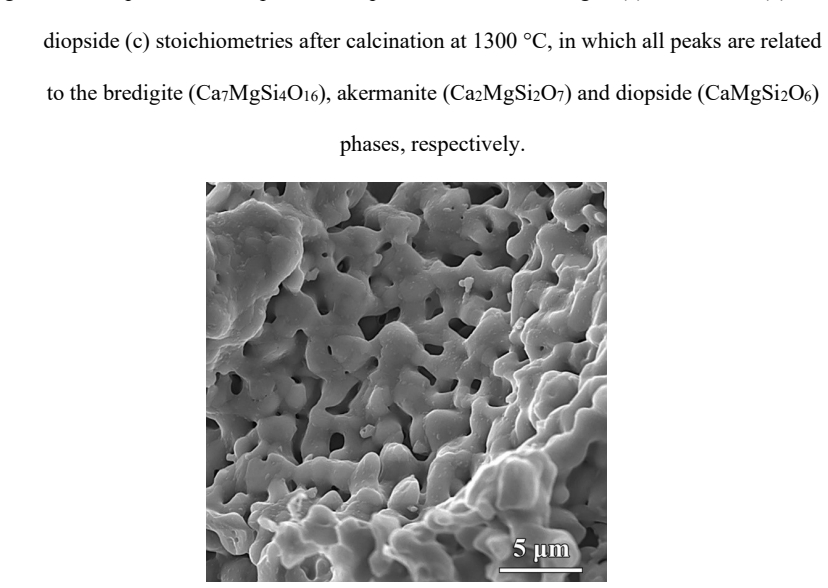
Bioceramic porous microspheres are promising substances for dental and orthopedic bone void filling, tissue engineering and drug delivery applications. In this research, the structure and cytocompatibility of bioactive magnesium-calcium silicate macroporous microspheres loaded with vancomycin hydrochloride, an antibiotic drug, were studied. In this regard, bredigite (Ca7MgSi4O16), akermanite (Ca2MgSi2O7) and diopside (CaMgSi2O6) carriers were fabricated through a sequence of sol-gel, calcination, droplet extrusion and sintering processes, followed by impregnated with vancomycin. X-ray diffraction (XRD) and scanning electron microscopy verified the formation of the desired ceramic crystalline phases and macroporous characteristics of the carriers, respectively. Based on the MTT assay, the antibiotic-loaded bredigite, akermanite and diopside devices comparatively exhibited the lowest, intermediate and highest levels of human bone marrow mesenchymal stem cells (hBM-MSCs) viability and proliferation, respectively. It was concluded that the role of the carrier bioresorption kinetics prevails over the drug delivery kinetics in determining the cell biocompatibility of the devices.
Editorial analysis
A structured set of objections, weighed in public.
Referee Report
Summary. The manuscript reports fabrication of vancomycin-loaded macroporous microspheres from bredigite (Ca7MgSi4O16), akermanite (Ca2MgSi2O7), and diopside (CaMgSi2O6) via sol-gel, calcination, droplet extrusion, and sintering, followed by drug impregnation. XRD and SEM confirm the target crystalline phases and macroporous morphology. MTT assays on human bone marrow mesenchymal stem cells (hBM-MSCs) show a viability ordering of diopside-loaded > akermanite-loaded > bredigite-loaded devices. The authors conclude that carrier bioresorption kinetics dominate over drug-release kinetics in determining cell biocompatibility.
Significance. If the causal link to bioresorption rates can be isolated and quantified, the result would inform material selection for antibiotic-eluting bone void fillers, highlighting degradation rate as a primary biocompatibility driver in the presence of vancomycin for orthopedic and dental applications.
major comments (2)
- [Abstract] Abstract: the central claim that 'the role of the carrier bioresorption kinetics prevails over the drug delivery kinetics' lacks direct supporting measurements. No time-resolved mass-loss data, ion-release profiles (Ca^{2+}, Mg^{2+}, SiO_{4}^{4-}), or vancomycin release kinetics are reported under the same culture-medium and time conditions as the MTT assays, leaving the viability ordering (diopside > akermanite > bredigite) open to alternative explanations such as surface chemistry or differential ion signaling.
- [Results] Results section (MTT assay description): the experimental design does not include control arms (e.g., non-degradable carriers or ion-supplemented media) that would isolate bioresorption effects from other material-specific variables known to modulate hBM-MSC proliferation. Without these, the attribution of the observed ordering to bioresorption kinetics remains untested.
minor comments (1)
- [Abstract] The abstract would be strengthened by inclusion of at least one quantitative metric (e.g., viability percentages or statistical p-values) from the MTT data rather than qualitative ordering alone.
Simulated Author's Rebuttal
We thank the referee for the detailed and constructive review of our manuscript. The comments highlight important aspects of experimental design and evidence strength for our central claim. We address each major comment below with our responses and planned revisions.
read point-by-point responses
-
Referee: [Abstract] Abstract: the central claim that 'the role of the carrier bioresorption kinetics prevails over the drug delivery kinetics' lacks direct supporting measurements. No time-resolved mass-loss data, ion-release profiles (Ca^{2+}, Mg^{2+}, SiO_{4}^{4-}), or vancomycin release kinetics are reported under the same culture-medium and time conditions as the MTT assays, leaving the viability ordering (diopside > akermanite > bredigite) open to alternative explanations such as surface chemistry or differential ion signaling.
Authors: We acknowledge that the manuscript does not present new concurrent time-resolved mass-loss, ion-release, or drug-release data collected under identical MTT assay conditions. The conclusion draws from the established bioresorption rate hierarchy of these silicates in the literature (bredigite > akermanite > diopside) and from our separate characterization showing comparable vancomycin release profiles across the three carriers. This supports the interpretation that carrier degradation is the dominant factor. We agree this leaves the claim open to alternative explanations. In the revised manuscript, we will expand the abstract slightly for precision, add a new paragraph in the Discussion section with references to prior degradation and ion-release studies on these exact phases, and explicitly discuss why surface chemistry or ion signaling are less likely to explain the full ordering given the compositional similarities. revision: partial
-
Referee: [Results] Results section (MTT assay description): the experimental design does not include control arms (e.g., non-degradable carriers or ion-supplemented media) that would isolate bioresorption effects from other material-specific variables known to modulate hBM-MSC proliferation. Without these, the attribution of the observed ordering to bioresorption kinetics remains untested.
Authors: The referee correctly identifies that the current design lacks explicit controls to isolate bioresorption from other variables. Our experiments compared the three silicate compositions under matched drug loading, processing, and culture conditions, with the viability trend aligning with known resorption rates rather than drug release. We recognize that non-degradable carriers or ion-supplemented media would provide stronger causal evidence. In the revision, we will add text in the Results and Discussion sections acknowledging this limitation, outlining why alternative factors (e.g., surface topography or specific ion effects) are unlikely to account for the observed differences based on the materials' properties, and recommending such controls for future studies. No new experimental data will be added, as this is outside the original scope. revision: partial
Circularity Check
No circularity: experimental observations with no derivation chain or self-referential reductions
full rationale
The manuscript describes an experimental workflow: sol-gel synthesis of three magnesium-calcium silicate phases (bredigite, akermanite, diopside), confirmation of phase and macroporosity by XRD/SEM, vancomycin impregnation, and MTT viability assays on hBM-MSCs. The central conclusion—that carrier bioresorption kinetics dominates drug-release kinetics—is drawn directly from the observed viability ranking (diopside highest, bredigite lowest) and the known relative degradation rates of the phases. No equations, fitted parameters, predictions, or self-citations appear in the provided text. The claim is therefore an empirical inference rather than a derivation that reduces to its own inputs by construction. This matches the default non-circular case for purely observational studies.
Axiom & Free-Parameter Ledger
axioms (1)
- domain assumption MTT assay results accurately indicate relative cell viability and proliferation without material-specific interference
Reference graph
Works this paper leans on
-
[1]
Hossain, U
K.M.Z. Hossain, U. Patel, I. Ahmed, Development of microspheres for biomedical applications: a review, Progress in Biomaterials, 4 (2015) 1-19
2015
-
[2]
Bohner, S
M. Bohner, S. Tadier, N. van Garderen, A. de Gasparo, N. Döbelin, G. Baroud, Synthesis of spherical calcium phosphate particles for dental and orthopedic applications, Biomatter, 3 (2013) e25103
2013
-
[3]
Y. Cai, Y. Chen, X. Hong, Z. Liu, W. Yuan, Porous microsphere and its applications, International Journal of Nanomedicine, 8 (2013) 1111-1120
2013
-
[4]
Kim, D.W
K.K. Kim, D.W. Pack, Microspheres for drug delivery, BioMEMS and Biomedical Nanotechnology, Springer2006, pp. 19-50
-
[5]
Berkland, M.J
C. Berkland, M.J. Kipper, B. Narasimhan, K.K. Kim, D.W. Pack, Microsphere size, precipitation kinetics and drug distribution control drug release from biodegradable polyanhydride microspheres, Journal of Controlled Release, 94 (2004) 129-141
2004
-
[6]
Jiranek, A.D
W.A. Jiranek, A.D. Hanssen, A.S. Greenwald, Antibiotic-loaded bone cement for infection prophylaxis in total joint replacement, The Journal of Bone and Joint Surgery, 88 (2006) 2487-2500
2006
-
[7]
M.E. Hake, H. Young, D.J. Hak, P.F. Stahel, E.M. Hammerberg, C. Mauffrey, Local antibiotic therapy strategies in orthopaedic trauma: Practical tips and tricks and review of the literature, Injury, 46 (2015) 1447-1456
2015
-
[8]
Gogia, J.P
J.S. Gogia, J.P. Meehan, P.E. Di Cesare, A.A. Jamali, Local antibiotic therapy in osteomyelitis, Seminars in Plastic Surgery, © Thieme Medical Publishers, 2009, pp. 100- 107
2009
-
[9]
Diba, O.-M
M. Diba, O.-M. Goudouri, F. Tapia, A.R. Boccaccini, Magnesium-containing bioactive polycrystalline silicate-based ceramics and glass-ceramics for biomedical applications, Current Opinion in Solid State and Materials Science, 18 (2014) 147-167
2014
-
[10]
M. Diba, F. Tapia, A.R. Boccaccini, L.A. Strobel, Magnesium‐containing bioactive glasses for biomedical applications, International Journal of Applied Glass Science, 3 (2012) 221-253
2012
-
[11]
C. Wu, H. Zreiqat, Porous bioactive diopside (CaMgSi2O6) ceramic microspheres for drug delivery, Acta Biomaterialia, 6 (2010) 820-829
2010
-
[12]
Zirak, A.B
N. Zirak, A.B. Jahromi, E. Salahinejad, Vancomycin release kinetics from Mg–Ca silicate porous microspheres developed for controlled drug delivery, Ceramics International, 46 (2020) 508-512
2020
-
[14]
S.-W. Choi, Y. Zhang, Y.-C. Yeh, A.L. Wooten, Y. Xia, Biodegradable porous beads and their potential applications in regenerative medicine, Journal of Materials Chemistry, 22 (2012) 11442-11451
2012
-
[15]
Huang, C.S
X. Huang, C.S. Brazel, On the importance and mechanisms of burst release in matrix- controlled drug delivery systems, Journal of Controlled Release, 73 (2001) 121-136
2001
-
[16]
Ribeiro, F.J
M. Ribeiro, F.J. Monteiro, M.P. Ferraz, Infection of orthopedic implants with emphasis on bacterial adhesion process and techniques used in studying bacterial-material interactions, Biomatter, 2 (2012) 176-194
2012
-
[17]
Furneri, A
P.M. Furneri, A. Garozzo, M.P. Musumarra, A.C. Scuderi, A. Russo, G. Bonfiglio, Effects on adhesiveness and hydrophobicity of sub-inhibitory concentrations of netilmicin, International journal of antimicrobial agents, 22 (2003) 164-167
2003
-
[18]
Booysen, H
E. Booysen, H. Sadie-Van Gijsen, S.M. Deane, W. Ferris, L.M. Dicks, The effect of vancomycin on the viability and osteogenic potential of bone-derived mesenchymal stem cells, Probiotics and antimicrobial proteins, 11 (2019) 1009-1014
2019
-
[19]
R.J. Fair, Y. Tor, Antibiotics and bacterial resistance in the 21st century, Perspectives in medicinal chemistry, 6 (2014) PMC. S14459
2014
-
[20]
C. Wu, J. Chang, Degradation, bioactivity, and cytocompatibility of diopside, akermanite, and bredigite ceramics, Journal of Biomedical Materials Research Part B: Applied Biomaterials, 83 (2007) 153-160. This is the accepted manuscript (postprint) of the following article: A. Bolandparvaz Jahromi, E. Salahinejad, Competition of carrier bioresorption and d...
discussion (0)
Sign in with ORCID, Apple, or X to comment. Anyone can read and Pith papers without signing in.