Recognition: no theorem link
Drug-delivery Ca-Mg silicate scaffolds encapsulated in PLGA
Pith reviewed 2026-05-10 17:40 UTC · model grok-4.3
The pith
PLGA coatings on bredigite scaffolds slow vancomycin release, buffer pH, and raise cell viability while preserving porosity for bone repair.
A machine-rendered reading of the paper's core claim, the machinery that carries it, and where it could break.
Core claim
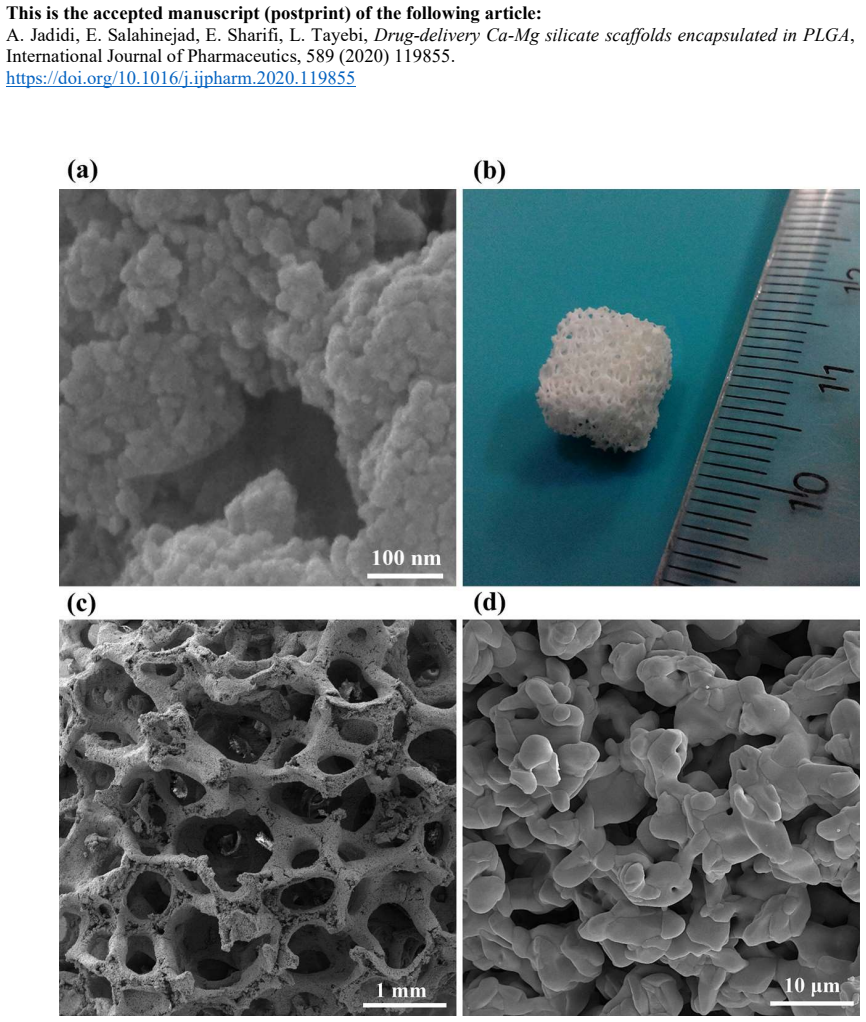
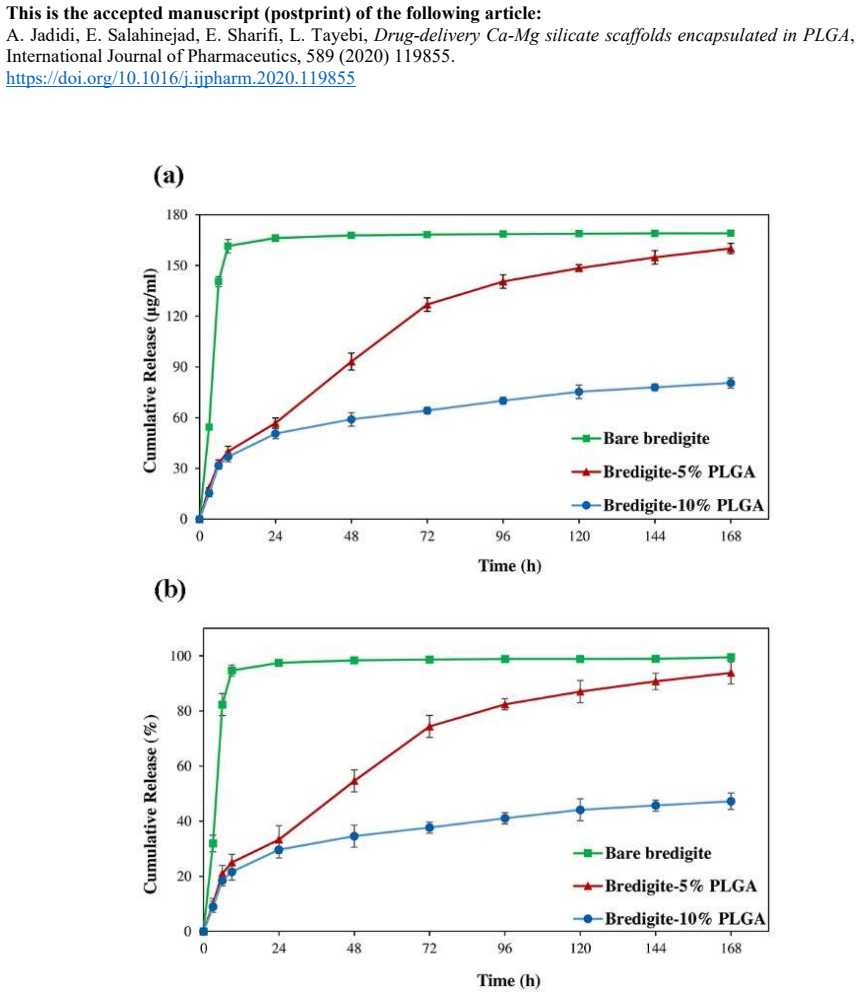
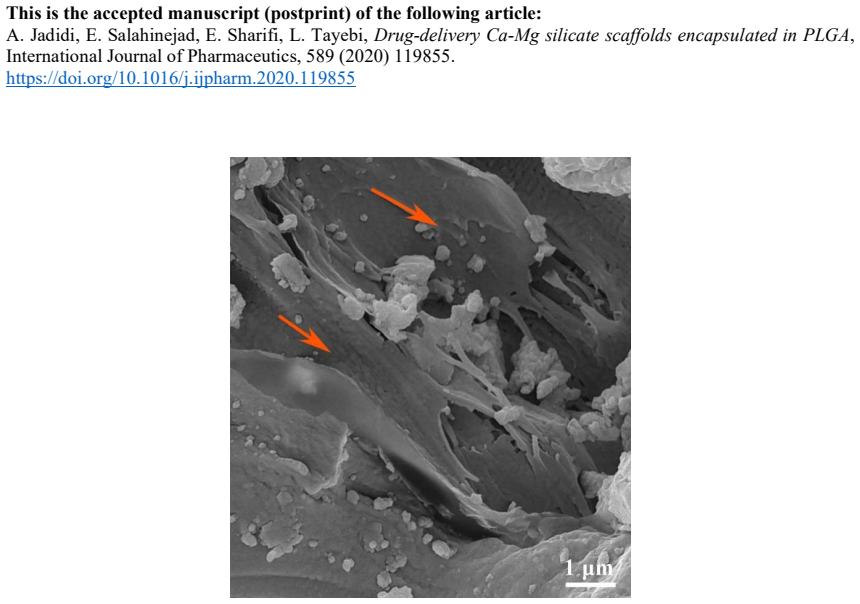
Bioresorbable bredigite porous scaffolds were fabricated by a foam replica method, loaded with vancomycin hydrochloride and encapsulated in PLGA coatings. The bare sample exhibited a burst release of vancomycin and low biocompatibility with dental pulp stem cells due to fast bioresorption. While keeping the desirable characteristics of pores for tissue engineering, the biodegradable PLGA coatings modified the drug release kinetics, buffered physiological pH and hence improved the cell viability of the vancomycin-loaded scaffolds considerably.
What carries the argument
The biodegradable PLGA coating on vancomycin-loaded bredigite scaffolds, which slows drug release from burst to controlled, buffers pH, and enhances cytocompatibility without blocking pores.
If this is right
- The coated scaffolds provide sustained antibiotic release suitable for preventing infection at bone defect sites.
- Dental pulp stem cell viability rises because pH is stabilized and initial drug burst is reduced.
- The open porous network stays available for cell infiltration and new tissue growth.
- A single scaffold structure now serves both mechanical support and local drug delivery functions.
Where Pith is reading between the lines
- This coating method could lower reliance on systemic antibiotics during orthopedic procedures.
- Similar polymer encapsulation might be tested on other calcium-magnesium silicate compositions or different antibiotics.
- Coating thickness could be varied to match release profiles to specific healing timelines.
- Long-term animal studies would be required to check whether the dual function actually accelerates bone repair.
Load-bearing premise
That the observed in vitro improvements in drug release and cell viability from the PLGA coating will carry over to effective in vivo bone regeneration and infection control.
What would settle it
An in vivo test in which coated scaffolds show no reduction in infection rates or bone formation compared with uncoated ones, or in which the coating causes scaffold collapse or blocked pores.
Figures




read the original abstract
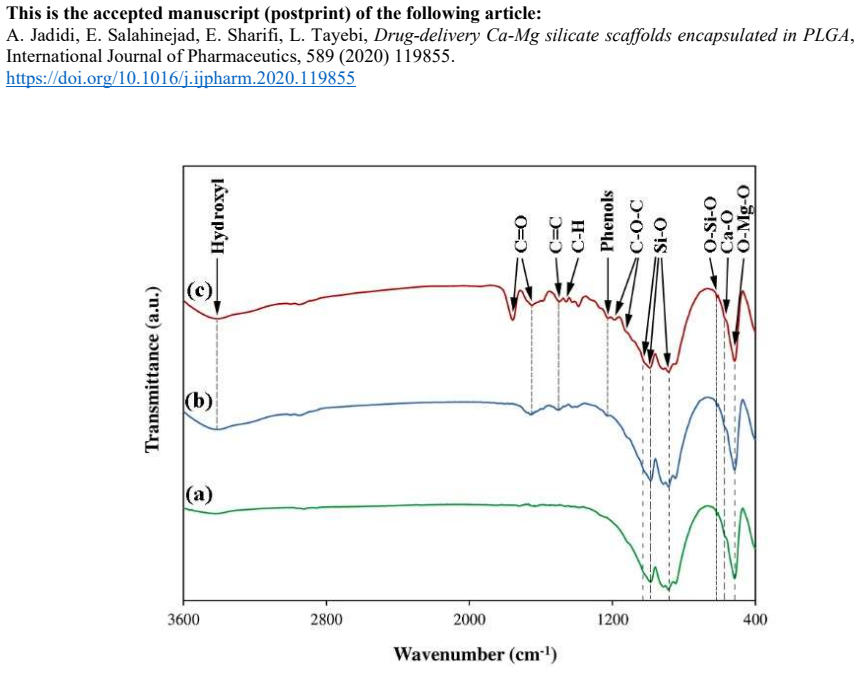
The aim of this work is to develop dual-functional scaffolds for bone tissue regeneration and local antibiotic delivery applications. In this respect, bioresorbable bredigite (Ca7MgSi4O16) porous scaffolds were fabricated by a foam replica method, loaded with vancomycin hydrochloride and encapsulated in poly lactic-co-glycolic acid (PLGA) coatings. Field emission scanning electron microscopy, Archimedes porosimetry and Fourier-transform infrared spectroscopy were used to characterize the structure of the scaffolds. The drug delivery kinetics and cytocompatibility of the prepared scaffolds were also studied in vitro. The bare sample exhibited a burst release of vancomycin and low biocompatibility with respect to dental pulp stem cells based on the MTT assay due to the fast bioresorption of bredigite. While keeping the desirable characteristics of pores for tissue engineering, the biodegradable PLGA coatings modified the drug release kinetics, buffered physiological pH and hence improved the cell viability of the vancomycin-loaded scaffolds considerably.
Editorial analysis
A structured set of objections, weighed in public.
Referee Report
Summary. The manuscript reports fabrication of porous bredigite (Ca7MgSi4O16) scaffolds by foam replica method, loaded with vancomycin hydrochloride, and encapsulated in PLGA coatings for dual bone tissue regeneration and local antibiotic delivery. Characterization used FESEM, Archimedes porosimetry, and FTIR. In vitro drug release kinetics and cytocompatibility (MTT assay with dental pulp stem cells) showed bare scaffolds with burst release and low viability due to fast bioresorption, while PLGA coatings modified release, buffered pH, and considerably improved viability while preserving porosity.
Significance. If the in vitro results hold with proper quantification, the work offers a straightforward polymer-coating strategy to mitigate fast resorption issues in Ca-Mg silicate scaffolds, enabling controlled antibiotic release and better cell compatibility for infected bone defect applications. The experimental approach is direct and avoids circularity or unstated models. However, the magnitude of improvement remains unquantified in the provided text, limiting evaluation of practical significance, and in vivo translation is unaddressed.
major comments (2)
- [Abstract] Abstract: The central claim that PLGA coatings 'modified the drug release kinetics, buffered physiological pH and hence improved the cell viability of the vancomycin-loaded scaffolds considerably' supplies no quantitative data, error bars, statistical tests, specific release percentages, pH values, or MTT viability numbers. This absence undermines assessment of the effect size and load-bearing support for the improvement claim.
- [Results] Results (drug release and cytocompatibility sections): Detailed profiles (cumulative release vs. time, pH buffering curves, MTT absorbance or viability percentages with replicates and controls) are required to substantiate the modifications and improvements; without them the causal link from coating to reduced burst and higher viability cannot be evaluated.
minor comments (2)
- [Methods] Methods: Expand on exact parameters for foam replica fabrication, vancomycin loading concentration, PLGA coating thickness or concentration, and incubation conditions for release and MTT assays to support reproducibility.
- [Discussion] Discussion: Clarify the mechanistic link between pH buffering by PLGA degradation products and the observed cell viability increase, with reference to relevant literature on bredigite resorption effects.
Simulated Author's Rebuttal
We thank the referee for the constructive comments on our manuscript. We agree that the abstract and results sections would benefit from more explicit quantitative data to support the claims regarding drug release modification, pH buffering, and improved cytocompatibility. We have revised the manuscript accordingly to address these points directly.
read point-by-point responses
-
Referee: [Abstract] Abstract: The central claim that PLGA coatings 'modified the drug release kinetics, buffered physiological pH and hence improved the cell viability of the vancomycin-loaded scaffolds considerably' supplies no quantitative data, error bars, statistical tests, specific release percentages, pH values, or MTT viability numbers. This absence undermines assessment of the effect size and load-bearing support for the improvement claim.
Authors: We agree that the abstract would be strengthened by including quantitative metrics. In the revised manuscript, we have updated the abstract to report specific values from our experiments, such as the percentage reduction in initial burst release, stabilized pH ranges, and MTT viability percentages (with error bars and statistical tests) for the PLGA-coated versus bare scaffolds. revision: yes
-
Referee: [Results] Results (drug release and cytocompatibility sections): Detailed profiles (cumulative release vs. time, pH buffering curves, MTT absorbance or viability percentages with replicates and controls) are required to substantiate the modifications and improvements; without them the causal link from coating to reduced burst and higher viability cannot be evaluated.
Authors: The figures in the original manuscript already display the cumulative release profiles, pH curves, and MTT results. To improve clarity and allow direct evaluation of the causal effects, we have expanded the textual descriptions in the results section to include specific numerical data points, time-dependent values, replicate details, control comparisons, error bars, and statistical analyses supporting the reduced burst release and viability improvements. revision: yes
Circularity Check
No significant circularity: purely experimental study
full rationale
This paper reports an experimental materials study on fabricating bredigite scaffolds, loading them with vancomycin, applying PLGA coatings, and measuring outcomes via direct characterization (FESEM, Archimedes porosimetry, FTIR) and in vitro assays (drug release kinetics, pH buffering, MTT cell viability). No mathematical derivations, models, equations, fitted parameters, or first-principles predictions exist. All claims rest on empirical data without any load-bearing steps that reduce to self-definitions, self-citations, or renamings. The central observation—that PLGA coating alters release and improves viability—is a straightforward experimental result, not a constructed equivalence.
Axiom & Free-Parameter Ledger
Reference graph
Works this paper leans on
-
[3]
Annual Review of Materials Science 28, 271-298
The material bone: structure-mechanical function relations. Annual Review of Materials Science 28, 271-298. This is the accepted manuscript (postprint) of the following article: A. Jadidi, E. Salahinejad, E. Sharifi, L. Tayebi, Drug-delivery Ca-Mg silicate scaffolds encapsulated in PLGA, International Journal of Pharmaceutics, 589 (2020) 119855. https://d...
discussion (0)
Sign in with ORCID, Apple, or X to comment. Anyone can read and Pith papers without signing in.