Recognition: unknown
MLE-Toolbox: An Open-Source Toolbox for Comprehensive EEG and MEG Data Analysis
Pith reviewed 2026-05-10 17:11 UTC · model grok-4.3
The pith
MLE-Toolbox supplies a single MATLAB graphical interface that runs the complete MEG and EEG analysis pipeline from raw data import to machine learning classification.
A machine-rendered reading of the paper's core claim, the machinery that carries it, and where it could break.
Core claim
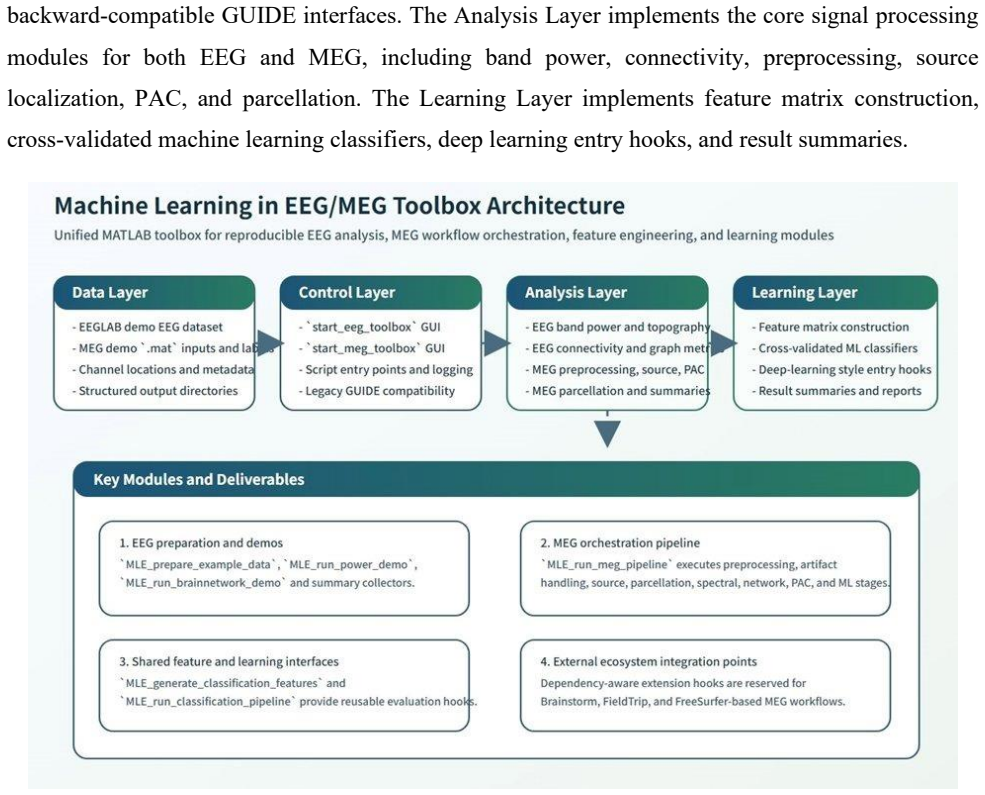
MLE-Toolbox is a comprehensive open-source MATLAB toolbox for end-to-end analysis of magnetoencephalography (MEG) and electroencephalography (EEG) data that integrates the full analysis pipeline within a unified and user-friendly graphical interface, covering raw data import, preprocessing, source localization, functional connectivity, oscillatory analysis, and machine learning-based classification, with native interoperability to Brainstorm, FieldTrip, EEGLAB, and FreeSurfer.
What carries the argument
The unified graphical user interface that chains automated artifact rejection, multiple source localization methods, phase-amplitude coupling, graph-theoretic network analysis, and integrated classifiers into a single workflow with one-click reporting.
If this is right
- Researchers can complete preprocessing through classification without exporting data between programs.
- Automated options for ICA, SSP, SSS, MNE, dSPM, sLORETA, and beamforming become available inside one interface.
- Graph-theoretic network measures and phase-amplitude coupling can be computed directly on parcellated data.
- One-click academic reports and native links to Brainstorm or FieldTrip reduce manual documentation steps.
- Machine learning classifiers can be trained and applied on the same processed data within the same session.
Where Pith is reading between the lines
- Wider adoption could reduce variability in analysis choices across different labs by encouraging use of the same chained defaults.
- The design may allow faster prototyping of new classification features because the preceding steps are already standardized inside the GUI.
- Future extensions could test whether the same interface supports real-time streaming data or simultaneous multi-subject analysis without performance loss.
- Clinical groups might use the report generator to produce standardized outputs for regulatory or multi-center studies.
Load-bearing premise
The described features are fully implemented in working code, correctly reproduce the cited methods, and deliver reliable automation and interoperability without major bugs or performance limits.
What would settle it
Loading a public MEG or EEG dataset into the toolbox, executing the full pipeline through source localization and classification, and checking whether every intermediate output matches the results obtained by running the same steps separately in the referenced toolboxes.
Figures


read the original abstract
MLE-Toolbox is a comprehensive open-source MATLAB toolbox for end-to-end analysis of magnetoencephalography (MEG) and electroencephalography (EEG) data. Inspired by widely used neuroimaging platforms such as Brainstorm and FieldTrip, it integrates the full analysis pipeline within a unified and user-friendly graphical interface (GUI), covering raw data import, preprocessing, source localization, functional connectivity, oscillatory analysis, and machine learning-based classification. The toolbox includes automated artifact rejection methods, including independent component analysis (ICA), signal-space projection (SSP), and signal-space separation (SSS); multiple source localization approaches, including minimum norm estimation (MNE), dynamic statistical parametric mapping (dSPM), standardized low-resolution brain electromagnetic tomography (sLORETA), and beamforming; multi-atlas parcellation with anatomical visualization; spectral power analysis with frequency-band brain mapping; phase-amplitude coupling (PAC); graph-theoretic brain network analysis; and integrated machine learning and deep learning classifiers. MLE-Toolbox also provides native interoperability with Brainstorm, FieldTrip, EEGLAB, and FreeSurfer, allowing researchers to build on established workflows while benefiting from additional automation, interactive visualization, and one-click academic report generation. Freely available for non-commercial use, MLE-Toolbox is designed to lower the barrier to rigorous, reproducible MEG/EEG research.
Editorial analysis
A structured set of objections, weighed in public.
Referee Report
Summary. The manuscript describes MLE-Toolbox, an open-source MATLAB toolbox for end-to-end MEG/EEG analysis. It claims to integrate the full pipeline in a unified GUI, including raw data import, preprocessing with automated artifact rejection (ICA, SSP, SSS), source localization (MNE, dSPM, sLORETA, beamforming), multi-atlas parcellation, spectral power analysis, phase-amplitude coupling, graph-theoretic network analysis, and ML/DL classification, while providing native interoperability with Brainstorm, FieldTrip, EEGLAB, and FreeSurfer plus one-click report generation.
Significance. If the claimed implementations are correct, complete, and interoperable as described, the toolbox could meaningfully lower barriers to reproducible MEG/EEG research by offering an automated, GUI-driven alternative that builds on established platforms. However, the complete absence of validation data, benchmarks, error metrics, or reproduction tests on public datasets prevents any assessment of whether the central claim of a working, comprehensive pipeline holds.
major comments (2)
- The manuscript supplies no validation data, benchmark comparisons, output figures against reference toolboxes, or reproduction tests on public datasets to confirm that the listed methods (ICA/SSP/SSS, MNE/dSPM/sLORETA/beamforming, PAC, graph networks, ML classifiers) are correctly implemented or interoperable. This directly undermines the central claim of a functional, automated full-pipeline toolbox.
- No quantitative performance metrics, accuracy assessments, or edge-case handling details are provided for any module, leaving open the possibility of hidden bugs, incomplete implementations, or non-standard behavior relative to the cited methods in Brainstorm/FieldTrip/EEGLAB.
Simulated Author's Rebuttal
We thank the referee for the detailed and constructive feedback. We agree that the absence of validation data and quantitative benchmarks in the original manuscript limits the ability to fully assess the toolbox's implementations and interoperability claims. We will strengthen the paper accordingly.
read point-by-point responses
-
Referee: The manuscript supplies no validation data, benchmark comparisons, output figures against reference toolboxes, or reproduction tests on public datasets to confirm that the listed methods (ICA/SSP/SSS, MNE/dSPM/sLORETA/beamforming, PAC, graph networks, ML classifiers) are correctly implemented or interoperable. This directly undermines the central claim of a functional, automated full-pipeline toolbox.
Authors: We acknowledge that the submitted manuscript does not contain explicit validation data, benchmark comparisons, or reproduction tests on public datasets. The toolbox is intended to provide automated wrappers and a unified GUI around established methods from Brainstorm, FieldTrip, EEGLAB, and FreeSurfer rather than re-implementing core algorithms from scratch. To address the concern, the revised manuscript will include a new Validation and Benchmarks section featuring reproduction tests on publicly available datasets (such as those from OpenNeuro), side-by-side output comparisons for source localization and PAC, and interoperability verification with the reference toolboxes. revision: yes
-
Referee: No quantitative performance metrics, accuracy assessments, or edge-case handling details are provided for any module, leaving open the possibility of hidden bugs, incomplete implementations, or non-standard behavior relative to the cited methods in Brainstorm/FieldTrip/EEGLAB.
Authors: We agree that quantitative performance metrics and edge-case details are missing from the current version. The revised manuscript will add specific metrics, including cross-validated accuracy for the integrated ML/DL classifiers on sample EEG/MEG data, timing and error metrics for preprocessing and source localization modules, and explicit descriptions of edge-case handling (e.g., artifact rejection on high-noise recordings or incomplete channel sets) with direct comparisons to the behavior of the underlying libraries. revision: yes
Circularity Check
No circularity: purely descriptive software paper with no derivations
full rationale
The manuscript is a feature-list description of MLE-Toolbox capabilities (GUI pipeline, ICA/SSP/SSS, MNE/dSPM/sLORETA/beamforming, PAC, graph networks, ML classifiers, interoperability with Brainstorm/FieldTrip/EEGLAB/FreeSurfer). No equations, no fitted parameters, no predictions, and no derivation chain exist. Claims rest on stated implementation rather than any self-referential reduction. Self-citations are absent from the provided text; any external references are to established platforms and do not bear the central claim. This matches the default non-circular case for descriptive toolbox papers.
Axiom & Free-Parameter Ledger
Reference graph
Works this paper leans on
-
[1]
J., Woolrich, M., Luckhoo, H., Price, D., Hale, J
Brookes, M. J., Woolrich, M., Luckhoo, H., Price, D., Hale, J. R., Stephenson, M. C., ... & Morris, P. G. (2011). Investigating the electrophysiological basis of resting state networks using magnetoencephalography. Proceedings of the National Academy of Sciences, 108(40), 16783–16788. Canolty, R. T., Edwards, E., Dalal, S. S., Soltani, M., Nagarajan, S. S...
2011
-
[2]
S., Segonne, F., Fischl, B., Quinn, B
Desikan, R. S., Segonne, F., Fischl, B., Quinn, B. T., Dickerson, B. C., Blacker, D., ... & Killiany, R. J. (2006). An automated labeling system for subdividing the human cerebral cortex on MRI scans into gyral based regions of interest. NeuroImage, 31(3), 968–980. Destrieux, C., Fischl, B., Dale, A., & Halgren, E. (2010). Automatic parcellation of human ...
2006
-
[3]
A., Strohmeier, D., Brodbeck, C.,
Gramfort, A., Luessi, M., Larson, E., Engemann, D. A., Strohmeier, D., Brodbeck, C., ... & Hamalainen, M. (2013). MEG and EEG data analysis with MNE -Python. Frontiers in Neuroscience, MLE-Toolbox | 18 7,
2013
-
[4]
Gross, J., Kujala, J., Hamalainen, M., Timmermann, L., Schnitzler, A., & Salmelin, R. (2001). Dynamic imaging of coherent sources: Studying neural interactions in the human brain. Proceedings of the National Academy of Sciences, 98(2), 694–699. Hamalainen, M. S., & Ilmoniemi, R. J. (1994). Interpreting magnetic fields of the brain: minimum norm estimates....
-
[5]
Rubinov, M., & Sporns, O
NeuroImage, 206, 116189. Rubinov, M., & Sporns, O. (2010). Complex network measures of brain connectivity: uses and interpretations. NeuroImage, 52(3), 1059–1069. Schaefer, A., Kong, R., Gordon, E. M., Laumann, T. O., Zuo, X. N., Holmes, A. J., ... & Yeo, B. T. (2018). Local-global parcellation of the human cerebral cortex from intrinsic functional connec...
2010
discussion (0)
Sign in with ORCID, Apple, or X to comment. Anyone can read and Pith papers without signing in.