Recognition: unknown
Timescale Limits of Linear-Threshold Networks
Pith reviewed 2026-05-10 07:10 UTC · model grok-4.3
The pith
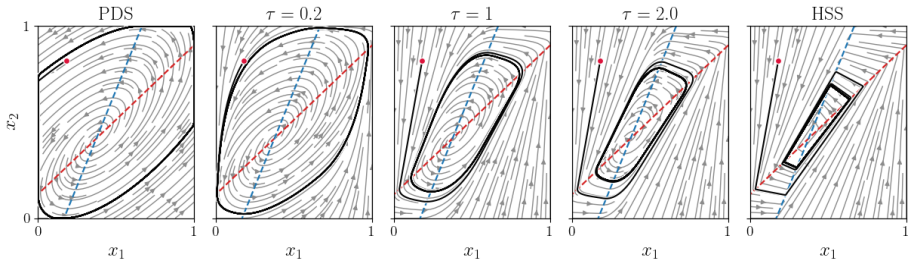
Under the LDS condition, the fast projected dynamical system limit of linear-threshold networks is globally exponentially stable and the slow hard-selector limit is globally asymptotically stable.
A machine-rendered reading of the paper's core claim, the machinery that carries it, and where it could break.
Core claim
Under the LDS condition the one-parameter family of linear-threshold networks converges to a projected dynamical system in the fast limit that is globally exponentially stable and to a hard-selector system in the slow limit that is globally asymptotically stable. Because the family preserves LDS and keeps the same equilibrium set at every parameter value, the stability of these two limiting systems indicates that the essential stability mechanisms of the original networks are already visible at the timescale extremes.
What carries the argument
The one-parameter family of linear-threshold networks that preserves the Lyapunov diagonal stability condition for every parameter value, keeps a parameter-independent equilibrium set, and converges to a projected dynamical system in the fast limit and a discontinuous hard-selector system in the slow limit.
If this is right
- The projected dynamical system limit is globally exponentially stable under LDS.
- The hard-selector system limit is globally asymptotically stable under LDS.
- Stability at the fast and slow endpoints indicates that the limits capture the essential mechanisms governing stability across the entire LTN family.
- Resolving stability at the timescale extremes supplies a structurally grounded path toward proving global stability for LTNs with asymmetric recurrence and diagonal dissipation.
Where Pith is reading between the lines
- The same limit-construction technique could be applied to other families of recurrent networks that admit a natural separation of timescales.
- Direct numerical integration of the original LTN equations at intermediate parameter values would test whether stability persists between the two proven limits.
- Control designs that exploit the proven stability of the endpoint systems could be tested for robustness when the network is restored to finite but extreme timescales.
Load-bearing premise
The one-parameter family preserves the LDS condition for all parameter values and the limiting systems capture the essential stability mechanisms of the original LTN family.
What would settle it
An explicit counterexample in which an intermediate value of the parameter produces an unstable trajectory in the linear-threshold network while the fast PDS limit remains exponentially stable and the slow HSS limit remains asymptotically stable under LDS.
Figures


read the original abstract
Linear-threshold networks (LTNs) capture the mesoscale behavior of interacting populations of neurons and are of particular interest to control theorists due to their dynamical richness and relative ease of analysis. The aim of this paper is to advance the study of global asymptotic stability in LTNs with asymmetric neural interactions and heterogeneous dissipation under the structural Lyapunov diagonal stability (LDS) condition. To this end, we introduce a one-parameter family of LTNs that preserves the LDS condition and has a parameter-independent equilibrium set. In the fast limit, this family converges to a projected dynamical system (PDS), while in the slow limit, it converges to a discontinuous hard-selector system (HSS). Under LDS, we prove that the fast PDS limit is globally exponentially stable and that the HSS limit is globally asymptotically stable. This alignment suggests that the limiting systems capture essential mechanisms governing stability across the entire LTN family. Together with numerical evidence, these findings indicate that resolving stability at the fast and slow endpoints provides a promising and structurally grounded path toward establishing global stability for LTNs with biologically plausible recurrence and diagonal dissipation.
Editorial analysis
A structured set of objections, weighed in public.
Referee Report
Summary. The manuscript constructs an explicit one-parameter family of linear-threshold networks (LTNs) that preserves the Lyapunov diagonal stability (LDS) condition for all parameter values while keeping the equilibrium set fixed. It derives the fast-timescale limit as a projected dynamical system (PDS) and the slow-timescale limit as a discontinuous hard-selector system (HSS). Under the LDS condition, it proves global exponential stability of the PDS limit and global asymptotic stability of the HSS limit. The paper argues that these limits capture essential stability mechanisms for the full LTN family, supported by numerical evidence, and positions the endpoint analysis as a promising structural path toward global stability results for LTNs with asymmetric interactions and heterogeneous dissipation.
Significance. If the stated stability theorems for the limiting systems hold, the work provides a concrete structural proxy for analyzing global stability in LTNs, which is of interest in control theory and neural population modeling. The explicit construction of a parameter family that preserves LDS and the fixed equilibrium set, together with self-contained proofs for the PDS and HSS limits, constitutes a clear strength; the alignment with numerics further supports the claim that endpoint stability offers insight into the intermediate regime.
minor comments (3)
- [Abstract and §1] The abstract and introduction refer to 'numerical evidence' supporting the alignment between limits and the family; specifying the range of parameter values tested, the metrics used (e.g., convergence rates or basin sizes), and whether the numerics include cases near the LDS boundary would strengthen the supporting claim.
- [§2] In the definition of the one-parameter family, the precise manner in which the parameter enters the vector field while preserving LDS for every value should be stated explicitly (e.g., via an equation showing the diagonal dissipation term or interaction matrix scaling).
- [§4 and §5] The proofs for the PDS and HSS limits rely on standard Lyapunov and projected-dynamics arguments; a short remark clarifying that these arguments do not invoke any fitted quantities from the original family would eliminate any potential reader concern about circularity.
Simulated Author's Rebuttal
We thank the referee for the positive assessment of our manuscript and the recommendation for minor revision. The provided summary accurately reflects the construction of the parameterized LTN family, the derivation of the PDS and HSS limits, and the stability results under the LDS condition.
Circularity Check
No significant circularity in derivation chain
full rationale
The paper constructs an explicit one-parameter family of LTNs preserving the LDS condition with fixed equilibria, derives the fast PDS and slow HSS limits, and supplies direct, self-contained proofs of global exponential stability for the PDS and global asymptotic stability for the HSS under LDS using standard Lyapunov and projected-dynamics arguments. These proofs do not reduce to quantities fitted inside the paper, self-citations that are load-bearing, or definitions that smuggle in the target result. The family is introduced to enable the limits rather than to force stability conclusions, and the paper only claims the limits are promising proxies rather than proving automatic transfer to intermediate members. No steps match the enumerated circularity patterns.
Axiom & Free-Parameter Ledger
axioms (2)
- domain assumption Lyapunov diagonal stability (LDS) implies global asymptotic stability for the class of systems considered
- standard math Standard existence and uniqueness results for projected dynamical systems and Filippov solutions for discontinuous systems
Reference graph
Works this paper leans on
-
[1]
Absolute stability of global pattern formation and parallel memory storage by competitive neural net- works,
M. A. Cohen and S. Grossberg, “Absolute stability of global pattern formation and parallel memory storage by competitive neural net- works,”IEEE Transactions on Systems, Man, and Cybernetics, vol. SMC-13, no. 5, p. 815–826, Sep. 1983
1983
-
[2]
Neural networks and physical systems with emer- gent collective computational abilities
J. J. Hopfield, “Neural networks and physical systems with emer- gent collective computational abilities.”Proceedings of the National Academy of Sciences, vol. 79, no. 8, p. 2554–2558, Apr. 1982
1982
-
[3]
Neurons with graded response have collective computational properties like those of two-state neurons
——, “Neurons with graded response have collective computational properties like those of two-state neurons.”Proceedings of the National Academy of Sciences, vol. 81, no. 10, p. 3088–3092, May 1984
1984
-
[4]
E. Nozari and J. Cort ´es, “Hierarchical selective recruitment in linear-threshold brain networks—Part I: Single-layer dynamics and selective inhibition,”IEEE Transactions on Automatic Control, vol. 66, no. 3, p. 949–964, Mar. 2021. [Online]. Available: http://dx.doi.org/10.1109/TAC.2020.3004801
-
[5]
Structural characterization of oscillations in brain networks with rate dynamics,
E. Nozari, R. Planas, and J. Cort ´es, “Structural characterization of oscillations in brain networks with rate dynamics,”Automatica, vol. 146, p. 110653, Dec. 2022. [Online]. Available: http: //dx.doi.org/10.1016/j.automatica.2022.110653
-
[6]
Diversity of emergent dynamics in competitive threshold-linear networks,
K. Morrison, A. Degeratu, V . Itskov, and C. Curto, “Diversity of emergent dynamics in competitive threshold-linear networks,”SIAM Journal on Applied Dynamical Systems, vol. 23, no. 1, p. 855–884, Mar. 2024. [Online]. Available: http://dx.doi.org/10.1137/22M1541666
-
[7]
E. Kaszkurewicz and A. Bhaya,Matrix Diagonal Stability in Systems and Computation. Boston, MA: Birkh ¨auser Boston, 2000. [Online]. Available: http://link.springer.com/10.1007/978-1-4612-1346-8
-
[8]
M. Arcak, C. Meissen, and A. Packard,Networks of Dissipative Systems, ser. SpringerBriefs in Electrical and Computer Engineering. Cham: Springer International Publishing, 2016. [Online]. Available: http://link.springer.com/10.1007/978-3-319-29928-0
-
[9]
New conditions for global stability of neural networks with application to linear and quadratic programming prob- lems,
M. Forti and A. Tesi, “New conditions for global stability of neural networks with application to linear and quadratic programming prob- lems,”IEEE Transactions on Circuits and Systems I: Fundamental Theory and Applications, vol. 42, no. 7, p. 354–366, Jul. 1995
1995
-
[10]
Com- petition, stability, and functionality in excitatory-inhibitory neural circuits,
S. Betteti, W. Retnaraj, A. Davydov, J. Cort ´es, and F. Bullo, 2025. [Online]. Available: https://arxiv.org/abs/2512.05252
-
[11]
Dynamical systems and variational inequalities,
P. Dupuis and A. Nagurney, “Dynamical systems and variational inequalities,”Annals of Operations Research, vol. 44, no. 1, p. 7–42, Feb. 1993. [Online]. Available: http://dx.doi.org/10.1007/BF02073589
-
[12]
Nagurney and D
A. Nagurney and D. Zhang,Projected dynamical systems and vari- ational inequalities with applications, 1996th ed., ser. International Series in Operations Research & Management Science. Dordrecht, Netherlands: Springer, Dec. 1995
1995
-
[13]
Discontinuous dynamical systems,
J. Cort ´es, “Discontinuous dynamical systems,”IEEE Control Systems Magazine, vol. 28, no. 3, pp. 36–73, 2008
2008
-
[14]
A. F. Filippov,Differential Equations with Discontinuous Righthand Sides, F. M. Arscott, Ed. Springer Netherlands, 1988. [Online]. Available: http://dx.doi.org/10.1007/978-94-015-7793-9
-
[15]
Lyapunov functions for the problem of lur’e in automatic control,
R. E. Kalman, “Lyapunov functions for the problem of lur’e in automatic control,”Proceedings of the National Academy of Sciences, vol. 49, no. 2, p. 201–205, Feb. 1963. [Online]. Available: http://dx.doi.org/10.1073/pnas.49.2.201
-
[16]
¨Uber abbildung von mannigfaltigkeiten,
L. E. J. Brouwer, “ ¨Uber abbildung von mannigfaltigkeiten,”Mathe- matische annalen, vol. 71, no. 1, pp. 97–115, 1911
1911
-
[17]
Khalil,Nonlinear Systems, ser
H. Khalil,Nonlinear Systems, ser. Pearson Education. Prentice Hall, 2002
2002
-
[18]
On the stability of projected dynamical systems,
D. Zhang and A. Nagurney, “On the stability of projected dynamical systems,”Journal of Optimization Theory and Applications, vol. 85, no. 1, p. 97–124, Apr. 1995. [Online]. Available: http://dx.doi.org/10.1007/BF02192301
discussion (0)
Sign in with ORCID, Apple, or X to comment. Anyone can read and Pith papers without signing in.