Recognition: unknown
HeadRank: Decoding-Free Passage Reranking via Preference-Aligned Attention Heads
Pith reviewed 2026-05-10 06:31 UTC · model grok-4.3
The pith
HeadRank reranks passages by aligning LLM attention heads to preferences in continuous space without decoding.
A machine-rendered reading of the paper's core claim, the machinery that carries it, and where it could break.
Core claim
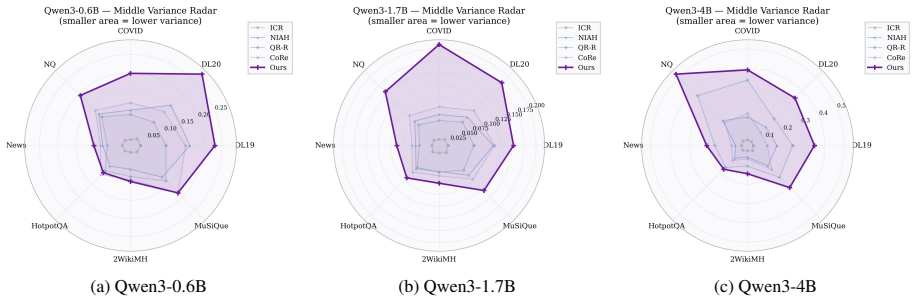
HeadRank lifts preference optimization from discrete token space into the continuous attention domain through entropy-regularized head selection, hard adjacent-level preference pairs, and a distribution regularizer that jointly sharpen discriminability in the homogenized middle zone. Depth truncation at the deepest selected layer further reduces inference to O(1) forward passes. Across 14 benchmarks on three Qwen3 scales using only 211 training queries, it consistently outperforms generative and decoding-free baselines with 100% formatting success.
What carries the argument
Entropy-regularized head selection combined with hard adjacent-level preference pairs and a distribution regularizer that aligns attention heads to preferences for listwise reranking in the attention domain.
If this is right
- HeadRank outperforms generative and decoding-free baselines across 14 benchmarks on three model scales from 0.6B to 4B.
- It achieves 100 percent formatting success on reranking outputs.
- At 4B scale, 57.4 percent of relevant middle-zone documents reach the top quartile compared with 14.2 percent for irrelevant ones.
- Performance holds with only 211 training queries.
- Depth truncation reduces inference cost to a constant number of forward passes.
Where Pith is reading between the lines
- The same head-selection and regularizer pattern could be applied to other long-context tasks that need fine-grained relevance signals, such as multi-document summarization.
- Training with hard adjacent pairs may allow effective alignment from far smaller preference datasets than token-level methods require.
- The O(1) forward-pass property opens the door to real-time reranking pipelines that combine HeadRank with existing retrieval indexes.
Load-bearing premise
That entropy-regularized head selection combined with hard adjacent-level preference pairs and a distribution regularizer can reliably overcome attention homogenization in middle context using only 211 training queries without introducing new biases or overfitting.
What would settle it
Measuring the top-quartile placement rate for relevant versus irrelevant middle-zone documents on a held-out benchmark with longer contexts or unseen model scales; if the gap shrinks to near zero, the claim of sharpened discriminability fails.
Figures





read the original abstract
Decoding-free reranking methods that read relevance signals directly from LLM attention weights offer significant latency advantages over autoregressive approaches, yet suffer from attention score homogenization: middle-context documents receive near-identical scores, destroying the fine-grained distinctions required for ranking. We propose HeadRank, a framework that lifts preference optimization from discrete token space into the continuous attention domain through entropy-regularized head selection, hard adjacent-level preference pairs, and a distribution regularizer that jointly sharpen discriminability in the homogenized middle zone. Depth truncation at the deepest selected layer further reduces inference to $\mathcal{O}(1)$ forward passes. Across 14 benchmarks on three Qwen3 scales (0.6B--4B) using only 211 training queries, HeadRank consistently outperforms generative and decoding-free baselines with 100\% formatting success. At 4B, 57.4\% of relevant middle-zone documents reach the top quartile versus 14.2\% for irrelevant ones -- a 43-percentage-point selectivity gap that demonstrates the effectiveness of attention-space preference alignment for listwise reranking.
Editorial analysis
A structured set of objections, weighed in public.
Referee Report
Summary. The paper introduces HeadRank, a decoding-free reranking framework that transfers preference optimization into the continuous attention domain of LLMs. It employs entropy-regularized head selection, hard adjacent-level preference pairs, and a distribution regularizer to mitigate attention homogenization in middle-context passages, combined with depth truncation for O(1) forward passes. Evaluated on 14 benchmarks across Qwen3 models (0.6B–4B) trained on only 211 queries, it reports consistent gains over generative and decoding-free baselines, 100% formatting success, and a 43-percentage-point selectivity gap (57.4% vs. 14.2%) for relevant vs. irrelevant middle-zone documents at the 4B scale.
Significance. If the results are robust, the work offers a latency-efficient alternative to autoregressive rerankers by directly exploiting attention signals, which could impact large-scale IR systems. The small training budget and perfect formatting success are practical strengths. The reported selectivity gap provides concrete evidence that attention-space alignment can restore discriminability where standard attention fails. These elements, if reproducible, position the method as a useful contribution to decoding-free reranking.
major comments (2)
- [§4.2] §4.2 (Training protocol): The head selection is optimized on only 211 queries using entropy regularization and hard adjacent preferences. No cross-validation, training-size ablation, or analysis of query diversity is described, which is load-bearing for the claim that the 43pp selectivity gap generalizes across 14 benchmarks and three model scales. Without such checks, the optimization may overfit to artifacts in the preference data rather than learning robust relevance signals.
- [Table 1 and §5.1] Table 1 and §5.1 (Results): The 57.4% vs. 14.2% middle-zone selectivity figures and all benchmark comparisons are reported without error bars, standard deviations, or statistical significance tests. This undermines confidence in the central claim that HeadRank “consistently outperforms” baselines, as variance across runs or seeds cannot be assessed.
minor comments (2)
- [§3.1] The abstract and §3.1 refer to “listwise reranking” yet the preference pairs are adjacent-level (pairwise). Clarify the distinction and whether the method is strictly pairwise or approximates listwise ranking.
- [Figure 2] Figure 2 (attention heatmaps) would benefit from explicit scale bars and a side-by-side comparison with the baseline attention distribution to visually substantiate the homogenization claim.
Simulated Author's Rebuttal
We thank the referee for the constructive feedback on our manuscript. We address the two major comments point by point below, providing our strongest honest defense while noting where revisions are warranted to improve clarity and robustness.
read point-by-point responses
-
Referee: [§4.2] §4.2 (Training protocol): The head selection is optimized on only 211 queries using entropy regularization and hard adjacent preferences. No cross-validation, training-size ablation, or analysis of query diversity is described, which is load-bearing for the claim that the 43pp selectivity gap generalizes across 14 benchmarks and three model scales. Without such checks, the optimization may overfit to artifacts in the preference data rather than learning robust relevance signals.
Authors: We appreciate the referee's concern about potential overfitting given the modest training set of 211 queries. The small data regime is intentional and presented as a strength, enabling practical deployment with minimal supervision. Generalization is supported by consistent outperformance across 14 benchmarks that span diverse domains and query types, as well as across three model scales (0.6B–4B). The entropy regularization, hard adjacent-level pairs, and distribution regularizer are explicitly designed to discourage homogenization and promote head selection that captures broad relevance patterns rather than data-specific artifacts. Nevertheless, we agree that explicit checks would strengthen the claims. In the revised manuscript we will add a description of how the 211 queries were selected for diversity, a short discussion of query characteristics, and an explicit statement of the limitation regarding the absence of cross-validation or training-size ablations. revision: partial
-
Referee: [Table 1 and §5.1] Table 1 and §5.1 (Results): The 57.4% vs. 14.2% middle-zone selectivity figures and all benchmark comparisons are reported without error bars, standard deviations, or statistical significance tests. This undermines confidence in the central claim that HeadRank “consistently outperforms” baselines, as variance across runs or seeds cannot be assessed.
Authors: We agree that the absence of error bars and statistical tests reduces the ability to quantify result stability. Because HeadRank is decoding-free, the inference path is deterministic once the selected heads and truncation depth are fixed; however, the preference optimization stage does contain stochastic elements. To address the referee's point directly, we will rerun the training with multiple random seeds, report standard deviations for the key metrics (including the middle-zone selectivity gap) in the revised Table 1 and §5.1, and add pairwise statistical significance tests (e.g., Wilcoxon signed-rank) against the strongest baselines. These additions will be included in the next version of the manuscript. revision: yes
Circularity Check
No significant circularity detected in derivation chain
full rationale
The paper describes training an entropy-regularized head selection process with hard adjacent-level preference pairs and a distribution regularizer on 211 queries, then evaluates the resulting attention-based reranking on 14 held-out benchmarks across three model scales. Reported metrics such as the 43-percentage-point selectivity gap are measured on separate test data rather than being fitted or renamed versions of the training objective. No equations reduce the central claims to self-definitional inputs, no uniqueness theorems are imported via self-citation, and no ansatzes are smuggled through prior work. The derivation remains self-contained against external benchmarks and externally defined preference pairs.
Axiom & Free-Parameter Ledger
Reference graph
Works this paper leans on
-
[1]
Aho and Jeffrey D
Alfred V. Aho and Jeffrey D. Ullman , title =. 1972
1972
-
[2]
Publications Manual , year = "1983", publisher =
1983
-
[3]
Ashok K. Chandra and Dexter C. Kozen and Larry J. Stockmeyer , year = "1981", title =. doi:10.1145/322234.322243
-
[4]
Scalable training of
Andrew, Galen and Gao, Jianfeng , booktitle=. Scalable training of
-
[5]
Dan Gusfield , title =. 1997
1997
-
[6]
Tetreault , title =
Mohammad Sadegh Rasooli and Joel R. Tetreault , title =. Computing Research Repository , volume =. 2015 , url =
2015
-
[7]
A Framework for Learning Predictive Structures from Multiple Tasks and Unlabeled Data , Volume =
Ando, Rie Kubota and Zhang, Tong , Issn =. A Framework for Learning Predictive Structures from Multiple Tasks and Unlabeled Data , Volume =. Journal of Machine Learning Research , Month = dec, Numpages =
-
[8]
Is C hat GPT good at search? investigating large language models as re-ranking agents
Sun, Weiwei and Yan, Lingyong and Ma, Xinyu and Wang, Shuaiqiang and Ren, Pengjie and Chen, Zhumin and Yin, Dawei and Ren, Zhaochun. Is C hat GPT Good at Search? Investigating Large Language Models as Re-Ranking Agents. Proceedings of the 2023 Conference on Empirical Methods in Natural Language Processing. 2023. doi:10.18653/v1/2023.emnlp-main.923
-
[9]
The Thirteenth International Conference on Learning Representations , year=
Attention in Large Language Models Yields Efficient Zero-Shot Re-Rankers , author=. The Thirteenth International Conference on Learning Representations , year=
-
[10]
Advances in Neural Information Processing Systems , volume=
HippoRAG: Neurobiologically Inspired Long-Term Memory for Large Language Models , author=. Advances in Neural Information Processing Systems , volume=
-
[11]
arXiv preprint arXiv:2510.02219 , year=
Contrastive Retrieval Heads Improve Attention-Based Re-Ranking , author=. arXiv preprint arXiv:2510.02219 , year=
-
[12]
Transactions of the Association for Computational Linguistics , volume=
Lost in the middle: How language models use long contexts , author=. Transactions of the Association for Computational Linguistics , volume=. 2024 , publisher=
2024
-
[13]
Advances in Neural Information Processing Systems , volume=
Direct Preference Optimization: Your Language Model is Secretly a Reward Model , author=. Advances in Neural Information Processing Systems , volume=
-
[14]
Foundations and Trends
The probabilistic relevance framework: BM25 and beyond , author=. Foundations and Trends. 2009 , publisher=
2009
-
[15]
doi: 10.18653/v1/2022.naacl-main.272
Santhanam, Keshav and Khattab, Omar and Saad-Falcon, Jon and Potts, Christopher and Zaharia, Matei. C ol BERT v2: Effective and Efficient Retrieval via Lightweight Late Interaction. Proceedings of the 2022 Conference of the North American Chapter of the Association for Computational Linguistics: Human Language Technologies. 2022. doi:10.18653/v1/2022.naac...
-
[16]
The Thirteenth International Conference on Learning Representations , year=
Retrieval Head Mechanistically Explains Long-Context Factuality , author=. The Thirteenth International Conference on Learning Representations , year=
-
[17]
Jinghao Zhang, Yuting Liu, Wenjie Wang, Qiang Liu, Shu Wu, Liang Wang, and Tat-Seng Chua
Query-Focused Retrieval Heads Improve Long-Context Reasoning and Re-ranking , author=. arXiv preprint arXiv:2506.09944 , year=
-
[18]
Advances in neural information processing systems , volume=
Are sixteen heads really better than one? , author=. Advances in neural information processing systems , volume=
-
[19]
Proceedings of the 57th Annual Meeting of the Association for Computational Linguistics , pages=
Analyzing Multi-Head Self-Attention: Specialized Heads Do the Heavy Lifting, the Rest Can Be Pruned , author=. Proceedings of the 57th Annual Meeting of the Association for Computational Linguistics , pages=
-
[20]
In-context Learning and Induction Heads
In-context learning and induction heads , author=. arXiv preprint arXiv:2209.11895 , year=
work page internal anchor Pith review arXiv
-
[21]
Thirty-fifth Conference on Neural Information Processing Systems Datasets and Benchmarks Track , year=
BEIR: A Heterogeneous Benchmark for Zero-shot Evaluation of Information Retrieval Models , author=. Thirty-fifth Conference on Neural Information Processing Systems Datasets and Benchmarks Track , year=
-
[22]
Representation Learning with Contrastive Predictive Coding
Representation learning with contrastive predictive coding , author=. arXiv preprint arXiv:1807.03748 , year=
work page internal anchor Pith review Pith/arXiv arXiv
-
[23]
What does bert look at? an analysis of bert’s attention
What does bert look at? an analysis of bert's attention , author=. arXiv preprint arXiv:1906.04341 , year=
-
[24]
Findings of the Association for Computational Linguistics ACL 2024 , pages=
Cutting Off the Head Ends the Conflict: A Mechanism for Interpreting and Mitigating Knowledge Conflicts in Language Models , author=. Findings of the Association for Computational Linguistics ACL 2024 , pages=
2024
-
[25]
Findings of the Association for Computational Linguistics ACL 2024 , pages=
Identifying Semantic Induction Heads to Understand In-Context Learning , author=. Findings of the Association for Computational Linguistics ACL 2024 , pages=
2024
-
[26]
Findings of the Association for Computational Linguistics: NAACL 2024 , pages=
Large Language Models are Effective Text Rankers with Pairwise Ranking Prompting , author=. Findings of the Association for Computational Linguistics: NAACL 2024 , pages=
2024
-
[27]
International conference on machine learning , pages=
Calibrate before use: Improving few-shot performance of language models , author=. International conference on machine learning , pages=. 2021 , organization=
2021
-
[28]
HotpotQA: A Dataset for Diverse, Explainable Multi-hop Question Answering
HotpotQA: A dataset for diverse, explainable multi-hop question answering , author=. arXiv preprint arXiv:1809.09600 , year=
work page internal anchor Pith review arXiv
-
[29]
Transactions of the Association for Computational Linguistics , volume=
MuSiQue: Multihop Questions via Single-hop Question Composition , author=. Transactions of the Association for Computational Linguistics , volume=
-
[30]
FEVER: a large-scale dataset for Fact Extraction and VERification
FEVER: a large-scale dataset for fact extraction and VERification , author=. arXiv preprint arXiv:1803.05355 , year=
work page internal anchor Pith review arXiv
-
[31]
Transactions of the Association for Computational Linguistics , volume=
Natural questions: a benchmark for question answering research , author=. Transactions of the Association for Computational Linguistics , volume=. 2019 , publisher=
2019
-
[32]
Constructing a multi-hop qa dataset for comprehensive evaluation of reasoning steps,
Constructing a multi-hop qa dataset for comprehensive evaluation of reasoning steps , author=. arXiv preprint arXiv:2011.01060 , year=
-
[33]
Advances in neural information processing systems , volume=
Attention is all you need , author=. Advances in neural information processing systems , volume=
-
[34]
CoRRabs/2003.07820(2020), https://arxiv.org/ abs/2003.07820
Overview of the TREC 2019 deep learning track , author=. arXiv preprint arXiv:2003.07820 , year=
-
[35]
Zhang, Le and Wang, Bo and Qiu, Xipeng and Reddy, Siva and Agrawal, Aishwarya , journal=
-
[36]
Zhuang, Honglei and others , journal=. Rank-
-
[37]
arXiv preprint arXiv:2310.07712 , year=
Found in the Middle: Permutation Self-Consistency Improves Listwise Ranking in Large Language Models , author=. arXiv preprint arXiv:2310.07712 , year=
-
[38]
Forty-Second International Conference on Machine Learning , year=
Which Attention Heads Matter for In-Context Learning? , author=. Forty-Second International Conference on Machine Learning , year=
-
[39]
Pradeep, Ronak and Sharifymoghaddam, Sahel and Lin, Jimmy , journal=. Rank
-
[40]
Reddy, Revanth Gangi and Doo, JaeYoung and Xu, Yifei and Sultan, Md Arafat and Bui, Devansh and Ji, Heng , journal=
-
[41]
Proceedings of the 47th International ACM SIGIR Conference , year=
A Setwise Approach for Effective and Highly Efficient Zero-shot Ranking with Large Language Models , author=. Proceedings of the 47th International ACM SIGIR Conference , year=
-
[42]
Document ranking with a pretrained sequence-to-sequence model,
Document Ranking with a Pretrained Sequence-to-Sequence Model , author=. arXiv preprint arXiv:2003.06713 , year=
-
[43]
Proceedings of the 57th Annual Meeting of the Association for Computational Linguistics , pages=
Is Attention Interpretable? , author=. Proceedings of the 57th Annual Meeting of the Association for Computational Linguistics , pages=
-
[44]
Proceedings of the 2019 Conference on EMNLP-IJCNLP , pages=
Attention is not not explanation , author=. Proceedings of the 2019 Conference on EMNLP-IJCNLP , pages=
2019
-
[45]
Beyond Yes and No: Improving Zero-Shot
Zhuang, Honglei and Qin, Zhen and Hui, Kai and Wu, Junru and Yan, Le and Wang, Xuanhui and Bendersky, Michael , journal=. Beyond Yes and No: Improving Zero-Shot
-
[46]
Efficient Streaming Language Models with Attention Sinks
Efficient Streaming Language Models with Attention Sinks , author=. arXiv preprint arXiv:2309.17453 , year=
work page internal anchor Pith review arXiv
-
[47]
arXiv preprint arXiv:2310.01427 , year=
Attention Sorting Combats Recency Bias in Long Context Language Models , author=. arXiv preprint arXiv:2310.01427 , year=
-
[48]
Large Language Models for Information Retrieval: A Survey , author=. arXiv preprint arXiv:2308.07107 , year=
-
[49]
Fine-tuning
Ma, Xueguang and Liang, Liang and Wang, Nan and Yang, Hao and Lin, Jimmy , booktitle=. Fine-tuning
-
[50]
Voorhees, Ellen and Alam, Tasmeer and Bedrick, Steven and Demner-Fushman, Dina and Hersh, William R and Lo, Kyle and Roberts, Kirk and Soboroff, Ian and Wang, Lucy Lu , journal=
-
[51]
Zero-Shot Listwise Document Reranking with a Large Language Model , author=. arXiv preprint arXiv:2305.02156 , year=
-
[52]
arXiv preprint arXiv:2310.13243 , year=
Open-source Large Language Models are Strong Zero-Shot Query Likelihood Models for Document Ranking , author=. arXiv preprint arXiv:2310.13243 , year=
-
[53]
Qwen3 Technical Report , author=. arXiv preprint arXiv:2505.09388 , year=
work page internal anchor Pith review Pith/arXiv arXiv
-
[54]
arXiv preprint arXiv:2509.07485 , year=
Multi-view-guided Passage Reranking with Large Language Models , author=. arXiv preprint arXiv:2509.07485 , year=
discussion (0)
Sign in with ORCID, Apple, or X to comment. Anyone can read and Pith papers without signing in.