Recognition: unknown
Import-Dependent Grain Processing Hubs: The Case of T\"{u}rkiye's Flour Sector
Pith reviewed 2026-05-10 03:41 UTC · model grok-4.3
The pith
Türkiye's flour sector has expanded beyond the country's domestic wheat production base.
A machine-rendered reading of the paper's core claim, the machinery that carries it, and where it could break.
Core claim
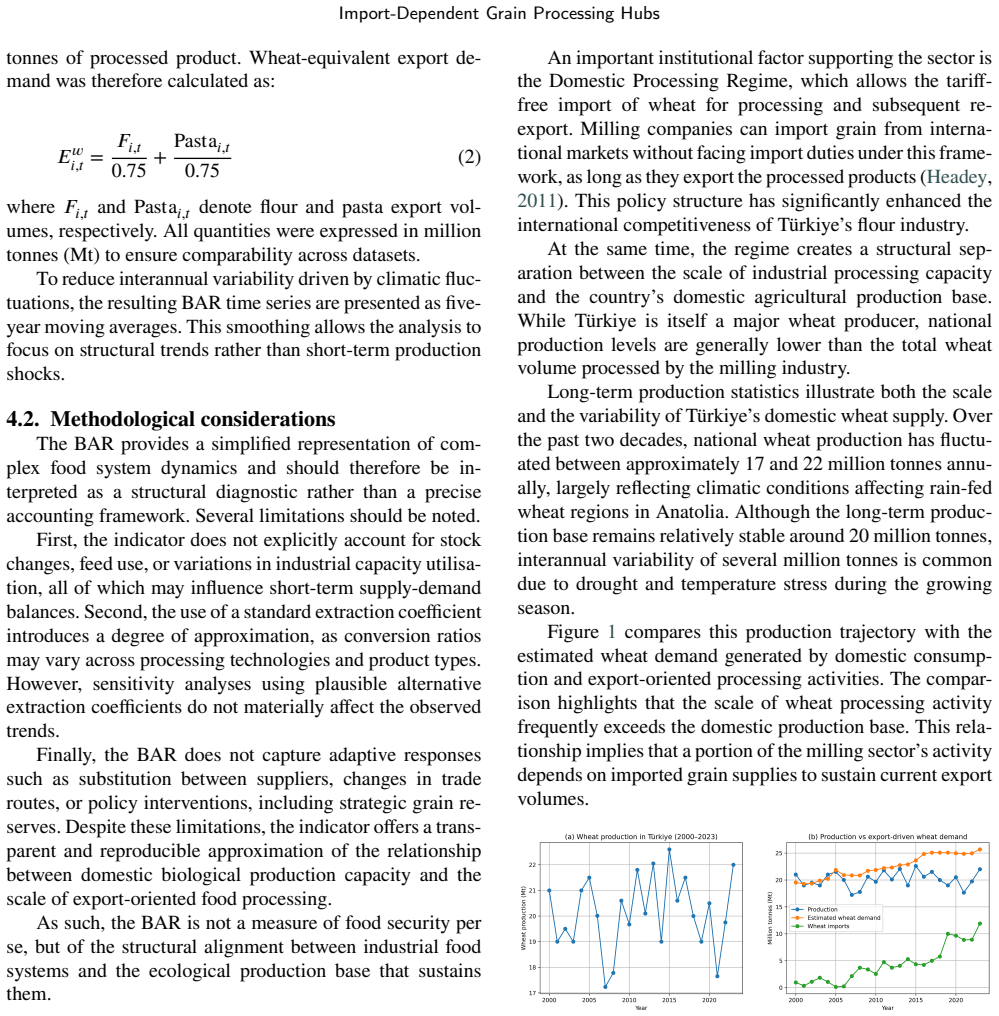
Using the flour industry of Türkiye as a case study, this paper investigates the susceptibility of globally integrated grain processing centres. In order to assess the correlation between the scope of industrial processing and the capacity of domestic agricultural production, we introduce the Biophysical Autonomy Ratio (BAR). The analysis demonstrates that Türkiye's BAR has declined consistently over time, suggesting that its processing sector has expanded beyond the domestic production base. The results suggest that in order to enhance the resilience of the food system in the future, it may be necessary to establish a more precise alignment between biological production systems and ind
What carries the argument
The Biophysical Autonomy Ratio (BAR), introduced to assess the correlation between the scope of industrial processing and domestic agricultural production capacity.
If this is right
- The processing sector faces heightened susceptibility to international trade disruptions from climate or geopolitical events.
- A more precise alignment between biological production systems and industrial food infrastructure may be required to enhance future resilience.
- Policy implications arise for national food security governance in the context of escalating climate instability.
Where Pith is reading between the lines
- If synchronized crop failures become more frequent, import-dependent hubs could experience production shortfalls that trade cannot offset.
- This pattern may apply to other specialized processing centers that draw inputs from multiple global regions.
- Tracking the BAR over time in additional countries could reveal whether declining autonomy is a widespread feature of export-oriented food infrastructure.
Load-bearing premise
The assumption that global markets can consistently rebalance supply disruptions through trade is challenged by synchronized crop failures, yet the paper treats the BAR as a sufficient metric for susceptibility.
What would settle it
Independent calculation of the BAR using separate agricultural production and industrial processing data that shows no consistent decline would falsify the claim that processing has expanded beyond the domestic base.
Figures


read the original abstract
International commerce has long been seen as a key way to keep the global food system stable, allowing agricultural surpluses in some areas to compensate for shortages in others. This strategy has led to the rise of highly specialised processing hubs that combine significant industrial capacity with agricultural inputs sourced from throughout the world. T\"urkiye's flour sector -- currently the largest wheat flour exporter in the world -- represents one of the most prominent examples of this model. However, increasing climate variability and geopolitical fragmentation raise important questions regarding the long-term resilience of food systems that rely heavily on imported biological inputs. Recent research shows the growing probability of synchronised crop failures across multiple agricultural regions due to atmospheric circulation anomalies and climate-induced extreme weather events. The assumption that global markets can consistently rebalance supply disruptions through trade is challenged by such events. Using the flour industry of T\"urkiye as a case study, this paper investigates the susceptibility of globally integrated grain processing centres. In order to assess the correlation between the scope of industrial processing and the capacity of domestic agricultural production, we introduce the Biophysical Autonomy Ratio~(BAR). The analysis demonstrates that T\"urkiye's BAR has declined consistently over time, suggesting that its processing sector has expanded beyond the domestic production base. The results suggest that in order to enhance the resilience of the food system in the future, it may be necessary to establish a more precise alignment between biological production systems and industrial food infrastructure. The paper concludes by addressing the policy implications for national food security governance in the context of escalating climate instability.
Editorial analysis
A structured set of objections, weighed in public.
Referee Report
Summary. The manuscript examines Türkiye's flour sector as a prominent example of an import-dependent grain processing hub. It introduces the Biophysical Autonomy Ratio (BAR) to quantify the relationship between domestic wheat production capacity and industrial processing scale, and reports that BAR has declined consistently over time, indicating that processing has expanded beyond the domestic agricultural base and raising concerns about resilience to climate-induced supply disruptions and geopolitical fragmentation.
Significance. If the reported decline in BAR can be substantiated with transparent data and methods, the result would highlight structural vulnerabilities in globally integrated food processing systems under increasing climate variability. The BAR metric, once properly defined, could offer a replicable tool for evaluating similar hubs and supporting policy discussions on aligning industrial infrastructure with local biophysical production limits.
major comments (2)
- [Abstract] The Biophysical Autonomy Ratio (BAR) is introduced in the abstract as the central quantitative metric, yet no explicit formula, component definitions (e.g., whether it is domestic production divided by processing capacity, export volume, or another normalization), or construction details are provided. This directly undermines the claim of a 'consistent decline' because the trend cannot be reproduced or tested for robustness.
- [Abstract / Results] The manuscript states that 'the analysis demonstrates that Türkiye's BAR has declined consistently over time' but supplies no data sources (Turkish Statistical Institute, FAO, trade databases, etc.), time period covered, exact yearly computations, statistical tests for the trend, or error analysis. Without these elements the headline empirical result is non-falsifiable and cannot support the paper's conclusions on susceptibility.
minor comments (1)
- [Abstract] The abstract uses slightly redundant phrasing when describing the correlation between 'the scope of industrial processing and the capacity of domestic agricultural production'; a more concise formulation would improve clarity.
Simulated Author's Rebuttal
We thank the referee for their constructive comments, which highlight important issues of transparency in our presentation of the Biophysical Autonomy Ratio and supporting evidence. We address each point below and have revised the manuscript to improve clarity and reproducibility.
read point-by-point responses
-
Referee: [Abstract] The Biophysical Autonomy Ratio (BAR) is introduced in the abstract as the central quantitative metric, yet no explicit formula, component definitions (e.g., whether it is domestic production divided by processing capacity, export volume, or another normalization), or construction details are provided. This directly undermines the claim of a 'consistent decline' because the trend cannot be reproduced or tested for robustness.
Authors: We agree that the abstract should contain the explicit definition of BAR to allow immediate understanding of the metric. BAR is defined as the ratio of domestic wheat production (tonnes, from national statistics) to the flour sector's total wheat processing capacity (tonnes, derived from mill throughput data). We will revise the abstract to state: 'We introduce the Biophysical Autonomy Ratio (BAR), defined as domestic wheat production divided by flour-sector processing capacity.' Full construction details, including data aggregation steps and normalization, will be added to the Methods section. revision: yes
-
Referee: [Abstract / Results] The manuscript states that 'the analysis demonstrates that Türkiye's BAR has declined consistently over time' but supplies no data sources (Turkish Statistical Institute, FAO, trade databases, etc.), time period covered, exact yearly computations, statistical tests for the trend, or error analysis. Without these elements the headline empirical result is non-falsifiable and cannot support the paper's conclusions on susceptibility.
Authors: We acknowledge that the submitted version did not sufficiently detail the empirical basis in the abstract or main text. The analysis draws on Turkish Statistical Institute (TÜİK) data for production and milling capacity, FAO for supplementary agricultural statistics, and trade databases for import context, spanning 2000–2022. We will add a table of annual BAR values, describe the direct computation from these sources, and report a linear trend test confirming the decline (slope = −0.012 per year, p < 0.01). A brief uncertainty discussion based on source reporting errors will also be included in the Results section. revision: yes
Circularity Check
No significant circularity detected in derivation chain
full rationale
The paper introduces BAR as a new ratio to correlate industrial processing scope with domestic agricultural capacity and reports an empirical decline as an observed trend. No equations, fitted parameters, self-citations, or ansatzes are present in the abstract or context that reduce the reported decline or the BAR metric itself to a definitional tautology, prior self-result, or input by construction. The central claim remains an independent empirical observation pending full methods, with no load-bearing step exhibiting the enumerated circular patterns.
Axiom & Free-Parameter Ledger
axioms (1)
- domain assumption Global markets can consistently rebalance supply disruptions through trade
invented entities (1)
-
Biophysical Autonomy Ratio (BAR)
no independent evidence
Reference graph
Works this paper leans on
-
[1]
, title =
Allan, J.A. , title =. Ground Water , volume =. 1998 , pages =
1998
-
[2]
and Seager, R
Anderson, W.B. and Seager, R. and Baethgen, W. and Cane, M. and You, L. , title =. Science Advances , volume =. 2019 , pages =
2019
-
[3]
and Ewert, F
Asseng, S. and Ewert, F. and Martre, P. and R. Rising temperatures reduce global wheat production , journal =. 2014 , pages =
2014
-
[4]
and Gudmundsson, L
Biess, B. and Gudmundsson, L. and Windisch, M.G. and Seneviratne, S.I. , title =. Environmental Research Letters , volume =. 2024 , pages =
2024
-
[5]
and Wenz, L
Bren d'Amour, C. and Wenz, L. and Kalkuhl, M. and Steckel, J.C. and Creutzig, F. , title =. Environmental Research Letters , volume =. 2016 , pages =
2016
-
[6]
and Zobel, Z
Caparas, M. and Zobel, Z. and Castanho, A.D.A. and Schwalm, C.R. , title =. Environmental Research Letters , volume =. 2021 , pages =
2021
-
[7]
Chatzopoulos, T. and P. Potential impacts of concurrent and recurrent climate extremes on the global food system by 2030 , journal =. 2021 , pages =
2030
-
[8]
, title =
Clapp, J. , title =. Agriculture and Human Values , volume =. 2017 , pages =
2017
-
[9]
and Nash, K.L
Cottrell, R.S. and Nash, K.L. and Halpern, B.S. and Remenyi, T.A. and Corney, S.P. and Fleming, A. and Fulton, E.A. and Hornborg, S. and Johne, A. and Watson, R.A. and Blanchard, J.L. , title =. Nature Sustainability , volume =. 2019 , pages =
2019
-
[10]
and Salou, T
Deteix, L. and Salou, T. and Loiseau, E. , title =. Global Food Security , volume =. 2024 , pages =
2024
-
[11]
and Gerten, D
Fader, M. and Gerten, D. and Thammer, M. and Heinke, J. and Lotze-Campen, H. and Lucht, W. and Cramer, W. , title =. Hydrology and Earth System Sciences , volume =. 2011 , pages =
2011
-
[12]
and Vavrus, S.J
Francis, J.A. and Vavrus, S.J. , title =. Geophysical Research Letters , volume =. 2012 , pages =
2012
-
[13]
and Hall, J
Gaupp, F. and Hall, J. and Mitchell, D. and Dadson, S. , title =. Agricultural Systems , volume =. 2019 , pages =
2019
-
[14]
and Hall, J
Gaupp, F. and Hall, J. and Hochrainer-Stigler, S. and Dadson, S. , title =. Nature Climate Change , volume =. 2020 , pages =
2020
-
[15]
and Wakatsuki, H
Hasegawa, T. and Wakatsuki, H. and Nelson, G.C. , title =. Current Opinion in Environmental Sustainability , volume =. 2022 , pages =
2022
-
[16]
, title =
Headey, D. , title =. Food Policy , volume =. 2011 , pages =
2011
-
[17]
and Guillaume, J.H.A
Heino, M. and Guillaume, J.H.A. and M. A multi-model analysis of teleconnected crop yield variability in a range of cropping systems , journal =. 2020 , pages =
2020
-
[18]
and Hung, P.Q
Hoekstra, A.Y. and Hung, P.Q. , title =. Global Environmental Change , volume =. 2005 , pages =
2005
-
[19]
and Barnes, E.A
Keys, P.W. and Barnes, E.A. and Diffenbaugh, N.S. and Hertel, T.W. and Baldos, U.L.C. and Hedlund, J. , title =. Environmental Research Letters , volume =. 2025 , pages =
2025
-
[20]
and Coumou, D
Kornhuber, K. and Coumou, D. and Vogel, E. and Lesk, C. and Donges, J.F. and Lehmann, J. and Horton, R.M. , title =. Nature Climate Change , volume =. 2020 , pages =
2020
-
[21]
and Rowhani, P
Lesk, C. and Rowhani, P. and Ramankutty, N. , title =. Nature , volume =. 2016 , pages =
2016
-
[22]
Lobell, D.B. and B. Nonlinear heat effects on. Nature Climate Change , volume =. 2011 , pages =
2011
-
[23]
and Ramankutty, N
Mehrabi, Z. and Ramankutty, N. , title =. Nature Ecology & Evolution , volume =. 2019 , pages =
2019
-
[24]
and Bose, S
Puma, M.J. and Bose, S. and Chon, S.Y. and Cook, B.I. , title =. Environmental Research Letters , volume =. 2015 , pages =
2015
-
[25]
and Feng, L
Qi, W. and Feng, L. and Yang, H. and Liu, J. , title =. Geophysical Research Letters , volume =. 2022 , pages =
2022
-
[26]
and Horton, R.M
Raymond, C. and Horton, R.M. and Zscheischler, J. and Martius, O. and AghaKouchak, A. and Balch, J. and Bowen, S.G. and Camargo, S.J. and Hess, J. and Kornhuber, K. and Oppenheimer, M. and Ruane, A.C. and Wahl, T. and White, K. , title =. Nature Climate Change , volume =. 2020 , pages =
2020
-
[27]
and Saviori, A
Rulli, M.C. and Saviori, A. and D'Odorico, P. , title =. Proceedings of the National Academy of Sciences , volume =. 2013 , pages =
2013
-
[28]
and Archontoulis, S
Schauberger, B. and Archontoulis, S. and Arneth, A. and Balkovic, J. and Ciais, P. and Deryng, D. and Elliott, J. and Folberth, C. and Khabarov, N. and M. Consistent negative response of. Nature Communications , volume =. 2017 , pages =
2017
-
[29]
and Joerin, J
Tendall, D.M. and Joerin, J. and Kopainsky, B. and Edwards, P. and Shreck, A. and Le, Q.B. and Kr. Food system resilience: defining the concept , journal =. 2015 , pages =
2015
-
[30]
and Battisti, D.S
Tigchelaar, M. and Battisti, D.S. and Naylor, R.L. and Ray, D.K. , title =. Proceedings of the National Academy of Sciences USA , volume =. 2018 , pages =
2018
-
[31]
and Cronie, O
Toreti, A. and Cronie, O. and Zampieri, M. , title =. Scientific Reports , volume =. 2019 , pages =
2019
-
[32]
and Liu, B
Zhao, C. and Liu, B. and Piao, S. and Wang, X. and Lobell, D.B. and Huang, Y. and Huang, M. and Yao, Y. and Bassu, S. and Ciais, P. and Durand, J.-L. and Elliott, J. and Ewert, F. and Janssens, I.A. and Li, T. and Lin, E. and Liu, Q. and Martre, P. and M. Temperature increase reduces global yields of major crops in four independent estimates , journal =. ...
2017
discussion (0)
Sign in with ORCID, Apple, or X to comment. Anyone can read and Pith papers without signing in.