Recognition: unknown
Causal inference for social network formation
Pith reviewed 2026-05-10 04:04 UTC · model grok-4.3
The pith
Indirect ties causally boost new professional connections more robustly than degree or density.
A machine-rendered reading of the paper's core claim, the machinery that carries it, and where it could break.
Core claim
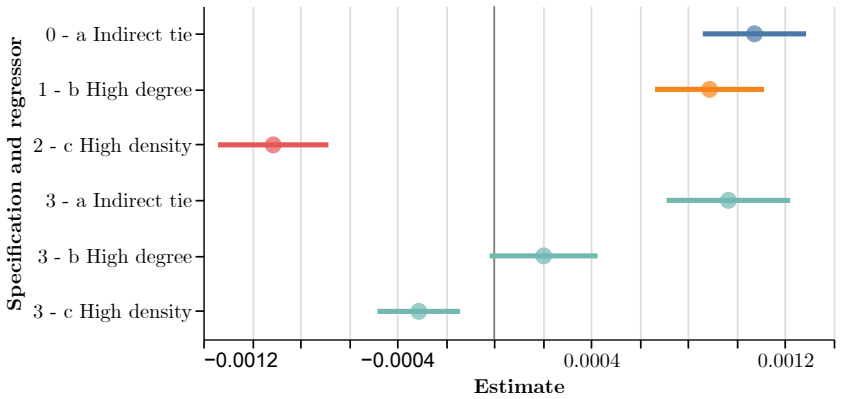
Applying the framework to data from a large professional services firm, where new hires are randomly assigned to project teams within offices, the analysis shows that indirect ties exert a strong and statistically significant positive causal effect on tie formation. In contrast, the causal effects of network degree and local network density are smaller in magnitude and less robust across specifications.
What carries the argument
Design-based causal inference approach that fixes the set of nodes and potential outcomes as non-random while using random team assignments to generate exogenous initial ties for estimating effects of indirect ties, degree, and density.
If this is right
- Indirect ties increase the probability of new direct connections in professional networks.
- Effects operating through an individual's overall degree or local density are weaker and more sensitive to model choices.
- Causal claims about network formation are possible without solving for equilibrium behavior by holding the node set fixed.
- Repeated network snapshots over time allow separation of the direction from existing structure to new ties.
Where Pith is reading between the lines
- Organizations could accelerate internal network formation by designing assignments that create more indirect ties across teams.
- The pattern suggests network growth is path-dependent, with early random bridges shaping later connectivity more than raw number of contacts.
- The same identification strategy could be applied to other random-assignment settings such as school cohorts or military units to test generalizability.
Load-bearing premise
Random assignment of new hires to project teams generates variation in initial ties that is independent of other factors shaping later connections, and fixing the node set removes equilibrium and sampling problems.
What would settle it
Finding no positive effect of indirect ties on subsequent tie formation when the same random-assignment design is applied in a different firm or when initial team assignments are shown to correlate with unobserved individual traits.
Figures

read the original abstract
This paper develops a framework for identification, estimation, and inference on the causal mechanisms driving endogenous social network formation. Identification is challenging because of unobserved confounders and reverse causality; inference is complicated by questions of equilibrium and sampling. We leverage repeated observations of a network over time and random variation in initial ties to address challenges to causal identification. Our design-based approach sidesteps questions of sampling and asymptotics by treating both the set of nodes (individuals) and potential outcomes as non-random. We apply our approach to data from a large professional services firm, where new hires are randomly assigned to project teams within offices. We estimate the causal effect on tie formation of indirect ties, network degree, and local network density. Indirect ties have a strong and significant positive effect on tie formation, while the effects of degree and density are smaller and less robust.
Editorial analysis
A structured set of objections, weighed in public.
Referee Report
Summary. The paper develops a design-based framework for causal inference on endogenous social network formation, using repeated observations of networks over time combined with random variation in initial ties from new-hire project-team assignments. It sidesteps equilibrium and sampling issues by treating the node set and potential outcomes as fixed/non-random, then applies the approach to firm data to estimate causal effects of indirect ties, degree, and local density on subsequent tie formation, finding a strong positive effect from indirect ties and smaller/less robust effects from degree and density.
Significance. If the identification holds, this contributes a credible design-based method for estimating causal mechanisms in network formation without parametric equilibrium assumptions, leveraging exogenous random assignment and panel structure. The empirical application yields interpretable estimates from real organizational data, with potential to inform research on social capital and tie dynamics; the random-assignment design and avoidance of self-referential fitting are particular strengths.
major comments (2)
- [Identification framework (around the design-based approach section)] The central identification claim (that fixing the node set and potential outcomes as non-random fully sidesteps equilibrium, sampling, and asymptotic issues) does not adequately address the interdependence of potential outcomes for tie formation. Even with a fixed node set, the formation of a tie between i and j depends on the realized network among all other nodes, violating no-interference and potentially biasing estimates of indirect-tie effects (which are themselves network-mediated). This requires explicit additional restrictions or robustness checks on the DGP.
- [Empirical results and robustness (application to professional services firm data)] The empirical application reports strong effects for indirect ties but smaller/less robust effects for degree and density; however, details on robustness to equilibrium assumptions, exact inference procedures, and checks against post-hoc selection in the firm data are needed to confirm the estimates are not sensitive to these issues.
minor comments (2)
- [Data and variable construction] Clarify the exact definition and measurement of 'indirect ties' and 'local network density' with an example or equation to aid replicability.
- [Abstract] The abstract could include a brief note on sample size or number of time periods for context on the panel structure.
Simulated Author's Rebuttal
We thank the referee for their constructive and insightful comments on our manuscript. We have revised the paper to explicitly address the identification assumptions and to expand the empirical robustness section. Below we respond point by point to the major comments.
read point-by-point responses
-
Referee: [Identification framework (around the design-based approach section)] The central identification claim (that fixing the node set and potential outcomes as non-random fully sidesteps equilibrium, sampling, and asymptotic issues) does not adequately address the interdependence of potential outcomes for tie formation. Even with a fixed node set, the formation of a tie between i and j depends on the realized network among all other nodes, violating no-interference and potentially biasing estimates of indirect-tie effects (which are themselves network-mediated). This requires explicit additional restrictions or robustness checks on the DGP.
Authors: We appreciate the referee highlighting this subtlety. Our design-based framework fixes the node set and potential outcomes as non-random precisely to avoid equilibrium modeling and sampling questions, allowing us to define causal effects directly from the random assignment of initial ties. We agree, however, that the no-interference component of SUTVA remains an implicit assumption and that indirect-tie effects are network-mediated by construction. In the revised manuscript we now state this assumption explicitly, discuss its plausibility in the context of short-horizon panel data and random team assignments that limit strategic spillovers, and add robustness checks that re-estimate the indirect-tie effect on restricted dyad subsets (e.g., pairs with no other common connections) and on office-level subnetworks. These additions clarify the scope of identification without changing the core approach. revision: yes
-
Referee: [Empirical results and robustness (application to professional services firm data)] The empirical application reports strong effects for indirect ties but smaller/less robust effects for degree and density; however, details on robustness to equilibrium assumptions, exact inference procedures, and checks against post-hoc selection in the firm data are needed to confirm the estimates are not sensitive to these issues.
Authors: We agree that greater transparency on these points will strengthen the empirical contribution. The revised version now includes: (i) explicit checks for sensitivity to equilibrium timing by reporting results under alternative lag structures and by comparing pre- and post-assignment network evolution; (ii) a complete description of the inference procedure, which implements randomization inference that exploits the known random-assignment mechanism rather than relying on asymptotic approximations; and (iii) institutional documentation and balance tests confirming that project-team assignments were made by a centralized HR process with no post-hoc adjustments or selection on unobservables. These additions confirm that the large indirect-tie effect is robust while the smaller degree and density effects remain less precisely estimated. revision: yes
Circularity Check
No significant circularity; identification relies on external randomization
full rationale
The paper's derivation chain uses random assignment of new hires to project teams as exogenous variation in initial ties, combined with repeated network observations, to identify causal effects of indirect ties, degree, and density on subsequent tie formation. This source of variation is external to the estimated outcomes and not fitted or defined in terms of them. Treating the node set and potential outcomes as non-random is an explicit design-based modeling choice to address sampling and equilibrium issues, but it does not reduce the empirical estimates to tautology or self-reference. No load-bearing steps reduce by construction to inputs, self-citations, or ansatzes; the central claims retain independent content from the data-generating process.
Axiom & Free-Parameter Ledger
axioms (2)
- domain assumption Random assignment of new hires to project teams is independent of individuals' potential network formation outcomes.
- domain assumption Treating the set of nodes and potential outcomes as non-random sidesteps sampling and asymptotic issues.
Reference graph
Works this paper leans on
-
[1]
Networks: An economics approach , year =
Goyal, Sanjeev , date-added =. Networks: An economics approach , year =
-
[2]
Structural balance: a generalization of Heider's theory
Cartwright, Dorwin and Harary, Frank , date-added =. Structural balance: a generalization of Heider's theory. , volume =. Psychological review , number =
-
[3]
A noncooperative model of network formation , volume =
Bala, Venkatesh and Goyal, Sanjeev , date-added =. A noncooperative model of network formation , volume =. Econometrica , number =
-
[4]
Shared partisanship dramatically increases social tie formation in a Twitter field experiment , volume =
Mosleh, Mohsen and Martel, Cameron and Eckles, Dean and Rand, David G , date-added =. Shared partisanship dramatically increases social tie formation in a Twitter field experiment , volume =. Proceedings of the National Academy of Sciences , number =
-
[5]
Tendencies toward triadic closure: Field experimental evidence , volume =
Mosleh, Mohsen and Eckles, Dean and Rand, David G , date-added =. Tendencies toward triadic closure: Field experimental evidence , volume =. Proceedings of the National Academy of Sciences , number =
-
[6]
The Anatomy of the Facebook Social Graph
Ugander, Johan and Karrer, Brian and Backstrom, Lars and Marlow, Cameron , date-added =. arXiv preprint arXiv:1111.4503 , title =
-
[7]
Social selection and peer influence in an online social network , url =
Kevin Lewis and Marco Gonzalez and Jason Kaufman , date-added =. Social selection and peer influence in an online social network , url =. Proceedings of the National Academy of Sciences , number =. 2012 , bdsk-url-1 =. doi:10.1073/pnas.1109739109 , eprint =
-
[8]
Lin, Nan , date-added =
-
[9]
A Structural Econometric Analysis of Network Formation Games Through Subnetworks , url =
Shuyang Sheng , date-added =. A Structural Econometric Analysis of Network Formation Games Through Subnetworks , url =. Econometrica , number =. 2020 , bdsk-url-1 =. doi:https://doi.org/10.3982/ECTA12558 , eprint =
-
[10]
Randomization tests for peer effects in group formation experiments , url =
Guillaume Basse AND Peng Ding AND Avi Feller AND Panos Toulis , date-added =. Randomization tests for peer effects in group formation experiments , url =. Econometrica , keywords =. 2024 , bdsk-url-1 =. doi:https://doi.org/10.3982/ECTA20134 , eprint =
-
[11]
Econometric models of network formation , volume =
De Paula,. Econometric models of network formation , volume =. Annual Review of Economics , number =
-
[12]
A paradox from randomization-based causal inference , year =
Ding, Peng , date-added =. A paradox from randomization-based causal inference , year =. Statistical science , pages =
-
[13]
Using standard tools from finite population sampling to improve causal inference for complex experiments , volume =
Mukerjee, Rahul and Dasgupta, Tirthankar and Rubin, Donald B , date-added =. Using standard tools from finite population sampling to improve causal inference for complex experiments , volume =. Journal of the American Statistical Association , number =
-
[14]
arXiv preprint arXiv:2503.13986 , title =
Tian, Pengfei and Yang, Fan and Ding, Peng , date-added =. arXiv preprint arXiv:2503.13986 , title =
-
[15]
On the application of probability theory to agricultural experiments
Neyman, Jerzy , date-added =. On the application of probability theory to agricultural experiments. Essay on principles , year =. Ann. Agricultural Sciences , pages =
-
[16]
An empirical model for strategic network formation , year =
Christakis, Nicholas and Fowler, James and Imbens, Guido W and Kalyanaraman, Karthik , booktitle =. An empirical model for strategic network formation , year =
-
[17]
Statistical analysis of network data with R , volume =
Kolaczyk, Eric D and Cs. Statistical analysis of network data with R , volume =
-
[18]
Identifying preferences in networks with bounded degree , volume =
De Paula,. Identifying preferences in networks with bounded degree , volume =. Econometrica , number =
-
[19]
Vault Career Guide to Consulting , volume =
Morkes, Andrew , date-added =. Vault Career Guide to Consulting , volume =
-
[20]
Social networks and cognition , volume =
Smith, Edward Bishop and Brands, Raina A and Brashears, Matthew E and Kleinbaum, Adam M , date-added =. Social networks and cognition , volume =. Annu. Rev. Sociol. , language =
-
[21]
Cartwright/harary (1956): Structural balance: A generalization of Heider's theory , year =
T. Cartwright/harary (1956): Structural balance: A generalization of Heider's theory , year =. Schl
1956
-
[22]
Contributions of the General Social Survey to Egocentric Network Research , year =
Marsden, Peter V and Fekete, Maleah and Baum, Derick , date-added =. Contributions of the General Social Survey to Egocentric Network Research , year =
-
[23]
The Econometrics of Randomized Experiments , volume =
Athey, Susan and Imbens, Guido W , booktitle =. The Econometrics of Randomized Experiments , volume =
-
[24]
Methods of identification in social networks , volume =
Graham, Bryan S , date-added =. Methods of identification in social networks , volume =. Annu. Rev. Econ. , number =
-
[25]
Discretion within constraint: Homophily and structure in a formal organization , volume =
Kleinbaum, Adam M and Stuart, Toby E and Tushman, Michael L , date-added =. Discretion within constraint: Homophily and structure in a formal organization , volume =. Organ. Sci. , language =
-
[26]
Looking Up and Looking Out:
McGinn, Kathleen L and Milkman, Katherine L , date-added =. Looking Up and Looking Out:. Organ. Sci. , language =
-
[27]
The psychology of interpersonal relations , year =
Heider, F , date-added =. The psychology of interpersonal relations , year =
-
[28]
Management Consultancy , year =
O'Mahoney, Joe and Markham, Calvert , date-added =. Management Consultancy , year =
-
[29]
Ties that last: Tie formation and persistence in research collaborations over time , volume =
Dahlander, Linus and McFarland, Daniel A , date-added =. Ties that last: Tie formation and persistence in research collaborations over time , volume =. Adm. Sci. Q. , language =
-
[30]
Network effects and social inequality , volume =
DiMaggio, Paul and Garip, Filiz , date-added =. Network effects and social inequality , volume =. Annu. Rev. Sociol. , language =
-
[31]
Change agents, networks, and institutions: A contingency theory of organizational change , volume =
Battilana, Julie and Casciaro, Tiziana , date-added =. Change agents, networks, and institutions: A contingency theory of organizational change , volume =. Acad. Manage. J. , language =
-
[32]
Structural Holes: The Social Structure of Competition , year =
Burt, Ronald S , date-added =. Structural Holes: The Social Structure of Competition , year =
-
[33]
Cumulative advantage as a mechanism for inequality: A review of theoretical and empirical developments , volume =
DiPrete, Thomas A and Eirich, Gregory M , date-added =. Cumulative advantage as a mechanism for inequality: A review of theoretical and empirical developments , volume =. Annu. Rev. Sociol. , language =
-
[34]
Empirical analysis of an evolving social network , volume =
Kossinets, Gueorgi and Watts, Duncan J , date-added =. Empirical analysis of an evolving social network , volume =. Science , language =
-
[35]
Knowledge sharing in organizations: Multiple networks, multiple phases , volume =
Hansen, Morten T and Mors, Marie Louise and L. Knowledge sharing in organizations: Multiple networks, multiple phases , volume =. Acad. Manage. J. , language =
-
[36]
Structural Holes and Good Ideas , volume =
Burt, Ronald S , date-added =. Structural Holes and Good Ideas , volume =. Am. J. Sociol. , month = sep, number =
-
[37]
Birds of a Feather: Homophily in Social Networks , volume =
McPherson, Miller and Smith-Lovin, Lynn and Cook, James M , date-added =. Birds of a Feather: Homophily in Social Networks , volume =. Annu. Rev. Sociol. , language =
-
[38]
Peer effects with random assignment: Results for Dartmouth roommates , year =
Sacerdote, B , date-added =. Peer effects with random assignment: Results for Dartmouth roommates , year =. Q. J. Econ. , publisher =
-
[39]
Trapped in your own net? Network cohesion, structural holes, and the adaptation of social capital , volume =
Gargiulo, Martin and Benassi, Mario , date-added =. Trapped in your own net? Network cohesion, structural holes, and the adaptation of social capital , volume =. Organ. Sci. , language =
-
[40]
Emergence of scaling in random networks , volume =
Barabasi, A L and Albert, R , date-added =. Emergence of scaling in random networks , volume =. Science , language =
-
[41]
Social structure and competition in interfirm networks , volume =
Uzzi, B , date-added =. Social structure and competition in interfirm networks , volume =. Administrative Science Quarterly , number =
-
[42]
The Review of Economic Studies , number =
Manski, C F , date-added =. The Review of Economic Studies , number =
-
[43]
Filling in the blanks: A theory of cognitive categories and the structure of social affiliation , volume =
Freeman, Linton C , date-added =. Filling in the blanks: A theory of cognitive categories and the structure of social affiliation , volume =. Soc. Psychol. Q. , month = jun, number =
-
[44]
Neocortex size as a constraint on group size in primates , volume =
Dunbar, Robin I M , date-added =. Neocortex size as a constraint on group size in primates , volume =. Journal of Human Evolution , month = jun, pages =
-
[45]
Social capital in the creation of human capital , volume =
Coleman, James S , date-added =. Social capital in the creation of human capital , volume =. Am. J. Sociol. , month = jan, pages =
-
[46]
Cognitive social structures , volume =
Krackhardt, D , date-added =. Cognitive social structures , volume =. Social Networks , month = jun, pages =
-
[47]
The focused organization of social ties , volume =
Feld, Scott L , date-added =. The focused organization of social ties , volume =. Am. J. Sociol. , month = mar, number =
-
[48]
Inequality and Heterogeneity: A Primitive Theory of Social Structure , volume =
Blau, Peter Michael , date-added =. Inequality and Heterogeneity: A Primitive Theory of Social Structure , volume =
-
[49]
The Matthew effect in science
Merton, R K , date-added =. The Matthew effect in science. The reward and communication systems of science are considered: The reward and communication systems of science are considered , volume =. Science , language =
-
[50]
The Triad , year =
Simmel, G and Wolff, K H , booktitle =. The Triad , year =
-
[51]
Anarchy, state, and utopia , year =
Nozick, Robert , date-added =. Anarchy, state, and utopia , year =
-
[52]
An Introduction to the Principles of Morals and Legislation , year =
Jeremy Bentham , date-added =. An Introduction to the Principles of Morals and Legislation , year =
-
[53]
Two Treatises of Government: In the Former, The False Principles, and Foundation of Sir Robert Filmer and His Followers, are Detected and Overthrown
John Locke , date-added =. Two Treatises of Government: In the Former, The False Principles, and Foundation of Sir Robert Filmer and His Followers, are Detected and Overthrown. The Latter is an Essay Concerning the True Original, Extent, and End of Civil Government , year =
-
[54]
Measuring utility by a single-response sequential method , volume =
Becker, Gordon M and DeGroot, Morris H and Marschak, Jacob , date-added =. Measuring utility by a single-response sequential method , volume =. Behavioral science , number =
-
[55]
Every cook can govern , volume =
James, Cyril Lionel Robert , date-added =. Every cook can govern , volume =. A Study of Democracy in Ancient Greece, Correspondence , number =
-
[56]
User-friendly introduction to PAC-Bayes bounds , volume =
Alquier, Pierre and others , date-added =. User-friendly introduction to PAC-Bayes bounds , volume =. Foundations and Trends
-
[57]
Generalization Bounds: Perspectives from Information Theory and PAC-Bayes , url =
Fredrik Hellstr. Generalization Bounds: Perspectives from Information Theory and PAC-Bayes , url =. Foundations and Trends. 2025 , bdsk-url-1 =. doi:10.1561/2200000112 , issn =
-
[58]
The epistemology of democracy , volume =
Anderson, Elizabeth , date-added =. The epistemology of democracy , volume =. Episteme , number =
-
[59]
The working sovereign: Labour and democratic citizenship , year =
Honneth, Axel , date-added =. The working sovereign: Labour and democratic citizenship , year =
-
[60]
Between facts and norms: Contributions to a discourse theory of law and democracy , year =
Habermas, J. Between facts and norms: Contributions to a discourse theory of law and democracy , year =
-
[61]
Urban Public Works in Spatial Equilibrium: Experimental Evidence from Ethiopia , url =
Franklin, Simon and Imbert, Cl. Urban Public Works in Spatial Equilibrium: Experimental Evidence from Ethiopia , url =. 2024 , bdsk-url-1 =. doi:10.1257/aer.20220471 , journal =
-
[62]
Labor Market Effects of Social Programs: Evidence from India's Employment Guarantee , url =
Imbert, Cl. Labor Market Effects of Social Programs: Evidence from India's Employment Guarantee , url =. 2015 , bdsk-url-1 =. doi:10.1257/app.20130401 , journal =
-
[63]
Why Workers Stay: Pay, Beliefs, and Attachment , year =
Caldwell, Sydnee and Haegele, Ingrid and Heining, Joerg , date-added =. Why Workers Stay: Pay, Beliefs, and Attachment , year =
-
[64]
The changing (dis-) utility of work , volume =
Kaplan, Greg and Schulhofer-Wohl, Sam , date-added =. The changing (dis-) utility of work , volume =. Journal of Economic Perspectives , number =
-
[65]
The value of working conditions in the United States and implications for the structure of wages , volume =
Maestas, Nicole and Mullen, Kathleen J and Powell, David and Von Wachter, Till and Wenger, Jeffrey B , date-added =. The value of working conditions in the United States and implications for the structure of wages , volume =. American Economic Review , number =
-
[66]
Power and dignity in the low-wage labor market: Theory and evidence from wal-mart workers , year =
Dube, Arindrajit and Naidu, Suresh and Reich, Adam D , date-added =. Power and dignity in the low-wage labor market: Theory and evidence from wal-mart workers , year =
-
[67]
Man's search for meaning: The case of Legos , volume =
Ariely, Dan and Kamenica, Emir and Prelec, Dra. Man's search for meaning: The case of Legos , volume =. Journal of Economic Behavior & Organization , number =
-
[68]
Valuing alternative work arrangements , volume =
Mas, Alexandre and Pallais, Amanda , date-added =. Valuing alternative work arrangements , volume =. American Economic Review , number =
-
[69]
When should you adjust standard errors for clustering? , volume =
Abadie, Alberto and Athey, Susan and Imbens, Guido W and Wooldridge, Jeffrey M , date-added =. When should you adjust standard errors for clustering? , volume =. The Quarterly Journal of Economics , number =
-
[70]
Lee , date-added =
David S. Lee , date-added =. Training, Wages, and Sample Selection: Estimating Sharp Bounds on Treatment Effects , url =. The Review of Economic Studies , number =. 2009 , bdsk-url-1 =
2009
-
[71]
Generalized lee bounds , volume =
Semenova, Vira , date-added =. Generalized lee bounds , volume =. Journal of Econometrics , pages =
-
[72]
Shaikh and Max Tabord-Meehan , date-added =
Yuehao Bai and Jizhou Liu and Azeem M. Shaikh and Max Tabord-Meehan , date-added =. Inference in cluster randomized trials with matched pairs , url =. Journal of Econometrics , keywords =. 2024 , bdsk-url-1 =. doi:https://doi.org/10.1016/j.jeconom.2024.105873 , issn =
-
[73]
Uniformity and the delta method , volume =
Kasy, Maximilian , date-added =. Uniformity and the delta method , volume =. Journal of Econometric Methods , number =
-
[74]
Annual Review of Economics , title =
Andrews, Isaiah and Stock, James and Sun, Liyang , date-added =. Annual Review of Economics , title =
-
[75]
Cash Transfers, Mental Health and Agency:
Bohmann, Sandra and Fiedler, Susann and Kasy, Maximilian and Schupp, J. Cash Transfers, Mental Health and Agency:. CESifo Working Paper , number =
-
[76]
Basic income and labor supply:
Bernhard, Sarah and Bohmann, Sandra and Fiedler, Susann and Kasy, Maximilian and Schupp, J. Basic income and labor supply:. Working Paper , publisher =
-
[77]
Mastering Chess and Shogi by Self-Play with a General Reinforcement Learning Algorithm
Mastering Chess and Shogi by Self-Play with a General Reinforcement Learning Algorithm , url =. 2017 , bdsk-url-1 =. arXiv , author =:1712.01815 , primaryclass =
work page Pith review arXiv 2017
-
[78]
How life works: a user's guide to the new biology , year =
Ball, Philip , booktitle =. How life works: a user's guide to the new biology , year =
-
[79]
, date-added =
Abraham, Y. , date-added =. `Lavender': The AI Machine Directing Israel's Bombing Spree in Gaza. , url =. 2024 , bdsk-url-1 =
2024
-
[80]
Training Compute-Optimal Large Language Models
Training Compute-Optimal Large Language Models , url =. 2022 , bdsk-url-1 =. arXiv , author =:2203.15556 , primaryclass =
work page internal anchor Pith review arXiv 2022
discussion (0)
Sign in with ORCID, Apple, or X to comment. Anyone can read and Pith papers without signing in.