Recognition: unknown
HiGMem: A Hierarchical and LLM-Guided Memory System for Long-Term Conversational Agents
Pith reviewed 2026-05-10 05:01 UTC · model grok-4.3
The pith
HiGMem lets LLMs first scan event summaries then fetch only the relevant turns needed for accurate long-term recall.
A machine-rendered reading of the paper's core claim, the machinery that carries it, and where it could break.
Core claim
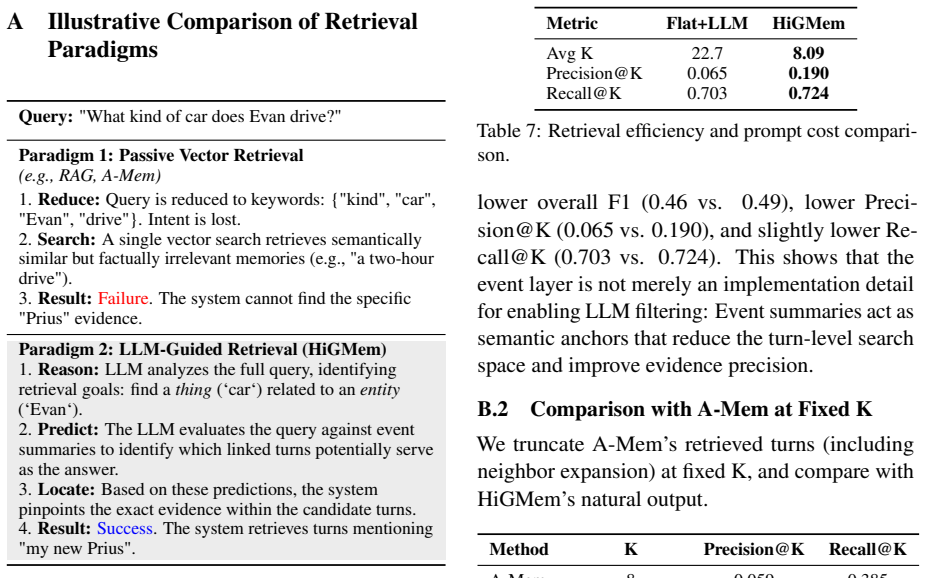
HiGMem organizes memory into a two-level hierarchy of event summaries and individual dialogue turns. The LLM first inspects the compact event summaries to decide which turns are likely to contain the needed evidence, then retrieves only those turns. The resulting evidence set is passed to the answer generator, yielding higher precision, lower context cost, and improved question-answering scores compared with pure vector retrieval.
What carries the argument
The LLM-guided selection step that treats event summaries as semantic anchors to predict and retrieve only the most relevant turns.
If this is right
- Answer generation receives shorter, higher-precision context, lowering token cost and latency.
- Retrieved memories become easier for humans or downstream systems to inspect and audit.
- Adversarial recall improves because reasoning can override superficial similarity matches.
- The same hierarchy can be maintained incrementally as new turns arrive without re-indexing everything.
Where Pith is reading between the lines
- The approach suggests that hybrid reasoning-plus-embedding retrieval may become standard for any agent that must handle extended interaction histories.
- Similar two-level structures could be tested in long-document or multi-turn tool-use settings where pure embedding search also returns too much noise.
- If the event-level summaries themselves become inaccurate over time, the entire selection benefit would degrade, pointing to a need for periodic summary refresh.
Load-bearing premise
LLM reasoning performed on the event summaries will correctly identify the exact turns that contain the required evidence and will not miss critical details or add its own selection errors.
What would settle it
An experiment on a new long-conversation dataset in which HiGMem either retrieves as many or more turns than a strong vector baseline while showing no F1 gain, or in which the LLM summarizer systematically drops turns that later prove necessary for correct answers.
Figures

read the original abstract
Long-term conversational large language model (LLM) agents require memory systems that can recover relevant evidence from historical interactions without overwhelming the answer stage with irrelevant context. However, existing memory systems, including hierarchical ones, still often rely solely on vector similarity for retrieval. It tends to produce bloated evidence sets: adding many superficially similar dialogue turns yields little additional recall, but lowers retrieval precision, increases answer-stage context cost, and makes retrieved memories harder to inspect and manage. To address this, we propose HiGMem (Hierarchical and LLM-Guided Memory System), a two-level event-turn memory system that allows LLMs to use event summaries as semantic anchors to predict which related turns are worth reading. This allows the model to inspect high-level event summaries first and then focus on a smaller set of potentially useful turns, providing a concise and reliable evidence set through reasoning, while avoiding the retrieval overhead that would be excessively high compared to vector retrieval. On the LoCoMo10 benchmark, HiGMem achieves the best F1 on four of five question categories and improves adversarial F1 from 0.54 to 0.78 over A-Mem, while retrieving an order of magnitude fewer turns. Code is publicly available at https://github.com/ZeroLoss-Lab/HiGMem.
Editorial analysis
A structured set of objections, weighed in public.
Referee Report
Summary. The paper introduces HiGMem, a two-level hierarchical memory system for long-term conversational LLM agents consisting of event summaries as semantic anchors and individual dialogue turns. An LLM reasons over the summaries to select a small subset of relevant turns for retrieval, aiming to improve precision and reduce context bloat compared to vector-similarity-only methods. On the LoCoMo10 benchmark, HiGMem reports the highest F1 scores on four of five question categories, raises adversarial F1 from 0.54 (A-Mem) to 0.78, and retrieves an order of magnitude fewer turns. The code is released publicly.
Significance. If the empirical gains prove robust, the work would be significant for memory architectures in conversational agents by demonstrating that LLM reasoning over hierarchical summaries can yield both higher answer quality and lower retrieval volume. The public code release supports reproducibility and is a clear strength. The approach directly targets the precision-recall tradeoff in long-context retrieval, which is a practical bottleneck.
major comments (3)
- [§4, §5] §4 (Methods) and §5 (Experiments): the central claim that LLM-guided selection over event summaries reliably identifies relevant turns without critical omissions rests on an unverified assumption. No ablation isolates the contribution of the LLM selection step, no oracle or human evaluation measures selection accuracy (precision/recall of predicted turns vs. ground-truth evidence turns), and no error analysis quantifies false-negative omissions that would directly undermine the reported F1 gains.
- [§5.2] §5.2 (Results on LoCoMo10): the adversarial F1 improvement (0.78 vs. 0.54) and order-of-magnitude reduction in retrieved turns are load-bearing for the efficiency claim, yet the manuscript provides no details on implementation hyperparameters, potential confounds (e.g., summary generation quality, LLM prompt sensitivity), or statistical significance testing across multiple runs.
- [§3] §3 (System Design): the fidelity of event summaries is not quantified. If summaries lose critical details, the downstream LLM turn-prediction step cannot recover them, collapsing the precision advantage over flat vector retrieval; no metric or human study assesses summary completeness.
minor comments (2)
- [§3] Notation for the two-level retrieval (event vs. turn) is introduced without a clear diagram or pseudocode in §3, making the flow from summary reasoning to turn selection harder to follow.
- [Table 1, Figure 2] Table 1 and Figure 2 would benefit from explicit column/axis labels indicating whether F1 is macro- or micro-averaged and whether the turn count is per-question or aggregate.
Simulated Author's Rebuttal
We thank the referee for the constructive and detailed feedback. We address each major comment below with specific plans for revision to strengthen the empirical validation and clarity of the manuscript.
read point-by-point responses
-
Referee: [§4, §5] §4 (Methods) and §5 (Experiments): the central claim that LLM-guided selection over event summaries reliably identifies relevant turns without critical omissions rests on an unverified assumption. No ablation isolates the contribution of the LLM selection step, no oracle or human evaluation measures selection accuracy (precision/recall of predicted turns vs. ground-truth evidence turns), and no error analysis quantifies false-negative omissions that would directly undermine the reported F1 gains.
Authors: We agree that isolating the LLM selection step and quantifying its accuracy is important for validating the central claim. In the revised manuscript, we will add an ablation comparing full HiGMem against a vector-similarity-only baseline on the event summaries. We will also include an oracle analysis using ground-truth relevant turns to compute selection precision and recall, along with a qualitative error analysis of missed turns on a sample of queries. These additions will directly address potential false negatives and the reliability of the selection mechanism. revision: yes
-
Referee: [§5.2] §5.2 (Results on LoCoMo10): the adversarial F1 improvement (0.78 vs. 0.54) and order-of-magnitude reduction in retrieved turns are load-bearing for the efficiency claim, yet the manuscript provides no details on implementation hyperparameters, potential confounds (e.g., summary generation quality, LLM prompt sensitivity), or statistical significance testing across multiple runs.
Authors: We will revise §5.2 to include full details on all hyperparameters, prompt templates, and LLM choices for summary generation and selection. We will discuss potential confounds such as summary quality and prompt sensitivity, and report results averaged over multiple runs with standard deviations to establish statistical significance of the F1 gains and retrieval reduction. revision: yes
-
Referee: [§3] §3 (System Design): the fidelity of event summaries is not quantified. If summaries lose critical details, the downstream LLM turn-prediction step cannot recover them, collapsing the precision advantage over flat vector retrieval; no metric or human study assesses summary completeness.
Authors: We acknowledge that quantifying summary fidelity is necessary to support the hierarchical approach. In the revision, we will add automatic metrics (e.g., ROUGE against original turns) and a small human study rating summary completeness and accuracy to demonstrate that critical details are preserved. revision: yes
Circularity Check
No circularity; empirical benchmark evaluation only
full rationale
The paper proposes HiGMem as a two-level hierarchical memory system that uses LLM reasoning over event summaries to select relevant dialogue turns, then reports direct empirical results on the LoCoMo10 benchmark (best F1 on 4/5 categories, adversarial F1 0.78 vs 0.54, order-of-magnitude fewer turns retrieved). No equations, fitted parameters, derivations, or self-referential predictions appear in the abstract or described method. The central claims are benchmark comparisons, not quantities that reduce by construction to the system's own inputs or prior self-citations. Any self-citations (if present) are not load-bearing for the reported performance numbers.
Axiom & Free-Parameter Ledger
Reference graph
Works this paper leans on
-
[1]
A Survey on the Memory Mechanism of Large Language Model based Agents
A survey on the memory mechanism of large language model based agents , author=. arXiv preprint arXiv:2404.13501 , year=
work page internal anchor Pith review arXiv
-
[2]
Frontiers of Computer Science , volume=
A survey on large language model based autonomous agents , author=. Frontiers of Computer Science , volume=. 2024 , doi=
2024
-
[3]
A-MEM: Agentic Memory for LLM Agents
A-mem: Agentic memory for llm agents , author=. arXiv preprint arXiv:2502.12110 , year=
work page internal anchor Pith review arXiv
-
[4]
MemGPT: Towards LLMs as Operating Systems
MemGPT: Towards LLMs as Operating Systems , author=. arXiv preprint arXiv:2310.08560 , year=
work page internal anchor Pith review arXiv
-
[5]
Proceedings of the 36th annual acm symposium on user interface software and technology , pages=
Generative agents: Interactive simulacra of human behavior , author=. Proceedings of the 36th annual acm symposium on user interface software and technology , pages=
-
[6]
Advances in Neural Information Processing Systems , volume=
Retrieval-augmented generation for knowledge-intensive NLP tasks , author=. Advances in Neural Information Processing Systems , volume=
-
[7]
Evaluating Very Long-Term Conversational Memory of LLM Agents
Evaluating very long-term conversational memory of llm agents , author=. arXiv preprint arXiv:2402.17753 , year=
work page internal anchor Pith review arXiv
-
[8]
The Twelfth International Conference on Learning Representations , year=
Raptor: Recursive abstractive processing for tree-organized retrieval , author=. The Twelfth International Conference on Learning Representations , year=
-
[9]
Proceedings of the AAAI Conference on Artificial Intelligence , volume=
Memorybank: Enhancing large language models with long-term memory , author=. Proceedings of the AAAI Conference on Artificial Intelligence , volume=. 2024 , doi=
2024
-
[10]
SQuAD: 100,000+ Questions for Machine Comprehension of Text
Squad: 100,000+ questions for machine comprehension of text , author=. arXiv preprint arXiv:1606.05250 , year=
work page internal anchor Pith review arXiv
-
[11]
2008 , publisher=
Introduction to information retrieval , author=. 2008 , publisher=
2008
-
[12]
Sentence-BERT: Sentence Embeddings using Siamese BERT-Networks
Sentence-bert: Sentence embeddings using siamese bert-networks , author=. arXiv preprint arXiv:1908.10084 , year=
work page internal anchor Pith review arXiv 1908
-
[13]
GPT-4 technical report , author=. arXiv preprint arXiv:2303.08774 , year=
work page internal anchor Pith review Pith/arXiv arXiv
-
[14]
arXiv preprint arXiv:2402.09727 , year=
A human-inspired reading agent with gist memory of very long contexts , author=. arXiv preprint arXiv:2402.09727 , year=
-
[15]
arXiv preprint arXiv:2507.22925 , year=
Hierarchical memory for high-efficiency long-term reasoning in llm agents , author=. arXiv preprint arXiv:2507.22925 , year=
-
[16]
R e SURE : Regularizing Supervision Unreliability for Multi-turn Dialogue Fine-tuning
Du, Yiming and Xiang, Yifan and Liang, Bin and Lin, Dahua and Wong, Kam-Fai and Tan, Fei. R e SURE : Regularizing Supervision Unreliability for Multi-turn Dialogue Fine-tuning. Proceedings of the 2025 Conference on Empirical Methods in Natural Language Processing. 2025. doi:10.18653/v1/2025.emnlp-main.959
-
[17]
da DPO : Distribution-Aware DPO for Distilling Conversational Abilities
Zhang, Zhengze and Wang, Shiqi and Shen, Yiqun and Guo, Simin and Lin, Dahua and Wang, Xiaoliang and Nguyen, Cam Tu and Tan, Fei. da DPO : Distribution-Aware DPO for Distilling Conversational Abilities. Findings of the Association for Computational Linguistics: ACL 2025. 2025. doi:10.18653/v1/2025.findings-acl.796
-
[18]
Beyond Goldfish Memory: Long-Term Open-Domain Conversation , url =
Xu, Jing and Szlam, Arthur and Weston, Jason. Beyond Goldfish Memory: Long-Term Open-Domain Conversation. Proceedings of the 60th Annual Meeting of the Association for Computational Linguistics (Volume 1: Long Papers). 2022. doi:10.18653/v1/2022.acl-long.356
-
[19]
Jang, Jihyoung and Boo, Minseong and Kim, Hyounghun. Conversation Chronicles: Towards Diverse Temporal and Relational Dynamics in Multi-Session Conversations. Proceedings of the 2023 Conference on Empirical Methods in Natural Language Processing. 2023. doi:10.18653/v1/2023.emnlp-main.838
discussion (0)
Sign in with ORCID, Apple, or X to comment. Anyone can read and Pith papers without signing in.