Recognition: unknown
Near-optimal density theorems for large dilates of large point configurations
Pith reviewed 2026-05-10 03:17 UTC · model grok-4.3
The pith
Any measurable set in Euclidean space with density exceeding 1 minus O((log n)/n) contains all sufficiently large similar copies of any fixed n-point configuration.
A machine-rendered reading of the paper's core claim, the machinery that carries it, and where it could break.
Core claim
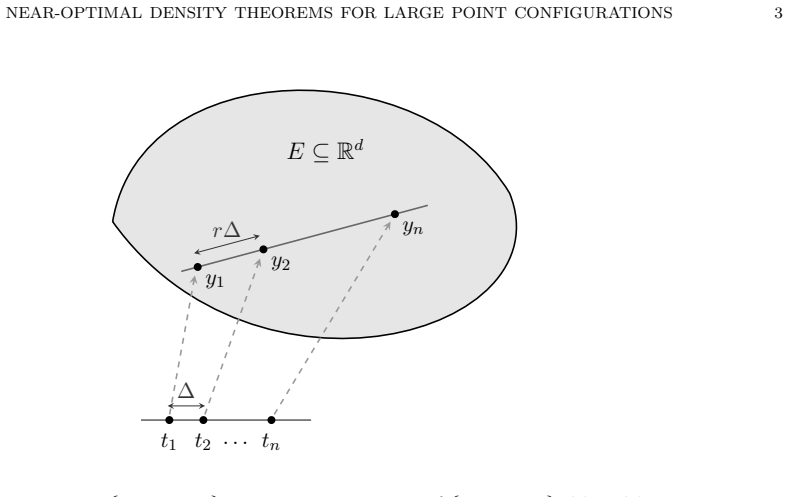
We prove a lower bound of the form 1-O((log n)/n) on the density threshold that forces a measurable set E in R^d to contain all sufficiently large similar copies of every n-point configuration. This matches the known upper bound up to the logarithmic factor. For embeddings into R^d equipped with the l^p norm, p in (1, infinity) excluding 2, the threshold is asymptotically 1-1/n+o(1/n).
What carries the argument
Equidistribution of polynomial sequences modulo 1 combined with probabilistic thinning, which selects large dilates inside sufficiently dense measurable sets; geometry of l^p spaces supplies the second estimate.
Load-bearing premise
The n-point configurations are fixed in advance, the set E is Lebesgue measurable, and the conclusion applies only to all sufficiently large dilates rather than every scale.
What would settle it
A Lebesgue measurable set E with upper density 1 - C(log n)/n for sufficiently large C that avoids similar copies of some fixed n-point configuration at all large scales would disprove the claim.
Figures


read the original abstract
We study density thresholds that force a measurable set $E\subseteq\mathbb{R}^d$ to contain all sufficiently large similar copies of every $n$-point configuration. We prove a lower bound of the form $1-O((\log n)/n)$, which matches the known upper bound up to the logarithmic factor, thus essentially resolving a problem posed by Falconer, Yavicoli, and the first author of the present paper. We also study the same problem for embeddings of $n$-point configurations into $\mathbb{R}^d$ equipped with the $\ell^p$ norm, obtaining an asymptotically sharp bound $1-1/n+o(1/n)$, as soon as $p\in(1,\infty)\setminus\{2\}$. In the proof of the former estimate we use equidistribution of polynomial sequences modulo $1$ combined with probabilistic thinning. The proof of the latter estimate relies on the geometry of the $\ell^p$ spaces for $p\neq2$.
Editorial analysis
A structured set of objections, weighed in public.
Referee Report
Summary. The paper studies density thresholds for measurable sets E in R^d to contain all sufficiently large similar copies of every n-point configuration. It proves a lower bound of 1 - O((log n)/n), matching the known upper bound up to a log factor, essentially resolving a problem posed by Falconer, Yavicoli, and the first author. For l^p norms with p ≠ 2, it obtains an asymptotically sharp bound of 1 - 1/n + o(1/n). The proofs rely on equidistribution of polynomial sequences modulo 1 with probabilistic thinning for the Euclidean case and on the geometry of l^p spaces for the other case.
Significance. If the results hold, this work provides near-optimal density theorems for large dilates of point configurations, significantly advancing the field by essentially settling the problem in the Euclidean setting and providing sharp bounds in l^p. The combination of equidistribution and probabilistic methods is a strength, as is the geometric approach for non-Euclidean norms. The results are falsifiable and the bounds are explicit in their asymptotic form.
minor comments (2)
- [Abstract] The phrase 'essentially resolving' in the abstract should be clarified by explicitly referencing the precise statement of the open problem from the cited work of Falconer, Yavicoli, and the first author.
- [Introduction] The assumptions that E is Lebesgue measurable and that the n-point configurations are fixed in advance (with the result applying only to sufficiently large dilates) are standard but should be stated more prominently at the beginning of the introduction to frame the scope.
Simulated Author's Rebuttal
We thank the referee for the positive evaluation of our manuscript and for recommending minor revision. The referee's summary accurately captures the main results, including the near-optimal density threshold of 1 - O((log n)/n) in the Euclidean setting and the asymptotically sharp bound 1 - 1/n + o(1/n) for l^p norms with p ≠ 2.
Circularity Check
Minor self-citation in problem statement; derivation remains independent
full rationale
The paper establishes its central density lower bound of 1-O((log n)/n) via equidistribution of polynomial sequences modulo 1 combined with probabilistic thinning for the Euclidean case, and via geometric properties of ℓ^p norms for p≠2. These tools are external and independent of the target result. The only self-reference is noting that the open problem was posed by Falconer, Yavicoli, and the first author; this citation is limited to the problem statement and does not justify or reduce the proof steps themselves. No self-definitional reductions, fitted inputs renamed as predictions, or load-bearing self-citation chains appear in the derivation chain.
Axiom & Free-Parameter Ledger
axioms (2)
- standard math Lebesgue measurability and density are well-defined for subsets of R^d
- standard math Equidistribution of polynomial sequences modulo 1 holds
Reference graph
Works this paper leans on
-
[1]
Math.54(1986), no
Jean Bourgain,A Szemer´ edi type theorem for sets of positive density inR k, Israel J. Math.54(1986), no. 3, 307–316
1986
-
[2]
Moshchevitin,Badly approximable numbers and Littlewood-type problems, Math
Yann Bugeaud and Nikolay G. Moshchevitin,Badly approximable numbers and Littlewood-type problems, Math. Proc. Cambridge Philos. Soc.150(2011), no. 2, 215–226
2011
-
[3]
Z.271(2012), no
,On fractional parts of powers of real numbers close to1, Math. Z.271(2012), no. 3-4, 627–637
2012
-
[4]
Clarkson,Uniformly convex spaces, Trans
James A. Clarkson,Uniformly convex spaces, Trans. Amer. Math. Soc.40(1936), no. 3, 396–414
1936
-
[5]
Brian Cook, ´Akos Magyar, and Malabika Pramanik,A Roth-type theorem for dense subsets ofR d, Bull. Lond. Math. Soc.49(2017), no. 4, 676–689
2017
-
[6]
Polona Durcik and Vjekoslav Kovaˇ c,Boxes, extended boxes and sets of positive upper density in the Eu- clidean space, Math. Proc. Cambridge Philos. Soc.171(2021), no. 3, 481–501
2021
-
[7]
PDE15(2022), no
,A Szemer´ edi-type theorem for subsets of the unit cube, Anal. PDE15(2022), no. 2, 507–549
2022
-
[8]
Polona Durcik, Vjekoslav Kovaˇ c, and Luka Rimani´ c,On side lengths of corners in positive density subsets of the Euclidean space, Int. Math. Res. Not. IMRN (2018), no. 22, 6844–6869
2018
-
[9]
Math.267(2025), no
Polona Durcik and Mario Stipˇ ci´ c,Quantitative bounds for products of simplices in subsets of the unit cube, Israel J. Math.267(2025), no. 1, 135–156
2025
-
[10]
Kenneth Falconer, Vjekoslav Kovaˇ c, and Alexia Yavicoli,The density of sets containing large similar copies of finite sets, J. Anal. Math.148(2022), no. 1, 339–359
2022
-
[11]
Dmitry Gayfulin and Nikolay Moshchevitin,On Furstenberg’s Diophantine result, Mosc. J. Comb. Number Theory12(2023), no. 4, 259–272
2023
-
[12]
Google,Gemini 3.1 pro, Large language model, 2026
2026
-
[13]
Graham,Recent trends in Euclidean Ramsey theory, Discrete Math.136(1994), no
Ronald L. Graham,Recent trends in Euclidean Ramsey theory, Discrete Math.136(1994), no. 1-3, 119– 127, Trends in discrete mathematics
1994
-
[14]
Vjekoslav Kovaˇ c,Density theorems for anisotropic point configurations, Canad. J. Math.74(2022), no. 5, 1244–1276
2022
-
[15]
Workshop report 25/2023 of the confer- ence held at Oberwolfach, June 4–June 9, 2023 (T
,Large copies of large configurations in large sets (extended abstract), Incidence Problems in Har- monic Analysis, Geometric Measure Theory, and Ergodic Theory. Workshop report 25/2023 of the confer- ence held at Oberwolfach, June 4–June 9, 2023 (T. Orponen, P. Shmerkin, and H. Wang, eds.), Oberwolfach Rep., vol. 20, EMS Press, EMS-Publishing House GmbH,...
2023
-
[16]
,Coloring and density theorems for configurations of a given volume, Proc. Lond. Math. Soc. (3) 132(2026), no. 3, Paper No. e70143, 56 pp
2026
-
[17]
Math.50 (2024), no
Vjekoslav Kovaˇ c and Bruno Predojevi´ c,Large dilates of hypercube graphs in the plane, Anal. Math.50 (2024), no. 3, 893–915
2024
-
[18]
Lauwerens Kuipers and Harald Niederreiter,Uniform distribution of sequences, Pure and Applied Mathe- matics, Wiley-Interscience [John Wiley & Sons], New York-London-Sydney, 1974
1974
-
[19]
Neil Lyall and ´Akos Magyar,Product of simplices and sets of positive upper density inR d, Math. Proc. Cambridge Philos. Soc.165(2018), no. 1, 25–51
2018
-
[20]
PDE13(2020), no
,Distance graphs and sets of positive upper density inR d, Anal. PDE13(2020), no. 3, 685–700
2020
-
[21]
,Weak hypergraph regularity and applications to geometric Ramsey theory, Trans. Amer. Math. Soc. Ser. B9(2022), 160–207
2022
-
[22]
Megginson,An introduction to Banach space theory, Graduate Texts in Mathematics, vol
Robert E. Megginson,An introduction to Banach space theory, Graduate Texts in Mathematics, vol. 183, Springer-Verlag, New York, 1998
1998
-
[23]
Moshchevitin,On small fractional parts of polynomials, J
Nikolay G. Moshchevitin,On small fractional parts of polynomials, J. Number Theory129(2009), no. 2, 349–357
2009
-
[24]
,On simultaneously badly approximable numbers, Bull. Lond. Math. Soc.42(2010), no. 1, 149–154
2010
-
[25]
,On the distribution modulo1of lacunary and sublacunary sequences: application of the Peres Schlag construction, Fundam. Prikl. Mat.16(2010), no. 5, 117–138
2010
-
[26]
OpenAI,Chatgpt 5.4 pro, Large language model, 2026
2026
-
[27]
Yuval Peres and Wilhelm Schlag,Two Erd˝ os problems on lacunary sequences: chromatic number and Diophantine approximation, Bull. Lond. Math. Soc.42(2010), no. 2, 295–300
2010
-
[28]
Bruno Predojevi´ c,Density theorems for euclidean point configurations, doctoral dissertation, University of Zagreb, 2026
2026
-
[29]
Vaughan,The Hardy-Littlewood method, second ed., Cambridge Tracts in Mathematics, vol
Robert C. Vaughan,The Hardy-Littlewood method, second ed., Cambridge Tracts in Mathematics, vol. 125, Cambridge University Press, Cambridge, 1997. Department of Mathematics, Faculty of Science, University of Zagreb, Bijeni ˇcka cesta 30, 10000 Zagreb, Croatia Email address:vjekovac@math.hr Bachelor’s Program in Mathematics, Faculty of Science, University ...
1997
discussion (0)
Sign in with ORCID, Apple, or X to comment. Anyone can read and Pith papers without signing in.