Recognition: unknown
Soft tilings
Pith reviewed 2026-05-10 02:48 UTC · model grok-4.3
The pith
Every locally polyhedral tiling of three-dimensional space can be completely softened by a new edge-bending algorithm.
A machine-rendered reading of the paper's core claim, the machinery that carries it, and where it could break.
Core claim
By constructing a new edge-bending algorithm, every locally polyhedral tiling of R^3 can be completely softened. A weaker form of the claim for polyhedral space tilings had been conjectured in 2024. As an auxiliary result, balanced polygonic tilings of the plane have an average of at least two spikes per cell.
What carries the argument
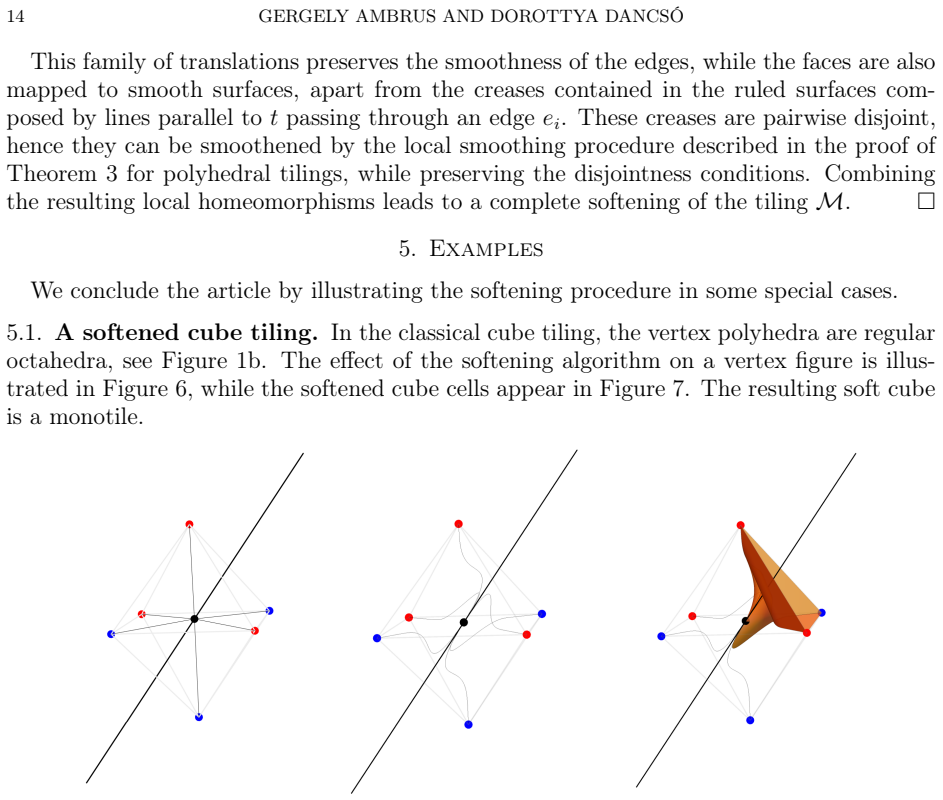
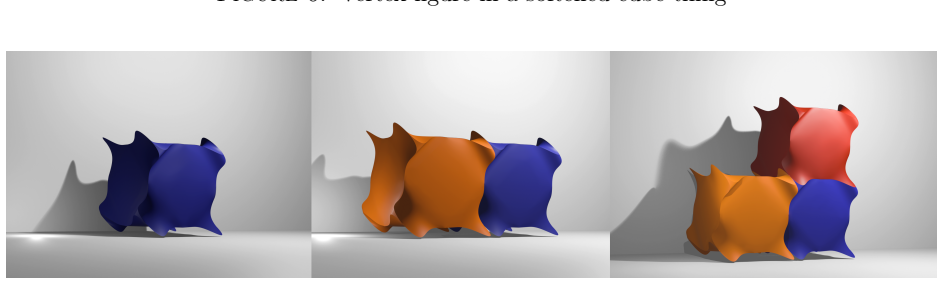
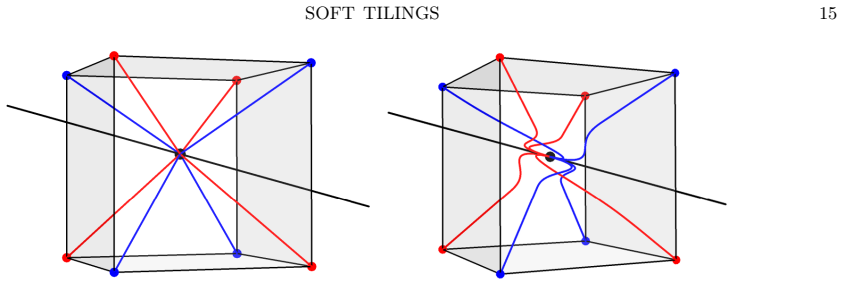
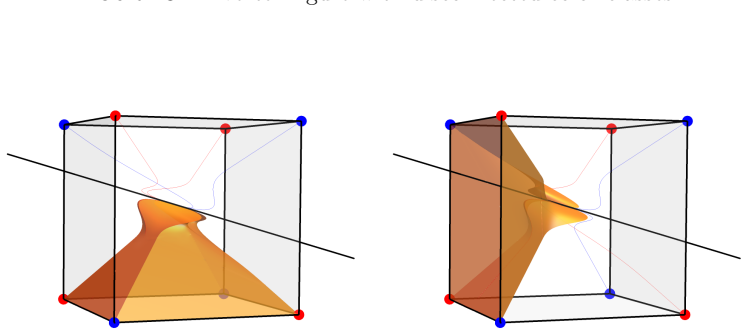
The edge-bending algorithm, which iteratively deforms edges while producing a continuous family of tilings that remain locally polyhedral throughout the deformation.
If this is right
- Every locally polyhedral tiling of R^3 admits a continuous softening deformation.
- The special case of strictly polyhedral tilings is included and therefore satisfies the 2024 conjecture.
- Balanced polygonic tilings of the plane necessarily average at least two spikes per cell.
- The algorithm supplies a constructive procedure rather than a non-constructive existence argument.
Where Pith is reading between the lines
- The result suggests that local polyhedrality is compatible with global flexibility in any dimension where analogous algorithms can be defined.
- Softened versions of such tilings may serve as models for non-rigid space-filling structures in materials or biology.
- The 2D spike bound could be used to derive further combinatorial constraints on planar tilings with prescribed edge curvatures.
Load-bearing premise
Locally polyhedral tilings admit an edge-bending process that reaches complete softening without encountering obstructions or non-termination.
What would settle it
An explicit locally polyhedral tiling of R^3 in which the edge-bending algorithm terminates before complete softening or fails to produce a continuous deformation family.
Figures

read the original abstract
By means of constructing a new edge-bending algorithm, we prove that every locally polyhedral tiling of $\mathbb{R}^3$ can be completely softened. A weaker form of this statement, for polyhedral space tilings, was conjectured by Domokos, Goriely, G. Horv\'ath and Reg\H{o}s in 2024. We also provide a short proof for a result of Domokos, G. Horv\'ath, and Reg\H{o}s, stating that in a balanced polygonic tiling of the plane, the average number of spikes is at least 2 per cell.
Editorial analysis
A structured set of objections, weighed in public.
Referee Report
Summary. The manuscript proves that every locally polyhedral tiling of R^3 admits a complete softening by means of a newly constructed edge-bending algorithm. This establishes a stronger form of the 2024 conjecture of Domokos, Goriely, Horváth and Regős for the polyhedral case. The paper also contains a short proof that the average number of spikes per cell in any balanced polygonal tiling of the plane is at least 2.
Significance. If the algorithm is rigorously shown to be well-defined on the entire class of locally polyhedral tilings, to terminate, and to produce a continuous one-parameter family of valid tilings, the result would be significant: it supplies a constructive resolution to a recent conjecture in tiling theory. The plane result is a clean combinatorial corollary. The manuscript ships a constructive mathematical proof, which is a clear strength.
minor comments (3)
- The precise definition of 'locally polyhedral' and the termination criterion for the edge-bending algorithm should be stated explicitly in the first section that introduces the main theorem, rather than being deferred to later technical lemmas.
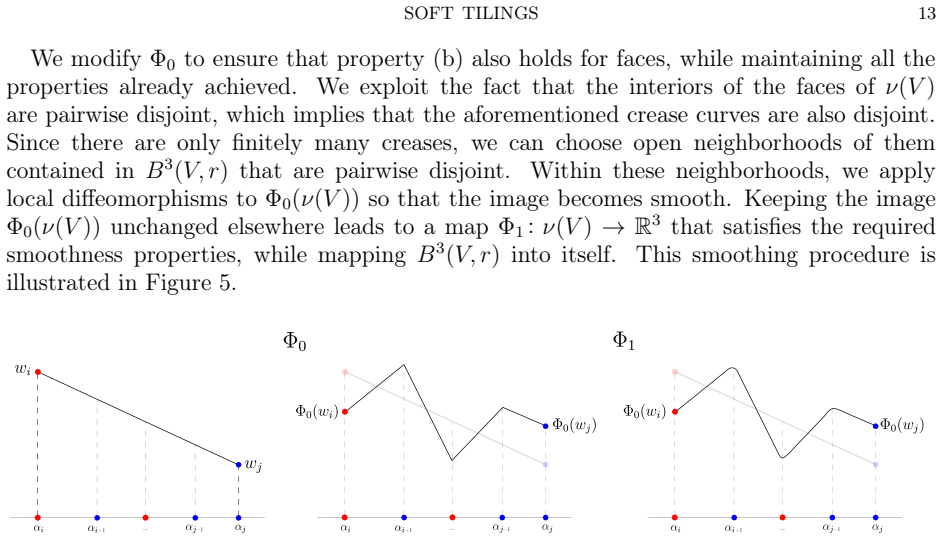
- A small illustrative figure showing one step of the edge-bending procedure on a simple cubic tiling would improve readability of the algorithm description.
- The short proof of the plane result (average spikes ≥2) could usefully include a one-sentence remark on how the argument relates to the 3D construction.
Simulated Author's Rebuttal
We thank the referee for the positive assessment of the manuscript, the recognition of its constructive resolution of the 2024 conjecture in the polyhedral case, and the recommendation for minor revision. No specific major comments were raised in the report.
Circularity Check
Constructive proof of external conjecture; no circularity
full rationale
The paper's central result is a constructive proof via a new edge-bending algorithm that every locally polyhedral tiling of R^3 admits a continuous softening, directly addressing a conjecture by unrelated authors (Domokos et al. 2024). The derivation chain consists of defining the algorithm, proving its well-definedness and termination on the given class of tilings, and verifying the output family is continuous and valid; none of these steps are shown to reduce by construction to fitted parameters, self-definitions, or prior self-citations. The secondary plane result is an independent short proof of a statement by other authors. No load-bearing premise relies on renaming known results or importing uniqueness from the present authors' prior work.
Axiom & Free-Parameter Ledger
axioms (2)
- standard math Standard axioms of Euclidean 3-space and topology for local polyhedrality.
- domain assumption Continuous deformations exist that preserve the combinatorial tiling structure.
Reference graph
Works this paper leans on
-
[1]
Appel and W
K. Appel and W. Haken. Every planar map is four colorable. Part I: Discharging.Illinois Journal of Mathematics, 21(3):429–490, 1977
1977
-
[2]
Domokos, A
G. Domokos, A. Goriely, Á. G. Horváth, and K. Regős. Soft cells and the geometry of seashells.PNAS Nexus, 3(9):pgae311, 2024
2024
-
[3]
Domokos, Á
G. Domokos, Á. G. Horváth, and K. Regős. A two-vertex theorem for normal tilings.Aequationes Mathematicae, 97(1):185–197, 2023
2023
-
[4]
P. M. Gruber.Convex and discrete geometry. Springer Verlag, 2007
2007
-
[5]
Grünbaum.Convex Polytopes, volume 221 ofGraduate Texts in Mathematics
B. Grünbaum.Convex Polytopes, volume 221 ofGraduate Texts in Mathematics. Springer Verlag, 2nd edition, 2003
2003
-
[6]
Grünbaum and G
B. Grünbaum and G. C. Shephard.Tilings and patterns. Freeman and Co., New York, 1987
1987
-
[7]
Harriss, D
E. Harriss, D. Schattschneider, and M. Senechal. Tilings. InHandbook of Discrete and Computational Geometry, 3rd Edition, pages 67–89. Chapman and Hall/CRC, 2017
2017
-
[8]
Karpiński and K
M. Karpiński and K. Piecuch. Linear-time algorithm for vertex 2-coloring without monochromatic triangles on planar graphs.arXiv preprint, 2021
2021
-
[9]
C.Thomassen.2-list-coloringplanargraphswithoutmonochromatictriangles.Journal of Combinatorial Theory, Series B, 98(6):1337–1348, 2008
2008
-
[10]
G. M. Ziegler.Lectures on polytopes, volume 152 ofGraduate Texts in Mathematics. Springer Verlag, 1994. Gergely Ambrus Bolyai Institute, University of Szeged, Hungary and Alfréd Rényi Institute of Mathematics, Budapest, Hungary e-mail address:ambrus@server.math.u-szeged.hu, ambrus@renyi.hu Dorottya Dancsó Bolyai Institute, University of Szeged, Hungary e-...
1994
discussion (0)
Sign in with ORCID, Apple, or X to comment. Anyone can read and Pith papers without signing in.