Recognition: 2 theorem links
· Lean TheoremOther red dots: A possible GLIMPSE of normal AGB stars at Cosmic Noon through extreme lensing
Pith reviewed 2026-05-13 06:47 UTC · model grok-4.3
The pith
Extreme lensing and deep JWST imaging detect individual AGB stars at redshifts 1-4
A machine-rendered reading of the paper's core claim, the machinery that carries it, and where it could break.
Core claim
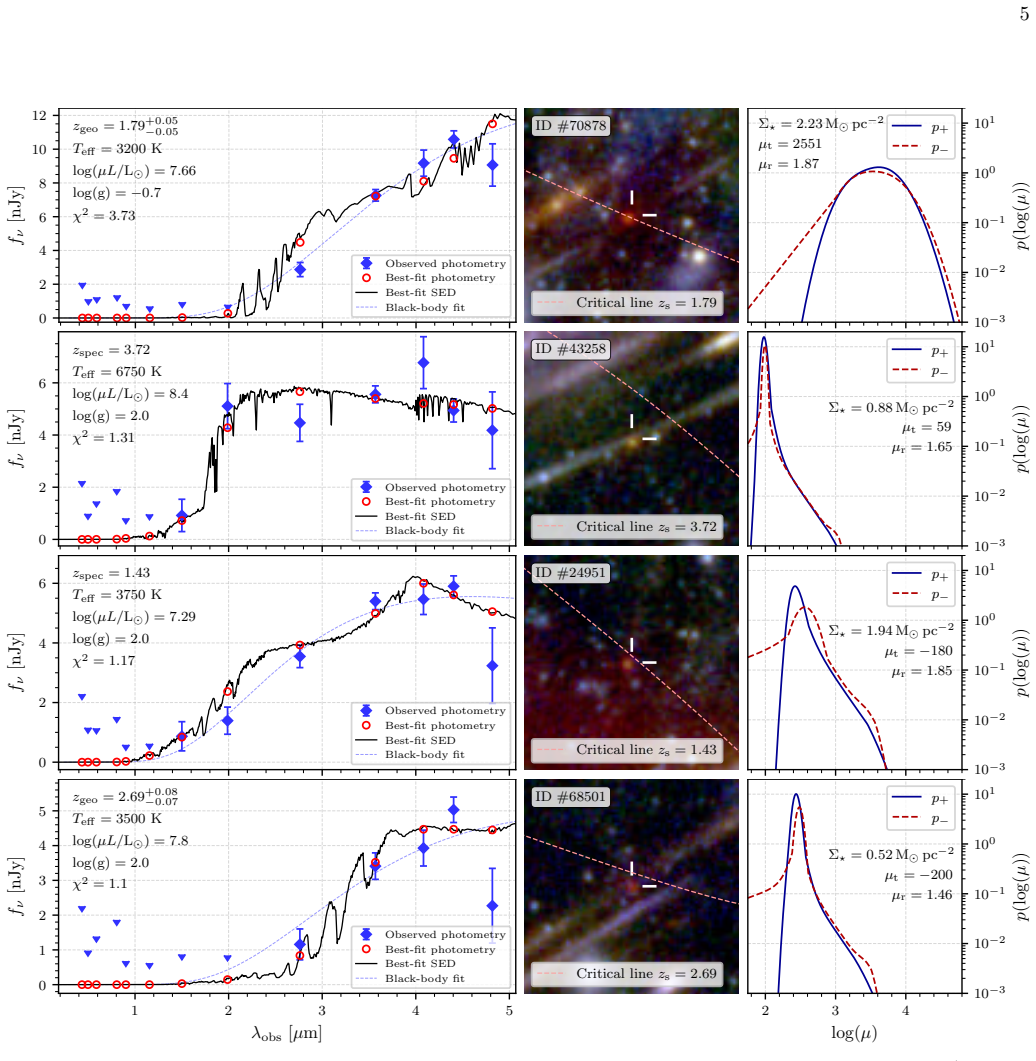
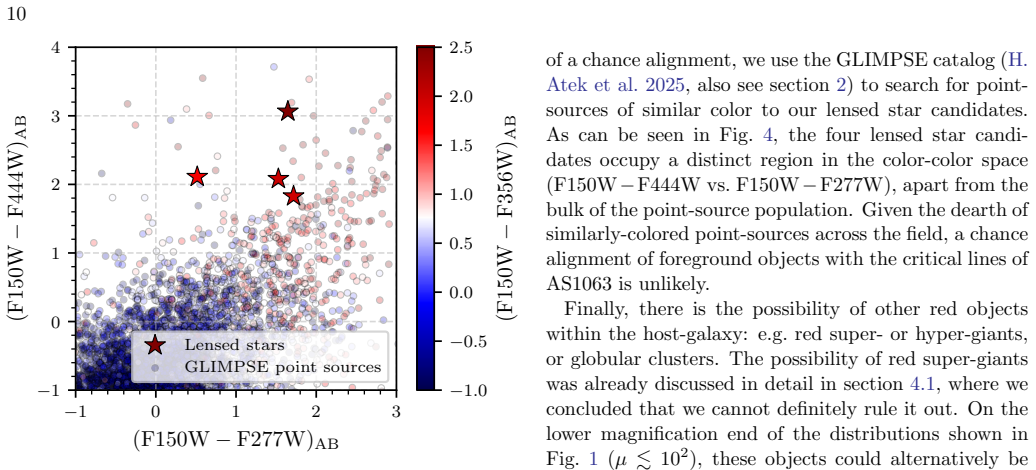
Thanks to the unprecedented depth of the GLIMPSE observations paired with the extreme lensing magnification up to mu approximately 10 to the 4, we might be resolving the lower-mass red stellar population. Concretely, we detect three likely extremely magnified asymptotic giant branch stars with effective temperatures 3200-3750 K and one yellow super-giant star with effective temperature 6750 K, possibly a yellow hyper-giant or Cepheid.
What carries the argument
Extreme gravitational lensing magnification near critical curves in Abell S1063, reaching factors up to 10,000, paired with ultra-deep JWST/NIRCam imaging that reaches surface brightnesses below 21 nJy per square arcsecond.
If this is right
- These detections open a possible window into stellar populations, evolution, and chemical enrichment at high redshifts.
- Lensed stars such as these could serve as standard candles to populate the distance ladder at cosmological redshifts.
- The appearance of similar sources in multiple faint arcs suggests this is a repeatable class of observable objects in deep lensed fields.
Where Pith is reading between the lines
- If the identifications hold, repeated imaging could measure pulsation periods of high-redshift AGB stars or Cepheids to test stellar models.
- The technique might eventually constrain the low-mass end of the initial mass function in galaxies at cosmic noon.
- Similar searches in other clusters could provide direct counts of evolved stars to compare with integrated light models of high-redshift galaxies.
Load-bearing premise
The four point sources are single stars rather than unresolved compact clusters or background contaminants, and their colors match stellar templates at the lensed redshifts.
What would settle it
Spectroscopy that shows absorption features matching AGB or supergiant atmospheres at the claimed redshifts and temperatures, or multi-epoch imaging that detects the expected variability of AGB or Cepheid stars.
Figures


read the original abstract
We report the discovery of four extremely faint ($m_{\mathrm{F444W}}\gtrsim29$) red point sources in recent ultra-deep JWST/NIRCam images of the strong lensing galaxy cluster Abell S1063. All four sources sit in lensed arcs, on the symmetry points very close to the critical curves for their host-galaxies' redshifts ($z\sim1-4$). Remarkably, these point sources appear in most arcs that are sufficiently faint close to the critical curve's position ($<21\,\mathrm{nJy}\,\mathrm{arcsec}^{-2}$ in F115W). This suggests that -- unlike previous caustic-crossing events or lensed stars -- thanks to the unprecedented depth of the GLIMPSE observations paired with the extreme lensing magnification (up to $\mu\sim10^4$) we might be resolving the lower-mass ($M\sim1-11\,\mathrm{M}_{\odot}$) red stellar population. Concretely, we detect three likely extremely magnified asymptotic giant branch (AGB) stars ($T_{\mathrm{eff}}\sim3200-3750$ K), and one yellow super-giant star ($T_{\mathrm{eff}}\sim6750$ K) -- possibly a yellow hyper-giant or a Cepheid. In addition to offering the first glimpse at low-mass extremely magnified stars, these detections open a possible window into stellar populations, evolution, and chemical enrichment at high redshifts, and could pave the way for using lensed stars such as these as standard candles to populate the distance ladder at cosmological redshifts.
Editorial analysis
A structured set of objections, weighed in public.
Referee Report
Summary. The manuscript reports the discovery of four extremely faint red point sources (m_F444W ≳29) in ultra-deep JWST/NIRCam images of the strong-lensing cluster Abell S1063. These sources lie on symmetry points very close to the critical curves of their host arcs at z∼1-4. The authors interpret three as extremely magnified AGB stars (T_eff∼3200-3750 K) and one as a yellow supergiant (T_eff∼6750 K), attributing the detections to the combination of GLIMPSE depth and magnifications up to μ∼10^4 that resolve low-mass (1-11 M_⊙) red stellar populations at cosmic noon.
Significance. If the identifications as individual stars are confirmed, the result would be significant: it offers the first direct view of the lower-mass end of the red stellar population at high redshift via extreme lensing, with potential implications for stellar evolution, chemical enrichment, and the use of such stars as standard candles. The approach leverages unprecedented JWST depth paired with caustic proximity in a novel way.
major comments (3)
- [Abstract and results section on source identification] The central claim that the four m_F444W ≳29 point sources are single AGB or yellow-supergiant stars at the arc redshifts rests on positional coincidence with critical curves plus broadband color matching to stellar templates in the available NIRCam bands. No spectroscopic confirmation is presented, and quantitative modeling of alternatives (compact star-forming knots, unresolved clusters, or foreground/background contaminants) is absent; this directly undermines the interpretation as resolved individual stars.
- [Lens modeling and magnification estimates] The extreme magnifications (μ∼10^4) invoked to resolve M∼1-11 M_⊙ stars are taken from external lens models without reported uncertainty quantification or sensitivity tests at the precise locations of the four sources; small shifts in the critical-curve position would change the inferred intrinsic luminosities and stellar types substantially.
- [Selection and detection statistics] The statement that the sources appear in 'most arcs that are sufficiently faint close to the critical curve's position (<21 nJy arcsec^{-2} in F115W)' introduces a potential post-hoc selection bias. The paper does not demonstrate that the detection rate remains significant when the faint-arc threshold is varied or when all arcs near critical curves are considered without the flux cut.
minor comments (2)
- [Photometry section] Clarify the exact photometric apertures and background subtraction used for the point sources in the F115W and F444W bands; provide the full SED table for independent verification.
- [Figures showing source positions] Add error bars or uncertainty regions to the critical-curve overlays in the figures showing the four sources.
Simulated Author's Rebuttal
We thank the referee for their careful and constructive review. We address each major comment below and describe the revisions we will incorporate.
read point-by-point responses
-
Referee: [Abstract and results section on source identification] The central claim that the four m_F444W ≳29 point sources are single AGB or yellow-supergiant stars at the arc redshifts rests on positional coincidence with critical curves plus broadband color matching to stellar templates in the available NIRCam bands. No spectroscopic confirmation is presented, and quantitative modeling of alternatives (compact star-forming knots, unresolved clusters, or foreground/background contaminants) is absent; this directly undermines the interpretation as resolved individual stars.
Authors: We agree that spectroscopic confirmation would be definitive, but the extreme faintness (m_F444W ≳29) makes it infeasible with current facilities. The positional alignment with critical curves and color consistency with stellar templates remain the primary evidence. In revision we will add quantitative simulations of alternative scenarios (compact knots, unresolved clusters, and contaminants) to assess their viability relative to the stellar interpretation. revision: partial
-
Referee: [Lens modeling and magnification estimates] The extreme magnifications (μ∼10^4) invoked to resolve M∼1-11 M_⊙ stars are taken from external lens models without reported uncertainty quantification or sensitivity tests at the precise locations of the four sources; small shifts in the critical-curve position would change the inferred intrinsic luminosities and stellar types substantially.
Authors: We will perform and report sensitivity tests that shift the critical-curve locations within the published uncertainties of the external lens models. The revised manuscript will include the resulting range in magnification and the corresponding impact on inferred stellar luminosities and types. revision: yes
-
Referee: [Selection and detection statistics] The statement that the sources appear in 'most arcs that are sufficiently faint close to the critical curve's position (<21 nJy arcsec^{-2} in F115W)' introduces a potential post-hoc selection bias. The paper does not demonstrate that the detection rate remains significant when the faint-arc threshold is varied or when all arcs near critical curves are considered without the flux cut.
Authors: We will revise the selection section to include a systematic test: we vary the surface-brightness threshold around the quoted value and repeat the analysis on the full set of arcs near critical curves without the flux cut. The revised text will show that the detection rate remains statistically significant across these variations, confirming that the result is not driven by a post-hoc cut. revision: yes
- Spectroscopic confirmation of the sources, which is not feasible with existing instrumentation given their extreme faintness.
Circularity Check
No significant circularity; claims rest on external lensing models and standard templates
full rationale
The paper presents an observational discovery of faint point sources and classifies them via broadband color matching to external stellar templates plus magnification factors drawn from cited lens models. No derivation chain, equation, or fitted parameter within the manuscript reduces the central claims to quantities defined by the paper itself. Self-citations (if present for lens modeling) are not load-bearing for the stellar identification step, which remains independently falsifiable against template libraries and contamination tests. This is the expected outcome for an observational report relying on standard astrophysical tools.
Axiom & Free-Parameter Ledger
free parameters (1)
- effective temperature from colors =
3200-3750 K and 6750 K
axioms (1)
- domain assumption Strong gravitational lensing produces magnifications up to 10^4 near critical curves of galaxy clusters
Lean theorems connected to this paper
-
IndisputableMonolith/Cost/FunctionalEquation.leanwashburn_uniqueness_aczel unclear?
unclearRelation between the paper passage and the cited Recognition theorem.
We fit the HST and JWST photometric fluxes with the stellar SED templates of T. Lejeune et al. (1997)... best-fit parameters... Teff, log(g), μLbol/L⊙
-
IndisputableMonolith/Foundation/RealityFromDistinction.leanreality_from_one_distinction unclear?
unclearRelation between the paper passage and the cited Recognition theorem.
We use a new parametric SL model... PIEMDs and 303 cluster member galaxies... AstroLensPy
What do these tags mean?
- matches
- The paper's claim is directly supported by a theorem in the formal canon.
- supports
- The theorem supports part of the paper's argument, but the paper may add assumptions or extra steps.
- extends
- The paper goes beyond the formal theorem; the theorem is a base layer rather than the whole result.
- uses
- The paper appears to rely on the theorem as machinery.
- contradicts
- The paper's claim conflicts with a theorem or certificate in the canon.
- unclear
- Pith found a possible connection, but the passage is too broad, indirect, or ambiguous to say the theorem truly supports the claim.
Forward citations
Cited by 1 Pith paper
-
A Glimpse of the Low-Mass End of the Direct Mass-Metallicity Relation at $z\sim6-8$
Direct [OIII]4364-based metallicities show that galaxies with stellar masses 10^6.7-9 solar masses at z~6-8 are 0.3-0.5 dex more metal-poor than local galaxies of the same mass, with slope 0.25 and 0.2 dex scatter.
Reference graph
Works this paper leans on
-
[1]
Abell, G. O., Corwin, Jr., H. G., & Olowin, R. P. 1989, ApJS, 70, 1, doi: 10.1086/191333
-
[2]
Allingham, J. F. V., Zitrin, A., Kokorev, V., et al. 2026, arXiv e-prints, arXiv:2602.14074, doi: 10.48550/arXiv.2602.14074 Arellano-C´ ordova, K. Z., Cullen, F., Carnall, A. C., et al. 2025, MNRAS, 540, 2991, doi: 10.1093/mnras/staf855 Astropy Collaboration, Robitaille, T. P., Tollerud, E. J., et al. 2013, A&A, 558, A33, doi: 10.1051/0004-6361/201322068
-
[3]
JWST’s GLIMPSE: an overview of the deep- est probe of early galaxy formation and cosmic reionization
Atek, H., Chisholm, J., Kokorev, V., et al. 2025, arXiv e-prints, arXiv:2511.07542, doi: 10.48550/arXiv.2511.07542
-
[4]
Bacon, R., Accardo, M., Adjali, L., et al. 2010, in Society of Photo-Optical Instrumentation Engineers (SPIE) Conference Series, Vol. 7735, Ground-based and Airborne Instrumentation for Astronomy III, ed. I. S. McLean, S. K. Ramsay, & H. Takami, 773508, doi: 10.1117/12.856027
-
[5]
2013, A&A, 559, L9, doi: 10.1051/0004-6361/201322620
Balestra, I., Vanzella, E., Rosati, P., et al. 2013, A&A, 559, L9, doi: 10.1051/0004-6361/201322620
-
[6]
Bastian, N., Covey, K. R., & Meyer, M. R. 2010, ARA&A, 48, 339, doi: 10.1146/annurev-astro-082708-101642
-
[7]
2014, MNRAS, 443, 3594, doi: 10.1093/mnras/stu1407
Bastian, N., & Strader, J. 2014, MNRAS, 443, 3594, doi: 10.1093/mnras/stu1407
-
[8]
2024, MNRAS, 527, 3246, doi: 10.1093/mnras/stad3308
Beauchesne, B., Cl´ ement, B., Hibon, P., et al. 2024, MNRAS, 527, 3246, doi: 10.1093/mnras/stad3308
-
[9]
2025, arXiv e-prints, arXiv:2509.07777, doi: 10.48550/arXiv.2509.07777
Beauchesne, B., Cl´ ement, B., Limousin, M., et al. 2025, arXiv e-prints, arXiv:2509.07777, doi: 10.48550/arXiv.2509.07777
-
[10]
Berg, D. A., Naidu, R. P., Chisholm, J., et al. 2025, arXiv e-prints, arXiv:2511.13591, doi: 10.48550/arXiv.2511.13591
work page internal anchor Pith review Pith/arXiv arXiv doi:10.48550/arxiv.2511.13591 2025
-
[11]
2019, A&A, 631, A130, doi: 10.1051/0004-6361/201935974
Bergamini, P., Rosati, P., Mercurio, A., et al. 2019, A&A, 631, A130, doi: 10.1051/0004-6361/201935974
-
[12]
Bezanson, R., Labbe, I., Whitaker, K. E., et al. 2022, arXiv e-prints, arXiv:2212.04026, doi: 10.48550/arXiv.2212.04026 B¨ oker, T., Beck, T. L., Birkmann, S. M., et al. 2023, PASP, 135, 038001, doi: 10.1088/1538-3873/acb846
-
[13]
2025,, 2.2.0 Zenodo, doi: 10.5281/zenodo.14889440
Bradley, L., Sip˝ ocz, B., Robitaille, T., et al. 2025, astropy/photutils: 2.2.0, 2.2.0 Zenodo, doi: 10.5281/zenodo.14889440
-
[14]
2023, msaexp: NIRSpec analyis tools, 0.6.17 Zenodo, doi: 10.5281/zenodo.8319596
Brammer, G. 2023, msaexp: NIRSpec analyis tools, 0.6.17 Zenodo, doi: 10.5281/zenodo.8319596
-
[15]
Bunker, A. J., Saxena, A., Cameron, A. J., et al. 2023, A&A, 677, A88, doi: 10.1051/0004-6361/202346159
-
[16]
2025, arXiv e-prints, arXiv:2512.07955, doi: 10.48550/arXiv.2512.07955
Cataldi, E., Belfiore, F., Curti, M., et al. 2025, arXiv e-prints, arXiv:2512.07955, doi: 10.48550/arXiv.2512.07955
work page internal anchor Pith review doi:10.48550/arxiv.2512.07955 2025
-
[17]
Chabrier, G. 2003, PASP, 115, 763, doi: 10.1086/376392
work page internal anchor Pith review doi:10.1086/376392 2003
-
[18]
Chen, W., Kelly, P. L., Diego, J. M., et al. 2019, ApJ, 881, 8, doi: 10.3847/1538-4357/ab297d
-
[19]
M., Slob, M., Kriek, M., et al
Cheng, C. M., Slob, M., Kriek, M., et al. 2026, arXiv e-prints, arXiv:2601.20864, doi: 10.48550/arXiv.2601.20864
-
[20]
Diego, J. M., Pascale, M., Kavanagh, B. J., et al. 2022, A&A, 665, A134, doi: 10.1051/0004-6361/202243605
-
[21]
Diego, J. M., Willner, S. P., Palencia, J. M., & Windhorst, R. A. 2026a, A&A, 706, A119, doi: 10.1051/0004-6361/202553675
-
[22]
M., Kaiser, N., Broadhurst, T., et al
Diego, J. M., Kaiser, N., Broadhurst, T., et al. 2018, ApJ, 857, 25, doi: 10.3847/1538-4357/aab617
-
[23]
Diego, J. M., Meena, A. K., Adams, N. J., et al. 2023a, A&A, 672, A3, doi: 10.1051/0004-6361/202245238
-
[24]
M., Pascale, M., Frye, B., et al
Diego, J. M., Pascale, M., Frye, B., et al. 2023b, A&A, 679, A159, doi: 10.1051/0004-6361/202345868
-
[25]
Diego, J. M., Sun, B., Yan, H., et al. 2023c, A&A, 679, A31, doi: 10.1051/0004-6361/202347556
-
[26]
Diego, J. M., Li, S. K., Amruth, A., et al. 2024a, A&A, 689, A167, doi: 10.1051/0004-6361/202450474 15
-
[27]
Diego, J. M., Amruth, A., Palencia, J. M., et al. 2024b, A&A, 690, A359, doi: 10.1051/0004-6361/202451246
-
[28]
Diego, J. M., Palencia, J. M., Goolsby, C., et al. 2026b, arXiv e-prints, arXiv:2601.11704. https://arxiv.org/abs/2601.11704
-
[29]
Doherty, C. L., Gil-Pons, P., Lau, H. H. B., et al. 2014, MNRAS, 441, 582, doi: 10.1093/mnras/stu571
-
[30]
L., Gil-Pons, P., Siess, L., & Lattanzio, J
Doherty, C. L., Gil-Pons, P., Siess, L., & Lattanzio, J. C. 2017, PASA, 34, e056, doi: 10.1017/pasa.2017.52
-
[31]
Earl, N., Tollerud, E., Jones, C., et al. 2021, astropy/specutils: V1.5.0, v1.5.0 Zenodo, doi: 10.5281/zenodo.5721652 El´ ıasd´ ottir,´A., Limousin, M., Richard, J., et al. 2007, ArXiv e-prints. https://arxiv.org/abs/0710.5636
-
[32]
Endsley, R., Stark, D. P., Whitler, L., et al. 2024, MNRAS, 533, 1111, doi: 10.1093/mnras/stae1857
-
[33]
2022, A&A, 661, A81, doi: 10.1051/0004-6361/202142673
Ferruit, P., Jakobsen, P., Giardino, G., et al. 2022, A&A, 661, A81, doi: 10.1051/0004-6361/202142673
-
[34]
and Lang, Dustin and Goodman, Jonathan , title =
Foreman-Mackey, D., Hogg, D. W., Lang, D., & Goodman, J. 2013, PASP, 125, 306, doi: 10.1086/670067
-
[35]
Freedman, W. L., & Madore, B. F. 2020, ApJ, 899, 67, doi: 10.3847/1538-4357/aba9d8
- [36]
-
[37]
Symposium, Vol. 376, IAU Symposium, ed. R. de Grijs, P. A. Whitelock, & M. Catelan, 1–14, doi: 10.1017/S1743921323003459
-
[38]
Fudamoto, Y., Sun, F., Diego, J. M., et al. 2025, Nature Astronomy, 9, 428, doi: 10.1038/s41550-024-02432-3
-
[39]
Fujimoto, S., Naidu, R. P., Chisholm, J., et al. 2025a, ApJ, 989, 46, doi: 10.3847/1538-4357/ade9a1
-
[40]
Fujimoto, S., Asada, Y., Naidu, R. P., et al. 2025b, arXiv e-prints, arXiv:2512.11790, doi: 10.48550/arXiv.2512.11790
-
[41]
Furtak, L. J., Meena, A. K., Zackrisson, E., et al. 2024, MNRAS, 527, L7, doi: 10.1093/mnrasl/slad135
-
[42]
Gardner, J. P., Mather, J. C., Abbott, R., et al. 2023, PASP, 135, 068001, doi: 10.1088/1538-3873/acd1b5
-
[43]
Gil-Pons, P., Doherty, C. L., Guti´ errez, J. L., et al. 2018, PASA, 35, e038, doi: 10.1017/pasa.2018.42
-
[44]
Greene, J. E., Labbe, I., Goulding, A. D., et al. 2024, ApJ, 964, 39, doi: 10.3847/1538-4357/ad1e5f
-
[45]
Humphreys, R. M., Davidson, K., & Smith, N. 2002, AJ, 124, 1026, doi: 10.1086/341380
-
[46]
Hunter, J. D. 2007, Computing in Science & Engineering, 9, 90, doi: 10.1109/MCSE.2007.55
-
[47]
2024, arXiv e-prints, arXiv:2405.04530, doi: 10.48550/arXiv.2405.04530
Jakobsen, P. 2024, arXiv e-prints, arXiv:2405.04530, doi: 10.48550/arXiv.2405.04530
-
[48]
2022, A&A, 661, A80, doi: 10.1051/0004-6361/202142663
Jakobsen, P., Ferruit, P., Alves de Oliveira, C., et al. 2022, A&A, 661, A80, doi: 10.1051/0004-6361/202142663
work page internal anchor Pith review doi:10.1051/0004-6361/202142663 2022
-
[49]
Jones, T. J., Humphreys, R. M., Gehrz, R. D., et al. 1993, ApJ, 411, 323, doi: 10.1086/172832
-
[50]
Karakas, A. I., & Lattanzio, J. C. 2014, PASA, 31, e030, doi: 10.1017/pasa.2014.21
-
[51]
1993, ApJ, 417, 450, doi: 10.1086/173325
Kassiola, A., & Kovner, I. 1993, ApJ, 417, 450, doi: 10.1086/173325
-
[52]
Kelly, P. L., Diego, J. M., Rodney, S., et al. 2018, Nature Astronomy, 2, 334, doi: 10.1038/s41550-018-0430-3
-
[53]
L., Chen, W., Alfred, A., et al
Kelly, P. L., Chen, W., Alfred, A., et al. 2022, arXiv e-prints, arXiv:2211.02670, doi: 10.48550/arXiv.2211.02670
-
[54]
2013, Stellar Structure and Evolution, doi: 10.1007/978-3-642-30304-3
Kippenhahn, R., Weigert, A., & Weiss, A. 2013, Stellar Structure and Evolution, doi: 10.1007/978-3-642-30304-3
-
[55]
Kobayashi, C., Karakas, A. I., & Lugaro, M. 2020, ApJ, 900, 179, doi: 10.3847/1538-4357/abae65
-
[56]
Kokorev, V., Caputi, K. I., Greene, J. E., et al. 2024, ApJ, 968, 38, doi: 10.3847/1538-4357/ad4265
-
[57]
2013, in Planets, Stars and Stellar Systems
Kroupa, P., Weidner, C., Pflamm-Altenburg, J., et al. 2013, in Planets, Stars and Stellar Systems. Volume 5: Galactic Structure and Stellar Populations, ed. T. D. Oswalt & G. Gilmore, Vol. 5, 115, doi: 10.1007/978-94-007-5612-0 4
-
[58]
Leavitt, H. S., & Pickering, E. C. 1912, Harvard College Observatory Circular, 173, 1
work page 1912
-
[59]
Lee, M. G., Freedman, W. L., & Madore, B. F. 1993, ApJ, 417, 553, doi: 10.1086/173334
-
[60]
1997, A&AS, 125, 229, doi: 10.1051/aas:1997373
Lejeune, T., Cuisinier, F., & Buser, R. 1997, A&AS, 125, 229, doi: 10.1051/aas:1997373
-
[61]
Levesque, E. M. 2017, Astrophysics of Red Supergiants, doi: 10.1088/978-0-7503-1329-2
-
[62]
M., Koekemoer, A., Coe, D., et al
Lotz, J. M., Koekemoer, A., Coe, D., et al. 2017, ApJ, 837, 97, doi: 10.3847/1538-4357/837/1/97
-
[63]
Lundqvist, E., Zackrisson, E., Hawcroft, C., Amarsi, A. M., & Welch, B. 2024, A&A, 690, A291, doi: 10.1051/0004-6361/202450403
-
[64]
2008, A&A, 482, 883, doi: 10.1051/0004-6361:20078467
Marigo, P., Girardi, L., Bressan, A., et al. 2008, A&A, 482, 883, doi: 10.1051/0004-6361:20078467
-
[65]
Matthee, J., Naidu, R. P., Brammer, G., et al. 2024, ApJ, 963, 129, doi: 10.3847/1538-4357/ad2345
-
[66]
McQuinn, K. B. W., Boyer, M., Skillman, E. D., & Dolphin, A. E. 2019, ApJ, 880, 63, doi: 10.3847/1538-4357/ab2627
-
[67]
K., Zitrin, A., Jim´ enez-Teja, Y., et al
Meena, A. K., Zitrin, A., Jim´ enez-Teja, Y., et al. 2023a, ApJL, 944, L6, doi: 10.3847/2041-8213/acb645
-
[68]
K., Chen, W., Zitrin, A., et al
Meena, A. K., Chen, W., Zitrin, A., et al. 2023b, MNRAS, 521, 5224, doi: 10.1093/mnras/stad869
-
[69]
Meena, A. K., Li, S. K., Zitrin, A., et al. 2025, A&A, 699, A299, doi: 10.1051/0004-6361/202555023
-
[70]
1991, ApJ, 379, 94, doi: 10.1086/170486
Miralda-Escude, J. 1991, ApJ, 379, 94, doi: 10.1086/170486
-
[71]
2014, MNRAS, 438, 1417, doi: 10.1093/mnras/stt2284 16
Monna, A., Seitz, S., Greisel, N., et al. 2014, MNRAS, 438, 1417, doi: 10.1093/mnras/stt2284 16
-
[72]
1986, ApJ, 305, 591, doi: 10.1086/164273
Mould, J., & Kristian, J. 1986, ApJ, 305, 591, doi: 10.1086/164273
-
[73]
2025, A&A, 693, A116, doi: 10.1051/0004-6361/202451153
Nabizadeh, A., Zackrisson, E., Lundqvist, E., et al. 2025, A&A, 693, A116, doi: 10.1051/0004-6361/202451153
-
[74]
Ofek, E. O. 2014, MAAT: MATLAB Astronomy and Astrophysics Toolbox,, Astrophysics Source Code Library, record ascl:1407.005 http://ascl.net/1407.005
work page 2014
-
[75]
Oke, J. B., & Gunn, J. E. 1983, ApJ, 266, 713, doi: 10.1086/160817
-
[76]
Palencia, J. M., Diego, J. M., Kavanagh, B. J., & Mart´ ınez-Arrizabalaga, J. 2024, A&A, 687, A81, doi: 10.1051/0004-6361/202347492
-
[77]
2012, ApJS, 199, 25, doi: 10.1088/0067-0049/199/2/25
Postman, M., Coe, D., Ben´ ıtez, N., et al. 2012, ApJS, 199, 25, doi: 10.1088/0067-0049/199/2/25
-
[78]
The Astronomical Journal , author =
Price-Whelan, A. M., Sip˝ ocz, B. M., G¨ unther, H. M., et al. 2018, AJ, 156, 123, doi: 10.3847/1538-3881/aabc4f
-
[79]
2021, A&A, 646, A83, doi: 10.1051/0004-6361/202039462
Richard, J., Claeyssens, A., Lagattuta, D., et al. 2021, A&A, 646, A83, doi: 10.1051/0004-6361/202039462
-
[80]
Rieke, M. J., Kelly, D. M., Misselt, K., et al. 2023, PASP, 135, 028001, doi: 10.1088/1538-3873/acac53
discussion (0)
Sign in with ORCID, Apple, or X to comment. Anyone can read and Pith papers without signing in.