Recognition: unknown
VLTI-GRAVITY observations of blazars
Pith reviewed 2026-05-10 02:31 UTC · model grok-4.3
The pith
Near-infrared interferometry detects compact jet emission from blazars at milliarcsecond scales.
A machine-rendered reading of the paper's core claim, the machinery that carries it, and where it could break.
Core claim
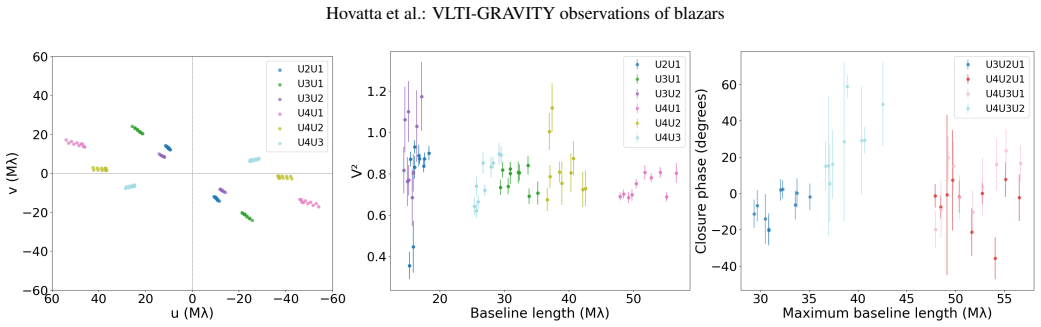
The squared visibilities measured for the flaring blazar are incompatible with a single unresolved point source without invoking significant additional unknown coherence loss. The same data can be reproduced either by adding an extended component to the point source or by using a single Gaussian component instead. This indicates that the observations are capturing the unresolved or only partially resolved base of the jet in near-infrared light. Attempts to observe four non-flaring blazars in wide-field mode produced either non-detections or data too limited for modeling.
What carries the argument
Squared visibility measurements obtained through near-infrared interferometry, tested against point-source and Gaussian models to determine whether the emission is spatially extended.
If this is right
- Compact jet emission from blazars is detectable with near-infrared interferometry.
- The jet base remains unresolved or only partially resolved at these wavelengths under the observed conditions.
- Improved instrument sensitivity and performance will enable spatial resolution and direct imaging of the near-infrared jet emission.
- Wide-field observing mode encounters practical difficulties with fainter targets, often resulting in unusable data.
Where Pith is reading between the lines
- Confirmation of extended near-infrared structure would locate the NIR-emitting zone relative to the central engine more tightly than millimeter data alone.
- The same technique could be applied to additional flaring events to test whether jet-base size changes with activity level.
- Future observations might distinguish instrumental coherence effects from true source extension through repeated measurements under varying conditions.
Load-bearing premise
The squared visibility data can be interpreted with standard calibration once an extra coherence loss term is added, and that simple point-source or Gaussian models are sufficient to describe the emission geometry.
What would settle it
A calibration run or independent measurement showing that the instrument coherence during the flaring-blazar observation matches the nominal value with no unexplained loss, or follow-up data that clearly separate an extended component from a pure point source.
Figures


read the original abstract
Parsec-scale jets of blazars have so far been spatially resolved only in millimeter and submillimeter wavelengths, where very long baseline interferometry can be used to obtain milliarcsecond-scale images of the jets. We have attempted to spatially resolve the near-infrared emission in jet-dominated blazars for the first time. We used the VLTI-GRAVITY instrument to obtain milliarcsecond-scale near-infrared interferometric observations of a flaring blazar Ton 599. Additionally, we observed four non-flaring blazars using the GRAVITY-wide mode, where a nearby bright star is used as a fringe tracker. We modeled the squared visibilities of Ton 599 and found that they are incompatible with a single unresolved point source unless there is a significant amount of additional unknown coherence loss in the instrument. With the present data, we cannot distinguish between a model with an unresolved point source and extended emission or coherence loss and a model with a single Gaussian component. This suggests that we are seeing the unresolved or only partially resolved jet-base in near-infrared wavelengths. The wide-field mode of GRAVITY was challenging for the additional relatively faint targets, resulting in either non-detections or poor-quality data that could not be modeled. Our observations demonstrate that it is possible to detect the compact jet emission in blazars with near-infrared interferometry, suggesting that with the improved GRAVITY+ instrument it will be possible to spatially resolve and image the near-infrared emission of blazar jets.
Editorial analysis
A structured set of objections, weighed in public.
Referee Report
Summary. The manuscript reports VLTI-GRAVITY observations of five blazars, with detailed modeling of squared visibilities for the flaring source Ton 599. These data are incompatible with an unresolved point source unless significant additional coherence loss is invoked; a single Gaussian component provides an alternative fit, but the observations cannot distinguish between partial resolution of the jet base and instrumental effects. Wide-mode observations of the four non-flaring targets yielded non-detections or unmodelable data. The authors conclude that compact jet emission is detectable in the near-infrared with interferometry and that GRAVITY+ will enable spatial resolution and imaging of blazar jets.
Significance. If the Ton 599 visibilities can be shown to favor an astrophysical origin over unknown systematics, this would mark the first near-infrared interferometric detection of compact emission associated with a blazar jet, providing a new probe of the jet-launching region complementary to radio VLBI. The work also documents practical limitations of GRAVITY wide mode for faint targets, which is useful for planning future observations. The current ambiguity between models, however, renders the detection claim preliminary rather than definitive.
major comments (2)
- [Abstract] Abstract: The claim that the observations 'demonstrate that it is possible to detect the compact jet emission' rests on the Ton 599 squared visibilities. The text states these are incompatible with a point source only after assuming significant additional unknown coherence loss, yet a single Gaussian component fits equally well and the two interpretations cannot be distinguished. This degeneracy means the data do not yet securely establish an astrophysical detection of extended jet emission versus instrumental coherence loss, which is load-bearing for the feasibility conclusion.
- [Modeling of Ton 599] Modeling section (Ton 599 analysis): The paper invokes 'additional coherence loss' as a free parameter to reconcile the data with a point source, while the Gaussian model has its own size parameter. No quantitative comparison (e.g., reduced chi-squared values, Bayesian evidence, or residual analysis) is provided to assess which interpretation is preferred or whether the degeneracy can be broken with the reported calibration. This directly affects whether the result supports the strongest claim.
minor comments (2)
- [Abstract] Abstract: The sentence 'we cannot distinguish between a model with an unresolved point source and extended emission or coherence loss and a model with a single Gaussian component' is awkwardly phrased and could be clarified to explicitly state the two competing scenarios.
- [Figures] Figure captions and text: Ensure all visibility plots for Ton 599 show both the point-source-plus-coherence-loss and Gaussian models overlaid on the data with residuals, and state the number of degrees of freedom for each fit.
Simulated Author's Rebuttal
We thank the referee for their careful and constructive review of our manuscript. We agree that the abstract claim requires tempering due to the acknowledged model degeneracy and that quantitative fit metrics should be added to the modeling section. We have revised the manuscript to address these points directly while preserving the honest description of the data limitations already present in the text.
read point-by-point responses
-
Referee: [Abstract] Abstract: The claim that the observations 'demonstrate that it is possible to detect the compact jet emission' rests on the Ton 599 squared visibilities. The text states these are incompatible with a point source only after assuming significant additional unknown coherence loss, yet a single Gaussian component fits equally well and the two interpretations cannot be distinguished. This degeneracy means the data do not yet securely establish an astrophysical detection of extended jet emission versus instrumental coherence loss, which is load-bearing for the feasibility conclusion.
Authors: We agree that the original abstract wording overstated the definitiveness of the result. The manuscript text already notes the inability to distinguish between an unresolved source plus coherence loss and a Gaussian component, and the referee correctly identifies that this ambiguity affects the strength of the feasibility conclusion. We have revised the abstract to replace 'demonstrate that it is possible to detect' with 'suggest that it may be possible to detect' and to explicitly reference the model degeneracy. This change ensures the abstract accurately reflects the preliminary character of the Ton 599 result while still conveying the practical demonstration that GRAVITY can obtain usable data on a flaring blazar. revision: yes
-
Referee: [Modeling of Ton 599] Modeling section (Ton 599 analysis): The paper invokes 'additional coherence loss' as a free parameter to reconcile the data with a point source, while the Gaussian model has its own size parameter. No quantitative comparison (e.g., reduced chi-squared values, Bayesian evidence, or residual analysis) is provided to assess which interpretation is preferred or whether the degeneracy can be broken with the reported calibration. This directly affects whether the result supports the strongest claim.
Authors: We acknowledge that the submitted manuscript lacks explicit quantitative model-comparison statistics. In the revised version we will include reduced chi-squared values for both the point-source model (with the additional coherence-loss parameter) and the single-Gaussian model, together with a short residual analysis. Because the number of independent visibility measurements is small, we do not intend to compute Bayesian evidence; the chi-squared comparison will suffice to illustrate that both models provide statistically acceptable fits, thereby quantifying the degeneracy already stated in the text. These additions will not change the conclusion that the present data cannot securely separate astrophysical extension from instrumental effects. revision: yes
Circularity Check
No circularity: direct observational modeling with no derivation chain
full rationale
The paper reports new VLTI-GRAVITY interferometric observations of blazars and compares squared visibility data to simple geometric models (unresolved point source vs. Gaussian). No theoretical derivation, fitted parameters renamed as predictions, or self-citation load-bearing steps exist. Conclusions follow from direct data-model comparison using standard techniques; the analysis is self-contained against external benchmarks.
Axiom & Free-Parameter Ledger
free parameters (2)
- additional coherence loss
- Gaussian component size or extended emission parameters
axioms (1)
- domain assumption VLTI-GRAVITY calibration and fringe-tracking performance follow standard models except for possible additional unknown coherence loss
Reference graph
Works this paper leans on
-
[1]
The Discovery of Polarized Water Vapor Megamaser Emission in a Molecular Accretion Disk. , keywords =. doi:10.3847/2041-8213/ad864f , archivePrefix =. 2410.10569 , primaryClass =
-
[2]
Parsec-scale HI outflows in powerful radio galaxies. , keywords =. doi:10.1051/0004-6361/202037677 , archivePrefix =. 2010.05996 , primaryClass =
-
[3]
Extended radio emission and the nature of blazars. , keywords =. doi:10.1086/163284 , adsurl =
-
[4]
Extended Radio Emission in MOJAVE Blazars: Challenges to Unification. , keywords =. doi:10.1088/0004-637X/710/1/764 , archivePrefix =. 1001.0731 , primaryClass =
-
[5]
GRAVITY - Instrument description. VLTI-How: The VLTI High angular resolution Observations Workshop (vltihow2022 , year = 2022, month = nov, eid =. doi:10.5281/zenodo.7535113 , adsurl =
-
[6]
Kinematics of Parsec-scale Jets of Gamma-Ray Blazars at 43 GHz within the VLBA-BU-BLAZAR Program. , keywords =. doi:10.3847/1538-4357/aa8407 , archivePrefix =. 1711.03983 , primaryClass =
-
[7]
Probing the inner regions of supermassive black hole accretion disks and jets
-
[8]
MAGIC Discovery of Very High Energy Emission from the FSRQ PKS 1222+21. , keywords =. doi:10.1088/2041-8205/730/1/L8 , archivePrefix =. 1101.4645 , primaryClass =
-
[9]
1992, ApJ, 398, 454, doi: 10.1086/171869
A Survey for High Optical Polarization in Quasars with Core-dominant Radio Structure: Is There a Beamed Optical Continuum?. , keywords =. doi:10.1086/171869 , adsurl =
-
[10]
37 GHz Observations of a Large Sample of BL Lacertae Objects. , keywords =. doi:10.1086/512609 , archivePrefix =. 0705.0887 , primaryClass =
-
[11]
Constraining Emission Models of Luminous Blazar Sources. , keywords =. doi:10.1088/0004-637X/704/1/38 , archivePrefix =. 0904.1414 , primaryClass =
-
[12]
Jet-driven Galaxy-scale Gas Outflows in the Hyperluminous Quasar 3C 273. , keywords =. doi:10.3847/1538-4357/ab24bc , archivePrefix =. 1905.10387 , primaryClass =
-
[13]
Emission-line Variability during a Nonthermal Outburst in the Gamma-Ray Bright Quasar 1156+295. , keywords =. doi:10.3847/1538-4357/ac4710 , archivePrefix =. 2202.00061 , primaryClass =
-
[14]
Dust in the Narrow-Line Region of Active Galactic Nuclei. , keywords =. doi:10.1086/186741 , adsurl =
-
[15]
Redefining the Torus: A Unifying View of AGNs in the Infrared and Submillimeter. , keywords =. doi:10.3847/1538-4357/ab4591 , archivePrefix =. 1909.08639 , primaryClass =
-
[16]
AGN Dusty Tori. I. Handling of Clumpy Media. , keywords =. doi:10.1086/590482 , archivePrefix =. 0806.0511 , primaryClass =
-
[17]
Emission from Hot Dust in the Infrared Spectra of Gamma-ray Bright Blazars. , keywords =. doi:10.1088/0004-637X/732/2/116 , archivePrefix =. 1103.1682 , primaryClass =
-
[18]
Cascading Constraints from Neutrino-emitting Blazars: The Case of TXS 0506+056. , keywords =. doi:10.3847/1538-4357/ab2bff , archivePrefix =. 1812.05654 , primaryClass =
-
[19]
First light for GRAVITY: Phase referencing optical interferometry for the Very Large Telescope Interferometer. , keywords =. doi:10.1051/0004-6361/201730838 , archivePrefix =. 1705.02345 , primaryClass =
-
[20]
The Relation between Gamma-Ray and Near-Infrared Radiation in Gamma-Ray-loud Blazars. , keywords =. doi:10.1086/303673 , adsurl =
-
[21]
An Accretion-induced X-Ray Flare in Sagittarius A*. , keywords =. doi:10.1086/339693 , archivePrefix =. astro-ph/0110564 , primaryClass =
-
[22]
Spatial Stability of Relativistic Jets: Application to 3C 345. , keywords =. doi:10.1086/165352 , adsurl =
-
[23]
A relativistic helical jet in the -ray AGN 1156+295. , keywords =. doi:10.1051/0004-6361:20031784 , archivePrefix =. astro-ph/0401627 , primaryClass =
-
[24]
OJ 287 Outburst Structure and a Binary Black Hole Model. , keywords =. doi:10.1086/176962 , adsurl =
-
[25]
OJ 287: Binary Pair of Supermassive Black Holes. , keywords =. doi:10.1086/166033 , adsurl =
-
[26]
BL Lac Objects , year = 1978, editor =
A report on the linear polarization survey of bright QSOs. BL Lac Objects , year = 1978, editor =
1978
-
[27]
The QSO 1156+295 : a multifrequency study of recent activity. , keywords =. doi:10.1086/161426 , adsurl =
-
[28]
MOJAVE: Monitoring of Jets in Active Galactic Nuclei with VLBA Experiments. V. Multi-Epoch VLBA Images. , keywords =. doi:10.1088/0004-6256/137/3/3718 , archivePrefix =. 0812.3947 , primaryClass =
-
[29]
D., Allende Prieto, C., Almeida, A., et al
The 13th Data Release of the Sloan Digital Sky Survey: First Spectroscopic Data from the SDSS-IV Survey Mapping Nearby Galaxies at Apache Point Observatory. , keywords =. doi:10.3847/1538-4365/aa8992 , archivePrefix =. 1608.02013 , primaryClass =
-
[30]
The Sloan Digital Sky Survey Quasar Catalog. V. Seventh Data Release. , keywords =. doi:10.1088/0004-6256/139/6/2360 , archivePrefix =. 1004.1167 , primaryClass =
-
[31]
Relativistic Jets of Blazars. New Astronomy Reviews , keywords =. doi:10.1016/j.newar.2020.101541 , archivePrefix =. 2003.06322 , primaryClass =
-
[32]
The resolved size and structure of hot dust in the immediate vicinity of AGN. , keywords =. doi:10.1051/0004-6361/201936767 , archivePrefix =. 1910.00593 , primaryClass =
-
[33]
MOJAVE. XVII. Jet Kinematics and Parent Population Properties of Relativistically Beamed Radio-loud Blazars. , keywords =. doi:10.3847/1538-4357/ab08ee , archivePrefix =. 1902.09591 , primaryClass =
-
[34]
MOJAVE. XV. VLBA 15 GHz Total Intensity and Polarization Maps of 437 Parsec-scale AGN Jets from 1996 to 2017. , keywords =. doi:10.3847/1538-4365/aa9c44 , archivePrefix =. 1711.07802 , primaryClass =
-
[35]
Variability and Spectral Characteristics of Three Flaring Gamma-Ray Quasars Observed by VERITAS and Fermi-LAT. , keywords =. doi:10.3847/1538-4357/ac32bd , archivePrefix =. 2110.13181 , primaryClass =
-
[36]
Astronomy Reports , keywords =
Variability of the Blazar 1156+295 in 2005-2020. Astronomy Reports , keywords =. doi:10.1134/S1063772921120039 , adsurl =
-
[37]
The connection between the parsec-scale radio jet and -ray flares in the blazar 1156+295. , keywords =. doi:10.1093/mnras/stu1873 , archivePrefix =. 1409.2542 , primaryClass =
-
[38]
On the origin of multifrequency temporal and spectral variability in Ton 599. , keywords =. doi:10.1017/pasa.2025.34 , archivePrefix =. 2410.23194 , primaryClass =
-
[39]
Broad-band spectral and temporal study of Ton 599 during the brightest 2023 January flare. , keywords =. doi:10.1093/mnras/stae588 , archivePrefix =. 2403.00572 , primaryClass =
-
[40]
Investigation of the correlation between optical and -ray flux variations in the blazar Ton 599. , keywords =. doi:10.1093/mnras/stad4003 , archivePrefix =. 2312.14857 , primaryClass =
-
[41]
The host galaxies of active galactic nuclei with powerful relativistic jets. , keywords =. doi:10.1093/mnras/stw1208 , archivePrefix =. 1605.05525 , primaryClass =
-
[42]
Raiteri, C. M. and Villata, M. and Carnerero, M. I. and Acosta-Pulido, J. A. and Larionov, V. M. and D'Ammando, F. and Arévalo, M. J. and Arkharov, A. A. and Bueno Bueno, A. and Di Paola, A. and Efimova, N. V. and González-Morales, P. A. and Gorshanov, D. L. and Grinon-Marin, A. B. and Lázaro, C. and Manilla-Robles, A. and Pastor Yabar, A. and Puerto Gimé...
-
[43]
Relativistic Jets from Active Galactic Nuclei. , keywords =. doi:10.1146/annurev-astro-081817-051948 , archivePrefix =. 1812.06025 , primaryClass =
-
[44]
The Two Micron All Sky Survey (2MASS). , keywords =. doi:10.1086/498708 , adsurl =
-
[45]
, journal=
Akaike, H. , journal=. A new look at the statistical model identification , year=
-
[46]
TANAMI: tracking active galactic nuclei with austral milliarcsecond interferometry . I. First-epoch 8.4 GHz images. , keywords =. doi:10.1051/0004-6361/200912724 , archivePrefix =. 1005.4432 , primaryClass =
-
[47]
Kinematics of Parsec-scale Jets of Gamma-Ray Blazars at 43 GHz during 10 yr of the VLBA-BU-BLAZAR Program. , keywords =. doi:10.3847/1538-4365/ac589c , archivePrefix =. 2202.12290 , primaryClass =
-
[48]
Optical and Infrared Interferometry and Imaging VIII , year = 2022, editor =
Flexible spectro-interferometric modelling of OIFITS data with PMOIRED. Optical and Infrared Interferometry and Imaging VIII , year = 2022, editor =. doi:10.1117/12.2626700 , archivePrefix =. 2207.11047 , primaryClass =
-
[49]
TANAMI: Tracking Active Galactic Nuclei with Austral Milliarcsecond Interferometry. II. Additional sources. , keywords =. doi:10.1051/0004-6361/201731455 , archivePrefix =. 1709.03091 , primaryClass =
-
[50]
ATLAS: A High-Cadence All-Sky Survey System
ATLAS: A High-cadence All-sky Survey System. , keywords =. doi:10.1088/1538-3873/aabadf , archivePrefix =. 1802.00879 , primaryClass =
work page internal anchor Pith review Pith/arXiv arXiv doi:10.1088/1538-3873/aabadf
-
[51]
CAZ catalog and optical light curves of 7918 blazar-selected active galactic nuclei
CAZ catalog and optical light curves of 7918 blazar-selected active galactic nuclei. A&A in press , keywords =. doi:10.48550/arXiv.2510.16584 , archivePrefix =. 2510.16584 , primaryClass =
work page internal anchor Pith review Pith/arXiv arXiv doi:10.48550/arxiv.2510.16584
-
[52]
Numerical Simulation of Hot Accretion Flows. IV. Effects of Black Hole Spin and Magnetic Field Strength on the Wind and the Comparison between Wind and Jet Properties. , keywords =. doi:10.3847/1538-4357/abfe63 , archivePrefix =. 2102.03317 , primaryClass =
-
[53]
Comparing Observed Properties of Winds in Low-luminosity Active Galactic Nuclei with Theoretical Predictions. , keywords =. doi:10.3847/1538-4357/adcc17 , archivePrefix =. 2502.08138 , primaryClass =
-
[54]
On the fate of gas accreting at a low rate on to a black hole. , keywords =. doi:10.1046/j.1365-8711.1999.02358.x , archivePrefix =. astro-ph/9809083 , primaryClass =
-
[55]
2012, MNRAS, 421, 2002, doi: 10.1111/j.1365-2966.2012.20431.x
GRMHD simulations of magnetized advection-dominated accretion on a non-spinning black hole: role of outflows. , keywords =. doi:10.1111/j.1365-2966.2012.22002.x , archivePrefix =. 1206.1213 , primaryClass =
-
[56]
Numerical Simulation of Hot Accretion Flows. II. Nature, Origin, and Properties of Outflows and their Possible Observational Applications. , keywords =. doi:10.1088/0004-637X/761/2/130 , archivePrefix =. 1206.4173 , primaryClass =
-
[57]
Freudling,et al., Automated data reduction workflows for astronomy
Automated data reduction workflows for astronomy. The ESO Reflex environment. , archivePrefix = "arXiv", eprint =. doi:10.1051/0004-6361/201322494 , adsurl =
-
[58]
Comptonization of Diffuse Ambient Radiation by a Relativistic Jet: The Source of Gamma Rays from Blazars?. , keywords =. doi:10.1086/173633 , adsurl =
-
[59]
Intrinsic absorption in 3C 279 at GeV-TeV energies and consequences for estimates of the extragalactic background light. , keywords =. doi:10.1111/j.1745-3933.2008.00584.x , archivePrefix =. 0809.2467 , primaryClass =
-
[60]
Long-term optical monitoring of TeV emitting blazars. I. Data analysis. , keywords =. doi:10.1051/0004-6361/201833621 , archivePrefix =. 1810.01751 , primaryClass =
-
[61]
Canonical high-power blazars. , keywords =. doi:10.1111/j.1365-2966.2009.15007.x , archivePrefix =. 0902.0793 , primaryClass =
-
[62]
2015, Monthly Notices of the Royal Astronomical Society, 448, 1060, doi: 10.1093/mnras/stv055
Fermi/LAT broad emission line blazars. , keywords =. doi:10.1093/mnras/stv055 , archivePrefix =. 1501.03504 , primaryClass =
-
[63]
Calibrating emission lines as quasar bolometers. , keywords =. doi:10.1111/j.1745-3933.2011.01019.x , archivePrefix =. 1101.4833 , primaryClass =
-
[64]
Astronomical Data Analysis Software and Systems VI , year = 1997, editor =
Difmap: an Interactive Program for Synthesis Imaging. Astronomical Data Analysis Software and Systems VI , year = 1997, editor =
1997
-
[65]
Large separation fringe tracking for the Very Large Telescope Interferometer
First light for GRAVITY Wide. Large separation fringe tracking for the Very Large Telescope Interferometer. , keywords =. doi:10.1051/0004-6361/202243941 , archivePrefix =. 2206.00684 , primaryClass =
-
[66]
First light for the GRAVITY+ Adaptive Optics: Extreme adaptive optics for the Very Large Telescope Interferometer. , keywords =. doi:10.1051/0004-6361/202555666 , archivePrefix =. 2509.21431 , primaryClass =
-
[67]
VLTI/GRAVITY interferometric measurements of the innermost dust structure sizes around active galactic nuclei. , keywords =. doi:10.1051/0004-6361/202450746 , archivePrefix =. 2407.13458 , primaryClass =
-
[68]
Resolving the Hot Dust Disk of ESO323-G77. , keywords =. doi:10.3847/1538-4357/abee80 , archivePrefix =. 2103.07482 , primaryClass =
-
[69]
Dusty Winds in Active Galactic Nuclei: Reconciling Observations with Models. , keywords =. doi:10.3847/2041-8213/aa6838 , archivePrefix =. 1703.07781 , primaryClass =
-
[70]
AGN Dusty Tori. II. Observational Implications of Clumpiness. , keywords =. doi:10.1086/590483 , archivePrefix =. 0806.0512 , primaryClass =
-
[71]
Hot Dust and the Near-Infrared Bump in the Continuum Spectra of Quasars and Active Galactic Nuclei. , keywords =. doi:10.1086/165571 , adsurl =
-
[72]
First detection of VHE gamma-ray signal from the FSRQ TON 0599. , keywords =. doi:10.1093/mnras/stag032 , archivePrefix =. 2601.03873 , primaryClass =
-
[73]
Advances in Optical/Infrared Interferometry. , keywords =. doi:10.1146/annurev-astro-121622-045019 , archivePrefix =. 2303.00453 , primaryClass =
discussion (0)
Sign in with ORCID, Apple, or X to comment. Anyone can read and Pith papers without signing in.