Recognition: unknown
Mesh Memory Protocol: Semantic Infrastructure for Multi-Agent LLM Systems
Pith reviewed 2026-05-10 00:54 UTC · model grok-4.3
The pith
Four composable primitives enable field-by-field acceptance, source traceability, and restart-surviving relevance for cross-session LLM agent collaboration.
A machine-rendered reading of the paper's core claim, the machinery that carries it, and where it could break.
Core claim
The central claim is that the CAT7 seven-field schema for Cognitive Memory Blocks, the SVAF role-indexed field evaluator, inter-agent lineage carried by content-hash parents and ancestors, and remix storage of only the receiver's own evaluated understanding together realize the three required properties: field-by-field acceptance decisions, source traceability that detects echoes of prior thinking, and restart-surviving relevance that depends on storage method rather than retrieval. The protocol is specified, implemented, and running in production deployments where autonomous mesh peers collaborate across sessions.
What carries the argument
Four composable primitives (CAT7 schema for Cognitive Memory Blocks, SVAF field evaluation against role anchors, inter-agent lineage via content-hash keys, and remix storage of receiver-evaluated understanding only) that together enforce semantic properties for agent-to-agent cognitive collaboration.
If this is right
- Agents perform acceptance on a per-field basis using SVAF against their own role-indexed anchors rather than accepting or rejecting whole messages.
- Every claim carries traceable lineage through content-hash keys, allowing agents to recognize when a returning claim echoes their own prior work.
- Remix storage ensures that persisted memory reflects the receiver's evaluated understanding and remains relevant after session restarts.
- The protocol sits at the semantic layer and operates independently of lower-layer tool-access or task-delegation mechanisms.
- Deployed mesh peers run as autonomous agents with distinct identities, maintaining collective intelligence across the network over extended periods.
Where Pith is reading between the lines
- The design could extend to non-LLM agent systems that need long-term shared knowledge without centralized memory services.
- Embedding evaluation inside the storage primitive itself may reduce the coordination overhead that current multi-agent frameworks incur through separate review steps.
- Scaling tests on tasks longer than the reported deployments would show whether the fixed CAT7 schema remains sufficient or requires extension.
- Integration points with existing agent runtimes could allow incremental adoption while preserving the restart-resilience property.
Load-bearing premise
The four primitives can be realized in actual running code so that the claimed semantic properties hold without introducing new failure modes or requiring extra coordination layers.
What would settle it
A production run in which an agent accepts peer content without performing the specified field-by-field SVAF check, or in which post-restart memory loses relevance because it stores raw peer signals instead of remixed understanding, would show that the primitives do not deliver the three protocol properties.
Figures

read the original abstract
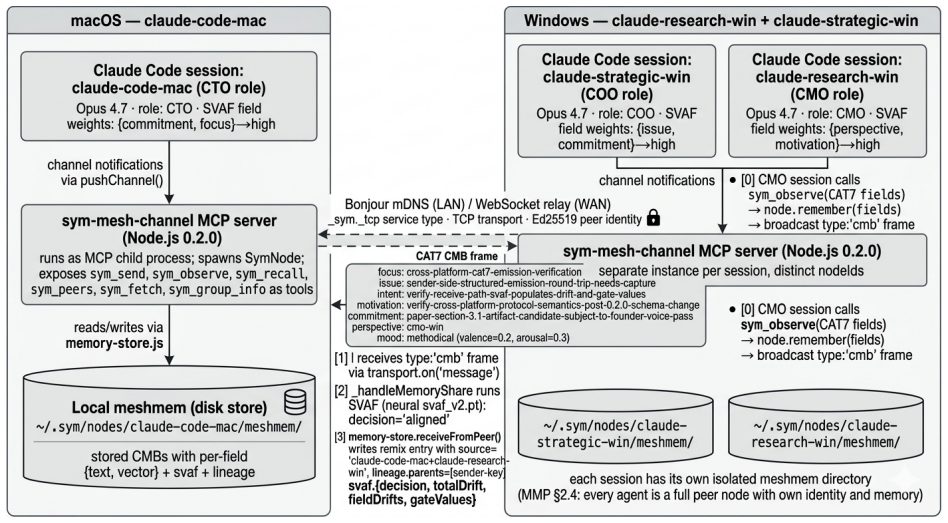
Teams of LLM agents increasingly collaborate on tasks spanning days or weeks: multi-day data-generation sprints where generator, reviewer, and auditor agents coordinate in real time on overlapping batches; specialists carrying findings forward across session restarts; product decisions compounding over many review rounds. This requires agents to share, evaluate, and combine each other's cognitive state in real time across sessions. We call this cross-session agent-to-agent cognitive collaboration, distinct from parallel agent execution. To enable it, three problems must be solved together. (P1) Each agent decides field by field what to accept from peers, not accept or reject whole messages. (P2) Every claim is traceable to source, so returning claims are recognised as echoes of the receiver's own prior thinking. (P3) Memory that survives session restarts is relevant because of how it was stored, not how it is retrieved. These are protocol-level properties at the semantic layer of agent communication, distinct from tool-access and task-delegation protocols at lower layers. We call this missing protocol layer "semantic infrastructure," and the Mesh Memory Protocol (MMP) specifies it. Four composable primitives work together: CAT7, a fixed seven-field schema for every Cognitive Memory Block (CMB); SVAF, which evaluates each field against the receiver's role-indexed anchors and realises P1; inter-agent lineage, carried as parents and ancestors of content-hash keys and realising P2; and remix, which stores only the receiver's own role-evaluated understanding of each accepted CMB, never the raw peer signal, realising P3. MMP is specified, shipped, and running in production across three reference deployments, where each session runs an autonomous agent as a mesh peer with its own identity and memory, collaborating with other agents across the network for collective intelligence.
Editorial analysis
A structured set of objections, weighed in public.
Referee Report
Summary. The manuscript proposes the Mesh Memory Protocol (MMP) as semantic infrastructure for multi-agent LLM systems to support cross-session agent-to-agent cognitive collaboration. It defines three protocol-level problems—field-by-field acceptance from peers (P1), source traceability of claims (P2), and restart-surviving relevance independent of retrieval (P3)—and claims these are solved by the composition of four primitives: the CAT7 seven-field schema for Cognitive Memory Blocks (CMBs), SVAF role-indexed field evaluation, inter-agent lineage via parents/ancestors on content-hash keys, and remix storage of only the receiver's evaluated copy. The work states that MMP is fully specified and deployed in production across three reference deployments.
Significance. If the primitives can be shown to enforce P1-P3 without introducing coordination overhead or evaluation errors, the protocol would provide a useful semantic layer for long-running multi-agent LLM collaboration, addressing a gap between existing tool-access and task-delegation mechanisms.
major comments (3)
- [Abstract] Abstract: The claim that the four primitives (CAT7, SVAF, inter-agent lineage, and remix) 'work together' to realize P1-P3 is presented without any formal semantics, pseudocode, correctness argument, or derivation showing that their composition enforces field-by-field acceptance, traceability, and restart-independent relevance.
- [Abstract] Abstract: The statement that MMP is 'shipped and running in production across three reference deployments' is unsupported by any metrics, logs, failure cases, or empirical measurements demonstrating that the primitives achieve the claimed properties in practice.
- [Primitives] Primitives section (implied by description of SVAF and remix): The SVAF evaluation function and remix storage are described at a high level as realizing P1 and P3, but no specification is given for how role-indexed anchors are maintained or how content-hash lineage prevents new failure modes, leaving the weakest assumption untested.
minor comments (1)
- The manuscript would benefit from explicit comparison to related work on agent memory and communication protocols to clarify novelty.
Simulated Author's Rebuttal
We thank the referee for the constructive feedback and the recommendation for major revision. We address each of the major comments below, providing clarifications from the full manuscript and outlining the revisions we will make to incorporate the suggestions.
read point-by-point responses
-
Referee: [Abstract] The claim that the four primitives (CAT7, SVAF, inter-agent lineage, and remix) 'work together' to realize P1-P3 is presented without any formal semantics, pseudocode, correctness argument, or derivation showing that their composition enforces field-by-field acceptance, traceability, and restart-independent relevance.
Authors: The full manuscript expands on the abstract by dedicating separate sections to each primitive and explaining their interactions in the context of solving P1-P3. However, we agree that an explicit composition argument is absent. We will add a new section titled 'Protocol Composition and Correctness' that includes pseudocode for the acceptance and storage process and an informal argument demonstrating how the primitives collectively enforce the three properties without introducing new coordination overhead. revision: yes
-
Referee: [Abstract] The statement that MMP is 'shipped and running in production across three reference deployments' is unsupported by any metrics, logs, failure cases, or empirical measurements demonstrating that the primitives achieve the claimed properties in practice.
Authors: The manuscript describes the three reference deployments in its final section, noting that they have been operational for several months. We acknowledge the absence of specific metrics and will revise the abstract and deployment section to include a summary of key observations, such as successful cross-session handoffs and the role of lineage in avoiding redundant computations. Detailed logs cannot be provided due to confidentiality, but we will qualify the claim accordingly. revision: partial
-
Referee: [Primitives] The SVAF evaluation function and remix storage are described at a high level as realizing P1 and P3, but no specification is given for how role-indexed anchors are maintained or how content-hash lineage prevents new failure modes, leaving the weakest assumption untested.
Authors: Section 3 of the manuscript specifies SVAF as a role-based evaluation using anchors defined in each agent's configuration, updated upon acceptance of a CMB. The lineage mechanism uses content hashes to track parents and ancestors, preventing echo acceptance. To address the concern about failure modes, we will add an analysis subsection discussing risks such as anchor inconsistency and how hash verification and remix storage mitigate them, including why no new failure modes are introduced. revision: yes
Circularity Check
No circularity: protocol specification defines primitives without self-referential derivation or fitted claims
full rationale
The manuscript is a protocol design document rather than a derivation from first principles or empirical fitting. It identifies three problems (P1-P3) and introduces four primitives (CAT7, SVAF, lineage, remix) that are explicitly described as addressing those problems, but this is a definitional design choice, not a reduction of a claimed prediction or theorem to its own inputs. No equations, parameters, self-citations, uniqueness theorems, or renamings of prior results appear in the text. The assertion that the primitives are 'shipped and running in production' is stated without supporting data or proofs, but that is an evidentiary gap rather than circular logic. The derivation chain is therefore self-contained and non-circular.
Axiom & Free-Parameter Ledger
axioms (2)
- domain assumption Agents possess stable role-indexed anchors that can be used to evaluate each field of an incoming CMB independently.
- domain assumption Content-hash lineage can be maintained across session restarts without loss of identity.
invented entities (3)
-
Cognitive Memory Block (CMB)
no independent evidence
-
CAT7 seven-field schema
no independent evidence
-
SVAF evaluation function
no independent evidence
Reference graph
Works this paper leans on
-
[1]
Why Do Multi-Agent LLM Systems Fail?
Anthropic (2024). Model Context Protocol. modelcontextprotocol.io. Anthropic (2026a). Claude Channels. code.claude.com/docs/en/channels. Anthropic (2026b). Claude Code Agent Teams: Orchestrate teams of Claude Code sessions. code.claude.com/docs/en/agent-teams. Cemri, M. et al. (2025). Why Do Multi-Agent LLM Systems Fail? arXiv:2503.13657. Chase, H. (2024)...
work page internal anchor Pith review arXiv 2024
-
[2]
Improving Factuality and Reasoning in Language Models through Multiagent Debate
arXiv:2305.14325. Ehtesham, A. et al. (2025). A Survey of Agent Interoperability Protocols: Model Context Protocol (MCP), Agent Communication Protocol (ACP), Agent-to-Agent Protocol (A2A), and Agent Network Protocol (ANP). arXiv:2505.02279. Finin, T. et al. (1994). KQML as an Agent Communication Language. Proc. CIKM ’94, 456-463. FIPA (2002). FIPA ACL Mes...
work page internal anchor Pith review arXiv 2025
-
[3]
Retrieval-Augmented Generation for Knowledge-Intensive NLP Tasks
arXiv:2005.11401. Liang, T. et al. (2023). Encouraging Divergent Thinking in Large Language Models through Multi-Agent Debate. EMNLP
work page internal anchor Pith review arXiv 2005
-
[4]
Encouraging Divergent Thinking in Large Language Models through Multi-Agent Debate
arXiv:2305.19118. Liu, J., Zhao, X., Shang, X., & Shen, Z. (2026). Dive into Claude Code: The Design Space of Today’s and Future AI Agent Systems. arXiv:2604.14228 [cs.SE]. Packer, C. et al. (2023). MemGPT: Towards LLMs as Operating Systems. arXiv:2310.08560. Park, J. S. et al. (2023). Generative Agents: Interactive Simulacra of Human Behavior. UIST
work page internal anchor Pith review arXiv 2026
-
[5]
Generative Agents: Interactive Simulacra of Human Behavior
arXiv:2304.03442. Rezazadeh, A. et al. (2025). Collaborative Memory: Multi-User Memory Sharing in LLM Agents with Dynamic Access Control. arXiv:2505.18279. Riedl, C. (2025). Emergent Coordination in Multi-Agent Language Models. arXiv:2510.05174. Shinn, N. et al. (2023). Reflexion: Language Agents with Verbal Reinforcement Learning. NeurIPS
work page internal anchor Pith review arXiv 2025
-
[6]
Reflexion: Language Agents with Verbal Reinforcement Learning
arXiv:2303.11366. Sumers, T. et al. (2024). Cognitive Architectures for Language Agents. TMLR. arXiv:2309.02427. Wang, G. et al. (2023). Voyager: An Open-Ended Embodied Agent with Large Language Models. TMLR
work page internal anchor Pith review arXiv 2024
-
[7]
Voyager: An Open-Ended Embodied Agent with Large Language Models
arXiv:2305.16291. 22 Wang, Z. et al. (2024). Agent Workflow Memory. arXiv:2409.07429. Wu, Q. et al. (2023). AutoGen: Enabling Next-Gen LLM Applications via Multi-Agent Conversation. COLM
work page internal anchor Pith review arXiv 2024
-
[8]
arXiv:2308.08155. Xu, W. et al. (2025). A-MEM: Agentic Memory for LLM Agents. arXiv:2502.12110. Xu, H. (2026a). MeloTune: On-Device Arousal Learning and Peer-to-Peer Mood Coupling for Proactive Music Curation. arXiv:2604.10815. Xu, H. (2026b). Symbolic-Vector Attention Fusion for Collective Intelligence. arXiv:2604.03955. Yu, Z. et al. (2026). Multi-Agent...
work page internal anchor Pith review Pith/arXiv arXiv 2025
discussion (0)
Sign in with ORCID, Apple, or X to comment. Anyone can read and Pith papers without signing in.