Recognition: unknown
Dynamically cold discs in high-redshift galaxies: comparison between ALMA observations and TNG50
Pith reviewed 2026-05-10 02:12 UTC · model grok-4.3
The pith
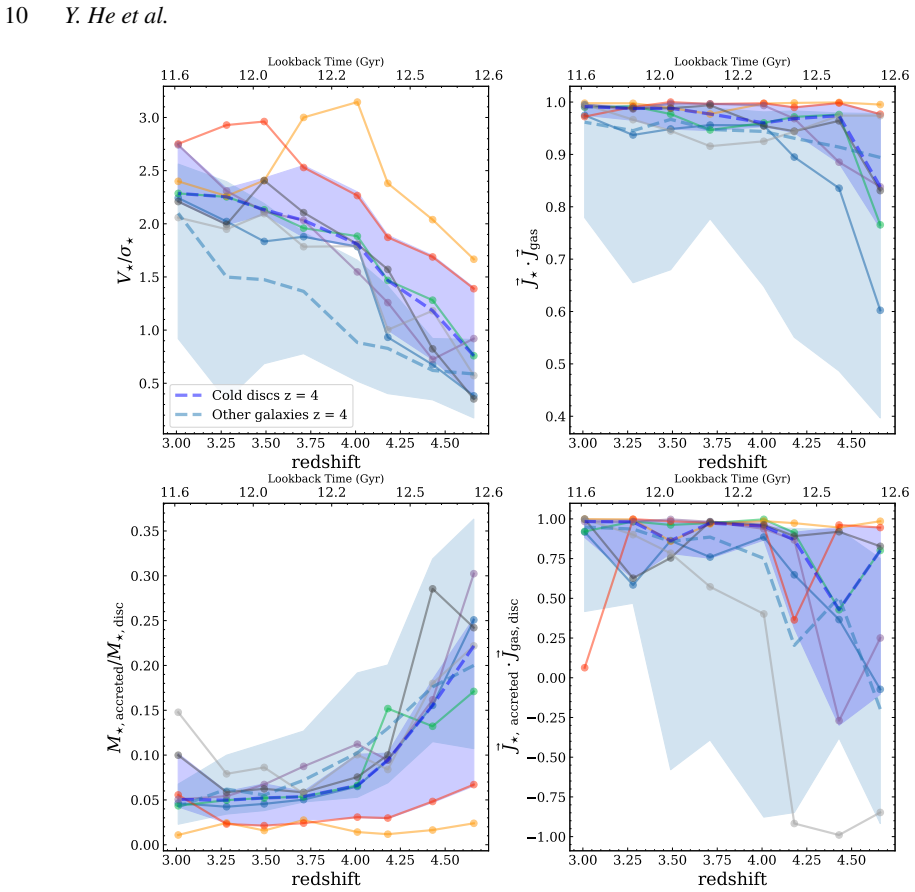
TNG50 shows that aligned gas accretion can produce rare dynamically cold discs at z=3-5, while most galaxies remain hotter due to misaligned infall.
A machine-rendered reading of the paper's core claim, the machinery that carries it, and where it could break.
Core claim
Dynamically cold disc formation in TNG50 is promoted by gas accretion with angular momentum aligned with the pre-existing disc, while most galaxies undergo misaligned accretion; such cold discs selected at z=4 remain dynamically colder than most of the TNG population across z=3-5, and a galaxy with V/σ ≳10 appears in a transient phase that lasts ≤200 Myr.
What carries the argument
The V/σ ratio of gas rotation velocity to velocity dispersion, extracted from mock emission-line datacubes that replicate ALMA [CII] observational methods and resolution effects.
If this is right
- Cold discs selected at z=4 stay dynamically colder than the average TNG50 population across the entire z=3-5 interval.
- The most extreme cold disc with V/σ ≳10 exists only transiently for no more than 200 Myr.
- Cold discs display lower mass accretion rates and more aligned stellar and dark-matter angular momentum vectors than the general population.
- By z=0, one-third of the cold high-redshift discs become massive disc galaxies while two-thirds become early-type galaxies.
Where Pith is reading between the lines
- If the alignment requirement is physically realistic, then the frequency of cold discs in real high-redshift galaxies may trace the prevalence of coherent gas inflows rather than merger rates alone.
- The short lifetime of the highest-V/σ phase suggests that very cold discs should be rare in any snapshot survey and may be caught only during brief windows of aligned accretion.
- The split evolution toward both disc and early-type galaxies by z=0 implies that high-redshift cold discs do not exclusively seed today's spiral galaxies.
Load-bearing premise
The mock emission line datacubes constructed from TNG50 accurately reproduce the observational effects, resolution, and analysis methods applied to real ALMA [CII] observations, including any beam smearing or noise that affects the measured V/σ ratios.
What would settle it
Direct ALMA observations that measure a substantially higher fraction of galaxies with V/σ >5 at z=4 than appears in the TNG50 sample, or that show no preference for aligned accretion in the coldest systems.
Figures




read the original abstract
Observations of highly rotationally supported gas discs in high redshift ($z$ > 3) star-forming galaxies challenge our understanding of galaxy formation, as the prevailing view holds that galaxies in the early universe are dynamically hot due to frequent mergers, gas accretion, and strong stellar feedback. We examined the kinematic properties of massive ($M_{\star} \geq 10^{10}\,M_{\odot}$) star-forming galaxies in the TNG50 cosmological hydrodynamical simulation in the redshift range $3\leq z \leq 5$. Mock emission line datacubes were constructed and analysed using the same methodology as for [CII] observations with ALMA. We measured the ratio of the gas rotation velocity ($V$) to velocity dispersion ($\sigma$) finding that most galaxies have $V/\sigma\sim$ $2-3$, lower than observed. However, a few simulated galaxies show $V/\sigma$ > 5. Such "cold" discs, selected at $z=4$, remain dynamically colder than most of the TNG population across $z=3-5$. A galaxy with $V/\sigma\gtrsim10$ appears in a transient phase that lasts $\leq200$ Myr. Dynamically cold disc formation in TNG50 is promoted by gas accretion with angular momentum aligned with the pre-existing disc, while most galaxies undergo misaligned accretion. Dynamically cold discs also show lower mass accretion rates and better aligned stellar and dark-matter angular momentum vectors. By tracing their evolution to $z = 0$, we find that one-third become massive disc galaxies and two-thirds become ETGs.
Editorial analysis
A structured set of objections, weighed in public.
Referee Report
Summary. The manuscript compares the gas kinematics of massive (M⋆ ≥ 10¹⁰ M⊙) star-forming galaxies in TNG50 at 3 ≤ z ≤ 5 against ALMA [CII] observations. Mock emission-line datacubes are generated and analysed with the same pipeline used on real data; the authors report that the majority of simulated galaxies have V/σ ∼ 2–3 (lower than observed), while rare cold discs (V/σ > 5) arise from aligned gas accretion, remain dynamically cold across z = 3–5, are transient (≤ 200 Myr), and evolve into a mixture of massive discs and ETGs by z = 0.
Significance. If the forward modelling of TNG50 to ALMA observables is robust, the work supplies a concrete prediction for the rarity and formation channel of dynamically cold high-redshift discs, together with falsifiable evolutionary tracks to z = 0. The identification of aligned accretion as the key driver and the quantification of the transient timescale are valuable additions to galaxy-formation theory.
major comments (2)
- [§3] §3 (mock datacube construction): the description of how beam smearing, noise, channelisation and the precise V/σ extraction algorithm are implemented must be expanded and validated against the actual ALMA data properties. Because the central claim of a systematic discrepancy (simulated V/σ lower than observed) rests on the fidelity of this forward model, any mismatch in resolution or noise treatment could alter the reported offset and the inferred rarity of cold discs.
- [§4] §4 (results on V/σ distributions): the text does not report the exact sample size, the distribution of measurement uncertainties on V/σ, or the precise definition and aperture used to extract V and σ from the mock cubes. These omissions prevent a quantitative assessment of the statistical significance of the difference with the ALMA sample.
minor comments (2)
- [Figures] Figure 2 (or equivalent): the colour scale and contour levels for the V/σ maps should be stated explicitly so that readers can reproduce the visual classification of cold discs.
- [Abstract and §2] The abstract and §2 should include the precise numerical sample size and the exact star-formation-rate threshold used to select the TNG50 galaxies.
Simulated Author's Rebuttal
We thank the referee for their constructive and detailed report. We agree that the robustness of the forward modeling and the clarity of the reported statistics are central to the strength of our conclusions, and we have revised the manuscript accordingly to address both major comments.
read point-by-point responses
-
Referee: §3 (mock datacube construction): the description of how beam smearing, noise, channelisation and the precise V/σ extraction algorithm are implemented must be expanded and validated against the actual ALMA data properties. Because the central claim of a systematic discrepancy (simulated V/σ lower than observed) rests on the fidelity of this forward model, any mismatch in resolution or noise treatment could alter the reported offset and the inferred rarity of cold discs.
Authors: We agree that the description in §3 requires expansion to demonstrate the fidelity of the mock datacubes. In the revised manuscript we will provide a substantially more detailed account of the implementation of beam smearing, noise addition, channelisation, and the precise V/σ extraction algorithm. We will also add a validation subsection that directly compares the mock data properties (resolution, noise characteristics, and channelisation) to those of the ALMA [CII] observations used in the comparison. This will allow readers to assess whether any differences in treatment could affect the reported V/σ offset. revision: yes
-
Referee: §4 (results on V/σ distributions): the text does not report the exact sample size, the distribution of measurement uncertainties on V/σ, or the precise definition and aperture used to extract V and σ from the mock cubes. These omissions prevent a quantitative assessment of the statistical significance of the difference with the ALMA sample.
Authors: We acknowledge that these quantitative details were omitted from the original text. In the revised manuscript we will explicitly state the sample size of TNG50 galaxies analysed at each redshift, report the distribution (or median and 16–84 percentile range) of the measurement uncertainties on V/σ, and provide the precise definitions of V and σ together with the aperture (or radial range) used for their extraction from the mock cubes. These additions will enable a direct statistical comparison with the ALMA sample. revision: yes
Circularity Check
No circularity: results follow directly from independent simulation analysis and external data comparison
full rationale
The paper extracts kinematic ratios from TNG50 snapshots, constructs mock datacubes using the same pipeline as the external ALMA observations, and compares the resulting V/σ distributions without fitting any parameters to the target data. Accretion alignment, transience, and descendant tracing are performed entirely within the simulation volume using its native particle data. No self-definitional loops, fitted inputs renamed as predictions, or load-bearing self-citations appear in the derivation; the mock construction is a forward-modeling step whose fidelity is an assumption but does not create circular equivalence to the inputs.
Axiom & Free-Parameter Ledger
axioms (1)
- domain assumption The TNG50 hydrodynamical simulation and its subgrid physics prescriptions accurately capture the kinematic evolution of gas discs in massive star-forming galaxies at 3 ≤ z ≤ 5.
Reference graph
Works this paper leans on
-
[1]
Velocity dispersion in the interstellar medium of early galaxies , volume=
Velocity dispersion in the interstellar medium of early galaxies. , keywords =. doi:10.1093/mnras/staa2792 , archivePrefix =. 2009.05049 , primaryClass =
-
[2]
KROME - a package to embed chemistry in astrophysical simulations. , keywords =. doi:10.1093/mnras/stu114 , archivePrefix =. 1311.1070 , primaryClass =
-
[3]
2010, MNRAS, 401, 791, doi: 10.1111/j.1365-2966.2009.15715.x
Galaxies in a simulated CDM Universe - I. Cold mode and hot cores. , keywords =. doi:10.1111/j.1365-2966.2009.14541.x , archivePrefix =. 0809.1430 , primaryClass =
-
[4]
The ALPINE-ALMA [C II] survey: characterization of spatial offsets in main-sequence galaxies at z 4-6. , keywords =. doi:10.1093/mnras/stae1371 , archivePrefix =. 2402.07982 , primaryClass =
-
[5]
The ALMA-CRISTAL survey: Resolved kinematic studies of main sequence star-forming galaxies at 4 < z < 6. , keywords =. doi:10.1051/0004-6361/202555362 , archivePrefix =. 2507.11600 , primaryClass =
-
[6]
The ALMA-ALPAKA survey. I. High-resolution CO and [CI] kinematics of star-forming galaxies at z = 0.5-3.5. , keywords =. doi:10.1051/0004-6361/202346444 , archivePrefix =. 2303.16227 , primaryClass =
-
[7]
Is there enough star formation in simulated protoclusters?. , keywords =. doi:10.1093/mnras/staa3693 , archivePrefix =. 2010.02259 , primaryClass =
-
[8]
High-redshift predictions from IllustrisTNG - III. Infrared luminosity functions, obscured star formation, and dust temperature of high-redshift galaxies. , keywords =. doi:10.1093/mnras/stab3794 , archivePrefix =. 2104.12788 , primaryClass =
-
[9]
Core condensation in heavy halos: a two-stage theory for galaxy formation and clustering. , keywords =. doi:10.1093/mnras/183.3.341 , adsurl =
-
[10]
Galaxy Formation through Hierarchical Clustering. , keywords =. doi:10.1086/170483 , adsurl =
-
[11]
Cosmological smoothed particle hydrodynamics simulations: a hybrid multiphase model for star formation. , keywords =. doi:10.1046/j.1365-8711.2003.06206.x , archivePrefix =. astro-ph/0206393 , primaryClass =
-
[12]
2009, Nature, 457, 451, doi: 10.1038/nature07648
Cold streams in early massive hot haloes as the main mode of galaxy formation. , keywords =. doi:10.1038/nature07648 , archivePrefix =. 0808.0553 , primaryClass =
-
[13]
FIRE-2 Simulations: Physics versus Numerics in Galaxy Formation
FIRE-2 simulations: physics versus numerics in galaxy formation. , keywords =. doi:10.1093/mnras/sty1690 , archivePrefix =. 1702.06148 , primaryClass =
-
[14]
Merger Histories of Galaxy Halos and Implications for Disk Survival. , keywords =. doi:10.1086/588579 , archivePrefix =. 0711.5027 , primaryClass =
-
[15]
How do Disks Survive Mergers?. , keywords =. doi:10.1088/0004-637X/691/2/1168 , archivePrefix =. 0806.1739 , primaryClass =
-
[16]
The Sins/zC-Sinf Survey of z -0.5ex 2 Galaxy Kinematics: Evidence for Powerful Active Galactic Nucleus-Driven Nuclear Outflows in Massive Star-Forming Galaxies. , keywords =. doi:10.1088/0004-637X/787/1/38 , archivePrefix =. 1311.2596 , primaryClass =
-
[17]
, keywords =
The internal structure of disky elliptical galaxies. , keywords =
-
[18]
The SAURON project - XII. Kinematic substructures in early-type galaxies: evidence for discs in fast rotators. , keywords =. doi:10.1111/j.1365-2966.2008.13712.x , archivePrefix =. 0807.1505 , primaryClass =
-
[19]
The SINS Survey: SINFONI Integral Field Spectroscopy of z -0.5ex 2 Star-forming Galaxies. , keywords =. doi:10.1088/0004-637X/706/2/1364 , archivePrefix =. 0903.1872 , primaryClass =
-
[20]
The ALMA Spectroscopic Survey in the HUDF: the Molecular Gas Content of Galaxies and Tensions with IllustrisTNG and the Santa Cruz SAM. , keywords =. doi:10.3847/1538-4357/ab30f2 , archivePrefix =. 1903.09158 , primaryClass =
-
[21]
Evolution of turbulence in galaxy disks across cosmic time: Difference between cold and warm gas
The ALMA-ALPAKA survey: II. Evolution of turbulence in galaxy disks across cosmic time: Difference between cold and warm gas. , keywords =. doi:10.1051/0004-6361/202450455 , archivePrefix =. 2407.06261 , primaryClass =
-
[22]
The KMOS ^ 3D Survey: Design, First Results, and the Evolution of Galaxy Kinematics from 0.7 <= z <= 2.7. , keywords =. doi:10.1088/0004-637X/799/2/209 , archivePrefix =. 1409.6791 , primaryClass =
-
[23]
The Evolution and Origin of Ionized Gas Velocity Dispersion from z 2.6 to z 0.6 with KMOS ^ 3D. , keywords =. doi:10.3847/1538-4357/ab27cc , archivePrefix =. 1906.02737 , primaryClass =
-
[24]
2019, MNRAS, 490, 3196, doi: 10.1093/mnras/stz2338
First results from the TNG50 simulation: the evolution of stellar and gaseous discs across cosmic time. , keywords =. doi:10.1093/mnras/stz2338 , archivePrefix =. 1902.05553 , primaryClass =
-
[25]
A dynamically cold disk galaxy in the early Universe. , keywords =. doi:10.1038/s41586-020-2572-6 , archivePrefix =. 2009.01251 , primaryClass =
-
[26]
A cold, massive, rotating disk galaxy 1.5 billion years after the Big Bang. , keywords =. doi:10.1038/s41586-020-2276-y , archivePrefix =. 2005.09661 , primaryClass =
-
[27]
A massive stellar bulge in a regularly rotating galaxy 1.2 billion years after the Big Bang. Science , keywords =. doi:10.1126/science.abc1893 , archivePrefix =. 2102.05957 , primaryClass =
-
[28]
Fast rotating and low-turbulence discs at z ≃ 4.5: Dynamical evidence of their evolution into local early-type galaxies. , keywords =. doi:10.1051/0004-6361/202039807 , archivePrefix =. 2011.05340 , primaryClass =
-
[29]
Dynamical properties of z 4.5 dusty star-forming galaxies and their connection with local early-type galaxies. , keywords =. doi:10.1093/mnras/stab2295 , archivePrefix =. 2102.05671 , primaryClass =
-
[30]
Regular rotation and low turbulence in a diverse sample of z 4.5 galaxies observed with ALMA. , keywords =. doi:10.1093/mnras/stad530 , archivePrefix =. 2302.03049 , primaryClass =
-
[31]
Kinematics and dynamics of the ``superthin'' edge-on disk galaxy IC 5249. , keywords =. doi:10.1051/0004-6361:20011311 , archivePrefix =. astro-ph/0109477 , primaryClass =
-
[32]
Mass modelling of a superthin galaxy, FGC 1540. , keywords =. doi:10.1093/mnras/sty1856 , archivePrefix =. 1807.02992 , primaryClass =
-
[33]
Evidence for supernova feedback sustaining gas turbulence in nearby star-forming galaxies. , keywords =. doi:10.1051/0004-6361/202038223 , archivePrefix =. 2006.10764 , primaryClass =
-
[34]
How 'cold' are the stellar discs of superthin galaxies?. , keywords =. doi:10.1093/mnras/stab155 , archivePrefix =. 2002.09198 , primaryClass =
-
[35]
Cool Gas in High-Redshift Galaxies. , keywords =. doi:10.1146/annurev-astro-082812-140953 , archivePrefix =. 1301.0371 , primaryClass =
-
[36]
^ 3D BAROLO: a new 3D algorithm to derive rotation curves of galaxies. , keywords =. doi:10.1093/mnras/stv1213 , archivePrefix =. 1505.07834 , primaryClass =
-
[37]
Dynamically cold disks in the early Universe: Myth or reality?. , keywords =. doi:10.1051/0004-6361/202348209 , archivePrefix =. 2311.05832 , primaryClass =
-
[38]
On the origin of surprisingly cold gas discs in galaxies at high redshift. , keywords =. doi:10.1093/mnras/stab3648 , archivePrefix =. 2103.06882 , primaryClass =
-
[39]
2017, MNRAS, 465, 3291, doi: 10.1093/mnras/stw2944
Simulating galaxy formation with black hole driven thermal and kinetic feedback. , keywords =. doi:10.1093/mnras/stw2944 , archivePrefix =. 1607.03486 , primaryClass =
work page internal anchor Pith review Pith/arXiv arXiv doi:10.1093/mnras/stw2944
-
[40]
2018b, MNRAS, 473, 4077, doi: 10.1093/mnras/stx2656
Simulating galaxy formation with the IllustrisTNG model. , keywords =. doi:10.1093/mnras/stx2656 , archivePrefix =. 1703.02970 , primaryClass =
work page internal anchor Pith review Pith/arXiv arXiv doi:10.1093/mnras/stx2656
-
[41]
First results from the TNG50 simulation: galactic outflows driven by supernovae and black hole feedback. , keywords =. doi:10.1093/mnras/stz2306 , archivePrefix =. 1902.05554 , primaryClass =
-
[42]
2018, MNRAS, 480, 5113, doi: 10.1093/mnras/sty2206
First results from the IllustrisTNG simulations: radio haloes and magnetic fields. , keywords =. doi:10.1093/mnras/sty2206 , archivePrefix =. 1707.03396 , primaryClass =
-
[43]
P., Pillepich, A., Springel, V., et al
First results from the IllustrisTNG simulations: a tale of two elements - chemical evolution of magnesium and europium. , keywords =. doi:10.1093/mnras/sty618 , archivePrefix =. 1707.03401 , primaryClass =
-
[44]
2018, MNRAS, 475, 624, doi: 10.1093/mnras/stx3040 —
First results from the IllustrisTNG simulations: the galaxy colour bimodality. , keywords =. doi:10.1093/mnras/stx3040 , archivePrefix =. 1707.03395 , primaryClass =
work page internal anchor Pith review doi:10.1093/mnras/stx3040
-
[45]
2018a, MNRAS, 475, 648, doi: 10.1093/mnras/stx3112
First results from the IllustrisTNG simulations: the stellar mass content of groups and clusters of galaxies. , keywords =. doi:10.1093/mnras/stx3112 , archivePrefix =. 1707.03406 , primaryClass =
-
[46]
2018, MNRAS, 475, 676, doi: 10.1093/mnras/stx3304
First results from the IllustrisTNG simulations: matter and galaxy clustering. , keywords =. doi:10.1093/mnras/stx3304 , archivePrefix =. 1707.03397 , primaryClass =
-
[47]
2010, MNRAS, 401, 791, doi: 10.1111/j.1365-2966.2009.15715.x
E pur si muove: Galilean-invariant cosmological hydrodynamical simulations on a moving mesh. , keywords =. doi:10.1111/j.1365-2966.2009.15715.x , archivePrefix =. 0901.4107 , primaryClass =
-
[48]
Planck 2015 results. XIII. Cosmological parameters. , keywords =. doi:10.1051/0004-6361/201525830 , archivePrefix =. 1502.01589 , primaryClass =
-
[49]
The evolution of large-scale structure in a universe dominated by cold dark matter. , keywords =. doi:10.1086/163168 , adsurl =
-
[50]
Populating a cluster of galaxies - I. Results at z=0. , keywords =. doi:10.1046/j.1365-8711.2001.04912.x , archivePrefix =. astro-ph/0012055 , primaryClass =
-
[51]
2010, MNRAS, 401, 791, doi: 10.1111/j.1365-2966.2009.15715.x
Substructures in hydrodynamical cluster simulations. , keywords =. doi:10.1111/j.1365-2966.2009.15034.x , archivePrefix =. 0808.3401 , primaryClass =
-
[52]
The merger rate of galaxies in the Illustris simulation: a comparison with observations and semi-empirical models. , keywords =. doi:10.1093/mnras/stv264 , archivePrefix =. 1502.01339 , primaryClass =
-
[53]
Gas-phase metallicity gradients of TNG50 star-forming galaxies. , keywords =. doi:10.1093/mnras/stab1803 , archivePrefix =. 2007.10993 , primaryClass =
-
[54]
Alejandro Benitez-Llambay , title =
-
[55]
The nature of the [C II] emission in dusty star-forming galaxies from the SPT survey. , keywords =. doi:10.1093/mnras/stv372 , archivePrefix =. 1501.06909 , primaryClass =
-
[56]
Characterizing the Multiphase Origin of [C II] Emission in M101 and NGC 6946 with Velocity-resolved Spectroscopy. , keywords =. doi:10.3847/1538-4357/abfcc6 , archivePrefix =. 2104.13452 , primaryClass =
-
[57]
Diagnosing the interstellar medium of galaxies with far-infrared emission lines. I. The [C II] 158 m line at z 0. , keywords =. doi:10.1051/0004-6361/202038207 , archivePrefix =. 2011.13441 , primaryClass =
-
[58]
Atomic and molecular gas in IllustrisTNG galaxies at low redshift. , keywords =. doi:10.1093/mnras/stz1323 , archivePrefix =. 1902.10714 , primaryClass =
-
[59]
Atomic hydrogen in IllustrisTNG galaxies: the impact of environment parallelled with local 21-cm surveys. , keywords =. doi:10.1093/mnras/sty3451 , archivePrefix =. 1810.12158 , primaryClass =
-
[60]
Non-circular motions and the diversity of dwarf galaxy rotation curves. , keywords =. doi:10.1093/mnras/sty2687 , archivePrefix =. 1706.07478 , primaryClass =
-
[61]
MNRAS , archivePrefix = "arXiv",
On the evolution of the H I column density distribution in cosmological simulations. , keywords =. doi:10.1093/mnras/stt066 , archivePrefix =. 1210.7808 , primaryClass =
-
[62]
, keywords =
Neutral hydrogen observations of the edge-on disk galaxy NGC 891. , keywords =
-
[63]
2004, MNRAS, 348, 1019, doi: 10.1111/j.1365-2966.2004.07422.x
Structure and kinematics of edge-on galaxy discs - III. The rotation curves in the gas. , keywords =. doi:10.1111/j.1365-2966.2004.07978.x , archivePrefix =. astro-ph/0405174 , primaryClass =
-
[64]
A tale of two galaxies: light and mass in NGC 891 and NGC 7814. , keywords =. doi:10.1051/0004-6361/201116634 , archivePrefix =. 1105.3867 , primaryClass =
-
[65]
The Structure of Rapidly Rotating Late-Type Spiral Galaxies. I. Photometry, H I, and Optical Kinematics. , keywords =. doi:10.1086/506177 , archivePrefix =. astro-ph/0605542 , primaryClass =
-
[66]
The dark matter halo shape of edge-on disk galaxies . III. Modelling the HI observations: results. , keywords =. doi:10.1051/0004-6361/200912567 , archivePrefix =. 1003.3109 , primaryClass =
-
[67]
HI rotation curves of spiral galaxies. I. NGC 3198. , keywords =
-
[68]
High-Resolution Rotation Curves and Galaxy Mass Models from THINGS. , keywords =. doi:10.1088/0004-6256/136/6/2648 , archivePrefix =. 0810.2100 , primaryClass =
-
[69]
2010, MNRAS, 407, 1403, doi: 10.1111/j.1365-2966.2010.16985.x
The lifetimes of spiral patterns in disc galaxies. , keywords =. doi:10.1111/j.1365-2966.2010.17545.x , archivePrefix =. 1008.2737 , primaryClass =
-
[70]
The dynamics of stars around spiral arms. , keywords =. doi:10.1111/j.1365-2966.2012.20411.x , archivePrefix =. 1112.0019 , primaryClass =
-
[71]
The Westerbork Hydrogen Accretion in LOcal GAlaxieS (HALOGAS) survey. I. Survey description and pilot observations. , keywords =. doi:10.1051/0004-6361/201015938 , archivePrefix =. 1012.0816 , primaryClass =
-
[72]
The extent and kinematics of the molecular gas in early-type galaxies
The ATLAS ^ 3D Project - XIV. The extent and kinematics of the molecular gas in early-type galaxies. , keywords =. doi:10.1093/mnras/sts353 , archivePrefix =. 1211.1011 , primaryClass =
-
[73]
GalPak ^ 3D : A Bayesian Parametric Tool for Extracting Morphokinematics of Galaxies from 3D Data. , keywords =. doi:10.1088/0004-6256/150/3/92 , archivePrefix =. 1501.06586 , primaryClass =
-
[74]
Dynamical characterization of galaxies up to z 7. , keywords =. doi:10.1051/0004-6361/202243582 , archivePrefix =. 2204.05325 , primaryClass =
-
[75]
Measuring galaxy asymmetries in 3D. , keywords =. doi:10.1093/mnras/stad1693 , archivePrefix =. 2306.02839 , primaryClass =
-
[76]
2011, MNRAS, 415, 2101, doi: 10.1111/j.1365-2966.2011.18820.x
COLD GASS, an IRAM legacy survey of molecular gas in massive galaxies - II. The non-universality of the molecular gas depletion time-scale. , keywords =. doi:10.1111/j.1365-2966.2011.18823.x , archivePrefix =. 1104.0019 , primaryClass =
-
[77]
Estimating gas accretion in disc galaxies using the Kennicutt-Schmidt law. , keywords =. doi:10.1111/j.1365-2966.2012.21650.x , archivePrefix =. 1207.0093 , primaryClass =
-
[78]
The twisted dark matter halo of the Milky Way. , keywords =. doi:10.1093/mnras/staa3883 , archivePrefix =. 2005.03025 , primaryClass =
-
[79]
The galaxy size to halo spin relation of disc galaxies in cosmological hydrodynamical simulations. , keywords =. doi:10.1093/mnras/stac3335 , archivePrefix =. 2110.04434 , primaryClass =
-
[80]
Volumetric star formation laws of disc galaxies. , keywords =. doi:10.1051/0004-6361/201834382 , archivePrefix =. 1810.03616 , primaryClass =
discussion (0)
Sign in with ORCID, Apple, or X to comment. Anyone can read and Pith papers without signing in.