Recognition: unknown
From Clerks to Agentic-AI: How will Technology Change Labor Market in Finance?
Pith reviewed 2026-05-10 02:08 UTC · model grok-4.3
The pith
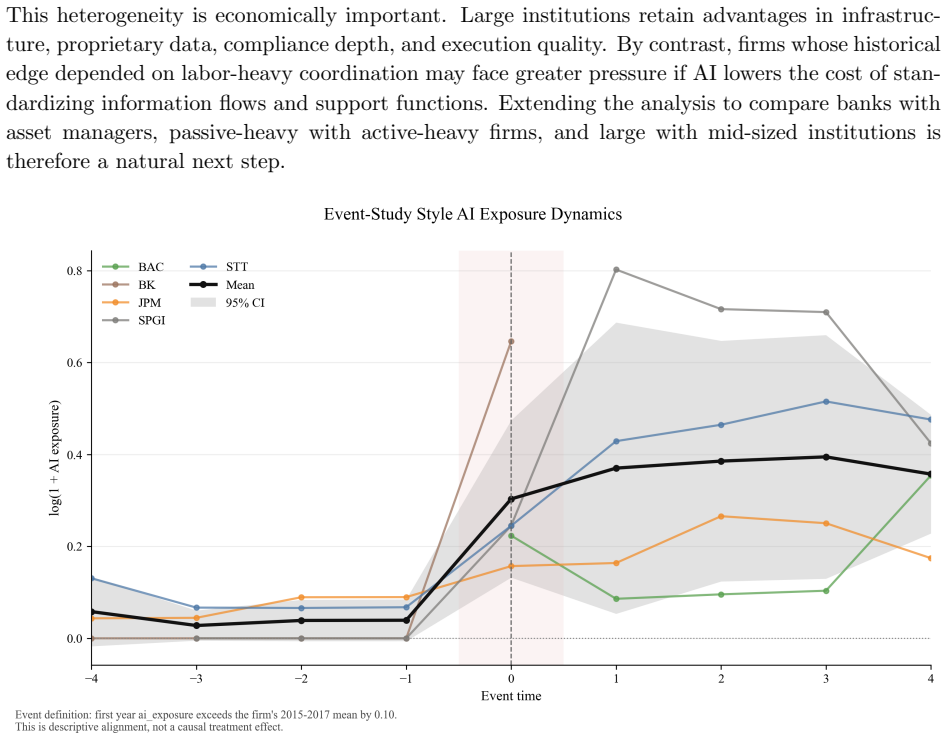
Technology waves in finance have changed the labor scale for managing assets, shown by tracking AUM per employee across computerization, indexing, and AI periods.
A machine-rendered reading of the paper's core claim, the machinery that carries it, and where it could break.
Core claim
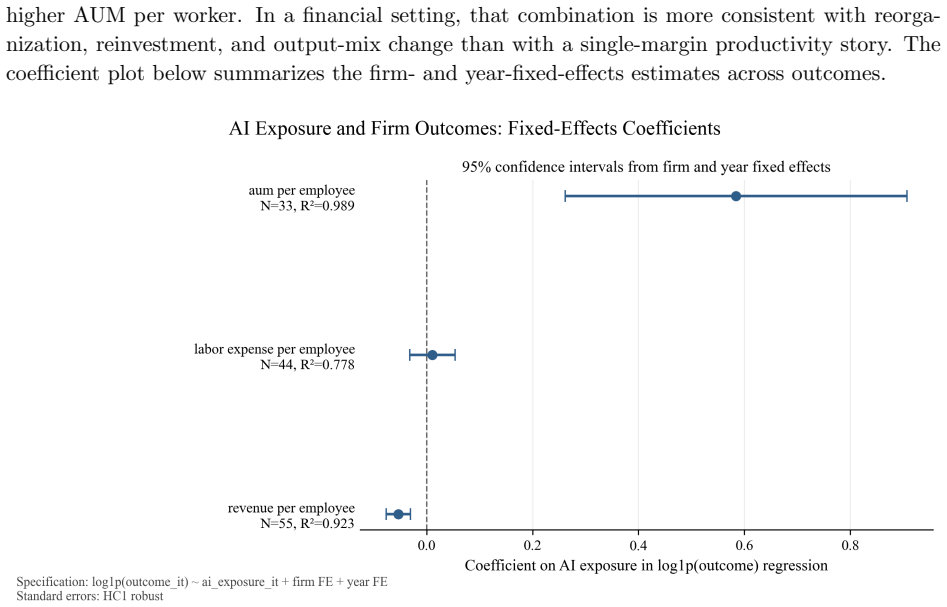
Using a small panel of representative firms, the authors compare changes in AUM per employee, revenue per employee, and operating expense intensity over time to document stylized facts about how technology changes the scale of asset management work across the computerization, indexing, and AI waves.
What carries the argument
Assets under management per employee, serving as a simple productivity proxy for the labor required to manage capital across technological periods.
If this is right
- Each technology wave corresponds to measurable shifts in how much capital an employee can oversee.
- Revenue per employee reflects combined effects of technology adoption and operational scaling.
- Operating expense intensity can be compared to assess cost efficiency gains across periods.
- The AI wave is included in the same descriptive framework as prior waves for consistency in tracking labor scale.
Where Pith is reading between the lines
- If the observed patterns continue, AI tools could allow even larger asset volumes to be managed with stable or reduced headcount in routine operations.
- Finance roles may shift toward oversight and exception-handling rather than direct portfolio work.
- Extending the panel to more firms or adding controls for market size could test the robustness of the documented trends.
- Similar productivity ratios might be applied to other financial activities like lending or trading to compare tech impacts.
Load-bearing premise
Assets under management per employee serves as a reliable proxy for the labor required to manage capital and the small panel of firms is representative of broader industry trends.
What would settle it
Panel data showing no increase or a decline in AUM per employee during the AI wave since 2015 would indicate that technology has not altered the labor scale in the manner described.
Figures



read the original abstract
Financial firms have gone through three major technological waves: computerization in the 1980s and 1990s, the rise of indexing and passive investing in the 2000s and 2010s, and the AI and automation wave from roughly 2015 to the present. This project studies how much labor is required to manage capital across those waves by tracking a simple productivity measure: assets under management per employee. Using a small panel of representative firms, we compare changes in AUM per employee, revenue per employee, and operating expense intensity over time. The goal is not to identify causal effects, but to document stylized facts about how technology changes the scale of asset management work.
Editorial analysis
A structured set of objections, weighed in public.
Referee Report
Summary. The manuscript documents stylized facts on labor requirements in asset management across three technological waves: computerization (1980s-1990s), indexing and passive investing (2000s-2010s), and AI/automation (2015-present). It tracks changes in assets under management (AUM) per employee, revenue per employee, and operating expense intensity using a small panel of representative firms, with the stated goal of describing trends in the scale of work rather than establishing causal effects.
Significance. If the trends prove robust after addressing measurement confounds and providing sample details, the paper could offer useful descriptive benchmarks for how technology has scaled operations in finance. However, the current lack of data transparency and adjustment for exogenous factors limits its ability to inform labor-market analyses or distinguish technology-driven productivity from market valuation effects.
major comments (2)
- Abstract and methods description: AUM per employee is presented as a proxy for labor required to manage capital, but the manuscript does not deflate AUM by a market index (e.g., S&P 500 or broad bond index) or report robustness checks using alternative scale measures such as number of accounts, trades, or regulatory filings. Because AUM equals quantities times prevailing valuations, observed increases could mechanically reflect post-GFC asset-price appreciation rather than technology-induced reductions in labor input.
- Methods description: The manuscript supplies no information on the identity or characteristics of the small panel of representative firms, the precise time periods and data sources used, sample size, or any stratification to hold market exposure constant. Without these details, it is impossible to assess whether the panel supports the claim of documenting industry-wide stylized facts or whether results are sensitive to selection.
minor comments (2)
- Abstract: The term 'operating expense intensity' is introduced without a definition or formula, making it unclear how this metric is constructed or normalized.
- Abstract: The claim that the panel consists of 'representative firms' is stated without supporting evidence or criteria for representativeness.
Simulated Author's Rebuttal
We thank the referee for the constructive comments, which help clarify the scope and limitations of our descriptive analysis. We agree that greater transparency on measurement issues and sample construction will strengthen the manuscript as a set of stylized facts. We address each major comment below and indicate the planned revisions.
read point-by-point responses
-
Referee: Abstract and methods description: AUM per employee is presented as a proxy for labor required to manage capital, but the manuscript does not deflate AUM by a market index (e.g., S&P 500 or broad bond index) or report robustness checks using alternative scale measures such as number of accounts, trades, or regulatory filings. Because AUM equals quantities times prevailing valuations, observed increases could mechanically reflect post-GFC asset-price appreciation rather than technology-induced reductions in labor input.
Authors: We appreciate this point on measurement. The paper is explicitly descriptive and does not attempt to isolate technology effects from valuation changes. We will revise the methods section to note that AUM reflects both quantities managed and prevailing market prices, and that post-GFC appreciation may contribute to observed trends. We will also add a discussion of revenue per employee as a complementary measure less directly tied to valuations, along with a caveat on the limitations of AUM as a labor-input proxy. Full robustness checks with alternative scales (e.g., accounts or filings) will be noted as data-constrained but discussed where possible. revision: partial
-
Referee: Methods description: The manuscript supplies no information on the identity or characteristics of the small panel of representative firms, the precise time periods and data sources used, sample size, or any stratification to hold market exposure constant. Without these details, it is impossible to assess whether the panel supports the claim of documenting industry-wide stylized facts or whether results are sensitive to selection.
Authors: We agree that additional sample details are needed for transparency. In the revision we will expand the data section to describe the panel's characteristics (e.g., firm size, asset-class focus), the exact time periods covered, data sources (annual reports and financial statements), sample size, and selection criteria. We will also discuss the panel's market exposure and any limitations on generalizability to the broader industry. revision: yes
Circularity Check
No circularity; purely descriptive documentation with no derivation chain
full rationale
The paper states its goal is to document stylized facts about labor requirements in asset management by tracking AUM per employee, revenue per employee, and operating expense intensity across three technological waves using a small panel of firms. It explicitly disclaims causal identification. No equations, models, fitted parameters, predictions, self-citations, or ansatzes appear in the provided text. The central measure is introduced directly as a simple productivity proxy without any reduction to prior inputs or self-referential definitions. The analysis is self-contained empirical observation and contains no load-bearing steps that could be circular by construction.
Axiom & Free-Parameter Ledger
axioms (1)
- domain assumption Assets under management per employee accurately reflects the labor required to manage capital
Reference graph
Works this paper leans on
-
[1]
Tasks, Automation, and the Rise in U.S. Wage In- equality
Acemoglu, D., and P. Restrepo. 2022. “Tasks, Automation, and the Rise in U.S. Wage In- equality.” Working paper
2022
-
[2]
Tasks at Work: Comparative Advantage, Technology and Labor Demand
Acemoglu, D., F. Kong, and P. Restrepo. 2025. “Tasks at Work: Comparative Advantage, Technology and Labor Demand.”Handbook of Labor Economics6: 1–114
2025
-
[3]
How AI Aggregation Affects Knowledge
Acemoglu, D., T. Lin, A. Ozdaglar, and J. Siderius. 2026. “How AI Aggregation Affects Knowledge.” Working paper
2026
-
[4]
AI, Human Cognition and Knowledge Collapse
Acemoglu, D., D. Kong, and A. Ozdaglar. 2026. “AI, Human Cognition and Knowledge Collapse.” Working paper
2026
-
[5]
Automation and Polarization
Acemoglu, D., and J. Loebbing. 2026. “Automation and Polarization.”Journal of Political Economy134(3): 1017–1072
2026
-
[6]
Building Pro-Worker Artificial Intelligence
Acemoglu, D., D. Autor, and S. Johnson. 2026. “Building Pro-Worker Artificial Intelligence.” Brookings Institution
2026
-
[7]
Innovation and Top Income Inequality
Aghion, P., U. Akcigit, A. Bergeaud, R. Blundell, and D. H´ emous. 2016. “Innovation and Top Income Inequality.”Journal of Political Economy124(5): 1473–1504
2016
-
[8]
Bergeaud, T
Aghion, P., A. Bergeaud, T. Boppart, and J.-F. Brouillette. 2025.Resetting the Innovation Clock: Endogenous Growth through Technological Turnover. Book manuscript
2025
-
[9]
A Research Agenda for the Economics of Transformative AI
Agrawal, A. K., E. Brynjolfsson, and A. Korinek. 2025. “A Research Agenda for the Economics of Transformative AI.” NBER Working Paper
2025
-
[10]
Agrawal, A. K., E. Brynjolfsson, and A. Korinek. 2025.The Economics of Transformative AI. Chicago: University of Chicago Press
2025
-
[11]
Does Automation Replace Experts or Augment Expertise? The Answer Is Yes
Autor, D. 2024. “Does Automation Replace Experts or Augment Expertise? The Answer Is Yes.” Schumpeter Lecture, European Economic Association
2024
-
[12]
Expertise
Autor, D., and N. Thompson. 2025. “Expertise.”Journal of the European Economic Associ- ation23(4): 1203–1271
2025
-
[13]
Resolving the Automation Paradox: Falling Labor Share, Rising Wages
Autor, D., and B. Kausik. 2026. “Resolving the Automation Paradox: Falling Labor Share, Rising Wages.” Working paper
2026
-
[14]
What Makes New Work Different from More Work?
Autor, D., C. Chin, A. Salomons, and B. Seegmiller. 2026. “What Makes New Work Different from More Work?” Forthcoming inAnnual Review of Economics
2026
-
[15]
The Turing Trap: The Promise and Peril of Human-Like Artificial Intelligence
Brynjolfsson, E. 2022. “The Turing Trap: The Promise and Peril of Human-Like Artificial Intelligence.”Daedalus
2022
-
[16]
Generative AI at Work
Brynjolfsson, E., D. Li, and L. Raymond. 2023. “Generative AI at Work.”Quarterly Journal of Economics. 11
2023
-
[17]
The Macroeconomics of Artificial Intelligence
Brynjolfsson, E., and G. Unger. 2023. “The Macroeconomics of Artificial Intelligence.” IMF working paper
2023
-
[18]
AI Adoption in America: Who, What, and Where
Brynjolfsson, E., K. McElheran, J. F. Li, Z. Kroff, E. Dinlersoz, L. Foster, and N. Zolas. 2024. “AI Adoption in America: Who, What, and Where.”Journal of Economics & Management Strategy
2024
-
[19]
New World Order: Labor, Capital, and Ideas in the Power Law Economy
Brynjolfsson, E., A. McAfee, and M. Spence. 2014. “New World Order: Labor, Capital, and Ideas in the Power Law Economy.”Foreign Affairs, July/August
2014
-
[20]
Will Humans Go the Way of Horses? Labor in the Second Machine Age
Brynjolfsson, E., and A. McAfee. 2015. “Will Humans Go the Way of Horses? Labor in the Second Machine Age.”Foreign Affairs, July/August
2015
-
[21]
The Business of Artificial Intelligence: What It Can and Cannot Do for Your Organization
Brynjolfsson, E., and A. McAfee. 2017. “The Business of Artificial Intelligence: What It Can and Cannot Do for Your Organization.”Harvard Business Review
2017
-
[22]
Minimum Wages and Rise of the Robots
Brynjolfsson, E., J. F. Li, J. Miranda, R. Seamans, and A. J. Wang. 2026. “Minimum Wages and Rise of the Robots.” NBER Working Paper 34895
2026
-
[23]
Post-AGI Economics As If Nothing Ever Happens
Kulveit, J. 2026. “Post-AGI Economics As If Nothing Ever Happens.”Less- Wrong, February 4, 2026.https://www.lesswrong.com/posts/fL7g3fuMQLssbHd6Y/ post-agi-economics-as-if-nothing-ever-happens#
2026
-
[24]
Human Work in the Robotic Future: Policy for the Age of Automation
McAfee, A., and E. Brynjolfsson. 2016. “Human Work in the Robotic Future: Policy for the Age of Automation.”Foreign Affairs, July/August. 12
2016
discussion (0)
Sign in with ORCID, Apple, or X to comment. Anyone can read and Pith papers without signing in.