Recognition: unknown
Generalized Invisibility in Metasurfaces
Pith reviewed 2026-05-10 01:26 UTC · model grok-4.3
The pith
Metasurface invisibility in dissimilar media requires pure bianisotropic coupling even in the dipolar limit.
A machine-rendered reading of the paper's core claim, the machinery that carries it, and where it could break.
Core claim
Electromagnetic invisibility, defined as reflectionless transmission with zero phase delay, can be realized in metasurfaces between dissimilar media only through pure bianisotropic coupling within a dipolar framework. Purely electric and purely magnetic responses are shown to be insufficient for lossless, passive, and reciprocal systems. Effective surface susceptibilities that account for the surrounding media and transverse wave vector yield closed-form conditions for co- and cross-polarized invisibility. The necessary bianisotropy can arise effectively from an anisotropic metasurface placed at the interface, without requiring intrinsic magnetoelectric coupling, as verified by full-wave sim
What carries the argument
Effective surface susceptibilities that incorporate surrounding media and transverse wave vector, which enable derivation of the required pure bianisotropic coupling for zero-phase transmission.
If this is right
- Invisibility becomes possible at oblique incidence via effective bianisotropy even when the metasurface itself is only anisotropic.
- Closed-form expressions give the exact susceptibility values needed for both co-polarized and cross-polarized cases.
- Standard Kerker-type designs using only electric or magnetic responses cannot produce zero-phase invisibility in asymmetric environments.
- The same framework applies to any pair of dissimilar media provided the dipolar approximation holds.
Where Pith is reading between the lines
- Designers of practical meta-optics at air-glass or air-water interfaces should prioritize structures that induce effective magnetoelectric coupling rather than pure electric or magnetic responses.
- The result suggests that extending the analysis to include weak higher-order multipoles could relax the strict bianisotropy requirement in symmetric media.
- Measuring the transmission phase at the precise angle where the effective bianisotropy cancels reflection would provide a direct experimental test.
- The approach may generalize to other wave phenomena such as acoustic or elastic metasurfaces where analogous bianisotropic parameters can be engineered.
Load-bearing premise
The metasurface response remains fully describable by effective surface susceptibilities within the dipolar approximation, without higher-order multipoles or violations of losslessness, passivity, or reciprocity.
What would settle it
A full-wave simulation or measurement that achieves reflectionless, zero-phase transmission through a purely electric or purely magnetic metasurface at an air-dielectric interface under oblique incidence, while remaining within the dipolar limit, would falsify the claim.
Figures

read the original abstract
Electromagnetic invisibility, defined as reflectionless transmission with zero phase delay, imposes strict constraints on metasurface designs that go beyond conventional reflection suppression based on the Kerker effect. This condition can be viewed as a metasurface analogue of radiationless states such as anapole excitations. Here, we show that invisibility in metasurfaces embedded in identical media can only be achieved by introducing degrees of freedom, such as non-zero angle of incidence or higher-order multipolar responses. We demonstrate that, in dissimilar substrate and superstrate, achieving invisibility within a dipolar framework fundamentally requires pure bianisotropic coupling, while purely electric and magnetic responses are insufficient for lossless, passive and reciprocal systems. Using effective surface susceptibilities that account for the surrounding media and transverse wave vector, we derive closed-form conditions for both co- and cross-polarized invisibility. Importantly, we also demonstrate that the required bianisotropy does not need to be intrinsic, as an effective bianisotropic response may be achieved with anisotropic metasurface in dissimilar media leading to magnetoelectric coupling. Full-wave simulations of a metasurface at an air-dielectric interface confirm invisibility under oblique incidence. This work establishes a universal dipolar framework for invisible meta-optics in practically realistic scenarios.
Editorial analysis
A structured set of objections, weighed in public.
Referee Report
Summary. The manuscript develops a generalized framework for electromagnetic invisibility in metasurfaces, defined as reflectionless transmission with zero phase delay. It argues that metasurfaces in identical media require non-zero incidence angle or higher-order multipoles for invisibility, while in dissimilar media, within the dipolar approximation, pure bianisotropic coupling is required and purely electric/magnetic responses are insufficient for lossless, passive, reciprocal systems. Closed-form conditions for co- and cross-polarized invisibility are derived from effective surface susceptibilities that incorporate surrounding media asymmetry and transverse wave vector. The work shows that effective bianisotropy can arise from anisotropic metasurfaces in dissimilar media without intrinsic magnetoelectric coupling, and validates the approach via full-wave simulations of a metasurface at an air-dielectric interface under oblique incidence.
Significance. If the derivations are correct and the dipolar approximation holds in the simulated configurations, the result is significant for providing analytical design rules for invisible meta-optics in realistic asymmetric environments. The explicit separation of intrinsic versus effective bianisotropy, the necessity of bianisotropic terms in the dipolar limit, and the use of media-aware susceptibilities represent a useful extension of anapole-like concepts to metasurfaces. The closed-form conditions and simulation confirmation add practical value beyond purely numerical approaches.
major comments (2)
- [Full-wave simulations] The central claim that invisibility in dissimilar media requires pure bianisotropic coupling (while electric/magnetic responses are insufficient) rests on the metasurface response being fully captured by the effective surface susceptibility model with negligible higher-order multipoles. The full-wave simulations of the anisotropic metasurface at an air-dielectric interface under oblique incidence (described in the abstract) provide no multipole decomposition, convergence checks on the dipolar truncation, or error bounds on higher-order contributions. Oblique incidence and media asymmetry are known to excite quadrupole and higher terms that can alter transmission phase and reflection, which directly risks undermining the 'insufficient' conclusion for electric/magnetic-only cases.
- [Theoretical derivation] The derivation of closed-form invisibility conditions from effective susceptibilities (accounting for media asymmetry and transverse wave vector) does not include explicit validity criteria or bounds for the dipolar approximation in the dissimilar-media, oblique-incidence regime. This assumption is load-bearing for the claim that the framework is universal within the dipolar limit.
minor comments (2)
- [Abstract] The abstract is information-dense; separating the identical-media and dissimilar-media cases into distinct sentences would improve readability.
- Notation for the effective susceptibilities (including the transverse wave vector dependence) should be introduced with a brief reminder of the underlying definitions to aid readers unfamiliar with asymmetric-media formulations.
Simulated Author's Rebuttal
We thank the referee for the careful and constructive review of our manuscript on generalized invisibility in metasurfaces. We address each major comment below and have revised the manuscript to incorporate additional supporting material where the concerns are valid.
read point-by-point responses
-
Referee: [Full-wave simulations] The central claim that invisibility in dissimilar media requires pure bianisotropic coupling (while electric/magnetic responses are insufficient) rests on the metasurface response being fully captured by the effective surface susceptibility model with negligible higher-order multipoles. The full-wave simulations of the anisotropic metasurface at an air-dielectric interface under oblique incidence (described in the abstract) provide no multipole decomposition, convergence checks on the dipolar truncation, or error bounds on higher-order contributions. Oblique incidence and media asymmetry are known to excite quadrupole and higher terms that can alter transmission phase and reflection, which directly risks undermining the 'insufficient' conclusion for electric/magnetic-only cases.
Authors: We agree that explicit verification of the dipolar approximation in the simulations is necessary to support the claim that purely electric/magnetic responses are insufficient. In the revised manuscript we will add a multipole decomposition of the scattered fields from the simulated structure, together with convergence tests on mesh density and a quantitative bound on the relative power in quadrupole and higher-order terms. These additions will confirm that higher-order contributions remain below a few percent for the chosen subwavelength periodicity and operating regime, thereby preserving the validity of the 'insufficient' conclusion within the stated limits. revision: yes
-
Referee: [Theoretical derivation] The derivation of closed-form invisibility conditions from effective susceptibilities (accounting for media asymmetry and transverse wave vector) does not include explicit validity criteria or bounds for the dipolar approximation in the dissimilar-media, oblique-incidence regime. This assumption is load-bearing for the claim that the framework is universal within the dipolar limit.
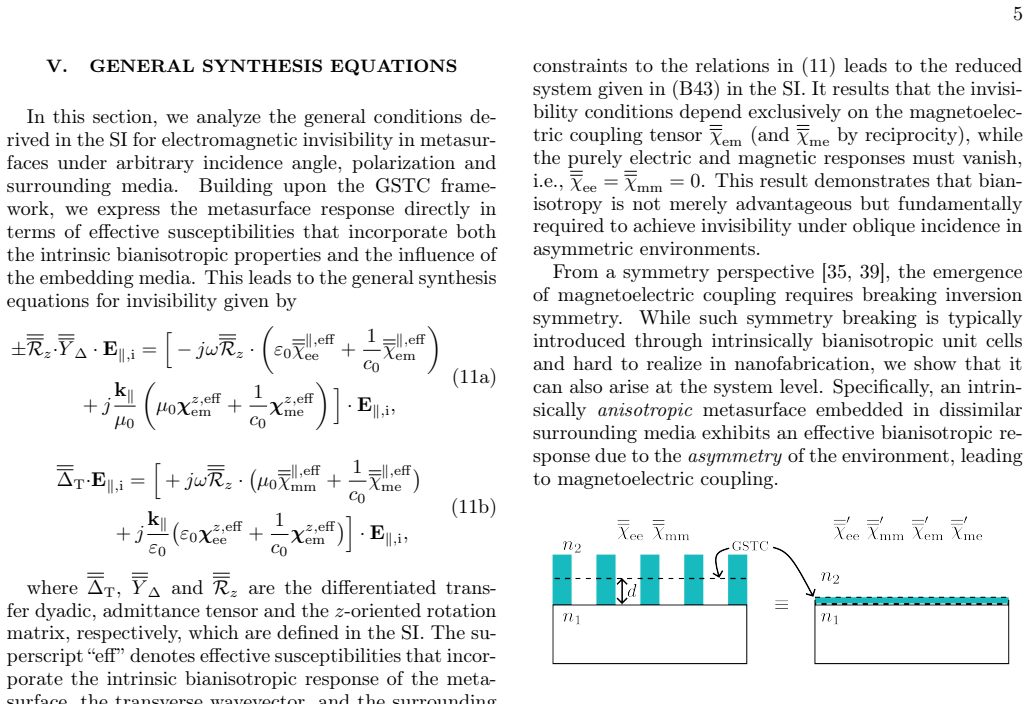
Authors: The closed-form conditions are derived under the standard dipolar (surface-susceptibility) model, which assumes subwavelength periodicity. To make the domain of applicability explicit, the revised manuscript will include a dedicated paragraph stating the validity criteria: the lattice constant must satisfy k0 a < 0.5, the transverse wave-vector component must remain below the first diffraction threshold, and the media asymmetry must not push the structure into a regime where higher multipoles are resonantly excited. These bounds will be illustrated with a brief parametric study showing the breakdown of the model when they are violated. revision: yes
Circularity Check
No circularity: derivation follows from standard susceptibility definitions
full rationale
The paper derives closed-form invisibility conditions by substituting the zero-reflection, zero-phase constraints into the standard effective surface susceptibility tensor (accounting for media asymmetry and k_t) within the dipolar model. This is a direct algebraic reduction from the definitions, not a self-referential loop or fitted input renamed as prediction. No load-bearing self-citations, uniqueness theorems imported from prior author work, or ansatzes smuggled via citation are evident in the derivation chain. The central claim (bianisotropy required for dissimilar media) is a logical consequence of the model assumptions rather than a tautology. The dipolar truncation and simulation validation are presented as external checks, not internal redefinitions.
Axiom & Free-Parameter Ledger
axioms (2)
- domain assumption The metasurface and system are lossless, passive, and reciprocal
- domain assumption Dipolar approximation suffices when effective susceptibilities include media and transverse wave vector
Reference graph
Works this paper leans on
- [1]
-
[2]
H.-T. Chen, A. J. Taylor, and N. Yu, A review of meta- surfaces: physics and applications, Reports on Progress in Physics79, 076401 (2016)
2016
-
[3]
A. Li, S. Singh, and D. Sievenpiper, Metasurfaces and their applications, Nanophotonics7, 989 (2018)
2018
-
[4]
Epstein and G
A. Epstein and G. V. Eleftheriades, Huygens’ meta- surfaces via the equivalence principle, Phys. Rev. Lett. (2016)
2016
-
[5]
Achouri and C
K. Achouri and C. Caloz,Electromagnetic Metasurfaces: Theory and Applications(Wiley-IEEE Press, Hoboken, NJ, 2021)
2021
-
[6]
Veksler, E
D. Veksler, E. Maguid, N. Shitrit, D. Ozeri, V. Kleiner, and E. Hasman, Multiple wavefront shaping by metasur- face based on mixed random antenna groups, Acs Pho- tonics2, 661 (2015)
2015
-
[7]
Balthasar Mueller, N
J. Balthasar Mueller, N. A. Rubin, R. C. Devlin, B. Groever, and F. Capasso, Metasurface polarization optics: independent phase control of arbitrary orthog- onal states of polarization, Physical review letters118, 113901 (2017)
2017
-
[8]
A. V. Kildishev, A. Boltasseva, and V. M. Shalaev, Pla- nar photonics with metasurfaces, Science339, 1232009 (2013)
2013
-
[9]
Huang, A
H. Huang, A. C. Overvig, Y. Xu, S. C. Malek, C.-C. Tsai, A. Alù, and N. Yu, Leaky-wave metasurfaces for inte- grated photonics, Nature nanotechnology18, 580 (2023)
2023
-
[10]
Yücel, F
M. Yücel, F. S. Cuesta, and K. Achouri, Angle-invariant scattering in metasurfaces, Physical Review B111, 235448 (2025)
2025
-
[11]
A. S. Solntsev, G. S. Agarwal, and Y. S. Kivshar, Meta- surfaces for quantum photonics, Nature Photonics15, 327 (2021)
2021
-
[12]
G. Li, S. Zhang, and T. Zentgraf, Nonlinear photonic metasurfaces, Nature Reviews Materials2, 17010 (2017)
2017
-
[13]
A. H. Dorrah, N. A. Rubin, A. Zaidi, M. Tamagnone, and F. Capasso, Metasurface optics for on-demand po- larization transformations along the optical path, Nature Photonics15, 287 (2021)
2021
-
[14]
Z. Shi, R. Cheng, G. Wei, S. A. Hickman, M. C. Shin, P. Topalian, L. Wang, D. Coso, Y. Wang, Q. Wang,et al., Flat-panel laser displays through large-scale photonic in- tegrated circuits, Nature644, 652 (2025)
2025
-
[15]
Gopakumar, G.-Y
M. Gopakumar, G.-Y. Lee, S. Choi, B. Chao, Y. Peng, J. Kim, and G. Wetzstein, Full-colour 3d holographic augmented-reality displays with metasurface waveguides, Nature629, 791 (2024)
2024
-
[16]
Y. Shi, C. Dai, S. Wan, Z. Wang, X. Li, and Z. Li, Electrical-driven dynamic augmented reality by on-chip vectorial meta-display, ACS Photonics11, 2123 (2024)
2024
-
[17]
R.Wood,Theinvisibilityoftransparentobjects,Physical Review (Series I)15, 123 (1902)
1902
-
[18]
Devaney and E
A. Devaney and E. Wolf, Radiating and nonradiating classical current distributions and the fields they gener- ate, Physical Review D8, 1044 (1973)
1973
-
[19]
Kerker, Invisible bodies, Journal of the Optical Soci- ety of America65, 376 (1975)
M. Kerker, Invisible bodies, Journal of the Optical Soci- ety of America65, 376 (1975)
1975
-
[20]
A. E. Miroshnichenko, A. B. Evlyukhin, Y. F. Yu, R. M. Bakker, A. Chipouline, A. I. Kuznetsov, B. Luk’yanchuk, B. N. Chichkov, and Y. S. Kivshar, Nonradiating anapole modes in dielectric nanoparticles, Nature communica- tions6, 8069 (2015)
2015
-
[21]
Yang and S
Y. Yang and S. I. Bozhevolnyi, Nonradiating anapole states in nanophotonics: from fundamentals to applica- tions, Nanotechnology30, 204001 (2019)
2019
-
[22]
A. A. Basharin, E. Zanganeh, A. K. Ospanova, P. Kap- itanova, and A. B. Evlyukhin, Selective superinvisibility effect via compound anapole, Physical Review B107, 155104 (2023)
2023
-
[23]
Hassan, A
E. Hassan, A. B. Evlyukhin, and A. Calà Lesina, Anapole plasmonic meta-atoms for nearly transparent metamate- rials, Laser & Photonics Reviews19, 2400118 (2025). 9
2025
-
[24]
Bukharin, A
M. Bukharin, A. Ospanova, and A. Basharin, Total invis- ibility of compound particles from the perspective of mul- tipole expansion, Physical Review B113, 045145 (2026)
2026
-
[25]
Alù and N
A. Alù and N. Engheta, Achieving transparency with plasmonic and metamaterial coatings, Physical Review E—Statistical, Nonlinear, and Soft Matter Physics72, 016623 (2005)
2005
-
[26]
X. Ni, Z. J. Wong, M. Mrejen, Y. Wang, and X. Zhang, An ultrathin invisibility skin cloak for visible light, Sci- ence349, 1310 (2015)
2015
-
[27]
Monticone and A
F. Monticone and A. Alu, Invisibility exposed: physical bounds on passive cloaking, Optica3, 718 (2016)
2016
-
[28]
Labate, A
G. Labate, A. Alù, and L. Matekovits, Surface- admittance equivalence principle for nonradiating and cloaking problems, Physical Review A95, 063841 (2017)
2017
-
[29]
H.-X. Xu, G. Hu, Y. Wang, C. Wang, M. Wang, S. Wang, Y. Huang, P. Genevet, W. Huang, and C.-W. Qiu, Polarization-insensitive 3d conformal-skin metasurface cloak, Light: science & applications10, 75 (2021)
2021
-
[30]
Liu and Y
W. Liu and Y. S. Kivshar, Generalized kerker effects in nanophotonics and meta-optics [invited], Optics Express 26, 13085 (2018)
2018
-
[31]
P. D. Terekhov, V. E. Babicheva, K. V. Baryshnikova, A. S. Shalin, A. Karabchevsky, and A. B. Evlyukhin, Multipole analysis of dielectric metasurfaces composed of nonspherical nanoparticles and lattice invisibility effect, Phys. Rev. B99, 045424 (2019)
2019
-
[32]
Zhang and A
X. Zhang and A. L. Bradley, Wide-angle invisible dielec- tric metasurface driven by transverse kerker scattering, Physical Review B103, 195419 (2021)
2021
-
[33]
V.R.TuzandA.B.Evlyukhin,Polarization-independent anapole response of a trimer-based dielectric metasur- face, Nanophotonics10, 4373 (2021)
2021
-
[34]
A. V. Kuznetsov, A. Canós Valero, M. Tarkhov, V. Bo- brovs, D. Redka, and A. S. Shalin, Transparent hy- brid anapole metasurfaces with negligible electromag- netic coupling for phase engineering, Nanophotonics10, 4385–4398 (2021)
2021
-
[35]
Poleva, K
M. Poleva, K. Frizyuk, K. Baryshnikova, A. Evlyukhin, M. Petrov, and A. Bogdanov, Multipolar theory of bian- isotropic response of meta-atoms, Phys. Rev. B107, L041304 (2023)
2023
-
[36]
E. F. Kuester, M. A. Mohamed, M. Piket-May, and C. L. Holloway, Averaged transition conditions for electromag- netic fields at a metafilm, IEEE Transactions on Anten- nas and Propagation51, 2641 (2003)
2003
-
[37]
Antennas Propagat.70, 11946 (2022)
K.Achouri, V.Tiukuvaara,andO.J.F.Martin,Multipo- lar Modeling of Spatially Dispersive Metasurfaces, IEEE Trans. Antennas Propagat.70, 11946 (2022)
2022
-
[38]
Tiukuvaara, O
V. Tiukuvaara, O. J. F. Martin, and K. Achouri, Quadrupolar susceptibility modeling of substrated meta- surfaces with application to the generalized Brewster ef- fect, Opt. Express, OE31, 22982 (2023)
2023
-
[39]
Achouri, V
K. Achouri, V. Tiukuvaara, and O. J. Martin, Spa- tial symmetries in nonlocal multipolar metasurfaces, Ad- vanced Photonics5, 046001 (2023)
2023
-
[40]
Allahverdizadeh and K
H. Allahverdizadeh and K. Achouri, Multipolar angular scattering of substrated metasurfaces, Physical Review B 112, 245420 (2025)
2025
-
[41]
S. A. Tretyakov,Analytical Modeling in Applied Electro- magnetics,ArtechHouseElectromagneticAnalysisSeries (Artech House, Boston, Mass., 2003). 10 SUPPLEMENTARY INFORMATION Appendix A: Unitary Transmission Representation In this section, we show that the transmission through a lossless and reflectionless metasurface can be expressed as a unitary transform...
2003
-
[42]
(A2) For a plane wave in mediumm, the normal power flux is given by ⟨Sz,m⟩= |Em|2 2ηm cosθ m, (A3) which leads to the relation |Ei|2 η1 cosθ 1 = |Et|2 η2 cosθ 2
Power normalization For a lossless metasurface, the normal component of the time-averaged Poynting vector must be conserved across the interface, ⟨Sz,1⟩=⟨S z,2⟩. (A2) For a plane wave in mediumm, the normal power flux is given by ⟨Sz,m⟩= |Em|2 2ηm cosθ m, (A3) which leads to the relation |Ei|2 η1 cosθ 1 = |Et|2 η2 cosθ 2. (A4) This condition imposes that ...
-
[43]
Defining τ= s η2 cosθ 1 η1 cosθ 2 , (A6) we write the transmission dyadic as T=τ U
Unitary form of the transmission It is convenient to factor out the scalar normalization term associated with the surrounding media in (A5). Defining τ= s η2 cosθ 1 η1 cosθ 2 , (A6) we write the transmission dyadic as T=τ U . (A7) Substituting into the previous relation yields U † U= I, (A8) which shows thatUis a unitary matrix. Therefore, once the power ...
-
[44]
Physical interpretation The unitary matrixUdescribes all possible lossless polarization transformations supported by the metasurface. In particular, • U= Icorresponds to co-polarized transmission without modification of the polarization state, •off-diagonal unitary matrices correspond to complete cross-polarization conversion, •more general unitary matric...
-
[45]
Dipole GSTC These relations describe the discontinuity of the tangential electromagnetic fields across an infinitesimally thin metasurface in terms of the induced electric and magnetic surface current densities. The gradient terms account for the contribution of normal polarization components, which become particularly important under oblique incidence wh...
-
[46]
Anisotropic sheet displaced from an interface We consider an anisotropic metasurface embedded in medium 2 and located at a distancedfrom the planar interface separating medium 1 and medium 2, as depicted in Fig. D.1. The metasurface is assumed reciprocal and purely anisotropic, χee ̸= 0, χmm ̸= 0, χem = χme = 0,(D2) so that any magnetoelectric coupling ap...
-
[47]
Equivalent bianisotropic sheet We now seek anequivalentreciprocal bianisotropic sheet located at the interface between the two media, charac- terized by the equivalent susceptibilitiesχxx′ ee ,χ yy ′ mm andχ xy′ em, whose scattering coefficients are given by Eqs. (D1). By enforcing t12 =t s,12, r 12 =r s,12, r 21 =r s,21,(D7) one obtains closed-form expre...
-
[48]
Cancellation of the anisotropic terms The effective parameters of the equivalent bianisotropic sheet are given by Eqs. (D8). In particular, the effective anisotropic susceptibilities read χxx′ ee = 4k χxx ee cos(kd) + 4−k 2χxx ee χyy mm sin(kd) k h −2 cos kd 2 +k χ xxee sin kd 2 ih −2 cos kd 2 +k χ yy mm sin kd 2 i ,(D9) χyy ′ mm = 4k χyy mm cos(kd) + 4−k...
discussion (0)
Sign in with ORCID, Apple, or X to comment. Anyone can read and Pith papers without signing in.