Recognition: unknown
Equinox: Decentralized Scheduling for Hardware-Aware Orbital Intelligence
Pith reviewed 2026-05-10 00:56 UTC · model grok-4.3
The pith
Equinox schedules satellite tasks by comparing each task's value to a local marginal cost that rises with battery drain, heat, or queue pressure.
A machine-rendered reading of the paper's core claim, the machinery that carries it, and where it could break.
Core claim
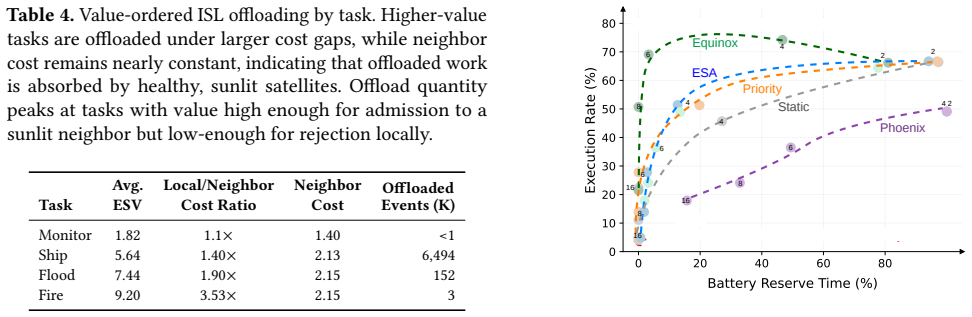
Equinox enables adaptive scheduling by compressing time-varying constraints, including battery charge, thermal headroom, and queue backlog, into a single state-dependent marginal cost of execution derived from a barrier function that rises sharply near safety limits. This local signal serves as a constellation-wide coordination primitive. Tasks execute only when their value exceeds the current cost, enabling value-ordered load shedding without explicit policies. If local costs exceed a neighbor's, tasks are dynamically offloaded over inter-satellite links, achieving distributed load balancing without routing protocols or global state.
What carries the argument
State-dependent marginal cost computed locally from a barrier function that rises sharply near safety limits on battery, thermal headroom, and queue backlog; it encodes instantaneous pressure and future risk to drive value-ordered execution and neighbor offloading.
Load-bearing premise
A single state-dependent marginal cost derived from a barrier function can accurately encode both instantaneous pressure and future risk across battery, thermal, and queue constraints, enabling correct value-ordered decisions and offloading without explicit policies or global state.
What would settle it
Re-running the 143-satellite multi-day simulation with task values randomized or set independently of scientific utility and checking whether the reported 20% goodput and 31% throughput gains disappear while battery-reserve benefits remain.
Figures




read the original abstract
Earth-observation satellites are emerging as distributed edge platforms for time-critical tasks, yet orbital scheduling remains challenged by intermittent energy harvesting and temporal coupling where eager execution risks future battery depletion. Existing schedulers rely on static priorities and lack mechanisms to adaptively shed work. We present Equinox, a lightweight, decentralized runtime for resource-constrained orbital systems. Equinox enables adaptive scheduling by compressing time-varying constraints, including battery charge, thermal headroom, and queue backlog, into a single state-dependent marginal cost of execution. Derived from a barrier function that rises sharply near safety limits, this cost encodes both instantaneous pressure and future risk. This local signal serves as a constellation-wide coordination primitive. Tasks execute only when their value exceeds the current cost, enabling value-ordered load shedding without explicit policies. If local costs exceed a neighbor's, tasks are dynamically offloaded over inter-satellite links, achieving distributed load balancing without routing protocols or global state. We evaluate Equinox using a multi-day simulation of a 143-satellite constellation grounded in physical Jetson Orin Nano measurements. Equinox improves scientific goodput by 20% and image-processing throughput by 31% over priority-based scheduling while maintaining 2.2x higher mean battery reserves. Under high demand, Equinox achieves 5.2x the execution rate of static scheduling by gracefully shedding work rather than collapsing under contention.
Editorial analysis
A structured set of objections, weighed in public.
Referee Report
Summary. The paper presents Equinox, a decentralized scheduling runtime for Earth-observation satellites that compresses battery, thermal, and queue constraints into a single state-dependent marginal cost derived from a barrier function. Tasks execute only when their value exceeds this local cost, enabling value-ordered shedding; offloading to neighbors occurs when local costs are higher, achieving load balancing without global state or routing protocols. A multi-day simulation of a 143-satellite constellation, grounded in Jetson Orin Nano measurements, reports 20% higher scientific goodput, 31% higher image-processing throughput, and 2.2x mean battery reserves versus priority-based scheduling, plus 5.2x execution rate under high demand via graceful shedding.
Significance. If the central claims hold, Equinox demonstrates a lightweight, policy-free mechanism for adaptive, hardware-aware scheduling in energy-intermittent orbital edge systems. The barrier-function approach to encoding future risk in local decisions could generalize to other distributed resource-constrained platforms. The simulation's grounding in physical Jetson Orin Nano measurements is a concrete strength that ties results to real hardware behavior.
major comments (3)
- [Abstract] Abstract: the marginal cost is asserted to be 'derived from a barrier function that rises sharply near safety limits,' yet no explicit equations, functional form, or parameter-selection procedure for the barrier function are supplied. This is load-bearing for the central claim that the single cost 'encodes both instantaneous pressure and future risk' and produces the reported gains independently of tuning.
- [Evaluation] Evaluation section: quantitative claims (20% goodput, 31% throughput, 2.2x battery reserves, 5.2x execution rate) are presented from a multi-day simulation without error bars, number of runs, statistical tests, or sensitivity analysis on barrier-function parameters, leaving the performance improvements unverifiable and the robustness of the decentralized coordination unassessed.
- [Method] Method description: the weakest assumption—that one state-dependent marginal cost suffices to capture battery, thermal, and queue constraints simultaneously for correct local decisions and offloading—is stated without formal justification, convergence arguments, or counter-example analysis, which is required to support the claim of 'distributed load balancing without routing protocols or global state.'
minor comments (2)
- [Abstract] Abstract: the term 'value' in 'value exceeds the current cost' and 'value-ordered load shedding' is used without a definition or how task value is computed or assigned.
- [Evaluation] Evaluation: clarify the exact mapping from Jetson Orin Nano power/thermal traces to the simulation model parameters.
Simulated Author's Rebuttal
We thank the referee for the constructive and detailed feedback. The comments identify key areas where additional clarity, statistical support, and justification will strengthen the manuscript. We address each major comment below and will incorporate revisions to improve verifiability and rigor.
read point-by-point responses
-
Referee: [Abstract] Abstract: the marginal cost is asserted to be 'derived from a barrier function that rises sharply near safety limits,' yet no explicit equations, functional form, or parameter-selection procedure for the barrier function are supplied. This is load-bearing for the central claim that the single cost 'encodes both instantaneous pressure and future risk' and produces the reported gains independently of tuning.
Authors: We agree the abstract would benefit from greater specificity on this central mechanism. Section 3.1 of the manuscript derives the marginal cost from the standard logarithmic barrier B(s) = -∑_i log(1 - s_i / s_i^max) over the normalized state vector s (battery charge, thermal headroom, queue backlog). This form rises sharply near any safety limit and is strictly increasing in each dimension, directly encoding both current pressure and future risk. Parameters are selected from Jetson Orin Nano hardware measurements to maintain conservative safety margins. We will revise the abstract to reference this functional form concisely and expand the methods section with an explicit parameter-selection procedure. We will also add sensitivity results to the evaluation to demonstrate that gains hold across reasonable parameter ranges. revision: yes
-
Referee: [Evaluation] Evaluation section: quantitative claims (20% goodput, 31% throughput, 2.2x battery reserves, 5.2x execution rate) are presented from a multi-day simulation without error bars, number of runs, statistical tests, or sensitivity analysis on barrier-function parameters, leaving the performance improvements unverifiable and the robustness of the decentralized coordination unassessed.
Authors: This critique is fair and points to a genuine limitation in the current presentation. The reported figures come from a single multi-day trace. In the revised manuscript we will execute 20 independent runs using varied random seeds for task arrivals, orbital phasing, and demand patterns. We will report means accompanied by standard-error bars, apply paired statistical tests (Wilcoxon signed-rank) to confirm significance of the 20–31% gains and 2.2× battery improvement, and include a sensitivity sweep over barrier parameters (±20% on safety thresholds). These additions will make the quantitative claims verifiable and directly address robustness of the decentralized coordination. revision: yes
-
Referee: [Method] Method description: the weakest assumption—that one state-dependent marginal cost suffices to capture battery, thermal, and queue constraints simultaneously for correct local decisions and offloading—is stated without formal justification, convergence arguments, or counter-example analysis, which is required to support the claim of 'distributed load balancing without routing protocols or global state.'
Authors: We will add a dedicated justification subsection. Because the barrier is additive and strictly convex in each constraint, the resulting scalar cost is monotonically responsive to any increase in future risk; local execution and offloading decisions therefore remain correct without needing to reconstruct the full constraint vector. For load balancing we will sketch a potential-function argument showing that each offload strictly decreases the neighborhood maximum cost, driving the system toward an equilibrium in which no further beneficial offload exists. We will also discuss a counter-example involving high communication latency that could induce transient oscillation, while noting that our scheduled inter-satellite-link model precludes this case. These additions supply the requested formal grounding while remaining within the scope of a systems paper. revision: partial
Circularity Check
No significant circularity in derivation chain
full rationale
The paper introduces Equinox by defining a marginal cost from a barrier function to compress constraints into a local signal for scheduling and offloading decisions. Performance gains (20% goodput, 31% throughput, 2.2x battery) are reported as direct outcomes of multi-day constellation simulations grounded in Jetson Orin Nano measurements, compared against priority-based and static baselines. No equations, self-citations, uniqueness theorems, or fitted-parameter renamings appear in the provided text that would reduce the central claims to inputs by construction. The barrier function serves as an explicit design choice whose effects are validated externally via simulation rather than asserted as a mathematical necessity. The derivation remains self-contained.
Axiom & Free-Parameter Ledger
free parameters (1)
- barrier function parameters
axioms (2)
- domain assumption Task value can be compared directly to the instantaneous marginal cost to decide execution.
- domain assumption Inter-satellite links are available and reliable enough for dynamic offloading when local cost exceeds a neighbor's cost.
Reference graph
Works this paper leans on
-
[1]
Ignacio F. Acero, Jonathan Diaz, Ronald Hurtado-Velasco, Sergio Ramiro Gonzalez Bautista, Sonia Rincón, Francisco L. Hernández, Ju- lian Rodriguez-Ferreira, and Jesus Gonzalez-Llorente. 2023. A Method for Validating CubeSat Satellite EPS Through Power Budget Analysis Aligned With Mission Requirements.IEEE Access11 (2023), 43316– 43332. doi:10.1109/ACCESS....
-
[2]
Blaise Agüera y Arcas, Travis Beals, Maria Biggs, Jessica V Bloom, Thomas Fischbacher, Konstantin Gromov, Urs Köster, Rishiraj Prava- han, and James Manyika. 2025. Towards a future space-based, highly scalable AI infrastructure system design. arXiv preprint arXiv:2511.19468.https://arxiv.org/abs/2511.19468
-
[3]
Han Cai, Chuang Gan, Tianzhe Wang, Zhekai Zhang, and Song Han
-
[4]
Once-for-all: Train one network and specialize it for efficient deployment,
Once-for-All: Train One Network and Specialize it for Efficient Deployment. arXiv:1908.09791 [cs.LG]
- [5]
-
[6]
Chaudhry and Halim Yanikomeroglu
Aizaz U. Chaudhry and Halim Yanikomeroglu. 2021. Laser In- tersatellite Links in a Starlink Constellation: A Classification and Analysis.IEEE Vehicular Technology Magazine16 (2021), 48–56. doi:10.1109/mvt.2021.3063706
-
[7]
Gordon Christie, Neil Fendley, James Wilson, and Ryan Mukherjee
-
[8]
InProceedings of the IEEE Confer- ence on Computer Vision and Pattern Recognition (CVPR)
Functional Map of the World. InProceedings of the IEEE Confer- ence on Computer Vision and Pattern Recognition (CVPR). 6172–6180. doi:10.1109/CVPR.2018.00646
-
[9]
Google Coral. 2019. USB Accelerator Datasheet.https://coral.ai/docs/ accelerator/datasheet/
2019
-
[10]
Bradley Denby, Krishna Chintalapudi, Ranveer Chandra, Brandon Lu- cia, and Shadi Noghabi. 2023. Kodan: Addressing the Computational Bottleneck in Space. InProceedings of the 28th ACM International Con- ference on Architectural Support for Programming Languages and Oper- ating Systems, Volume 3 (ASPLOS 2023). Association for Computing Ma- chinery, New York...
-
[11]
Bradley Denby and Brandon Lucia. 2020. Orbital Edge Computing: Nanosatellite Constellations as a New Class of Computer System. InProceedings of the Twenty-Fifth International Conference on Archi- tectural Support for Programming Languages and Operating Systems (ASPLOS ’20). Association for Computing Machinery, New York, NY, USA, 939–954. doi:10.1145/33733...
-
[12]
Ansel Kaplan Erol, Seungjun Lee, and Divya Mahajan. 2025. Earth- Sight: A Distributed Framework for Low-Latency Satellite Intelligence. arXiv preprint arXiv:2511.10834.https://arxiv.org/abs/2511.10834
work page internal anchor Pith review Pith/arXiv arXiv 2025
-
[13]
European Space Agency. 2025. Sentinel Satellite Data.https://sentinel. esa.int/web/sentinel/user-guidesAccessed: 2025
2025
-
[14]
Corrado Gini. 1921. Measurement of Inequality of Incomes.The Economic Journal31, 121 (1921), 124–125
1921
-
[15]
Yu, Stephen J
Jianping Gou, B. Yu, Stephen J. Maybank, and Dacheng Tao. 2020. Knowledge Distillation: A Survey.International Journal of Com- puter Vision129 (2020), 1789 – 1819.https://api.semanticscholar. org/CorpusID:219559263
2020
-
[16]
Yifei Hu, Wenbin Gong, and Fangming Zhou. 2023. A Lyapunov- Optimized Dynamic Task Offloading Strategy for Satellite Edge Com- puting.Applied Sciences13, 7 (2023), 4281. doi:10.3390/app13074281
-
[17]
Longbo Huang and Michael J. Neely. 2013. Utility Optimal Sched- uling in Energy-Harvesting Networks.IEEE/ACM Transactions on Networking21, 4 (2013), 1117–1130. doi:10.1109/TNET.2012.2226406
-
[18]
Rachel Jewett. 2024. Planet to Use Nvidia AI Proces- sor Onboard Pelican Satellite.Via Satellite(June 2024). https://www.satellitetoday.com/innovation/2024/06/10/planet- to-use-nvidia-ai-processor-onboard-pelican-satellite/Accessed: 2024-06-10
2024
-
[19]
Leela S Karumbunathan. 2022. Nvidia Jetson AGX Orin Series. NVIDIA Technical Brief.https://www.nvidia.com/content/dam/en- zz/Solutions/gtcf21/jetson-orin/nvidia-jetson-agx-orin-technical- brief.pdf
2022
-
[21]
Zhouyu Li, Zhijin Yang, Huayue Gu, Xiaojian Wang, Yuchen Liu, and Ruozhou Yu. 2025. OrbitChain: Orchestrating In-orbit Real-time Analytics of Earth Observation Data. arXiv preprint arXiv:2508.13374. https://doi.org/10.48550/arXiv.2508.13374
-
[22]
Weisen Liu, Zeqi Lai, Qian Wu, Hewu Li, Qi Zhang, Zonglun Li, Yuanjie Li, and Jun Liu. 2024. In-Orbit Processing or Not? Sunlight-Aware Task Scheduling for Energy-Efficient Space Edge Computing Networks. In IEEE INFOCOM 2024 — IEEE Conference on Computer Communica- tions. IEEE, Vancouver, BC, Canada. doi:10.1109/INFOCOM52122. 2024.10621268
-
[23]
NASA Atmospheric Science Data Center. 2025. CER SSF Aqua-FM3- MODIS Edition4A.https://asdc.larc.nasa.gov/project/CERES/CER_ SSF_Aqua-FM3-MODIS_Edition4A
2025
-
[24]
Planet Labs Inc. 2025. Our Constellations: Dove, RapidEye, and SkySat Fleets.https://www.planet.com/our-constellations/Accessed: 2025- 04-13
2025
-
[25]
Thomas Pusztai, Cynthia Marcelino, and Stefan Nastic. 2024. Hyper- Drive: Scheduling Serverless Functions in the Edge-Cloud-Space 3D Continuum. In2024 IEEE/ACM Symposium on Edge Computing (SEC). IEEE, Rome, Italy. doi:10.1109/SEC62691.2024.00028
-
[26]
2019.Skyfield: High Precision Research-Grade Posi- tions for Planets and Earth Satellites Generator.https://rhodesmill.org/ skyfield/
Brandon Rhodes. 2019.Skyfield: High Precision Research-Grade Posi- tions for Planets and Earth Satellites Generator.https://rhodesmill.org/ skyfield/
2019
- [27]
-
[28]
Spire Global Inc. 2025. Canadian Space Agency Assigns Can$72 Million Contract to Spire Global Canada to Design WildFireSat Mission.https://ir.spire.com/news-events/press-releases/detail/242/ canadian-space-agency-assigns-can72-million-contract-toAccessed: 2025-04-13
2025
-
[29]
Spire Global Inc. 2025. Spirepedia: Spire’s Satellite Constellation. https://spire.com/spirepedia/constellation/Accessed: 2025-04-13
2025
- [30]
-
[31]
Bill Tao, Om Chabra, Ishani Janveja, Indranil Gupta, and Deepak Va- sisht. 2024. Known Knowns and Unknowns: Near-realtime Earth Observation Via Query Bifurcation in Serval. In21st USENIX Sym- posium on Networked Systems Design and Implementation (NSDI 24). USENIX Association, Santa Clara, CA, USA, 809–824.https://www. 13 usenix.org/conference/nsdi24/prese...
2024
-
[32]
Vallado, Paul Crawford, Richard Hujsak, and T.S
David A. Vallado, Paul Crawford, Richard Hujsak, and T.S. Kelso
-
[33]
InAIAA/AAS Astrodynamics Specialist Conference and Exhibit
Revisiting Spacetrack Report #3. InAIAA/AAS Astrodynamics Specialist Conference and Exhibit. AIAA. doi:10.2514/6.2006-6753
-
[34]
Deepak Vasisht, Jayanth Shenoy, and Ranveer Chandra. 2021. L2D2: Low Latency Distributed Downlink for LEO Satellites. InProceedings of the 2021 ACM SIGCOMM Conference. Association for Computing Ma- chinery, New York, NY, USA, 151–164. doi:10.1145/3452296.3472932
-
[35]
Pauli Virtanen, Ralf Gommers, Travis E. Oliphant, Matt Haberland, Tyler Reddy, David Cournapeau, Evgeni Burovski, Pearu Peterson, Warren Weckesser, Jonathan Bright, et al. 2020. SciPy 1.0: Fundamental Algorithms for Scientific Computing in Python.Nature Methods17 (2020), 261–272. doi:10.1038/s41592-019-0686-2
-
[36]
Nair, and Divya Mahajan
Irene Wang, Prashant J. Nair, and Divya Mahajan. 2023. FLuID: mit- igating stragglers in federated learning using invariant dropout. In Proceedings of the 37th International Conference on Neural Informa- tion Processing Systems(New Orleans, LA, USA)(NIPS ’23). Curran Associates Inc., Red Hook, NY, USA, Article 3202, 16 pages
2023
-
[37]
Jinfeng Wen, Jianshu Zhao, Zixi Zhu, Xiaomin Zhang, Qi Liang, Ao Zhou, and Shangguang Wang. 2025. SateLight: A Satellite Application Update Framework for Satellite Computing. InProceedings of the 40th IEEE/ACM International Conference on Automated Software Engineering (ASE). IEEE, Seoul, Republic of Korea. doi:10.1109/ASE62289.2025. 11334499arXiv:2509.12809
-
[38]
Ardagna, Shangguang Wang, and Mengwei Xu
Chen Yang, Qibo Sun, Qiyang Zhang, Hao Lu, Claudio A. Ardagna, Shangguang Wang, and Mengwei Xu. 2024. Toward Efficient Satellite Computing Through Adaptive Compression.IEEE Transactions on Services Computing17, 6 (2024), 4411–4422. doi:10.1109/TSC.2024. 3470341
-
[39]
Su Yao, Yiying Lin, Mu Wang, Ke Xu, Mingwei Xu, Changqiao Xu, and Hongke Zhang. 2025. LEOEdge: A Satellite-Ground Cooperation Platform for AI Inference in Large LEO Constellations.IEEE Journal on Selected Areas in Communications43, 1 (2025), 36–50. doi:10.1109/ JSAC.2024.3460083
-
[40]
Xinyuan Zhang, Jiang Liu, Ran Zhang, Yudong Huang, Jincheng Tong, Ning Xin, Liang Liu, and Zehui Xiong. 2024. Energy-Efficient Computation Peer Offloading in Satellite Edge Computing Networks. IEEE Transactions on Mobile Computing23, 4 (2024), 3077–3091. doi:10.1109/TMC.2023.3269801
-
[41]
Yihua Zhang, Yuguang Yao, Parikshit Ram, Pu Zhao, Tianlong Chen, Min-Fong Hong, Yanzhi Wang, and Sijia Liu. 2022. Advancing Model Pruning via Bi-level Optimization.ArXivabs/2210.04092 (2022).https: //api.semanticscholar.org/CorpusID:252780187 14 A Experimentation Environment With the mechanism and its parameters defined, this section documents the physica...
discussion (0)
Sign in with ORCID, Apple, or X to comment. Anyone can read and Pith papers without signing in.