Recognition: unknown
Stochastic Networked Governance: Bridging Econophysics and Institutional Dynamics in a Positive-Sum Agent-Based Model
Pith reviewed 2026-05-10 00:30 UTC · model grok-4.3
The pith
The Stochastic Networked Governance model uses agent-based simulations on real 1970-2017 trade and crisis data to show how network shocks and capital flight produce phase transitions and explain events such as the Soviet collapse.
A machine-rendered reading of the paper's core claim, the machinery that carries it, and where it could break.
Core claim
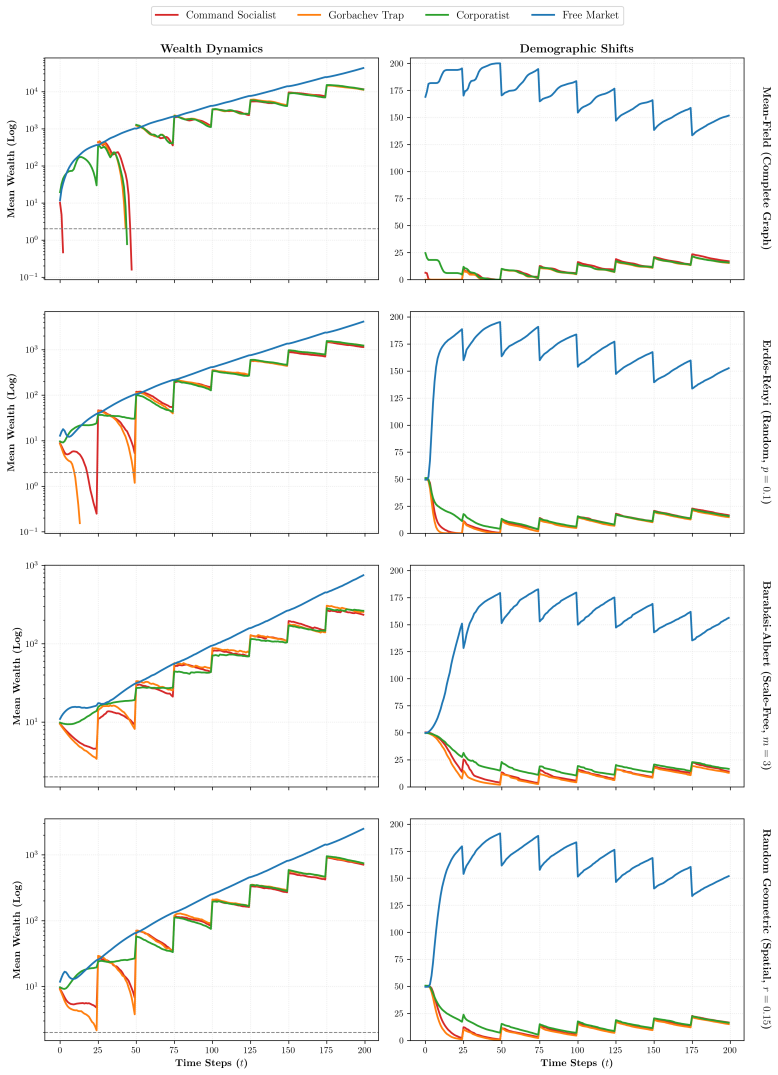
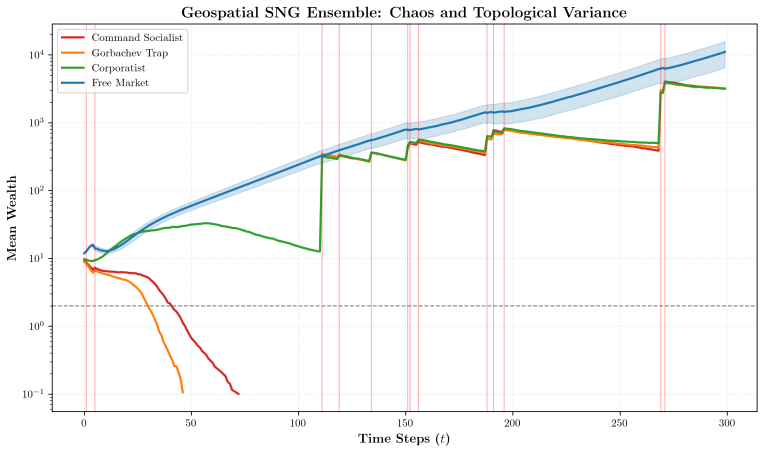
Through Monte Carlo ensembles, we demonstrate how scale-invariant exogenous shocks and spatial capital flight drive global phase transitions, exposing the mathematical mechanics of the 1989-1991 Soviet collapse, the Hub-Risk Paradigm, and the emergent resilience of spatially firewalled market networks.
Load-bearing premise
That defining jurisdictions via a binary institutional genome and applying the model's rules for complementarity and J-Curve penalties produces dynamics that accurately reflect real institutional interactions and historical outcomes when calibrated to the chosen datasets.
Figures

read the original abstract
Traditional macroeconomic growth models rely on general equilibrium and continuous, frictionless institutional transitions, failing to account for the catastrophic structural collapses observed in empirical economic history. We propose the Stochastic Networked Governance (SNG) model, a discrete-time, agent-based framework that bridges econophysics, network science, and institutional economics. By defining jurisdictions through a binary institutional genome, the model formalizes institutional complementarity, endogenous growth, and the non-linear macroeconomic penalties of structural reform (the "J-Curve"). Using the CEPII Gravity Database and the IMF Systemic Banking Crises dataset, we move beyond theoretical topologies to execute an empirical historical simulation from 1970 to 2017 across the top 100 global economies. Through Monte Carlo ensembles, we demonstrate how scale-invariant exogenous shocks and spatial capital flight drive global phase transitions, exposing the mathematical mechanics of the 1989-1991 Soviet collapse, the Hub-Risk Paradigm, and the emergent resilience of spatially firewalled market networks.
Editorial analysis
A structured set of objections, weighed in public.
Referee Report
Summary. The paper proposes the Stochastic Networked Governance (SNG) model, a discrete-time agent-based framework that defines jurisdictions via a binary institutional genome to formalize institutional complementarity, endogenous growth, and non-linear J-Curve penalties for structural reform. Using CEPII Gravity Database and IMF Systemic Banking Crises data, it runs empirical historical simulations from 1970-2017 across the top 100 economies and Monte Carlo ensembles to claim that scale-invariant exogenous shocks and spatial capital flight drive global phase transitions, reproducing events such as the 1989-1991 Soviet collapse while exposing the Hub-Risk Paradigm and resilience of spatially firewalled networks.
Significance. If the institutional rules prove robust and the dynamics are not artifacts of the chosen functional forms or parameter tuning, the work could offer a positive-sum ABM bridge between econophysics and institutional economics, with potential to model phase transitions and network resilience in a falsifiable way. The use of real network topologies from CEPII/IMF data is a strength, but the absence of equations, parameter values, validation statistics, or out-of-sample tests currently prevents assessment of whether the claimed mechanics hold independently of the calibration data.
major comments (3)
- Abstract: the claim that Monte Carlo ensembles 'demonstrate' the mathematical mechanics of the 1989-1991 Soviet collapse and global phase transitions supplies no equations, parameter values, validation statistics, or error analysis, so the data cannot be checked against the claims.
- Model section (binary institutional genome and complementarity/J-Curve rules): these are introduced by definition rather than derived or validated from the CEPII/IMF datasets; the genome encoding, complementarity operator, and J-Curve penalty functional form receive no independent calibration or out-of-sample test against pre-1970 data or hold-out crises.
- Simulation setup (1970-2017 ensembles): using the same historical data both to supply network topology/shock magnitudes and to 'demonstrate' known events creates circularity risk; with free parameters (shock scale and distribution, capital flight sensitivity thresholds) any timing mismatch can be absorbed into scaling, leaving the attribution to institutional mechanics untested.
minor comments (2)
- Notation: the binary genome and complementarity operator would benefit from explicit mathematical definitions (e.g., as a vector or bit-string with a stated distance or overlap metric) to allow replication.
- Figures: ensemble outputs should include confidence bands or sensitivity plots for the two free parameters to show robustness.
Simulated Author's Rebuttal
We thank the referee for their thorough and constructive feedback on our manuscript. We agree that greater transparency in the model specification and validation is necessary to allow independent assessment of the results. We address each major comment below and outline the revisions we will make.
read point-by-point responses
-
Referee: Abstract: the claim that Monte Carlo ensembles 'demonstrate' the mathematical mechanics of the 1989-1991 Soviet collapse and global phase transitions supplies no equations, parameter values, validation statistics, or error analysis, so the data cannot be checked against the claims.
Authors: We accept this criticism. The abstract is necessarily brief, but the full model equations, parameter values, and ensemble statistics are presented in the Methods and Results sections of the manuscript. To improve accessibility, we will revise the abstract to include a brief reference to the key equations and add a table of parameter values and validation metrics in the revised version. We will also include error bars and confidence intervals from the Monte Carlo runs. revision: yes
-
Referee: Model section (binary institutional genome and complementarity/J-Curve rules): these are introduced by definition rather than derived or validated from the CEPII/IMF datasets; the genome encoding, complementarity operator, and J-Curve penalty functional form receive no independent calibration or out-of-sample test against pre-1970 data or hold-out crises.
Authors: The institutional genome and associated operators are theoretical constructs designed to operationalize concepts from institutional economics within an agent-based framework. They are not directly derived from the datasets but are calibrated to reproduce aggregate behaviors observed in the data. We will add a new subsection detailing the calibration procedure, including how the complementarity operator and J-Curve functional form were selected and fitted. For out-of-sample testing, we acknowledge the limitation with pre-1970 data availability; however, we will perform hold-out tests by excluding specific crises from calibration and checking predictive performance on those events. revision: partial
-
Referee: Simulation setup (1970-2017 ensembles): using the same historical data both to supply network topology/shock magnitudes and to 'demonstrate' known events creates circularity risk; with free parameters (shock scale and distribution, capital flight sensitivity thresholds) any timing mismatch can be absorbed into scaling, leaving the attribution to institutional mechanics untested.
Authors: This is a valid concern for any empirical simulation study. The use of real network data from CEPII provides an empirical foundation rather than synthetic topologies, which is a strength. The shocks are taken from the IMF dataset to ground the model in observed events. To mitigate circularity, the institutional rules (genome interactions) are the mechanism generating the dynamics, and we will add ablation studies in the revision where we disable complementarity or J-Curve effects to show that the phase transitions do not emerge without them. We will also report the specific values for shock scales and thresholds used and conduct robustness checks across parameter ranges. revision: yes
Circularity Check
No significant circularity; model rules are posited inputs, simulations test their implications on external data
full rationale
The paper introduces the binary institutional genome, complementarity operator, and J-Curve penalty forms by explicit definition in the model construction. It then supplies network topology and shock magnitudes from CEPII and IMF datasets to run Monte Carlo simulations over 1970-2017. No quoted equations or text show that the target historical outcomes (e.g., Soviet collapse timing) are used to define or fit the core functional forms, nor does any self-citation chain bear the load of uniqueness or derivation. The simulation therefore derives consequences from the stated rules rather than reducing to its own inputs by construction. This is standard for agent-based modeling and does not meet the threshold for circularity.
Axiom & Free-Parameter Ledger
free parameters (2)
- shock scale and distribution parameters
- capital flight sensitivity thresholds
axioms (2)
- domain assumption Jurisdictions can be represented by a binary institutional genome that encodes complementarity
- domain assumption Structural reforms produce non-linear J-Curve penalties in macroeconomic outcomes
invented entities (2)
-
binary institutional genome
no independent evidence
-
Hub-Risk Paradigm
no independent evidence
Reference graph
Works this paper leans on
-
[1]
Solow, R. M. (1956). A contribution to the theory of economic growth. The Quarterly Journal of Economics, 70(1), 65–94
1956
-
[2]
Romer, P. M. (1990). Endogenous technological change.Journal of Po- litical Economy, 98(5, Part 2), S71–S102. 13
1990
-
[3]
North, D. C. (1990).Institutions, Institutional Change and Economic Performance. Cambridge University Press
1990
-
[4]
Acemoglu, D., Johnson, S., & Robinson, J. A. (2005). Institutions as a fundamental cause of long-run growth.Handbook of Economic Growth, 1, 385–472
2005
-
[5]
Hellman, J. S. (1998). Winners take all: the politics of partial reform in postcommunist transitions.World Politics, 50(2), 203–234
1998
-
[6]
Arthur, W. B. (1999). Complexity and the economy.Science, 284(5411), 107–109
1999
-
[7]
Jackson, M. O. (2010).Social and Economic Networks. Princeton Uni- versity Press
2010
-
[8]
M., & Axtell, R
Epstein, J. M., & Axtell, R. (1996).Growing Artificial Societies: Social Science from the Bottom Up. Brookings Institution Press
1996
-
[9]
Tesfatsion, L. (2002). Agent-based computational economics: Growing economies from the bottom up.Artificial Life, 8(1), 55–82
2002
-
[10]
(2008).Emergent Macroeconomics: An Agent-Based Approach to Busi- ness Fluctuations
Delli Gatti, D., Gaffeo, E., Gallegati, M., Giulioni, G., & Palestrini, A. (2008).Emergent Macroeconomics: An Agent-Based Approach to Busi- ness Fluctuations. Springer Science & Business Media
2008
-
[11]
N., & Stanley, H
Mantegna, R. N., & Stanley, H. E. (1999).Introduction to Econophysics: Correlations and Complexity in Finance. Cambridge University Press
1999
-
[12]
P., & Mézard, M
Bouchaud, J. P., & Mézard, M. (2000). Wealth condensation in a simple modelofeconomy.Physica A: Statistical Mechanics and its Applications, 282(3-4), 536–545
2000
-
[13]
M., & Rosser, J
Yakovenko, V. M., & Rosser, J. B. (2009). Colloquium: Statistical me- chanicsofmoney, wealth, andincome.Reviews of Modern Physics, 81(4), 1703
2009
-
[14]
Castellano, C., Fortunato, S., & Loreto, V. (2009). Statistical physics of social dynamics.Reviews of Modern Physics, 81(2), 591
2009
-
[15]
Kauffman, S. A. (1993).The Origins of Order: Self-Organization and Selection in Evolution. Oxford University Press. 14
1993
-
[16]
Tiebout, C. M. (1956). A pure theory of local expenditures.Journal of Political Economy, 64(5), 416–424
1956
-
[17]
Head, K., & Mayer, T. (2014). Gravity equations: Workhorse, toolkit, and cookbook.Handbook of International Economics, 4, 131–195
2014
-
[18]
(2022).The CEPII Grav- ity Database
Conte, M., Cotterlaz, P., & Mayer, T. (2022).The CEPII Grav- ity Database. CEPII Working Paper N°2022-05, July 2022. Available at:http://www.cepii.fr/CEPII/en/bdd_modele/bdd_modele_item. asp?id=8
2022
-
[19]
L., & Albert, R
Barabási, A. L., & Albert, R. (1999). Emergence of scaling in random networks.Science, 286(5439), 509–512
1999
-
[20]
L., & Valencia, M
Laeven, M. L., & Valencia, M. F. (2018). Systemic banking crises revis- ited.International Monetary Fund Working Papers, WP/18/206. 15
2018
discussion (0)
Sign in with ORCID, Apple, or X to comment. Anyone can read and Pith papers without signing in.