Recognition: unknown
Efficient Quantum Algorithms for Higher-Order Coupled Oscillators
Pith reviewed 2026-05-10 01:03 UTC · model grok-4.3
The pith
Quantum algorithms for the simplicial Kuramoto model yield polynomial advantage in synchronization estimation and super-polynomial advantage in no-phase-locking certification.
A machine-rendered reading of the paper's core claim, the machinery that carries it, and where it could break.
Core claim
Under explicit assumptions on data access and types together with simplicial structure, the paper derives end-to-end quantum gate complexities for synchronization estimation and for certification of the no-phase-locking regime in the simplicial Kuramoto model, identifying regimes of polynomial quantum advantage for the former task and super-polynomial quantum advantage for the latter over classical methods.
What carries the argument
The quantum algorithms that reduce synchronization estimation and no-phase-locking certification in the simplicial Kuramoto model to gate-complexity calculations that exploit the simplicial structure and stated data-access assumptions.
Load-bearing premise
The explicit assumptions on data access and types, and simplicial structure, must hold for the derived gate complexities and stated quantum advantages to apply.
What would settle it
A classical algorithm achieving the same or better scaling for synchronization estimation or no-phase-locking certification under identical data-access, data-type, and simplicial-structure assumptions would falsify the claimed advantages.
Figures


read the original abstract
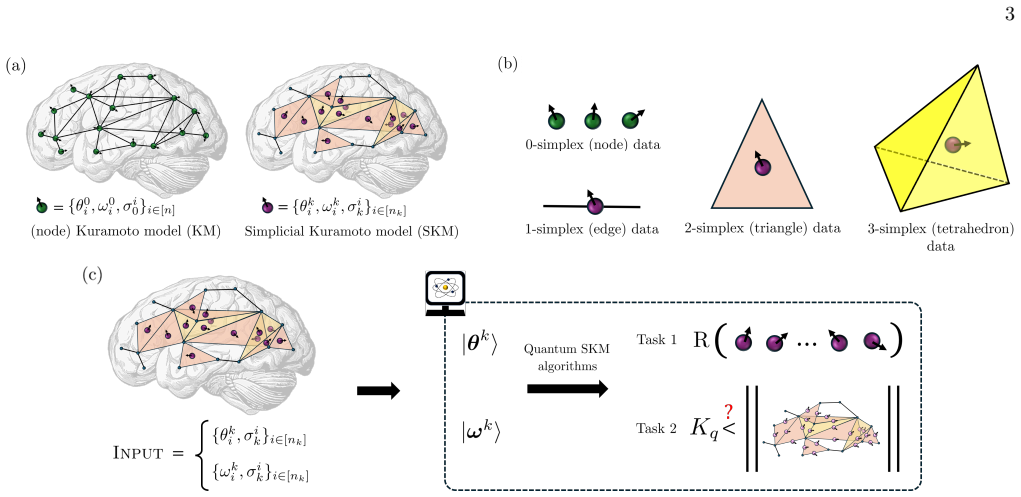
Higher-order networks with multiway interactions can exhibit collective dynamical phenomena that are absent in traditional pairwise network models. However, analyzing such dynamics becomes computationally prohibitive as their state space grows combinatorially in the multiway interaction order. Here we develop quantum algorithms for two central tasks -- synchronization estimation and certification of the no-phase-locking regime -- in the simplicial Kuramoto model. This model is a higher-order generalization of the celebrated Kuramoto model for coupled oscillators on graph-based networks. Under explicit assumptions on data access and types, and simplicial structure, we derive end-to-end quantum gate complexities and identify regimes with polynomial quantum advantage for synchronization estimation and super-polynomial quantum advantage for no-phase-locking certification over classical methods. More broadly, these results extend quantum algorithms for higher-order networks from structural analysis to nonlinear dynamical diagnostics, easing a major computational bottleneck and opening a route to quantum methods for probing higher-order phenomena beyond the reach of direct classical approaches.
Editorial analysis
A structured set of objections, weighed in public.
Referee Report
Summary. The manuscript develops quantum algorithms for synchronization estimation and certification of the no-phase-locking regime in the simplicial Kuramoto model, a higher-order generalization of the standard Kuramoto oscillator model on networks. Under explicit assumptions on data access, data types, and simplicial structure, the authors derive end-to-end quantum gate complexities and identify regimes exhibiting polynomial quantum advantage for synchronization estimation and super-polynomial quantum advantage for no-phase-locking certification relative to classical methods. The work positions these results as extending quantum algorithms for higher-order networks from static structural analysis to nonlinear dynamical diagnostics.
Significance. If the stated assumptions are realistic, the oracles efficiently implementable, and the complexity derivations correct, this provides a concrete route to quantum-assisted analysis of collective dynamics on higher-order networks whose state spaces grow combinatorially. The explicit identification of advantage regimes under well-defined input models is a positive feature that could guide future work on quantum methods for complex systems exhibiting multiway interactions.
major comments (2)
- [Abstract] Abstract: The polynomial and super-polynomial quantum advantage claims are conditioned on 'explicit assumptions on data access and types, and simplicial structure.' The manuscript must demonstrate that these assumptions do not inadvertently equip classical algorithms with equivalent oracles or preprocessing shortcuts (e.g., by providing a side-by-side accounting of classical input-model costs versus quantum oracle construction costs for dense simplicial complexes). Without such a comparison, the reported gate complexities do not necessarily establish end-to-end advantage.
- [Complexity analysis section] Section on complexity analysis (around the derivation of gate counts for the two tasks): The advantage regimes are identified post-hoc under the assumptions. An explicit statement is needed showing that the classical baseline algorithms are optimal under the same input model; otherwise the super-polynomial claim for no-phase-locking certification risks being an artifact of a weaker classical model rather than a genuine quantum separation.
minor comments (2)
- [Abstract] The abstract refers to 'simplicial structure' without a one-sentence gloss; adding a brief parenthetical definition would improve accessibility for readers outside the immediate subfield.
- [Notation and preliminaries] Notation for the higher-order coupling tensors and the simplicial Laplacian should be introduced with an explicit reference to the relevant equation on first use to avoid ambiguity in later complexity statements.
Simulated Author's Rebuttal
We thank the referee for their detailed and constructive report. We address each major comment below and have revised the manuscript to strengthen the presentation of the input models and complexity comparisons.
read point-by-point responses
-
Referee: [Abstract] Abstract: The polynomial and super-polynomial quantum advantage claims are conditioned on 'explicit assumptions on data access and types, and simplicial structure.' The manuscript must demonstrate that these assumptions do not inadvertently equip classical algorithms with equivalent oracles or preprocessing shortcuts (e.g., by providing a side-by-side accounting of classical input-model costs versus quantum oracle construction costs for dense simplicial complexes). Without such a comparison, the reported gate complexities do not necessarily establish end-to-end advantage.
Authors: We agree that an explicit side-by-side accounting is necessary to substantiate end-to-end advantage. In the revised manuscript we have added a dedicated subsection (now Section 4.3) that compares the classical and quantum input models under the same oracle assumptions. For dense simplicial complexes of order k on n vertices, both models receive access to the simplicial structure and coupling parameters via oracles of comparable cost; the classical baseline requires Θ(n^k) queries in the worst case to read the full interaction tensor, while the quantum algorithms achieve the stated gate complexities via amplitude amplification and quantum linear-system solvers. We clarify that the assumptions do not grant classical algorithms any additional preprocessing shortcuts beyond standard data-structure access. revision: yes
-
Referee: [Complexity analysis section] Section on complexity analysis (around the derivation of gate counts for the two tasks): The advantage regimes are identified post-hoc under the assumptions. An explicit statement is needed showing that the classical baseline algorithms are optimal under the same input model; otherwise the super-polynomial claim for no-phase-locking certification risks being an artifact of a weaker classical model rather than a genuine quantum separation.
Authors: We accept that an explicit optimality argument for the classical baselines is required. The revised manuscript now includes a new paragraph in the complexity analysis section that establishes information-theoretic lower bounds for the no-phase-locking certification task under the stated input model. Specifically, certifying the absence of phase locking in a dense k-simplicial Kuramoto system requires distinguishing exponentially many possible phase configurations, which necessitates Ω(2^{Ω(n)}) classical queries in the worst case when the simplicial structure is provided only via oracle access. This lower bound matches the classical upper bound we compare against, confirming that the super-polynomial separation is not an artifact of a weaker classical model. revision: yes
Circularity Check
No significant circularity; derivations are conditional on explicit external assumptions
full rationale
The paper states its central claims as end-to-end quantum gate complexities derived under explicit assumptions on data access, data types, and simplicial structure for the simplicial Kuramoto model. These assumptions are presented as inputs that enable the complexity analysis and advantage regimes, rather than being defined in terms of the claimed predictions. No load-bearing step reduces by construction to a fitted parameter, a self-citation chain, or a renaming of known results; the derivation chain relies on standard quantum algorithmic techniques applied to the model under those assumptions. The advantages are explicitly qualified as holding only when the assumptions permit efficient oracles while classical methods lack equivalent shortcuts, which is a standard non-circular framing.
Axiom & Free-Parameter Ledger
axioms (1)
- domain assumption Assumptions on data access and types, and simplicial structure
Reference graph
Works this paper leans on
-
[1]
From Corollary 2, we have L2(m, k) = k2 ek mk−1 logm | {z } :=g(m,k) 1 + kc−1 m2 −1 | {z } :=p(m,k) .(26) We denote byg(m, k) the growth term and byp(m, k) the penalty term
Unlike (n, k), which are often presented as dependent parameters to demonstrate the advantage regime in the QTDA literature [40], bothmandkare independent pa- rameters. From Corollary 2, we have L2(m, k) = k2 ek mk−1 logm | {z } :=g(m,k) 1 + kc−1 m2 −1 | {z } :=p(m,k) .(26) We denote byg(m, k) the growth term and byp(m, k) the penalty term. We analyze the...
-
[2]
Un- der our input model, Task 1 yields at most polynomial improvements innfor fixed interaction orderk
and balanced complete multipartite graphs (Task 2), since these families admit efficient implementations of the simplex membership oracle at the gate level. Un- der our input model, Task 1 yields at most polynomial improvements innfor fixed interaction orderk. In con- trast, for Task 2 on balanced multipartite instances with k= Θ(logn), we obtain a super-...
2021
-
[3]
Petri, P
G. Petri, P. Expert, F. Turkheimer, and F. Vaccarino, Homological scaffolds of brain functional networks, J. R. Soc. Interface11, 20140873 (2014)
2014
-
[4]
J. Xu, T. L. Wickramarathne, and N. V. Chawla, Repre- senting higher-order dependencies in networks, Sci. Adv. 2, e1600028 (2016)
2016
-
[5]
Giusti, R
C. Giusti, R. Ghrist, and D. S. Bassett, Two’s company, three (or more) is a simplex: algebraic-topological tools for understanding higher-order structure in neural data, J. Comput. Neurosci.41, 1 (2016)
2016
-
[6]
M. W. Reimann, M. Nolte, M. Scolamiero, K. Turner, R. Perin, G. Chindemi, P. D lotko, R. Levi, K. Hess, and H. Markram, Cliques of neurons bound into cavities pro- vide a missing link between structure and function, Front. Comput. Neurosci.11, 48 (2017)
2017
-
[7]
Patania, F
A. Patania, F. Vaccarino, and G. Petri, Topological anal- ysis of data, EPJ Data Sci.6, 7 (2017)
2017
-
[8]
Iacopini, G
I. Iacopini, G. Petri, A. Barrat, and V. Latora, Simpli- cial models of social contagion, Nat. Commun.10, 2485 (2019)
2019
-
[9]
J. T. Matamalas, S. G´ omez, and A. Arenas, Abrupt phase transition of epidemic spreading in simplicial com- plexes, Phys. Rev. Res.2, 012049 (2020)
2020
-
[10]
Bianconi,Higher-Order Networks, Elements in the Structure and Dynamics of Complex Networks (Cam- bridge University Press, 2021)
G. Bianconi,Higher-Order Networks, Elements in the Structure and Dynamics of Complex Networks (Cam- bridge University Press, 2021)
2021
-
[11]
C. Bick, E. Gross, H. A. Harrington, and M. T. Schaub, SIAM Review65, 686 (2023)
2023
-
[12]
Battiston, G
F. Battiston, G. Cencetti, I. Iacopini, V. Latora, M. Lu- cas, A. Patania, J.-G. Young, and G. Petri, Networks beyond pairwise interactions: structure and dynamics, Phys. Rep.874, 1 (2020)
2020
-
[13]
Battiston, E
F. Battiston, E. Amico, A. Barrat, G. Bianconi, G. F. de Arruda, B. Franceschiello, I. Iacopini, S. K´ efi, V. La- tora, Y. Moreno, M. M. Murray, T. P. Peixoto, F. Vac- carino, and G. Petri, The physics of higher-order inter- actions in complex systems, Nat. Phys.17, 1093 (2021)
2021
-
[14]
Majhi, M
S. Majhi, M. Perc, and D. Ghosh, Dynamics on higher- order networks: a review, J. R. Soc. Interface19, 20220043 (2022)
2022
-
[15]
A. P. Mill´ an, J. J. Torres, and G. Bianconi, Explo- sive higher-order kuramoto dynamics on simplicial com- plexes, Phys. Rev. Lett.124, 218301 (2020)
2020
-
[16]
DeVille, Consensus on simplicial complexes: Re- sults on stability and synchronization, Chaos31, 023137 (2021)
L. DeVille, Consensus on simplicial complexes: Re- sults on stability and synchronization, Chaos31, 023137 (2021)
2021
-
[17]
Arnaudon, R
A. Arnaudon, R. L. Peach, G. Petri, and P. Expert, Con- necting hodge and sakaguchi-kuramoto through a math- ematical framework for coupled oscillators on simplicial complexes, Commun. Phys.5, 211 (2022)
2022
-
[18]
Nurisso, A
M. Nurisso, A. Arnaudon, M. Lucas, R. L. Peach, P. Ex- pert, F. Vaccarino, and G. Petri, A unified framework for simplicial kuramoto models, Chaos34, 053118 (2024)
2024
-
[19]
Kuramoto, Self-entrainment of a population of cou- pled non-linear oscillators, inInternational Symposium 12 on Mathematical Problems in Theoretical Physics, edited by H
Y. Kuramoto, Self-entrainment of a population of cou- pled non-linear oscillators, inInternational Symposium 12 on Mathematical Problems in Theoretical Physics, edited by H. Araki (Springer Berlin Heidelberg, Berlin, Heidel- berg, 1975) pp. 420–422
1975
-
[20]
S. H. Strogatz, From kuramoto to crawford: Exploring the onset of synchronization in populations of coupled oscillators, Physica D143, 1 (2000)
2000
-
[21]
J. A. Acebr´ on, L. L. Bonilla, C. J. P´ erez Vicente, and R. Ritort, F.and Spigler, Rev. Mod. Phys.77, 137 (2005)
2005
-
[22]
F. A. Rodrigues, T. K. D. M. Peron, P. Ji, and J. Kurths, The kuramoto model in complex networks, Phys. Rep. 610, 1 (2016)
2016
-
[23]
Breakspear, S
M. Breakspear, S. Heitmann, and A. Daffertshofer, Gen- erative models of cortical oscillations: neurobiological im- plications of the kuramoto model, Frontiers in Human Neuroscience4, 190 (2010)
2010
-
[24]
Cabral, E
J. Cabral, E. Hugues, O. Sporns, and G. Deco, Role of local network oscillations in resting-state functional con- nectivity, NeuroImage57, 130 (2011)
2011
-
[25]
Sadilek and S
M. Sadilek and S. Thurner, Physiologically motivated multiplex Kuramoto model describes phase diagram of cortical activity, Sci. Rep.5, 10015 (2015)
2015
-
[26]
D¨ orfler, M
F. D¨ orfler, M. Chertkov, and F. Bullo, Synchronization in Complex Oscillator Networks and Smart Grids, Proc. Natl. Acad. Sci. U.S.A.110, 2005 (2013)
2005
-
[27]
A. E. Motter, S. A. Myers, M. Anghel, and T. Nishikawa, Spontaneous synchrony in power-grid networks, Nat. Phys.9, 191 (2013)
2013
-
[28]
P. H. J. Nardelli, N. Rubido, C. Wang, M. S. Baptista, C. Pomalaza-Raez, P. Cardieri, and M. Latva-aho, Mod- els for the modern power grid, EPJ Special Topics223, 2423 (2014)
2014
-
[29]
Pluchino, V
A. Pluchino, V. Latora, and A. Rapisarda, Changing opinions in a changing world: A new perspective in so- ciophysics, Int. J. Mod. Phys. C16, 515 (2005)
2005
-
[30]
Pluchino, S
A. Pluchino, S. Boccaletti, V. Latora, and A. Rapisarda, Opinion dynamics and synchronization in a network of scientific collaborations, Physica A Stat. Mech. Appl. 372, 316 (2006)
2006
-
[31]
Ghorbanchian, J
R. Ghorbanchian, J. G. Restrepo, J. J. Torres, and G. Bianconi, Higher-order simplicial synchronization of coupled topological signals, Commun. Phys.4, 120 (2021)
2021
-
[32]
Calmon, J
L. Calmon, J. G. Restrepo, J. J. Torres, and G. Bian- coni, Dirac synchronization is rhythmic and explosive, Commun. Phys.5, 1 (2022)
2022
-
[33]
A. P. Mill´ an, H. Sun, L. Giambagli, R. Muolo, T. Car- letti, J. J. Torres, F. Radicchi, J. Kurths, and G. Bian- coni, Topology shapes dynamics of higher-order net- works, Nat. Phys.21, 353 (2025)
2025
-
[34]
Lloyd, S
S. Lloyd, S. Garnerone, and P. Zanardi, Quantum al- gorithms for topological and geometric analysis of data, Nat. Commun.7, 10138 (2016)
2016
-
[35]
Gyurik, C
C. Gyurik, C. Cade, and V. Dunjko, Towards Quantum Advantage via Topological Data Analysis, Quantum6, 1 (2022)
2022
-
[36]
Hayakawa, Quantum algorithm for persistent betti numbers and topological data analysis, Quantum6, 873 (2022)
R. Hayakawa, Quantum algorithm for persistent betti numbers and topological data analysis, Quantum6, 873 (2022)
2022
-
[37]
A streamlined quantum algorithm for topological data analysis with exponentially fewer qubits
S. McArdle, A. Gily´ en, and M. Berta, A stream- lined quantum algorithm for topological data analysis with exponentially fewer qubits (2025), arXiv:2209.12887 [quant-ph]
work page internal anchor Pith review Pith/arXiv arXiv 2025
-
[38]
R. Hayakawa, K. C. Chen, and M. H. Hsieh, Quantum walks on simplicial complexes and harmonic homology: Application to topological data analysis with superpoly- nomial speedups (2024), arXiv:2404.15407 [quant-ph]
-
[39]
C. M. G. Leditto, A. Southwell, B. Tonekaboni, G. A. L. White, M. Usman, and K. Modi, Topological signal pro- cessing on quantum computers for higher-order network analysis, Phys. Rev. Applied23, 054054 (2025)
2025
-
[40]
Carlsson, Topology and data, Bulletin of the American Mathematical Society46, 255 (2009)
G. Carlsson, Topology and data, Bulletin of the American Mathematical Society46, 255 (2009)
2009
-
[41]
Barbarossa and S
S. Barbarossa and S. Sardellitti, IEEE Trans. Signal Pro- cess.68, 2992 (2020)
2020
-
[42]
D. W. Berryet al., Analyzing prospects for quantum ad- vantage in topological data analysis, PRX Quantum5, 010319 (2024)
2024
-
[43]
C. M. G. Leditto, A. Southwell, B. Tonekaboni, M. Us- man, and K. Modi, Quantum HodgeRank: Topology- based rank aggregation on quantum computers, Phys. Rev. Applied23, L061005 (2025)
2025
-
[44]
N.-H. Chia, A. Gily´ en, T. Li, H.-H. Lin, E. Tang, and C. Wang, inProceedings of the 52nd Annual ACM SIGACT Symposium on Theory of Computing, STOC 2020 (Association for Computing Machinery, New York, NY, USA, 2020) p. 387–400
2020
-
[45]
Gharibian and F
S. Gharibian and F. Le Gall, inProceedings of the Annual ACM Symposium on Theory of Computing(Association for Computing Machinery, 2022) pp. 19–32
2022
-
[46]
Haruna and Y
T. Haruna and Y. Fujiki, Hodge decomposition of in- formation flow on small-world networks, Front. Neural Circuits10, 77 (2016)
2016
-
[47]
A. E. Sizemore, J. E. Phillips-Cremins, R. Ghrist, and D. S. Bassett, The importance of the whole: Topolog- ical data analysis for the network neuroscientist, Netw. Neurosci.3, 656 (2019)
2019
-
[48]
Parastesh, M
F. Parastesh, M. Mehrabbeik, K. Rajagopal, S. Jafari, and M. Perc, Synchronization in hindmarsh–rose neurons subject to higher-order interactions, Chaos32, 013125 (2022)
2022
-
[49]
Majhi, S
S. Majhi, S. Ghosh, P. K. Pal, S. Pal, T. K. Pal, D. Ghosh, J. Zavrˇ snik, and M. Perc, Patterns of neu- ronal synchrony in higher-order networks, Physics of Life Reviews52, 144 (2025)
2025
-
[50]
Franci, A
A. Franci, A. Chaillet, E. Panteley, and F. Lamnabhi- Lagarrigue, Desynchronization and inhibition of ku- ramoto oscillators by scalar mean-field feedback, Math. Control Signals Syst.24, 169 (2012)
2012
-
[51]
Lowet, M
E. Lowet, M. J. Roberts, P. Bonizzi, J. Karel, and P. De Weerd, Quantifying neural oscillatory synchro- nization: A comparison between spectral coherence and phase-locking value approaches, PLoS One11, e0146443 (2016)
2016
-
[52]
Weerasinghe, B
G. Weerasinghe, B. Duchet, H. Cagnan, P. Brown, C. Bick, and R. Bogacz, Predicting the effects of deep brain stimulation using a reduced coupled oscillator model, PLoS Comput. Biol.15, e1006575 (2019)
2019
-
[53]
Reyner-Parra and G
D. Reyner-Parra and G. Huguet, Phase-locking patterns underlying effective communication in exact firing rate models of neural networks, PLoS Comput. Biol.18, e1009342 (2022)
2022
-
[54]
Y. Guo, D. Zhang, Z. Li, Q. Wang, and D. Yu, Overviews on the applications of the kuramoto model in modern power system analysis, Int. J. Electr. Power Energy syst. 129, 106804 (2021)
2021
-
[55]
Gupta, A
S. Gupta, A. Campa, and S. Ruffo, Kuramoto model of synchronization: equilibrium and nonequilibrium as- pects, J. Stat. Mech.2014, R08001 (2014). 13
2014
-
[56]
Jadbabaie, N
A. Jadbabaie, N. Motee, and M. Barahona, On the sta- bility of the kuramoto model of coupled nonlinear oscilla- tors, inProceedings of the American Control Conference (ACC)(2005) pp. 4296–4301
2005
-
[57]
Hatcher,Algebraic Topology(Cambridge University Press, New York, 2001)
A. Hatcher,Algebraic Topology(Cambridge University Press, New York, 2001)
2001
-
[58]
A. N. Hirani, Phd thesis, Caltech, California, USA (2014)
2014
-
[59]
P. S. Skardal, D. Taylor, and J. Sun, Optimal synchro- nization of complex networks, Phys. Rev. Lett.113, 144101 (2014)
2014
-
[60]
P. S. Skardal, L. Arola-Fern´ andez, D. Taylor, and A. Are- nas, Higher-order interactions can better optimize net- work synchronization, Phys. Rev. Res.3, 043193 (2021)
2021
-
[61]
Gily´ en, Y
A. Gily´ en, Y. Su, G. H. Low, and N. Wiebe, inPro- ceedings of the Annual ACM Symposium on Theory of Computing(2019)
2019
-
[62]
Giovannetti, S
V. Giovannetti, S. Lloyd, and L. Maccone, Architectures for a quantum random access memory, Phys. Rev. A78, 052310 (2008)
2008
-
[63]
Babbush, C
R. Babbush, C. Gidney, D. W. Berry, N. Wiebe, J. Mc- Clean, A. Paler, A. Fowler, and H. Neven, Encoding elec- tronic spectra in quantum circuits with linear t complex- ity, Phys. Rev. X8, 041015 (2018)
2018
-
[64]
B¨ artschi and S
A. B¨ artschi and S. Eidenbenz, Deterministic Preparation of Dicke States, inLecture Notes in Computer Science (including subseries Lecture Notes in Artificial Intelli- gence and Lecture Notes in Bioinformatics), Vol. 11651 LNCS (Springer Verlag, 2019) pp. 126–139
2019
-
[65]
I. Kerenidis and A. Prakash, Quantum machine learning with subspace states (2022), arXiv:2202.00054 [quant- ph]
-
[66]
I. Y. Akhalwaya, Y.-H. He, L. Horesh, V. Jejjala, W. Kirby, K. Naidoo, and S. Ubaru, Representation of the fermionic boundary operator, Phys. Rev. A106, 022407 (2022)
2022
-
[67]
S. A. Metwalli, F. Le Gall, and R. Van Meter, Finding small and large k-clique instances on a quantum com- puter, IEEE Trans. Quantum Eng.1, 1 (2021)
2021
-
[68]
Sachdeva and N
S. Sachdeva and N. K. Vishnoi, Faster algorithms via ap- proximation theory, Found. Trends Theor. Comput. Sci. 9, 125–210 (2014)
2014
-
[69]
Musco, C
C. Musco, C. Musco, and A. Sidford, Stability of the lanczos method for matrix function approximation, in Proceedings of the Twenty-Ninth Annual ACM-SIAM Symposium on Discrete Algorithms, SODA ’18 (Society for Industrial and Applied Mathematics, USA, 2018) p. 1605–1624
2018
-
[70]
G. H. Low, V. Kliuchnikov, and L. Schaeffer, Trading T gates for dirty qubits in state preparation and unitary synthesis, Quantum8, 1375 (2024)
2024
-
[71]
Song, Quantum walk on simplicial complexes for sim- plicial community detection, Quantum Inf
E. Song, Quantum walk on simplicial complexes for sim- plicial community detection, Quantum Inf. Process.23, 199 (2024)
2024
-
[72]
Rajagopalan and P
R. Rajagopalan and P. K. Varshney, Data-aggregation techniques in sensor networks: A survey, IEEE Commun. Surv. Tutor.8, 48 (2006)
2006
-
[73]
Lucas, G
M. Lucas, G. Cencetti, and F. Battiston, Multiorder laplacian for synchronization in higher-order networks, Phys. Rev. Res.2, 033410 (2020)
2020
-
[74]
P. S. Skardal and A. Arenas, Higher order interac- tions in complex networks of phase oscillators promote abrupt synchronization switching, Commun. Phys.3, 218 (2020)
2020
-
[75]
S. A. Cuccaro., T. G. Draper, S. A. Kutin., and D. P. Moulton, A new quantum ripple-carry addition circuit (2004), arXiv:quant-ph/0410184
work page Pith review arXiv 2004
- [76]
-
[77]
Sakaguchi and Y
H. Sakaguchi and Y. Kuramoto, A soluble active rotator model showing phase transitions via mutual entrainment, Prog. Theor. Phys.76, 576 (1986)
1986
-
[78]
J. J. Torres and G. Bianconi, Simplicial complexes: Higher-order spectral dimension and dynamics, J. Phys. Complex.1, 015002 (2020)
2020
-
[79]
J.-P. Liu, H. O. Kolden, H. K. Krovi, N. F. Loureiro, K. Trivisa, and A. M. Childs, Efficient quantum al- gorithm for dissipative nonlinear differential equations, Proc. Natl. Acad. Sci. U.S.A.118, e2026805118 (2021)
2021
-
[80]
Y. Tanaka and K. Fujii, A polynomial time quantum algorithm for exponentially large scale nonlinear dif- ferential equations via hamiltonian simulation (2025), arXiv:2305.00653 [quant-ph]
discussion (0)
Sign in with ORCID, Apple, or X to comment. Anyone can read and Pith papers without signing in.