Recognition: unknown
The January 2010 flare of Mrk421: Insights from a stochastic acceleration model
Pith reviewed 2026-05-09 23:39 UTC · model grok-4.3
The pith
Spectral variability in Mrk 421's January 2010 flare aligns with stochastic acceleration of particles.
A machine-rendered reading of the paper's core claim, the machinery that carries it, and where it could break.
Core claim
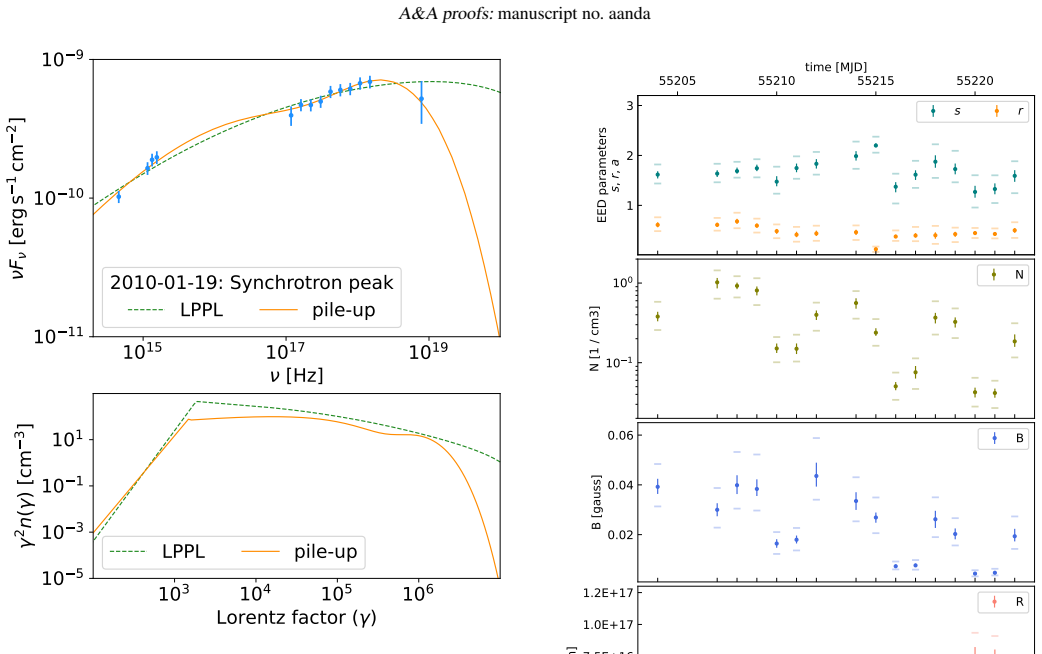
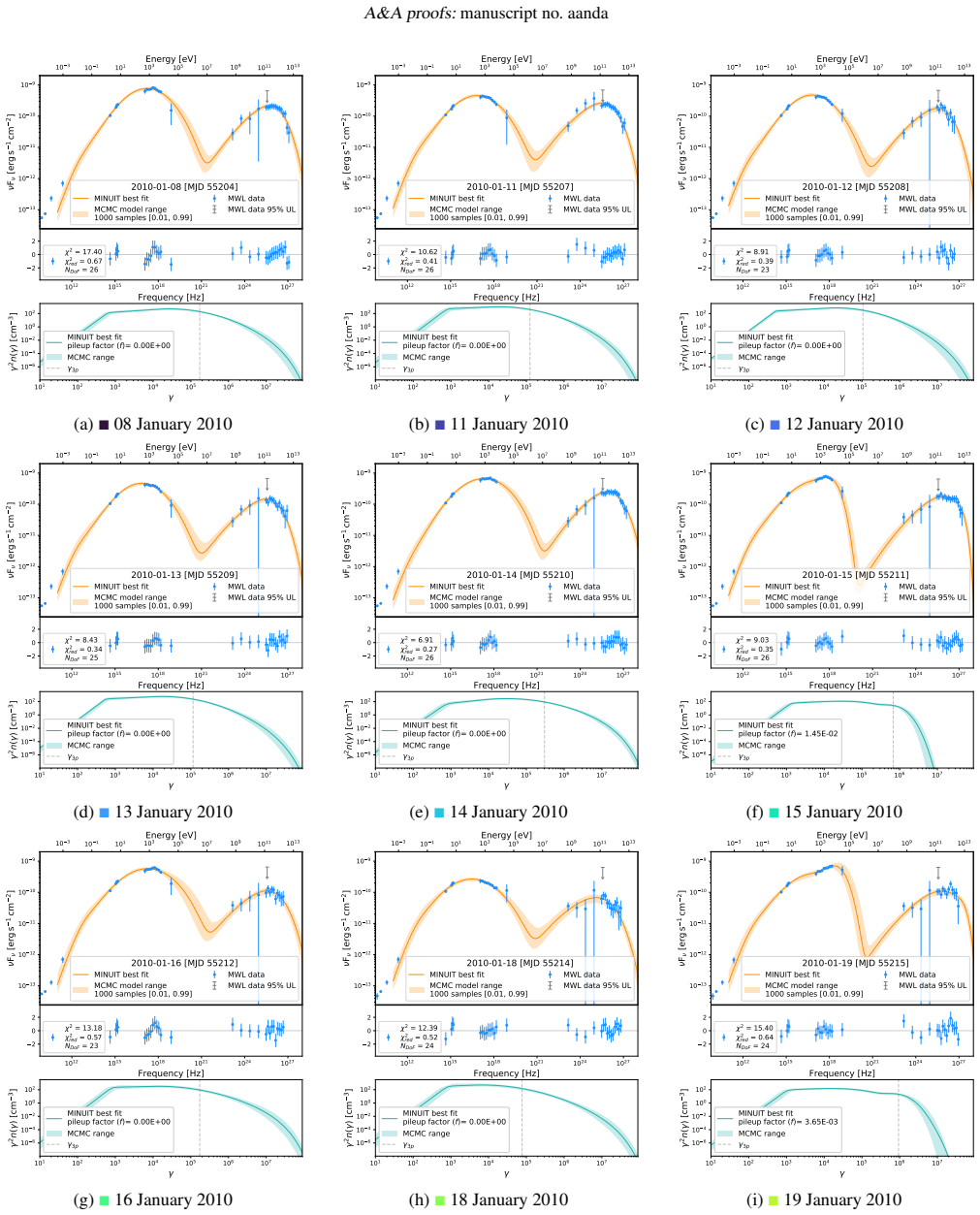
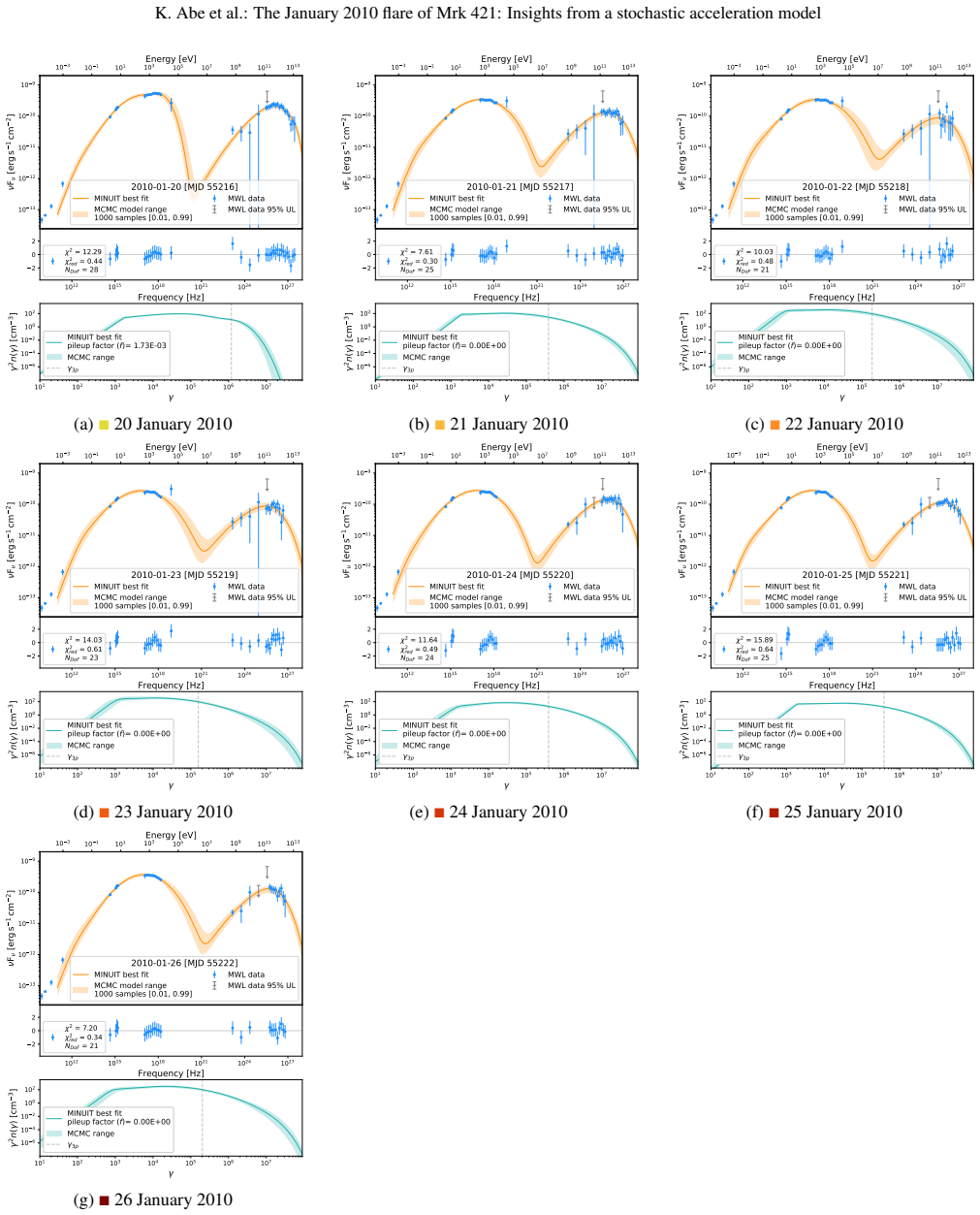
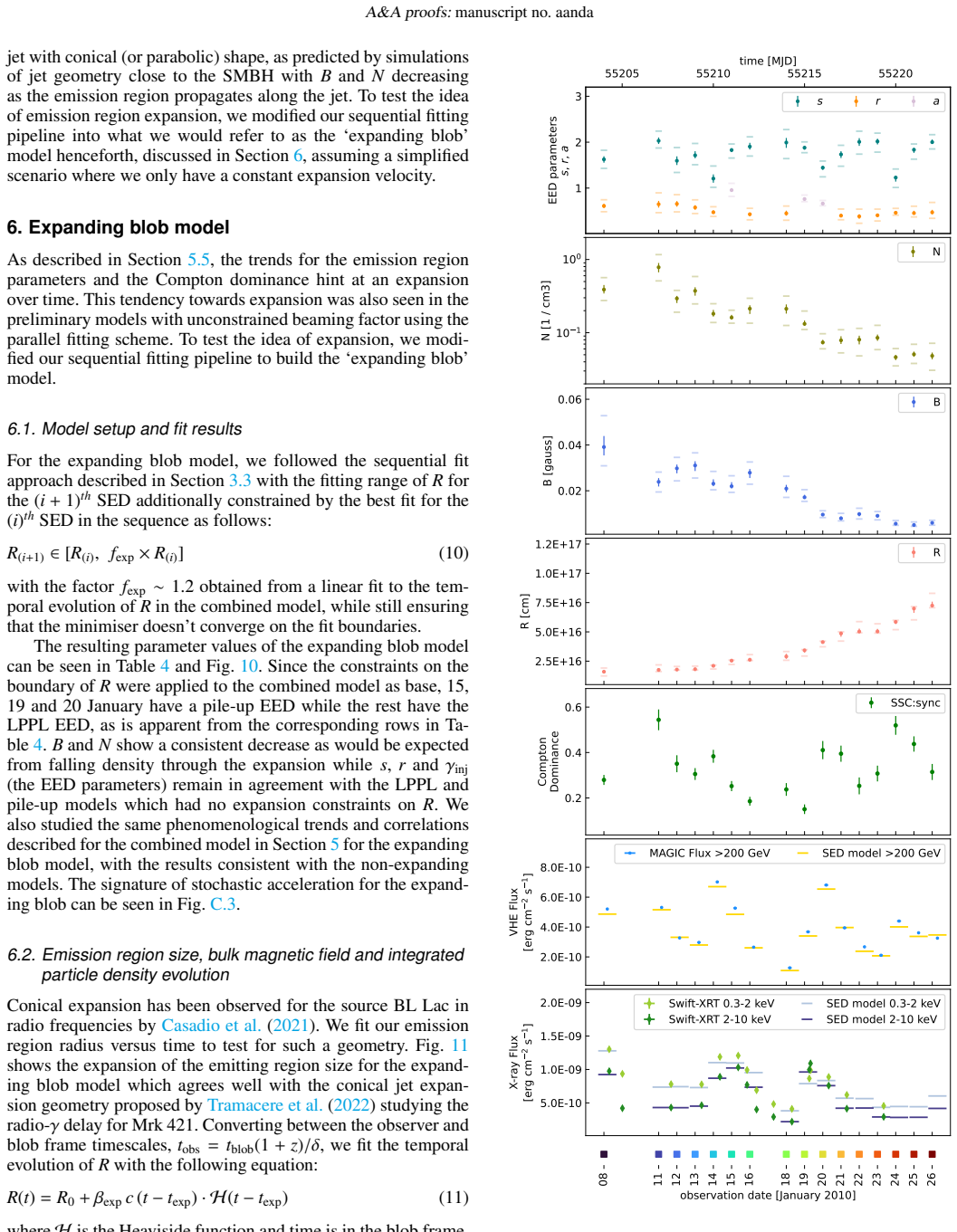
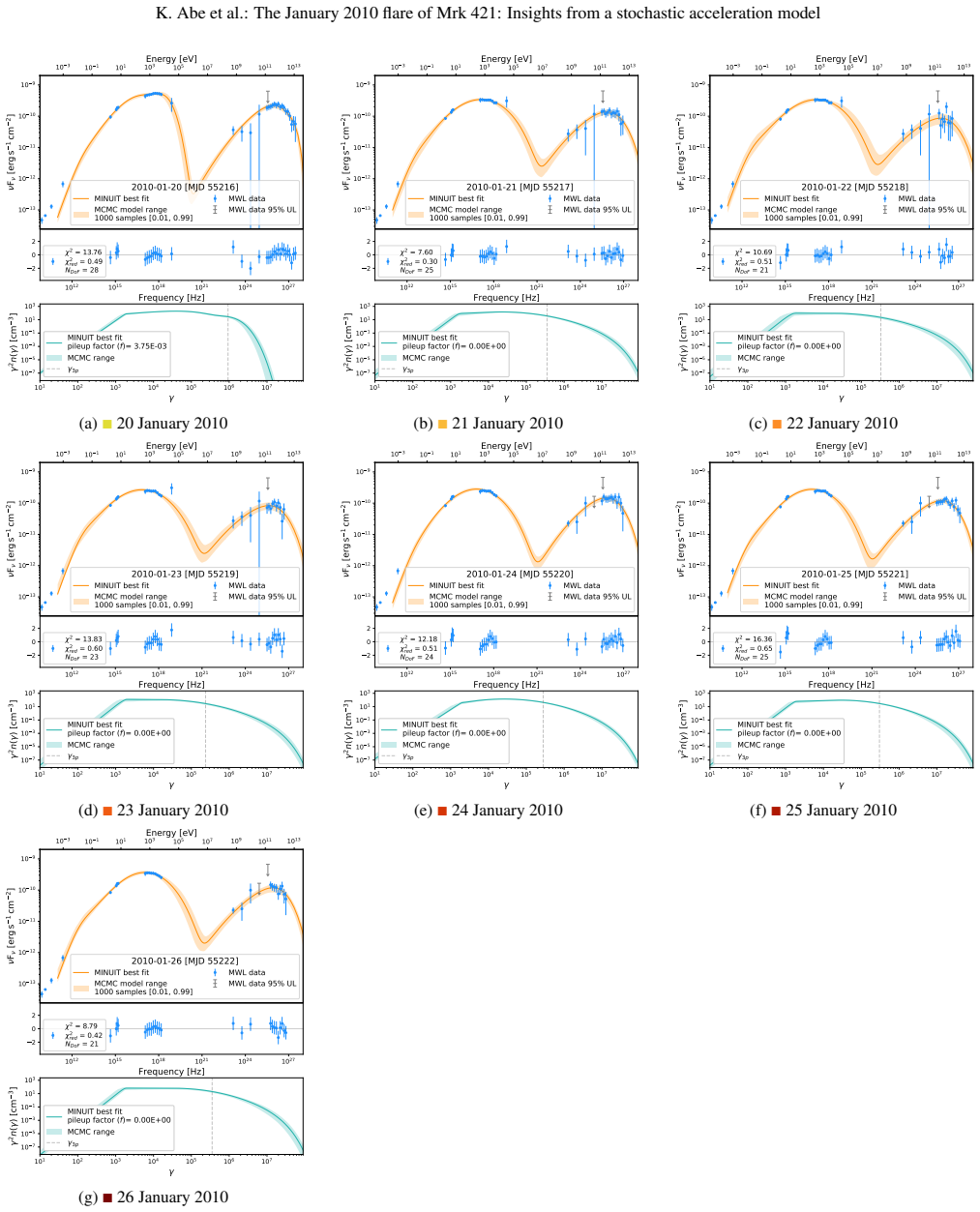
The multi-wavelength observations reveal that the standard LPPL distribution develops a Maxwellian pile-up component at the transition from acceleration to cooling dominated phase on three nights in the dataset. The sequential snapshot evolution SED model, incorporating an expanding emission region in some tests, shows phenomenology that agrees well with theoretical and numerical studies on temporal evolution using the diffusion equation approach.
What carries the argument
The LPPL (log-parabola with low-energy power-law) distribution augmented by a Maxwellian pile-up component within a single-zone leptonic synchrotron self-Compton framework, fitted via JetSeT software and a simplified temporal evolution model.
If this is right
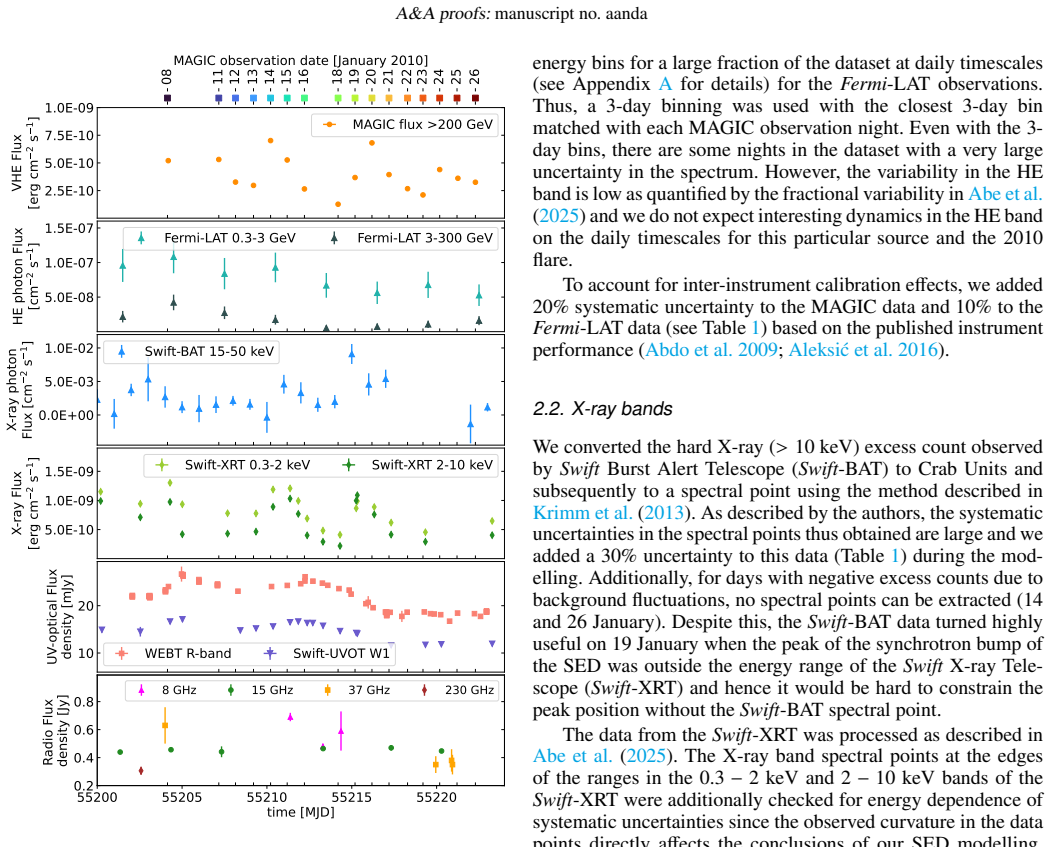
- The model captures the strong variability and correlations between very-high energy gamma rays and X-rays seen in the light curves.
- Three nights show evidence of the pile-up feature indicating the acceleration-cooling transition.
- The overall SED evolution matches expectations from stochastic acceleration theory.
- Testing an expanding emission region provides additional context but the core fits rely on the particle distribution changes.
Where Pith is reading between the lines
- Similar modeling could apply to other blazar flares to test if stochastic acceleration is a common mechanism.
- Future observations with higher sensitivity might confirm the pile-up component directly in the spectra.
- The single-zone assumption implies that multi-zone effects are not dominant during this flare period.
Load-bearing premise
That a single emission zone with purely leptonic processes and the specified particle distributions can account for all observed spectral features without contributions from hadronic processes or external photon fields.
What would settle it
If future data shows spectral features or correlations that cannot be reproduced by the LPPL plus pile-up model in a single zone, or if multi-wavelength campaigns reveal significant hadronic signatures, the interpretation would be challenged.
Figures







read the original abstract
Mrk421 displayed its highest flux state ever observed in February of 2010 with very high TeV fluxes and interesting cross-band correlations and a spectral energy distribution (SED) evolution not entirely consistent with the standard single zone leptonic synchrotron self-Compton model. The source was already in a high state in January 2010 and displayed strong variability in the days preceding the highest state. We study the temporal evolution of the spectra in January to extract information about the particle dynamics and the physical properties of the emission region. We build up on the temporal variability and correlations studied in the previous work (MAGIC collaboration - Abe et al. 2025) and attempt to improve the SED model fits with a physics oriented approach. The multi-wavelength data was processed and the SEDs were fit using JetSeT. The SED evolution and cross band correlations were modelled using leptonic log-parabola with a low energy power-law branch (LPPL) and pile-up distributions that are predicted in a stochastic acceleration scenario. A simplified temporal evolution model was developed and fit to the SEDs and the resulting trends and phenomenology were characterised in context of theoretical literature. An expanding emission region model was also tested. We find the spectral variability to be well in agreement with stochastic acceleration. Our analysis suggests that the standard LPPL distribution develops a Maxwellian pile-up component at the transition from acceleration to cooling dominated phase on 3 nights in the dataset, as also hinted by the very-high energy and X-ray light curves. The resulting phenomenology of our sequential snapshot evolution SED model agrees well with theoretical and numerical simulation studies on temporal evolution using the diffusion equation approach.
Editorial analysis
A structured set of objections, weighed in public.
Referee Report
Summary. The paper analyzes the January 2010 high-state flare of Mrk 421 using multi-wavelength data. SEDs are fitted in JetSeT with a single-zone leptonic model based on log-parabola plus low-energy power-law (LPPL) distributions augmented by Maxwellian pile-up components. A simplified temporal evolution model and an expanding emission-region scenario are developed and compared to the observed SED changes and cross-band correlations. The central claim is that the spectral variability agrees with stochastic acceleration, with the LPPL developing a Maxwellian pile-up at the acceleration-to-cooling transition on three specific nights, and that the overall phenomenology matches theoretical expectations from diffusion-equation studies.
Significance. If the modeling is robust, the work supplies a physics-motivated interpretation of blazar flare evolution that links observations directly to stochastic acceleration predictions. The use of established fitting software (JetSeT) and explicit comparison to numerical simulation literature are positive features that could help bridge data and theory in AGN jet studies.
major comments (1)
- [SED fitting results and temporal evolution model (abstract and main results sections)] The assertion that a Maxwellian pile-up component appears on three nights (abstract and results describing the SED fits) rests on visual or qualitative agreement after adjusting LPPL curvature, peak, pile-up amplitude and location parameters. No Δχ², likelihood-ratio test, AIC/BIC comparison, or other quantitative metric is reported to establish that the extra pile-up parameters are required by the data rather than optional. This directly affects the load-bearing claim that the distribution “develops a Maxwellian pile-up component at the transition” on those nights.
Simulated Author's Rebuttal
We thank the referee for their careful and constructive review of our manuscript. We address the single major comment below.
read point-by-point responses
-
Referee: The assertion that a Maxwellian pile-up component appears on three nights (abstract and results describing the SED fits) rests on visual or qualitative agreement after adjusting LPPL curvature, peak, pile-up amplitude and location parameters. No Δχ², likelihood-ratio test, AIC/BIC comparison, or other quantitative metric is reported to establish that the extra pile-up parameters are required by the data rather than optional. This directly affects the load-bearing claim that the distribution “develops a Maxwellian pile-up component at the transition” on those nights.
Authors: We agree that the original manuscript presented the inclusion of the Maxwellian pile-up component on the basis of physically motivated fits and visual agreement with the data rather than formal statistical model comparison. The pile-up parameters were introduced following expectations from stochastic acceleration theory and the diffusion-equation literature, and the overall SED evolution was additionally constrained by the observed cross-band correlations and light-curve behavior. To address the referee’s concern directly, the revised manuscript will include AIC and BIC comparisons (and, where applicable, likelihood-ratio tests) between the baseline LPPL and LPPL-plus-pile-up models for the three nights in question. These quantitative metrics will be reported in the results section and will be used to support or qualify the claim in the abstract. We will also ensure that the wording of the claim reflects the outcome of the statistical tests. revision: yes
Circularity Check
Pile-up identification and stochastic-acceleration agreement derived from SED fits without statistical validation of model necessity
specific steps
-
fitted input called prediction
[Abstract]
"Our analysis suggests that the standard LPPL distribution develops a Maxwellian pile-up component at the transition from acceleration to cooling dominated phase on 3 nights in the dataset, as also hinted by the very-high energy and X-ray light curves."
The Maxwellian pile-up is an explicit component of the LPPL+pile-up distribution that is fitted to each night's SED; its reported presence on three specific nights is therefore a direct consequence of the model form adopted and the parameter values obtained, rather than an independent prediction tested against a baseline (pure LPPL) model.
-
fitted input called prediction
[Abstract]
"We find the spectral variability to be well in agreement with stochastic acceleration. ... The resulting phenomenology of our sequential snapshot evolution SED model agrees well with theoretical and numerical simulation studies on temporal evolution using the diffusion equation approach."
The SED evolution model is constructed from the same LPPL+pile-up distributions that are fitted to the data; the reported agreement with stochastic-acceleration phenomenology is therefore obtained by fitting the very functional forms whose predictions are then claimed to be confirmed.
full rationale
The paper fits observed SEDs in JetSeT using the LPPL+pile-up functional form motivated by stochastic acceleration theory, then reports that the data show the pile-up developing on three nights at the acceleration-cooling transition. This identification is obtained directly from the chosen parametrization and its time evolution; no quantitative model-comparison statistic is supplied to demonstrate that the extra pile-up parameters are required by the data rather than optional. The resulting claim of agreement with stochastic acceleration therefore reduces in part to the input model choice and fitted parameters.
Axiom & Free-Parameter Ledger
free parameters (3)
- LPPL curvature and peak parameters
- Pile-up amplitude and location
- Emission-region expansion rate
axioms (2)
- domain assumption Leptonic synchrotron self-Compton emission dominates the observed SED
- domain assumption Stochastic acceleration produces the observed log-parabola plus pile-up distributions
Reference graph
Works this paper leans on
-
[1]
Reviews of Modern Physics , year = 1970, month = jan, volume =. doi:10.1103/RevModPhys.42.237 , adsurl =
-
[2]
A new pile-up mechanism for relativistic electronspectra
An explanation of abrupt cutoffs in the optical-infrared spectra of non-thermal sources. A new pile-up mechanism for relativistic electronspectra. , keywords =
-
[3]
, keywords =
A viable mechanism to establish relativistic thermal particle distribution functions in cosmic sources. , keywords =
-
[4]
Cosmic-Ray Transport and Acceleration. I. Derivation of the Kinetic Equation and Application to Cosmic Rays in Static Cold Media. , keywords =. doi:10.1086/167009 , adsurl =
-
[5]
, keywords =. doi:10.1086/305772 , archiveprefix =. astro-ph/9710327 , primaryclass =
work page internal anchor Pith review Pith/arXiv arXiv doi:10.1086/305772
-
[6]
doi:10.1086/345083 , archiveprefix =
, keywords =. doi:10.1086/345083 , archiveprefix =. astro-ph/0209562 , primaryclass =
-
[7]
On characterizing the variability properties of X-ray light curves from active galaxies. , keywords =. doi:10.1046/j.1365-2966.2003.07042.x , archivePrefix =. astro-ph/0307420 , primaryClass =
-
[8]
2004, A&A, 413, 489, doi: 10.1051/0004-6361:20031558
, keywords =. doi:10.1051/0004-6361:20031558 , archiveprefix =. astro-ph/0312260 , primaryclass =
-
[9]
doi:10.1051/0004-6361:20053644 , archiveprefix =
, keywords =. doi:10.1051/0004-6361:20053644 , archiveprefix =. astro-ph/0511673 , primaryclass =
-
[10]
doi:10.1051/0004-6361:200811157 , archiveprefix =
, keywords =. doi:10.1051/0004-6361:200811157 , archiveprefix =. 0811.4246 , primaryclass =
-
[11]
doi:10.1103/PhysRevLett.103.251101 , archiveprefix =
, keywords =. doi:10.1103/PhysRevLett.103.251101 , archiveprefix =. 0912.0973 , primaryclass =
-
[12]
, keywords =. doi:10.1111/j.1365-2966.2009.15898.x , archiveprefix =. 0909.0932 , primaryclass =
-
[13]
, keywords =. doi:10.1088/0004-637X/737/2/103 , archiveprefix =. 1012.4804 , primaryclass =
work page internal anchor Pith review Pith/arXiv arXiv doi:10.1088/0004-637x/737/2/103
-
[14]
doi:10.1088/0067-0049/194/2/29 , archiveprefix =
, keywords =. doi:10.1088/0067-0049/194/2/29 , archiveprefix =. 1011.3111 , primaryclass =
-
[15]
doi:10.1051/0004-6361/201118569 , archiveprefix =
, keywords =. doi:10.1051/0004-6361/201118569 , archiveprefix =. 1203.3850 , primaryclass =
-
[16]
doi:10.1051/0004-6361/201321858 , archiveprefix =
, keywords =. doi:10.1051/0004-6361/201321858 , archiveprefix =. 1310.4973 , primaryclass =
-
[17]
doi:10.1088/0067-0049/209/1/14 , archiveprefix =
, keywords =. doi:10.1088/0067-0049/209/1/14 , archiveprefix =. 1309.0755 , primaryclass =
-
[18]
doi:10.1051/0004-6361/201424216 , archiveprefix =
, keywords =. doi:10.1051/0004-6361/201424216 , archiveprefix =. 1502.02650 , primaryclass =
-
[19]
doi:10.1088/0004-637X/809/1/38 , archiveprefix =
, keywords =. doi:10.1088/0004-637X/809/1/38 , archiveprefix =. 1505.00933 , primaryclass =
-
[20]
doi:10.1016/j.astropartphys.2015.02.005 , archiveprefix =
Astroparticle Physics , keywords =. doi:10.1016/j.astropartphys.2015.02.005 , archiveprefix =. 1409.5594 , primaryclass =
-
[22]
doi:10.3847/0004-637X/821/1/61 , archiveprefix =
, keywords =. doi:10.3847/0004-637X/821/1/61 , archiveprefix =. 1506.02892 , primaryclass =
-
[23]
doi:10.3390/galaxies7010020 , archiveprefix =
Galaxies , keywords =. doi:10.3390/galaxies7010020 , archiveprefix =. 1901.04178 , primaryclass =
-
[24]
doi:10.22323/1.354.0032 , archiveprefix =
High Energy Phenomena in Relativistic Outflows VII , year = 2019, month = jul, eid =. doi:10.22323/1.354.0032 , archiveprefix =. 1909.13106 , primaryclass =
-
[25]
doi:10.1093/mnras/stz1292 , archiveprefix =
, keywords =. doi:10.1093/mnras/stz1292 , archiveprefix =. 1905.01043 , primaryclass =
-
[26]
, keywords =. doi:10.1051/0004-6361/201935557 , archiveprefix =. 2101.10651 , primaryclass =
-
[27]
, keywords =. doi:10.1051/0004-6361/202039616 , archiveprefix =. 2102.08952 , primaryclass =
-
[28]
doi:10.1051/0004-6361/202141062 , archiveprefix =
, keywords =. doi:10.1051/0004-6361/202141062 , archiveprefix =. 2108.12271 , primaryclass =
-
[29]
doi:10.1093/mnras/stab1445 , archiveprefix =
, keywords =. doi:10.1093/mnras/stab1445 , archiveprefix =. 2105.12480 , primaryclass =
-
[30]
doi:10.3390/galaxies10010035 , archiveprefix =
Galaxies , keywords =. doi:10.3390/galaxies10010035 , archiveprefix =. 2202.07490 , primaryclass =
-
[31]
doi:10.3847/1538-4357/acd2d0 , archiveprefix =
, keywords =. doi:10.3847/1538-4357/acd2d0 , archiveprefix =. 2305.02860 , primaryclass =
-
[32]
doi:10.1093/mnras/stae643 , archiveprefix =
, keywords =. doi:10.1093/mnras/stae643 , archiveprefix =. 2402.19377 , primaryclass =
-
[33]
doi:10.1051/0004-6361/202555109 , archiveprefix =
, keywords =. doi:10.1051/0004-6361/202555109 , archiveprefix =. 2508.18008 , primaryclass =
-
[34]
doi:10.48550/arXiv.2509.08686 , archiveprefix =
arXiv e-prints , keywords =. doi:10.48550/arXiv.2509.08686 , archiveprefix =. 2509.08686 , primaryclass =
-
[35]
Acciari, V. A. and Ansoldi, S. and Antonelli, L. A. and Engels, A. Arbet and Baack, D. and Babić, A. and Banerjee, B. and de Almeida, U. Barres and Barrio, J. A. and González, J. Becerra and Bednarek, W. and Bellizzi, L. K. and Bernardini, E. and Berti, A. and Besenrieder, J. and Bhattacharyya, W. and Bigongiari, C. and Biland, A. and Blanch, O. and Bonno...
-
[36]
Baloković, M. and Paneque, D. and Madejski, G. and Furniss, A. and Chiang, J. and Ajello, M. and Alexander, D. M. and Barret, D. and Blandford, R. D. and Boggs, S. E. and Christensen, F. E. and Craig, W. W. and Forster, K. and Giommi, P. and Grefenstette, B. and Hailey, C. and Harrison, F. A. and Hornstrup, A. and Kitaguchi, T. and Koglin, J. E. and Madse...
-
[37]
doi:10.1086/505319 , archiveprefix =
, keywords =. doi:10.1086/505319 , archiveprefix =. astro-ph/0604504 , primaryclass =
-
[38]
Begelman, M C and Blandford, R D and Rees, M J , title =. Rev. Mod. Phys.; (United States) , volume =. 1984 , month =. doi:10.1103/RevModPhys.56.255 , url =
-
[39]
Carnerero, M. I. and Raiteri, C. M. and Villata, M. and Acosta-Pulido, J. A. and Larionov, V. M. and Smith, P. S. and D'Ammando, F. and Agudo, I. and Arévalo, M. J. and Bachev, R. and Barnes, J. and Boeva, S. and Bozhilov, V. and Carosati, D. and Casadio, C. and Chen, W. P. and Damljanovic, G. and Eswaraiah, E. and Forné, E. and Gantchev, G. and Gómez, J....
-
[40]
2010, , 405, 1025, 10.1111/j.1365-2966.2010.16486.x
Domínguez, A. and Primack, J. R. and Rosario, D. J. and Prada, F. and Gilmore, R. C. and Faber, S. M. and Koo, D. C. and Somerville, R. S. and Pérez-Torres, M. A. and Pérez-González, P. and Huang, J.-S. and Davis, M. and Guhathakurta, P. and Barmby, P. and Conselice, C. J. and Lozano, M. and Newman, J. A. and Cooper, M. C. , title =. Monthly Notices of th...
-
[41]
emcee: The MCMC Hammer , journal =. 1202.3665 , doi =
work page internal anchor Pith review arXiv
-
[42]
doi:10.1051/0004-6361/202451624 , archiveprefix =
, keywords =. doi:10.1051/0004-6361/202451624 , archiveprefix =. 2501.03831 , primaryclass =
-
[43]
, keywords =. doi:10.1046/j.1365-8711.1998.01828.x , archiveprefix =. astro-ph/9804103 , primaryclass =
-
[44]
Galaxies , volume =
Prandini, Elisa and Ghisellini, Gabriele , title =. Galaxies , volume =. 2022 , number =
2022
-
[45]
, keywords =. doi:10.3847/1538-4357/aa8407 , archiveprefix =. 1711.03983 , primaryclass =
-
[46]
doi:10.3847/1538-4357/ab6612 , archiveprefix =
, keywords =. doi:10.3847/1538-4357/ab6612 , archiveprefix =. 2002.03567 , primaryclass =
-
[47]
doi:10.1051/0004-6361/201424811 , archiveprefix =
, keywords =. doi:10.1051/0004-6361/201424811 , archiveprefix =. 1412.3576 , primaryclass =
-
[48]
doi:10.1051/0004-6361/202141004 , archiveprefix =
, keywords =. doi:10.1051/0004-6361/202141004 , archiveprefix =. 2106.05516 , primaryclass =
-
[49]
doi:10.1051/0004-6361/201834603 , archiveprefix =
, keywords =. doi:10.1051/0004-6361/201834603 , archiveprefix =. 2001.07729 , primaryclass =
-
[50]
Final data release of the combined LDS and IAR surveys with improved stray-radiation corrections
, keywords =. doi:10.1051/0004-6361:20041864 , archiveprefix =. astro-ph/0504140 , primaryclass =
-
[51]
, keywords =. doi:10.1051/0004-6361/201629178 , archiveprefix =. 1610.06175 , primaryclass =
-
[52]
doi:10.1063/1.32074 , adsurl =
Particle Acceleration Mechanisms in Astrophysics , year = 1979, editor =. doi:10.1063/1.32074 , adsurl =
-
[53]
doi:10.1086/588813 , archiveprefix =
, keywords =. doi:10.1086/588813 , archiveprefix =. 0803.0989 , primaryclass =
-
[54]
doi:10.1051/0004-6361:20066723 , archiveprefix =
, keywords =. doi:10.1051/0004-6361:20066723 , archiveprefix =. astro-ph/0702151 , primaryclass =
-
[55]
doi:10.1051/0004-6361/200810865 , archiveprefix =
, keywords =. doi:10.1051/0004-6361/200810865 , archiveprefix =. 0901.4124 , primaryclass =
-
[56]
doi:10.1088/0004-637X/739/2/66 , archiveprefix =
, keywords =. doi:10.1088/0004-637X/739/2/66 , archiveprefix =. 1107.1879 , primaryclass =
-
[57]
doi:10.1051/0004-6361/202142003 , archiveprefix =
, keywords =. doi:10.1051/0004-6361/202142003 , archiveprefix =. 2112.03941 , primaryclass =
-
[58]
doi:10.1093/mnras/stab1182 , eprint =
, keywords =. doi:10.1093/mnras/stab1182 , archiveprefix =. 2007.12661 , primaryclass =
-
[59]
Urry, C. Megan and Padovani, Paolo , title =. Publications of the Astronomical Society of the Pacific , abstract =. 1995 , month =. doi:10.1086/133630 , url =
work page internal anchor Pith review doi:10.1086/133630 1995
-
[60]
doi:10.1007/s11214-005-5095-4 , archiveprefix =
, keywords =. doi:10.1007/s11214-005-5095-4 , archiveprefix =. astro-ph/0507413 , primaryclass =
-
[61]
Gamma Ray Bursts 2010 , year = 2011, editor =. doi:10.1063/1.3621807 , archiveprefix =. 1102.4717 , primaryclass =
-
[62]
1999, Publications of the Astronomical Society of the Pacific, 111, 63, doi: 10.1086/316293 33
, keywords =. doi:10.1086/316293 , archiveprefix =. astro-ph/9809387 , primaryclass =
-
[63]
, year = 2025, volume = 700, pages =
Looking into the jet cone of the neutrino-associated very high-energy blazar PKS 1424+240 , doi =. , year = 2025, volume = 700, pages =
2025
-
[64]
Proceedings, 33rd International Cosmic Ray Conference (ICRC2013): Rio de Janeiro, Brazil , pages =
MARS, the MAGIC analysis and reconstruction software , author =. Proceedings, 33rd International Cosmic Ray Conference (ICRC2013): Rio de Janeiro, Brazil , pages =
discussion (0)
Sign in with ORCID, Apple, or X to comment. Anyone can read and Pith papers without signing in.